Call for Papers | Rethinking Centers and Peripheries in France
As noted at Le Blog de l’ApAhAu:
Transferts culturels et tensions autour du modèle exogène: Architecture et aménagement du territoire: Le royaume de France et ses provinces dans l’Europe, XVIIe–XVIIIe siècles
Université de Poitiers, 28 March 2024
Proposals due by 31 January 2024
Durant l’Ancien Régime, un réseau de relations intense a alimenté les échanges entre les foyers artistiques principaux mais également à travers des centres de production dits secondaires voire subalternes. L’étude des mobilités des hommes, des objets et des idées montre une variété des pratiques et des circulations qui oblige aujourd’hui à opérer des décentrements vers des modèles de compréhension des territoires et des phénomènes d’appropriation, hors du schéma, initié dès les années 1980 par E. Castelnuovo et C. Ginzburg sur le rapport entre centre et périphéries[1]. Dans un renouvellement des perspectives d’étude, ce cadre analytique fondateur mais désormais trop restrictif doit être reformulé pour mettre en place une réflexion autour de dynamiques spatiales qui s’intéressent aux capitales provinciales, aux villes frontières, aux territoires ruraux et aux arcs de circulation qui traversent l’Europe en marge des axes principaux.
Pour cette première journée d’études, l’approche privilégiée vise à mesurer si le concept de centralisation des standards culturels reste pertinent face à des territoires larges, rarement connectés par les études contemporaines.
• Un premier axe s’intéressera à la question de l’étude des constructions historiographiques autour des nationalismes artistiques, de la mise en place des principes de domination centre / périphérie et marges, etc.
• Un deuxième axe examinera le rapport au lieu, la prise en compte des qualités intrinsèques des contextes pour mieux comprendre les schémas de diffusion dans un système où modèles et vocabulaires exogènes peinent souvent à s’imposer.
Nous attendons des communications portant spécifiquement sur l’aménagement du territoire et l’architecture.
Les communications dureront 30 minutes. Les propositions de communication d’environ 200 mots, accompagnées d’une courte notice bio-bibliographique seront à envoyer, au plus tard le 31 janvier 2024 à marie.luce.pujalte.fraysse@univ-poitiers.fr, magaly.piquart@gmail.com, et poteljean@gmail.com.
1 Enrico Castelnuovo et Carlo Ginzburg, « Domination symbolique et géographie artistique dans l’histoire de l’art italien », Actes de la recherche en sciences sociales, vol. 40, novembre 1981, Sociologie de l’œil, p.51–72.
Comité d’organisation
• Marie-Luce Pujalte-Fraysse, Maître de Conférences HDR en histoire de l’art moderne, Université de Poitiers
• Magaly Piquart-Vesperini, Doctorante en histoire de l’architecture moderne, Paris I, Ater en histoire de l’art moderne, Université de Poitiers
• Jean Potel, Doctorant en histoire de l’architecture moderne, Sorbonne Université
New Book | Palaces of Reason
From The Pennsylvania State UP:
Robin Thomas, Palaces of Reason: The Royal Residences of Bourbon Naples (University Park: Penn State University Press, 2024), 212 pages, ISBN: 978-0271095219, $110.
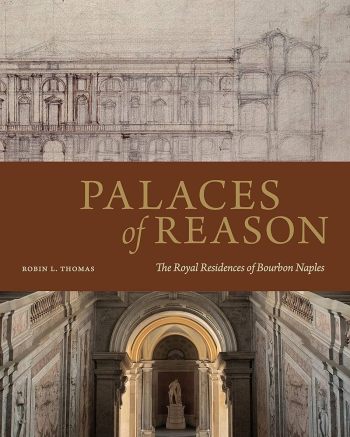 Palaces of Reason traces the fascinating history of three royal residences built outside of Naples in the eighteenth century at Capodimonte, Portici, and Caserta. Commissioned by King Charles of Bourbon and Queen Maria Amalia of Saxony, who reigned over the Kingdom of the Two Sicilies, these buildings were far more than residences for the monarchs. They were designed to help reshape the economic and cultural fortunes of the realm.
The palaces at Capodimonte, Portici, and Caserta are among the most complex architectural commissions of the eighteenth century. Considering the architecture and decoration of these complexes within their political, cultural, and economic contexts, Robin L. Thomas argues that Enlightenment ideas spurred their construction and influenced their decoration. These modes of thinking saw the palaces as more than just centers of royal pleasure or muscular assertions of the crown’s power. Indeed, writers and royal ministers viewed them as active agents in improving the cultural, political, social, and economic health of the kingdom. By casting the palaces within this narrative, Thomas counters the assumption that they were imitations of Versailles and the swan songs of absolutism, while expanding our understanding of the eighteenth-century European palace more broadly.
Robin L. Thomas is Professor of Art History and Architecture at Penn State University. He is the author of Architecture and Statecraft: Charles of Bourbon’s Naples, 1734–1759, also published by Penn State University Press.
New Book | Volcanic
From Yale UP:
John Brewer, Volcanic: Vesuvius in the Age of Revolutions (New Haven: Yale University Press, 2023), 544 pages, ISBN: 978-0300272666, £30 / $40.
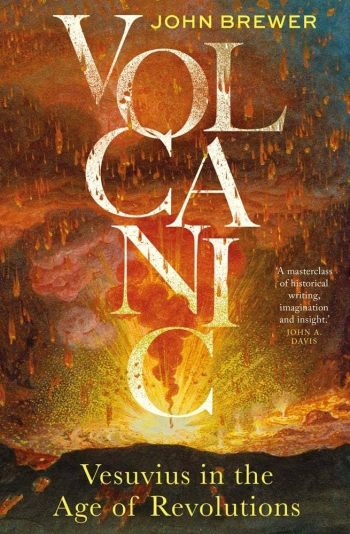 A vibrant, diverse history of Vesuvius and the Bay of Naples in the age of Romanticism
Vesuvius is best known for its disastrous eruption of 79CE. But only after 1738, in the age of Enlightenment, did the excavations of Herculaneum and Pompeii reveal its full extent. In an era of groundbreaking scientific endeavour and violent revolution, Vesuvius became a focal point of strong emotions and political aspirations, an object of geological enquiry, and a powerful symbol of the Romantic obsession with nature. John Brewer charts the changing seismic and social dynamics of the mountain, and the meanings attached by travellers to their sublime confrontation with nature. The pyrotechnics of revolution and global warfare made volcanic activity the perfect political metaphor, fuelling revolutionary enthusiasm and conservative trepidation. From Swiss mercenaries to English entrepreneurs, French geologists to local Neapolitan guides, German painters to Scottish doctors, Vesuvius bubbled and seethed not just with lava, but with people whose passions, interests, and aims were as disparate as their origins.
John Brewer is emeritus professor of humanities and social sciences at the California Institute of Technology and a faculty associate of the Harvard University History Department. His books include Pleasures of the Imagination, which won the Wolfson History Prize and was shortlisted for the National Book Awards.
A New Chapter for the Berger Prize
From The Walpole Society:
 The Walpole Society is delighted to announce an agreement with the Berger Collection Educational Trust (BCET) to run the leading book prize for British art history, the Berger Prize. The Berger Prize celebrates brilliant writing and scholarship about the arts and architecture of the United Kingdom. The Walpole Society, which promotes the study of Britain’s art history, will deliver the Berger Prize from 2024, working alongside the BCET and Denver Art Museum, home of the Berger Collection of British art. The Walpole Society was appointed following the retirement of Robin Simon, co-founder and organiser of the prize since 2001. Chair of BCET trustees, Katherine MB Berger, and Dr Jonny Yarker, incoming chair of judges, paid tribute to Robin Simon at the 2023 Prize ceremony.
Several initiatives starting in 2024 will build on the Prize’s two decades of support for British art history, further broadening its reach:
• A new website to showcase the prize.
• The prize’s eligibility and rules, with a renewed commitment to governance and transparency, will be updated. Nominations for the 2024 prize close on 28 March.
• The incumbent prizewinner will deliver a lecture at the Denver Art Museum, home of the Berger Collection. The 2024 lecture by Tim Clayton is on 7 May.
• A summer event in London will announce the long list. In 2024 this will be on 28 June, when Tim Clayton will talk about his 2023 Berger Prizewinning book, James Gillray: A Revolution in Satire.
• New from 2024, each shortlisted book will receive a prize of £500. The 2024 shortlist will be announced at a virtual event on 15 September.
• The first prize of £5000 is the largest sum offered by any art history book prize. The winner of the 2024 Berger Prize will be presented on 15 November, at a ceremony at London’s Reform Club.
• A new podcast from The Walpole Society, launching in the latter part of 2024, will showcase brilliant writing and scholarship about the arts and architecture of the United Kingdom, with a focus on Berger Prize shortlisted authors.
• Walpole Society trustee, Dr Jonny Yarker, succeeds Robin Simon as chair of judges. Joining the panel in 2024 are Clare Hornsby, Chairwoman of The Walpole Society, and Angelica Daneo, Chief Curator at the Denver Art Museum. Click here for information about the 2024 prize jury.
Katherine MB Berger, Chairman of the Berger Collection Educational Trust (BCET), commented: “We are all so excited and we look forward to future vibrant initiatives—and to working together with The Walpole Society on our shared aim for promoting excellence in British art history.”
Clare Hornsby, Chairwoman of The Walpole Society, said: “We’re honoured to have been chosen by the Berger Collection Educational Trust to run the Berger Prize. The Prize feels like a natural fit for The Walpole Society, whose goals are so closely aligned with it and with the BCET. We intend the Prize in this new era to reach an even wider audience—in the UK, US, and internationally, whilst honouring its twenty year heritage established by Robin Simon and Katherine Berger.”
Incoming chair of Berger Prize judges, Dr Jonny Yarker, said: “British art history is extraordinary for its richness, range and creativity. I look forward to the Berger Prize both recognising the brilliance and dedication of researchers, whose books are often the summation of a life’s research, and also for the Prize to offer an annual snapshot of the field of studies in all its diversity and depth.”
New Book | The Beauty of the Flower
From Reaktion, with additional distribution by The University of Chicago Press:
Stephen Harris, The Beauty of the Flower: The Art and Science of Botanical Illustration (London: Reaktion Books, 2023), 336 pages, ISBN: 97-81789147803, £30 / $45.
 Featuring superb and rare images, this book reveals the fascinating stories behind botanical illustration.
In a world flooded with images designed to create memories, validate perceptions and influence others, botanical illustration is about creating technically accurate depictions of plants. Reproductions of centuries-old botanical illustrations frequently adorn greetings cards, pottery and advertising, to promote heritage or generate income, yet their art is scientific: its purpose is to record, display and transmit scientific data. The Beauty of the Flower shows us how scientific botanical illustrations are collaborations among artists, scientists and publishers. It explores the evolution and interchanges of these illustrations since the mid-fifteenth century, the ways in which they have been used to communicate scientific ideas about plants and how views of botanical imagery change. Featuring unique images rarely seen outside of specialist literature this book reveals the fascinating stories behind these remarkable illustrations.
Stephen A. Harris is an Associate Professor of Plant Sciences and curator of the herbarium at the University of Oxford. His books include Sunflowers (Reaktion, 2018) and Roots to Seeds: 400 Years of Oxford Botany (2021).
c o n t e n t s
Preface
1 Plant and Page
2 Themes and Trends
3 Science and Illustration
4 Blood and Treasure
5 Garden and Grove
6 Inside and Out
7 Habit and Habitat
8 Observe and Test
9 Sweat and Tears
Appendix: Plant Names
References
Further Reading
Acknowledgements
Photo Acknowledgements
Index
New Book | The Man Who Organized Nature
From Princeton UP:
Gunnar Broberg, The Man Who Organized Nature: The Life of Linnaeus, translated by Anna Paterson (Princeton: Princeton University Press, 2023), 512 pages, ISBN: 978-0691213422, £35 / $40.
 A new biography of Carl Linnaeus, offering a vivid portrait of Linnaeus’s life and work
Carl Linnaeus (1707–1778), known as the father of modern biological taxonomy, formalized and popularized the system of binomial nomenclature used to classify plants and animals. Linnaeus himself classified thousands of species; the simple and immediately recognizable abbreviation ‘L’ is used to mark classifications originally made by Linnaeus. This biography, by the leading authority on Linnaeus, offers a vivid portrait of Linnaeus’s life and work. Drawing on a wide range of previously unpublished sources—including diaries and personal correspondence—as well as new research, it presents revealing and original accounts of his family life, the political context in which he pursued his work, and his eccentric views on sexuality.
The Man Who Organized Nature describes Linnaeus’s childhood in a landscape of striking natural beauty and how this influenced his later work. Linnaeus’s Lutheran pastor father, knowledgeable about plants and an enthusiastic gardener, helped foster an early interest in botany. The book examines the political connections that helped Linnaeus secure patronage for his work, and untangles his ideas about sexuality. These were not, as often assumed, an attempt to naturalize gender categories but more likely reflected the laissez-faire attitudes of the era. Linnaeus, like many other brilliant scientists, could be moody and egotistical; the book describes his human failings as well as his medical and scientific achievements. Written in an engaging and accessible style, The Man Who Organized Nature—one of the only biographies of Linnaeus to appear in English—provides new and fascinating insights into the life of one of history’s most consequential and enigmatic scientists.
Gunnar Broberg (1942–2022) was professor emeritus of history of ideas and sciences at Lund University in Sweden. He was the author of numerous books, including Golden Apples, which won the August Prize for best Swedish nonfiction title of the year, and The History of the Night, which was nominated for Best Swedish History Book of the Year. Anna Paterson, a retired neuroscientist, is an award-winning translator and the author of Scotland’s Landscape: Endangered Icon.
Exhibition | The Botanical Library of Benjamin Delessert
Delessert assembled a massive herbarium and botanical library (along with a large shell collection). At his death, his 300,00 plant specimens went to Geneva’s Conservatoire botanique and his books to the Institut de France. A selection is now on view at the Bibliothèque Mazarine.
◊ ◊ ◊ ◊ ◊
Un herbier-monde: La bibliothèque botanique de Benjamin Delessert (1773–1847)
Bibliothèque Mazarine, Paris, 8 December 2023 — 2 March 2024
Curated by Sabrina Castandet-Le Bris with Dominique Drouin and Olivier Thomas
 La botanique gagna d’abord Benjamin Delessert comme une passion familiale. Né en 1773 à Lyon dans un milieu protestant d’origine genevoise acquis aux idées philanthropiques et progressistes, il fut appelé à présider, tout jeune homme encore, aux destinées de l’établissement bancaire paternel, puis de ses propres entreprises, et réunit une importante fortune personnelle qu’il consacra à l’oeuvre de sa vie : rassembler l’une des plus importantes collections botaniques au monde, et en faire bénéficier l’ensemble de la communauté des savants.
Alors que son herbier personnel s’enrichissait de pièces historiques provenant des pères fondateurs de la botanique (Linné, Plumier ou Hermann), son esprit curieux le portait dans le même temps vers l’innovation scientifique et le soutien aux disciplines nouvelles préfigurant l’écologie. Une adhésion enthousiaste aux recherches sur la classification naturelle développées par son ami Augustin-Pyramus de Candolle, et la place faite dans sa vaste bibliothèque à la géographie botanique naissante, l’engagent à soutenir des expéditions naturalistes et à contribuer à des entreprises majeures de l’édition botanique du XIXe siècle. L’intuition visionnaire de l’impérieuse nécessité de réunir les savoirs sur le monde végétal, explique à la fois sa pratique altruiste de la collection, ses engagements éditoriaux, et son intervention déterminante dans la communauté scientifique.
Léguée à l’Académie des sciences en 1869 et conservée depuis à la bibliothèque de l’Institut, cette collection de 8500 titres permet de retracer les contours et les usages d’un « musée botanique » exceptionnel, et d’interroger les fonctions de l’herbier—qu’il soit naturel ou figuré—à la lumière des enjeux actuels de préservation de la biodiversité.
New Book | A Delicate Matter
From The Pennsylvania State UP:
Oliver Wunsch, A Delicate Matter: Art, Fragility, and Consumption in Eighteenth-Century France (University Park: Penn State University Press, 2024), 192 pages, ISBN: 978-0271095288, $100.
 Eighteenth-century France witnessed an unprecedented proliferation of materially unstable art, from oil paintings that cracked within years of their creation to enormous pastel portraits vulnerable to the slightest touch or vibration. In A Delicate Matter, Oliver Wunsch traces these artistic practices to the economic and social conditions that enabled them: an ascendant class of art collectors who embraced fragile objects as a means of showcasing their disposable wealth. While studies of Rococo art have traditionally focused on style and subject matter, this book reveals how the physical construction of paintings and sculptures was central to the period’s reconceptualization of art. Drawing on sources ranging from eighteenth-century artists’ writings to twenty-first-century laboratory analyses, Wunsch demonstrates how the technical practices of eighteenth-century painters and sculptors provoked a broad transformation in the relationship between art, time, and money. Delicacy, which began the eighteenth century as a commodified extension of courtly sociability, was by century’s end reimagined as the irreducible essence of art’s autonomous value. Innovative and original, A Delicate Matter is an important intervention in the growing body of scholarship on durability and conservation in eighteenth-century French art. It challenges the art historical tendency to see decay as little more than an impediment to research, instead showing how physical instability played a critical role in establishing art’s meaning and purpose.
Oliver Wunsch is Assistant Professor of Art History at Boston College.
Exhibition | Pastels, between Line and Color
Now on view at the Cognacq-Jay:
Pastels, entre ligne et couleur
Musée Cognacq-Jay, Paris, 12 October 2023 — 11 February 2024
Curated by Pascal Faracci and Sixtine de Saint-Léger
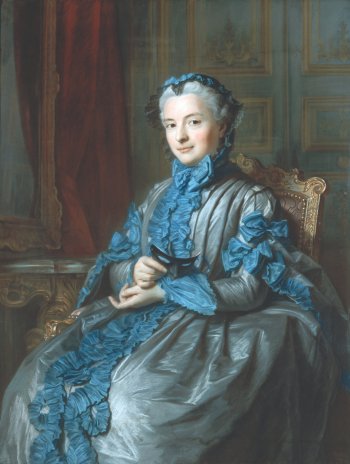
Maurice Quentin de La Tour, Portrait de Madame la présidente de Rieux, en habit de bal, tenant un masque, 1742 (Musée Cognacq-Jay).
Siècle d’or du pastel, le XVIIIe voit s’épanouir la virtuosité de dessinateurs tels que Maurice-Quentin de La Tour, le « prince des pastellistes », et son rival talentueux Jean-Baptiste Perronneau. Ils sont à l’honneur dans la collection Cognacq-Jay, avec des portraits qui comptent parmi leurs chefs-d’œuvre, comme celui de Madame la présidente de Rieux, en habit de bal, tenant un masque, aux dimensions monumentales. À ces œuvres françaises s’ajoutent celles de trois pastellistes anglais : Hugh Douglas Hamilton, John Russel et Daniel Gardner, témoins des échanges artistiques entre les deux pays autant que du goût singulier d’Ernest Cognacq pour l’école britannique.
La facture moelleuse, l’éclatante fraîcheur des coloris et l’expressivité des modèles de ces portraits témoignent du talent des artistes à manier le pastel, cette poudre de couleur aux nuances et aux dégradés variant à l’infini. À la fois ligne et couleur, le pastel offre une rapidité d’écriture, une transcription sensible de l’émotion et une intensité qui reste intacte au fil du temps.
Aux côtés des œuvres de la collection Cognacq-Jay, une sélection de pastels d’artistes du XVIIIe, tels que François Boucher ou Élisabeth Vigée Le Brun issus d’autres institutions de Paris Musées, complète ce panorama.
L’accrochage exceptionnel de ces œuvres fragiles, accompagné d’une médiation spécifique, permettra d’éclairer le goût pour le portrait intime, caractéristique du siècle des Lumières, et sera également l’occasion de dévoiler les dernières acquisitions du musée en arts graphiques.
New Book | Color Charts: A History
With the original French edition (Nuanciers: éloge du subtil) published in October, the English translation is due in February from Princeton UP:
Anne Varichon, Color Charts: A History, translated by Kate Deimling (Princeton: Princeton University Press, 2024), 284 pages, ISBN: 978-0691255170, £45 / $55.
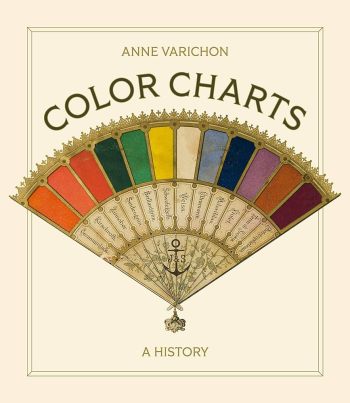 A beautifully illustrated history of the many inventive, poetic, and alluring ways in which color swatches have been selected and staged
The need to categorize and communicate color has mobilized practitioners and scholars for centuries. Color Charts describes the many different methods and ingenious devices developed since the fifteenth century by doctors, naturalists, dyers, and painters to catalog fragments of colors. With the advent of industrial society, manufacturers and merchants developed some of the most beautiful and varied tools ever designed to present all the available colors. Thanks to them, society has discovered the abundance of color embodied in a plethora of materials: cuts of fabric, leather, paper, and rubber; slats of wood and linoleum; delicate skeins of silk; careful deposits of paint and pastels; fragments of lipstick; and arrangements of flower petals. These samples shape a visual culture and a chromatic vocabulary and instill a deep desire for color.
Anne Varichon traces the emergence of modern color charts from a set of processes developed over the centuries in various contexts. She presents illuminating examples that bring this remarkable story to life, from ancient writings revealing attention to precise shade to contemporary designers’ color charts, dyers’ notebooks, and Werner’s famous color nomenclature. Varichon argues that color charts have linked generations of artists, artisans, scientists, industrialists, and merchants, and have played an essential and enduring role in the way societies think about color. Drawing on nearly two hundred documents from public and private collections, almost all of them previously unpublished, this wonderfully illustrated book shows how the color chart, in its many distinct forms and expressions, is a practical tool that has transcended its original purpose to become an educational aid and subject of contemplation worthy of being studied and admired.
Anne Varichon is an anthropologist specializing in material cultures and ideas about color. She is the author of Colors: What They Mean and How to Make Them.










 Enfilade
leave a comment