Battle of New Orleans Historical Symposium, 2024
From Nunez Community College, with registration available at Eventbrite:
The 9th Annual Battle of New Orleans Historical Symposium
Nunez Community College, Chalmette (New Orleans), 5–6 January 2024
The 9th Annual Battle of New Orleans Historical Symposium will take place January 5th and 6th in Chalmette, Louisiana, at Nunez Community College (on Friday) and at the St. Bernard Council Chambers (on Saturday).
f r i d a y , 5 j a n u a r y
9.00 Coffee
9.30 Welcome and Opening Remarks — Tina Tinney
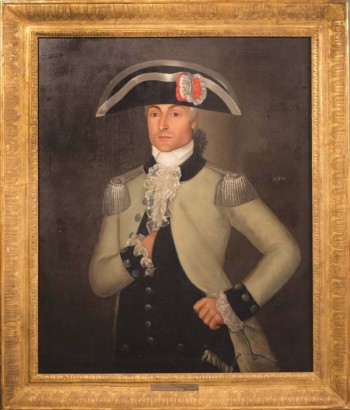
Attributed to José Francisco Xavier de Salazar y Mendoza, Portrait of Captain Joseph Bernard Vallière d’Hauterive, ca. 1791–95, oil on canvas (Little Rock: Historic Arkansas Museum). Vallière d’Hauterive was the Grenoble-born commandant of the Arkansas Post from 1787 to 1790; this portrait was likely painted upon his return to New Orleans.
9.45 Morning Talks
• Overview of Battle of New Orleans — William Hyland
• ‘Nothing Pleases Them So Much as the Uniform’: Martial Culture and Military Life in Early Louisiana — Philippe Halbert
• The Past as Prelude: The Impact of Spain and the Galvez Expedition on the American Victory in the Battle of New Orleans — Bradford Waters
12.15 Lunch
1.30 Afternoon Talks
• ‘Pirate City’: Tracing Property Records of Selected Members of Jean Laffite’s Baratarian Pirate Syndicate who Played Prominent Roles in the War Effort of the Winter of 1814–15 — Ina Fandrich
• What if New Orleans had been Taken by the British in 1815? — Harold Youmans
4.00 Wine and Cheese Reception
s a t u r d a y , 6 j a n u a r y
10.00 Welcome — Katherine Lemoine
10.05 Morning Talks
• A Reminiscence of the Battle of New Orleans by Bernard de Marigny — William Hyland
• Native American Influence in the Battle of New Orleans: Houma Indians in Louisiana — Colleen Billiot
• Scottish Heraldry: A Window into a Culture — Christen Raby Elliot
12.45 Closing Remarks — William Hyland
Attingham Courses in 2024
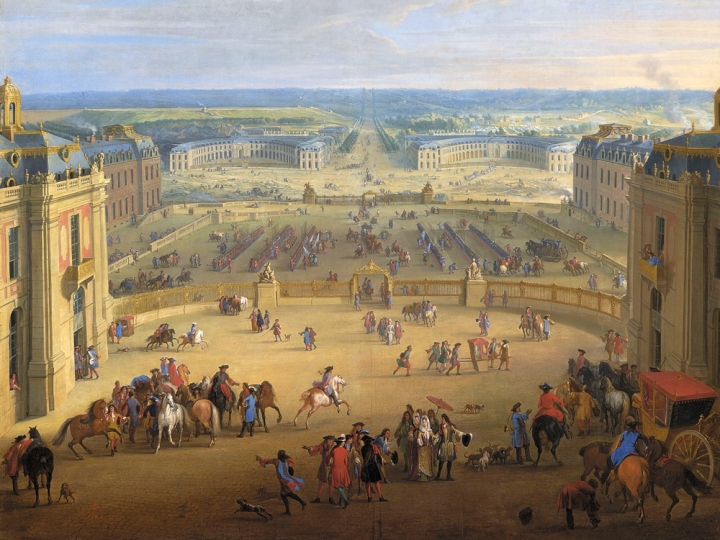
View of Versailles with the Royal Stables in the Foreground
(Versailles: Musée Lambinet)
◊ ◊ ◊ ◊ ◊
This year’s Attingham offerings:
The Attingham Summer School, 29 June — 14 July 2024
Applications due by 28 January
The 71st Attingham Summer School, a 16-day residential course directed by David Adshead and Tessa Wild, will visit country houses in Sussex, Buckinghamshire, Oxfordshire, Derbyshire, Northamptonshire, Wiltshire, and Dorset. From West Dean, our first base, we will study, amongst other houses and gardens: the complex overlays of Arundel Castle, the ancestral seat of the Dukes of Norfolk; Petworth House, where the patronage of great British artists such as Turner and Flaxman enrich its Baroque interiors; Parham, a fine Elizabethan house in an unrivalled setting and Standen, an Arts and Crafts reinterpretation of the country house.
In the Midlands a series of related houses will be examined: Hardwick Hall, unique amongst Elizabethan houses for its survival of late 16th-century decoration and contents; Bolsover Castle, a Jacobean masque setting frozen in stone and Chatsworth, where the collections and gardens of the Cavendishes and Dukes of Devonshires span more than four centuries. Other highlights include the superb collections and landscaped gardens at Boughton House, ‘the English Versailles’.
Based in Salisbury, the final part of the course will explore the estates and collections of Dorset and Wiltshire. Our itinerary will include Wilton House, the fine Palladian seat of the Earls of Pembroke, renowned for its state rooms and outstanding art collection; Henry Hoare II and Henry Flitcroft’s magnificent garden at Stourhead, the superlative example of the 18th-century English landscape garden style; and Kingston Lacey, home of the collector, traveller and pioneering Egyptologist William John Bankes, who spent the last fourteen years of his life in exile in Venice, from where he continued to embellish the interiors and add to his significant collections.
◊ ◊ ◊ ◊ ◊
Royal Collection Studies, 1–10 September 2024
Applications due by 11 February
The Royal Collection is one of the world’s leading collections of fine and decorative art, with over one million works from six continents, many of them masterpieces. Working in partnership with The Royal Collection Trust, this ten-day residential course offers participants the opportunity to study the magnificent holdings of paintings, furniture, metalwork, porcelain, jewellery, sculpture, arms and armour, books and works on paper and to examine the architecture and interiors of the palaces which house them.
Based near Windsor, the course also examines the history of the collection and the key roles played by monarchs and their consorts over the centuries. Combining a mixture of lectures and tutorials, visits to both the occupied and unoccupied palaces in and around London and close-up object study, Royal Collection Studies aims to give experienced professionals in the heritage sector a deeper understanding of this remarkable collection.
The course is intended to be interactive, with participants asked to contribute and participate in group discussions. As with all Attingham courses, the group is encouraged to engage with current curatorial debates, questions of display and interpretation and, in this instance, the issues surrounding a working collection. During the course, members find that they build an invaluable network for the ongoing exchange of ideas and expertise.
Royal Collection Studies is organised on broadly chronological principles, developing an understanding of the changing function and character of the British Royal Collection. The course is held when the Royal Family is not in residence and Windsor Castle is the central focus. The programme explores palaces past and present and five centuries of collecting and display, covering all aspects of the collection.
◊ ◊ ◊ ◊ ◊
Attingham Study Programme: Arts and Crafts Houses and Gardens, 16–22 September 2024
Applications due by 11 February
This seven-day study programme will explore the origins and evolution of the Arts and Crafts movement in England by studying the work of its leading architects and designers and considering its influence here and abroad. We will be based in Surrey and Gloucestershire and will examine houses, gardens and collections in Kent, Sussex, Surrey, Oxfordshire, Gloucestershire, Worcestershire, and Herefordshire.
The course will begin with the two influential houses which bookend the architect Philip Webb’s career: Red House, designed for William Morris in 1859–60, and Standen, his most complete surviving work, with its fine collection of original Morris & Co. furnishings, furniture, and decorative arts. We will explore the extraordinary creative partnership between Gertrude Jekyll and Edwin Lutyens at Munstead Wood, where Jekyll’s skill as a designer and horticulturist finds perfect expression in her own garden which clothes the house designed for her by Lutyens. We will also visit Vann, where the architect W D Caröe extended his 16th-century house and commissioned Jekyll to create a water garden in 1911. From Surrey, we will travel to Morris’s country home at Kelmscott Manor and on to Gloucestershire where we will spend time studying the pre-eminent Arts and Crafts collections of The Wilson in Cheltenham. Among the houses and gardens we will explore in this area, are Rodmarton Manor, designed by Ernest Gimson for Claud and Margaret Biddulph, and recognised as the last and greatest of the houses, entirely built and with its furniture made to Arts and Crafts ideals using local materials and craftspeople. At Owlpen Manor, which the architect, Norman Jewson, discovered in a state of near-dereliction and acquired in 1925, in order to repair it and ensure its survival, we will study the Mander family’s wonderful collection. We will then spend a day at two superb and highly contrasting houses near Malvern, the moated 19th-century Madresfield Court, home to the Lygon family for over 900 years, with its library by CR Ashbee and the Guild of Handicraft and exceptional chapel and Perrycroft, designed by CFA Voysey as a country retreat for JW Wilson MP in 1893–94, on a spectacular sloping site in the Malvern Hills.
◊ ◊ ◊ ◊ ◊
Court Culture and the Horse, 1700–1900: Versailles, Chantilly, and Compiègne, 6–11 October 2024
Applications due by 11 February
This intensive short course will explore the central role of horses, ceremonial carriages and grand stable complexes within French court culture during the long 18th century. By connecting these objects and spaces with their immediate surroundings, we hope to reach a more nuanced understanding of their importance in French aristocratic life and of how this is reflected in the architecture, interiors and art collections of the palaces and chateaux we will be visiting.
The programme is planned to coincide with a major new exhibition entitled Cheval en majesté, au coeur d’une civilisation to be held at the Château de Versailles. We will spend the first full day of the course visiting the palace, including the great and small stables, highly important spaces often overlooked by visitors. From our hotel in the 19th arrondissement, we will travel by coach to the Château de Chantilly to study the spectacular 18th-century stables (the largest princely stables in Europe), the newly redisplayed Musée du Cheval, and the interiors and collections of the château. A day will be spent at the Château de Compiègne, a palace built to indulge Louis XV’s passion for hunting and now also the home of the Musée Nationale de la Voiture, established in 1927, comprising the foremost collection of horse-drawn vehicles, harnesses and livery in France. Other visits in Paris will explore smaller spaces with equine connections, including the cavalry department of the Republican Guard who were responsible for protecting the Kings of France and who now play an important ceremonial role.
Frick Director Ian Wardropper to Retire in 2025
From the museum press release (3 January 2024) . . .
 The Frick Collection announced today that Ian Wardropper, the institution’s Anna-Maria and Stephen Kellen Director, will retire in 2025 following fourteen years of service to the Frick and a fifty-year museum career. During his tenure as the Frick’s director, Wardropper led the museum and library through a period of strategic and measured growth, which included the first comprehensive renovation and upgrade of the Frick’s historic buildings in nearly ninety years and a focused acquisitions program that has enhanced the institution’s art and library collections. He also prioritized accessibility and public outreach, spearheading innovative strategies and partnerships that enabled audiences to experience the museum and library in new ways. This has ranged from inventive online programs including Cocktails with a Curator to partnerships with the Ghetto Film School to the conceptualization and management of Frick Madison, which enabled the Frick’s collections and programs to be enjoyed throughout the institution’s renovation and enhancement project.
The Board of Trustees is working with an executive search firm to conduct an international search for the Frick’s next director. Wardropper will be honored for his innumerable contributions to the museum and the arts community at large at the institution’s fall 2024 gala, which precedes the public reopening of the museum and library in late 2024. . . .
The full press release is available here»
Robin Pogrebin covered the story yesterday for The New York Times.
The Furniture History Society’s Early Career Symposium

◊ ◊ ◊ ◊ ◊
From The Furniture History Society, with registration at Eventbrite:
The Furniture History Society Early Career Research Symposium
The Metropolitan Museum of Art, New York, 24 January 2024
The Furniture History Society is delighted to hold its seventh Early Career Research Symposium at The Metropolitan Museum of Art in New York on Wednesday, 24th January. The symposium is part of our Early Career Development (ECD) programme and presents current research by emerging scholars in the fields of furniture history, the decorative arts, and historic interiors. The wide range of papers reflects the variety of interests among young scholars with speakers from Britain, the Czech Republic, France, Italy, and the United States. We welcome curators, dealers, academics, members of the Furniture History Society, and anyone interested in the decorative arts and the history of interiors to join us for this symposium to enjoy the fascinating medley of topics, ranging from the 1650s to the 1950s. The event is free, but it is necessary to register here on Eventbrite by midnight Sunday, 21st January to secure a place. This event is neither being recorded nor livestreamed.
The day is made possible thanks to the generous support of the Oliver Ford Trust.
p r o g r a m m e
9.30 Welcome
9.45 Morning Session A
• Cynthia Kok (Rijksmuseum, Amsterdam) Ebonyworkers in 17th-Century Amsterdam
• Bridget Griffin (The Attingham Trust, London), Crafting Connections: Mapping the Lives and Trade Networks of British and Irish Immigrant Furniture Makers in North-Eastern Port Cities of Early America
• Grace Ford-Dirks (Philadelphia Museum of Art), Exploring the Lives and Meanings of an 18th-Century Caribbean Armoire
11.15 Break
11.45 Morning Session B
• Noah Dubay (Bard Graduate Center, New York), Comfort, Convenience, and Convalescence: How the Fauteuil de Malade Changed 18th-Century France
• Geoffrey Ripart (Bard Graduate Center, New York), The Road from Rome to Paris: Sourcing Rare Marbles at the End of the Ancien Regime and the Rise of French Taste for Objets d’Art Made from Stone, 1760–1810
12.45 Lunch Break
1.45 Afternoon Session A
• Romana Mastrella (University of La Sapienza, Rome), Collecting Fireplaces
• Justine Gain (École de Louvre, Paris), When the Furniture Matches the Architecture: The Birth of French Eclecticism through the Oeuvre of Jean-Baptiste Plantar (1790–1879)
• Laura Jenkins (Courtauld Institute of Art, London) From Galerie to Ballroom: Gilbert Cuel at 1 West 57th Street
3.15 Break
3.45 Afternoon Session B
• Karolina Kourilova (Masaryk University, Brno), Design behind the Iron Curtain: Furniture Industry Development in Post-War Czechoslovakia
• Melania Andronic (University of La Sapienza, Rome), Rational Furniture: A Chair Is Made for Sitting
4.45 Closing Remarks
◊ ◊ ◊ ◊ ◊
Images: Detail of a fireplace, 1785, by Luigi Valadier in the Sala della Flora on the first floor of the Villa Borghese in Rome. Detail of a cabinet attributed to Herman Doomer, Amsterdam ca. 1640–50 (New York: The Met). Detail of a drawing by Jean-Baptiste Plantar in the Album d’une centaine de dessins d’architecture, Paris, ca. 1855 (held online by the Institut national d’histoire de l’art). Detail of the Galerie dorée at the Hôtel de Toulouse (now Banque de France), decorated by Robert de Cotte and Francois-Antoine Vasse, 1713–17 (photo by Guilhem Vellut).
Exhibition | Canops: Extraordinary Furniture for Charles III of Spain
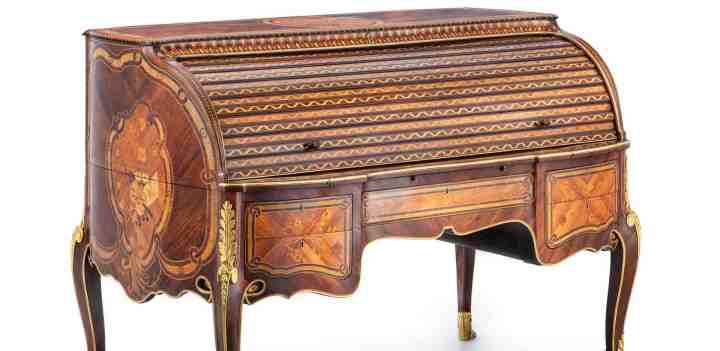
Madrid court workshop of Charles III under the direction of José Canops, Writing bureau with exotic marquetry decoration, ca. 1772–73
(Staatliche Museen zu Berlin, Kunstgewerbemuseum; photo by Stephan Klonk)
◊ ◊ ◊ ◊ ◊
Now on view at Berlin’s Museum of Decorative Arts, from the Staatliche Museen zu Berlin, with a related conference taking place 25–27 January:
Canops: Extraordinary Furniture for Charles III of Spain, 1759–1788
Kunstgewerbemuseum, Schloss Köpenick, Berlin, 12 October 2023 — 11 February 2024
Curated by Achim Stiegel
Although largely unknown today, the work of José Canops (1733–1814), an ébéniste of German descent born Joseph Cnops, and his Madrid workshop is one of the crowning achievements of European furniture-making.
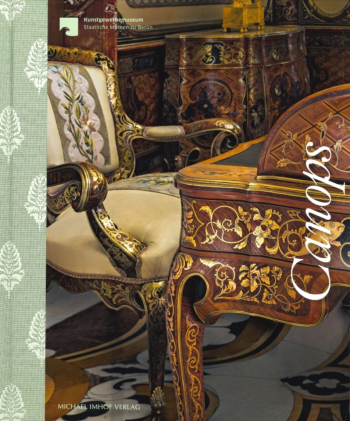 The furniture and boiseries are from the apartments of Charles III of Spain (r. 1759–1788), a Gesamtkunstwerk in exuberant rococo style conceived by the court painter and stuccoist Mattia Gasparini—a truly European creation inspired by Italian traditions, a taste for Parisian opulence, and the exotic worlds of Asia. Such elements combine in Canops’s work with the precision of German cabinetmaking and the riches of the Spanish colonies.
The starting point for the exhibition and publication was the acquisition for the Kunstgewerbemuseum of a magnificent roll-top desk by José Canops. With lavish new photography and never previously exhibited loans from the Patrimonio Nacional (the Spanish royal collections in Madrid), German and international audiences are afforded a glimpse into a hitherto hidden world.
In conjunction with the Spanish Embassy, the Ibero-Amerikanisches Institut of the Preußischer Kulturbesitz and Instituto Cervantes Berlin, the exhibition is accompanied by a programme of supporting events within the context of the 2023 Spanish presidency of the Council of the European Union.
Daniela Heinze, Achim Stiegel, et al., Canops: Möbel von Welt für Karl III. von Spanien (1759–1788), with photographs by Stephan Klonk (Petersberg: Michael Imhof Verlag, 2023), 288 pages, ISBN: 978-3731913689, €50.
Highlights Tour | American Furniture Study Center at Yale

View of case furniture in the Leslie P. and George H. Hume American Furniture Study Center
(New Haven: Yale West Campus)
◊ ◊ ◊ ◊ ◊
From the Yale University Art Gallery:
Furniture Study Highlights Tour
Hume American Furniture Study Center, New Haven, first Fridays of each month, 5 January — 3 May 2024
Join us at 12.30 on the first Friday of the month for a one-hour, in-person tour of the Leslie P. and George H. Hume American Furniture Study Center at the Collection Studies Center, Yale West Campus. See more than 1,300 examples of American furniture and clocks from the 17th century to the present in this facility, which opened in 2019, as well as an outstanding collection of contemporary wood art. Registration is required, and space is limited. Registered visitors will receive a confirmation email including directions to the site.
The Decorative Arts Trust Announces New Publishing Grants
From the press release (11 December 2023) . . .
Publishing Grant for First-Time Authors or Recent PhD Graduates, up to $5000
Publishing Grant in Support of Catalogues and Conference Proceedings, up to $50,000
Proposals due by 31 March 2024
The Decorative Arts Trust announces the creation of a new publishing grant program. This latest expansion of the Trust’s efforts to invigorate scholarship and broaden appreciation of material culture represents a major initiative under the leadership of Brock Jobe and Margaret Pritchard, who serve as President and Vice President of the Board of Governors, respectively. The endeavor is structured to respond to the changing needs of the field and to support publishing efforts in both the print and digital sectors.
“The Trust’s Board recognizes the strong demand for and limited supply of resources focused on publishing in the art community,” according to Executive Director Matthew A. Thurlow. “The organization receives dozens of requests for funding each year for publishing-related projects through our Prize for Excellence and Innovation and Failey Grant program and has supported a variety of books through those awards. This new venture establishes a commitment to sharing important art historical research as broadly as possible.”
The Trust will allocate funding to two separate grants. Building on its long tradition of promoting emerging scholars, the Trust will award an annual grant of up to $5,000 to a first-time author or a PhD graduate who is converting their dissertation into a book-length academic publication. Academic presses are also able to apply on behalf of authors currently under contract.
The second grant line is applicable to exhibition and collections catalogues and compilations of conference papers. The Trust will provide up to $50,000 per year for this purpose, and proposals can request funding from $5,000 to the full $50,000, depending on the level of need. Both nonprofit organizations and independent scholars are welcome to apply. Project and publication teams that include early career professionals will receive preference.
To steward the program and oversee the selection of grant recipients, the Trust created a new advisory committee overseen by Pritchard. The committee consists of museum professionals and academics with broad experience in publishing. The members are eager for the opportunity to support publications tackling the broad context of the Americas and to encourage projects that advance diversity in the study of American decorative arts and material culture.
The deadline to submit proposals for the inaugural round of grants is 31 March 2024. More information and submission guidelines can be found here.
New Book | Futuristic Fiction, Utopia, and Satire
Coming in March from Brepols:
Giulia Iannuzzi, Futuristic Fiction, Utopia, and Satire in the Age of the Enlightenment: Samuel Madden’s ‘Memoirs of the Twentieth Century’ (1733) (Brepols, 2024), 460 pages, ISBN: 978-2503606026, €125.
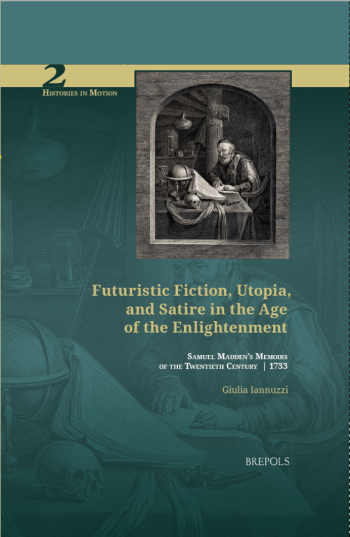 Published anonymously in 1733, Memoirs of the Twentieth Century is one of the earliest futuristic novels known in Anglophone and Euro-American literature. It foregrounds an acceleration of history brought about by an increasing degree of global interconnectedness and the exclusion of prophetism and astrology as credible ways to know the future. The work of Samuel Madden, an Irish writer and philanthropist of Whig sympathies, it consists of a collection of diplomatic letters composed in the 1990s, which the narrator claims were brought to him from the time to come by a supernatural entity. Through these correspondences, twentieth-century world scenarios are spread out before the reader, in which British naval power rules the waves and international commerce, while the transnational scheming of the Jesuits threatens the independence of weaker European courts.
This book—which includes a study followed by an annotated edition of the text—assesses the cultural significance of this literary work, as an apt observatory on how historical time as a cultural construction was shaped, during the eighteenth century, by new forms of transnational circulation of information, and by the dubious space carved out in European culture by seventeenth- and early eighteenth-century debates on the nature of historical knowledge. Through and by means of the Memoirs case study, this volume aims to contribute to a wider cultural history of the future and speculative fiction. The novel’s ironic distancing of beliefs considered to be superstitious and absurd—such as divination techniques and occult and magical disciplines—offers an exceptional testimony to the negotiation of the boundaries of verisimilitude and credibility within a religious enlightenment.
Giulia Iannuzzi has worked on the history of publishing and translation processes, and on the history of speculative imagination in a comparative perspective. Her articles have been published in academic journals such as History, History of Historiography, Cromohs, Perspectives, American Literary Scholarship, and Journal of Romance Studies.
c o n t e n t s
Introduction: Knowledge, Power, and Time in the Age of the Enlightenment
Part I | Samuel Madden’s Eighteenth-Century Memoirs from the Future
1 Where Was the Future?
2 When Was the Future?
3 An Irish Whig between Philanthropism and Literature
4 An Eighteenth-Century Twentieth Century
5 An (Unreliable) Historian of the Future
6 A ‘Good Genius’ and the ‘Scene of Things below’
7 Empirical Science, Global Consciousness, and ‘the History of Future Times’
8 Blurring the Dichotomy between History and Fiction
9 Satirising Past Futures
10 ‘Publishing’ the Letters
11 ‘This Prodigious Society’: Anti-Jesuit Satire
12 Whose Credulity, Whose Credibility
13 Bookish Mysteries and an ‘Alternate George VI’
14 Concluding Remarks
Part II | Memoirs of the Twentieth Century
A Note on the Text
Samuel Madden, Memoirs of the Twentieth Century
Notes to the Text
Bibliography
Index










 Enfilade
leave a comment