Conference | Eco Edo: Ecological Perspectives
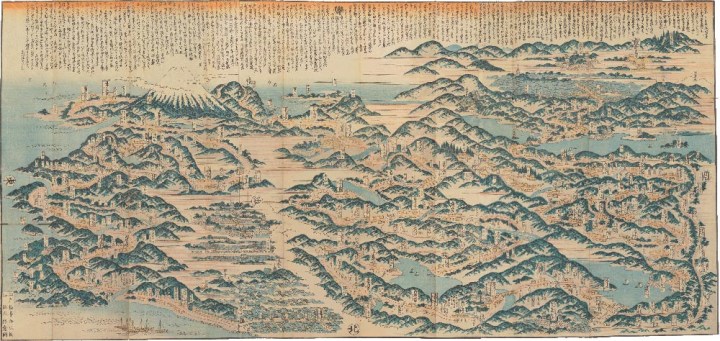
Panoramic Map of the Tōkaidō Highway, Shōtei Kinsui, drawn by Kuwagata (better known as Keisai). Published by Sanoya Ichigorō, Izumiya Hanbei, and Izumoji Manjirō, n.d. (likely 1810). Polychrome xylography, 52 x 24 inches (Los Angeles: Richard C. Rudolph Collection of Japanese Maps, Special Collections, UCLA Library).
◊ ◊ ◊ ◊ ◊
As noted yesterday at ArtHist.net:
Eco Edo: Ecological Perspectives on Early Modern Japanese Art
William Andrews Clark Memorial Library, UCLA, Los Angeles, 2 February 2024
Organized by Kristopher Kersey
On 2 February 2024, the William Andrews Clark Memorial Library at UCLA will host the conference Eco Edo: Ecological Perspectives on Early Modern Japanese Art. This is the second of three conferences at UCLA this year on the theme of early modern Japanese art.
The art of Japan’s Edo period (1603–1868) presents a paradox. On the one hand, the nineteenth-century proliferation of ukiyo-e—polychrome woodblock prints of the ‘floating words’ of theater and sex work—made the popular visual culture of this city a familiar component of modern art in the nineteenth and twentieth centuries. Yet the outsize fascination with ukiyo-e outside Japan has sorely obscured Edo’s far more diverse social, material, and artistic landscapes. In an effort to countervail the enduring stereotypes of early modern Japanese art, Open Edo will present a suite of conferences addressing three interlinked themes: the representation and agency of marginalized groups, the ecological horizons of artistic production, and the ongoing need to counter the myth that Japan in early modernity was somehow disconnected from the rest of the world. Throughout the year-long series, the focus will be both historical and historiographical inasmuch as Open Edo asks how Japanese art history might challenge the discourse of early modernity writ large.
If interested in attending, please register, as space is limited in the Clark Library (also, note that the Clark is housed in a villa in West Adams, about 8 miles east of the main UCLA campus in Westwood). The conference is free and open to the public. Parking is free, and lunch is provided. To register, follow this link. There is no livestream or recording, but an edited volume should follow. Should you have any questions, please email kersey@humnet.ucla.edu.
p r o g r a m
9.30 Coffee and registration
10.00 Director’s welcome by Bronwen Wilson (UCLA), with opening remarks by Kristopher Kersey (UCLA)
10.15 Panel 1
Moderator: Kristopher Kersey (UCLA)
• Greg Levine (University of California, Berkeley), ‘Close Looking,’ but at What? Hasegawa Tōhaku’s Pine Grove and ‘Attentional Deviance’
• Rachel Saunders (Harvard Art Museums), The Birds, Flowers, and Botany of Edo Rinpa
11.45 Lunch, with a display of Clark Library materials in the North Book Room
1.00 Panel 2
Moderator: William Marotti (UCLA)
• Chelsea Foxwell (University of Chicago), What Are Bugs Doing in Edo-Period Paintings?
• Kit Brooks (National Museum of Asian Art, Smithsonian Institution), Morphing into Madness: Shifting Perceptions of the Japanese Wolf
2.30 Coffee break
3.00 Panel 3
Moderator: Kendall Brown (California State University Long Beach)
• Christian Tagsold (Heinrich Heine University Düsseldorf), The Thousand Gardens of Edo: Exploring the Nature of the Cultivated Environment
• Nobuko Toyosawa (Oriental Institute of the Czech Academy of Sciences), The Place of Ecology in Matsudaira Sadanobu’s Gardens
4.40 Plenary discussion with all speakers
5.30 Reception
Scholarships | The Aesthetic Inventions of Ecology, ca. 1800
From ArtHist.net:
The Aesthetic Inventions of Ecology around 1800
Doctoral and Post-Doctoral Scholarships
Johannes Gutenberg-Universität Mainz, 1 October 2024 — 30 September 2027
Applications due by 15 May 2024
Johannes Gutenberg University Mainz announces the following scholarships within the framework of the new Mini Graduate College (MGRK), The Aesthetic Inventions of Ecology around 1800 (Die ästhetischen Erfindungen der Ökologie um 1800), funded by the Gutenberg Junior College (GNK):
• 4 doctoral scholarships (m/f/d) with a monthly stipend of EUR 1,550
• 1 postdoctoral scholarship (m/f/d) with a monthly stipend of EUR 1,900
The scholarships are to be filled by 1 October 2024, with a duration of three years. Selection interviews will take place in June 2024.
Requirements
• Excellent university degree (state examination, MEd, MA, or equivalent) in German Studies, English Studies, Art History, Music Theory, or related fields
• An innovative project idea within the research area of MGRK
• Knowledge in the areas of Classicism and Romanticism, as well as in ecological matters
• Interest in interdisciplinary work and team collaboration
• Proficiency in the college’s languages German and English
• Postdoctoral applicants should also present an outstanding dissertation, along with initial presentation and publication activities
Application Documents
• A one to two-page motivational letter explaining the reasons for pursuing the planned doctoral or postdoctoral project, demonstrating expectations from a Mini Graduate College and convincing statements about interdisciplinary work
• Curriculum vitae and academic certificates (high school diploma, MA, state examination, transcript of records for all courses in the master’s program, equivalent foreign degrees, and PhD for postdocs)
• If possible, a list of publications
• If necessary, language proficiency certificates
• A project outline (approximately 5–7 pages) for a project tailored to the college’s theme and methodology
• A work sample (e.g., master’s thesis, dissertation for postdocs) and an abstract (approximately 1 page) of the work sample
• Identification of two university professors who can provide information about personal suitability and academic qualifications
Further details of the research and study program of the Mini Graduate College are available by AESTHOEK1800@uni-mainz.de on request.
The university aims to increase the proportion of women in research and teaching and encourages qualified female academics to apply. Disabled individuals will be given preferential consideration if equally qualified. The college is committed to the principles of diversity and gender equality. International applicants should have sufficient knowledge of German. The MGRK accepts fellows from other funding organizations and guest scholars without offering funding, but with full integration into research.
For inquiries, please contact the participating faculty representatives:
• Prof. Dr. Barbara Thums, Department of German, Johannes Gutenberg University Mainz, thums@uni-mainz.de
• Prof. Dr. Rainer Emig, Department of English and Linguistics / English Literature and Culture, Johannes Gutenberg University Mainz, emigr@uni-mainz.de
• Prof. Dr. Immanuel Ott, Music Theory, Mainz University of Music at the Johannes Gutenberg University Mainz, immot@uni-mainz.de
• Prof. Dr. Gregor Wedekind, Department of Art History and Musicology / Art History, Johannes Gutenberg University of Mainz, Gregor.wedekind@uni-mainz.de
Please send your complete application documents in electronic form as a consolidated PDF file titled “Name-First Name-Application” by 15 May 2024, via email to the spokesperson of the MGRK:
Prof. Dr. Barbara Thums
Johannes Gutenberg University Mainz
Faculty 05 – Philosophy and Philology
aesthoek@uni-mainz.de










 Enfilade
leave a comment