New Books | Shortlist, 2024 Charles Rufus Morey Book Award
The shortlist for the 2024 Charles Rufus Morey Book Award, from the College Art Association, with three of the five books addressing the long 18th c. (and special congratulations to HECAA president, Jennifer Van Horn) –CH
The Charles Rufus Morey Book Award, named in honor of one of the founding members of CAA and first teachers of art history in the United States, was established in 1953. This award honors an especially distinguished book in the history of art, published in the English language. Preference is given to books, including catalogues raisonnés, by a single author, but major publications in the form of articles or group studies may be included. Publication of documents or inventories, unless specifically in the context of an exhibition, are also eligible.
◊ ◊ ◊ ◊ ◊
Delia Cosentino and Adriana Zavala, Resurrecting Tenochtitlan: Imagining the Aztec Capital in Modern Mexico City (Austin: University of Texas Press, 2023), 272 pages, ISBN: 978-1477326992, $60.
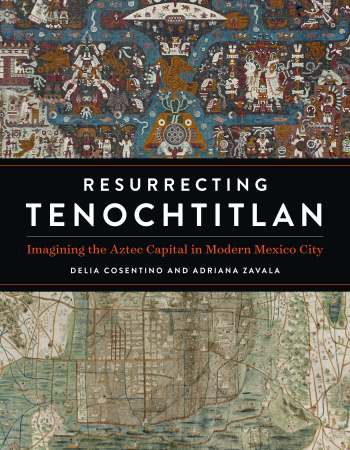 How Mexican artists and intellectuals created a new identity for modern Mexico City through its ties to Aztec Tenochtitlan
After archaeologists rediscovered a corner of the Templo Mayor in 1914, artists, intellectuals, and government officials attempted to revive Tenochtitlan as an instrument for reassessing Mexican national identity in the wake of the Revolution of 1910. What followed was a conceptual excavation of the original Mexica capital in relation to the transforming urban landscape of modern Mexico City. Revolutionary-era scholars took a renewed interest in sixteenth century maps as they recognized an intersection between Tenochtitlan and the foundation of a Spanish colonial settlement directly over it. Meanwhile, Mexico City developed with modern roads and expanded civic areas as agents of nationalism promoted concepts like indigenismo, the embrace of Indigenous cultural expressions. The promotion of artworks and new architectural projects such as Diego Rivera’s Anahuacalli Museum helped to make real the notion of a modern Tenochtitlan. Employing archival materials, newspaper reports, and art criticism from 1914 to 1964, Resurrecting Tenochtitlan connects art history with urban studies to reveal the construction of a complex physical and cultural layout for Mexico’s modern capital.
Delia Cosentino is an associate professor of Latin American art history at DePaul University. She is the author of Las joyas de Zinacantepec: Arte colonial en el Monasterio de San Miguel and was a guest editor for Artl@s Bulletin’s thematic volume Cartographic Styles and Discourse.
Adriana Zavala is an associate professor of the history of art and architecture and race, colonialism, and diaspora studies at Tufts University. She is the author of Becoming Modern, Becoming Tradition: Women, Gender, and Representation in Mexican Art.
◊ ◊ ◊ ◊ ◊
Matthew Francis Rarey, Insignificant Things: Amulets and the Art of Survival in the Early Black Atlantic (Durham: Duke University Press, 2023), 304 pages, ISBN: 978-1478017158 (hardback), $100 / ISBN: 978-1478019855, $27.
 In Insignificant Things Matthew Francis Rarey traces the history of the African-associated amulets that enslaved and other marginalized people carried as tools of survival in the Black Atlantic world from the seventeenth to the nineteenth centuries. Often considered visually benign by white Europeans, these amulet pouches, commonly known as ‘mandingas’, were used across Africa, Brazil, and Portugal and contained myriad objects, from herbs and Islamic prayers to shells and coins. Drawing on Arabic-language narratives from the West African Sahel, the archives of the Portuguese Inquisition, sixteenth- and seventeenth-century European travel and merchant accounts of the West African Coast, and early nineteenth-century Brazilian police records, Rarey shows how mandingas functioned as portable archives of their makers’ experiences of enslavement, displacement, and diaspora. He presents them as examples of the visual culture of enslavement and critical to conceptualizing Black Atlantic art history. Ultimately, Rarey looks to the archives of transatlantic slavery, which were meant to erase Black life, for objects like the mandingas that were created to protect it.
Matthew Francis Rarey is Associate Professor of Art History at Oberlin College.
◊ ◊ ◊ ◊ ◊
Tatiana Reinoza, Reclaiming the Americas: Latinx Art and the Politics of Territory (Austin: University of Texas Press, 2023), 248 pages, ISBN: 978-1477326909, $35.
 How Latinx artists around the US adopted the medium of printmaking to reclaim the lands of the Americas
Printmakers have conspired, historically, to illustrate the maps created by European colonizers that were used to chart and claim their expanding territories. Over the last three decades, Latinx artists and print studios have reclaimed this printed art form for their own spatial discourse. This book examines the limited editions produced at four art studios around the US that span everything from sly critiques of Manifest Destiny to printed portraits of Dreamers in Texas.
Reclaiming the Americas is the visual history of Latinx printmaking in the US. Tatiana Reinoza employs a pan-ethnic comparative model for this interdisciplinary study of graphic art, drawing on art history, Latinx studies, and geography in her discussions. The book contests printmaking’s historical complicity in the logics of colonization and restores the art form and the lands it once illustrated to the Indigenous, migrant, mestiza/o, and Afro-descendant people of the Americas.
Tatiana Reinoza is an assistant professor of art history at the University of Notre Dame.
◊ ◊ ◊ ◊ ◊
Andrew Shanken, The Everyday Life of Memorials (New York: Zone Books, 2022), 432 pages, ISBN: 9781942130727, £30 / $35.
 Memorials are commonly studied as part of the commemorative infrastructure of modern society. Just as often, they are understood as sites of political contestation, where people battle over the meaning of events. But most of the time, they are neither. Instead, they take their rest as ordinary objects, part of the street furniture of urban life. Most memorials are ‘turned on’ only on special days, such as Memorial Day, or at heated moments, as in August 2017, when the Robert E. Lee monument in Charlottesville was overtaken by a political maelstrom. The rest of the time they are turned off. This book is about the everyday life of memorials. It explores their relationship to the pulses of daily life, their meaning within this quotidian context, and their place within the development of modern cities. Through Andrew Shanken’s close historical readings of memorials, both well-known and obscure, two distinct strands of scholarship are thus brought together: the study of the everyday and memory studies. From the introduction of modern memorials in the wake of the French Revolution through the recent destruction of Confederate monuments, memorials have oscillated between the everyday and the ‘not-everyday’. In fact, memorials have been implicated in the very structure of these categories. The Everyday Life of Memorials explores how memorials end up where they are, grow invisible, fight with traffic, get moved, are assembled into memorial zones, and are drawn anew into commemorations and political maelstroms that their original sponsors never could have imagined. Finally, exploring how people behave at memorials and what memorials ask of people reveals just how strange the commemorative infrastructure of modernity is.
Andrew M. Shanken is Professor of Architecture at the University of California, Berkeley. He is the author of 194X: Architecture, Planning, and Consumer Culture on the American Home Front and Into the Void Pacific: Building the 1939 San Francisco World’s Fair.
◊ ◊ ◊ ◊ ◊
Jennifer Van Horn, Portraits of Resistance: Activating Art during Slavery (New Haven: Yale University Press, 2022), 344 pages, ISBN: 978-0300257632, $60.
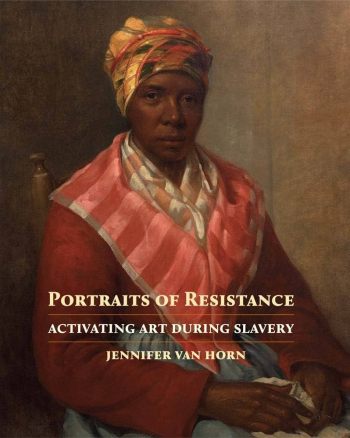 A highly original history of American portraiture that places the experiences of enslaved people at its center
This timely and eloquent book tells a new history of American art: how enslaved people mobilized portraiture for acts of defiance. Revisiting the origins of portrait painting in the United States, Jennifer Van Horn reveals how mythologies of whiteness and of nation building erased the aesthetic production of enslaved Americans of African descent and obscured the portrait’s importance as a site of resistance. Moving from the wharves of colonial Rhode Island to antebellum Louisiana plantations to South Carolina townhouses during the Civil War, the book illuminates how enslaved people’s relationships with portraits also shaped the trajectory of African American art post-emancipation. Van Horn asserts that Black creativity, subjecthood, viewership, and iconoclasm constituted instances of everyday rebellion against systemic oppression. Portraits of Resistance is not only a significant intervention in the fields of American art and history but also an important contribution to the reexamination of racial constructs on which American culture was built.
Jennifer Van Horn is associate professor of art history and history at the University of Delaware.










 Enfilade
leave a comment