Summer Seminar | Disability Histories in the Visual Archive
This week-long summer seminar will take place at the American Antiquarian Society:
Disability Histories in the Visual Archive: Redress, Protest, and Justice
American Antiquarian Society, Worcester, Massachusetts, 9–14 June 2024
Led by Jennifer Van Horn and Laurel Daen
Applications due by 8 April 2024
The seminar will focus on the visual and material cultures of disability in eighteenth and nineteenth-century North America. Participants will hone their skills in visual and material culture analysis, learn key methods and theories, including cripping, and gain experience working closely with archives and visual materials that support disability history. We will explore the unparalleled collections of the AAS, especially the library’s exemplary graphic arts collection of prints, photographs, and ephemera as well as collections materials on related topics such as education and printing for the blind.
The seminar will interrogate disability as lived experience, analytical category, and site for creativity and protest. Centering the histories of diverse peoples, we will explore topics such as enslavement, colonization, indigeneity, gender, education, warfare, and disability rights. Participants will actively work toward disability justice by attending to understudied and obscured histories, by questioning how we can use visual and material things to redress past injustices and dismantle ableism, and by considering equitable archival access.
Interdisciplinary in approach, the seminar welcomes scholars across multiple fields and areas of expertise that might include art history, Black studies, design history, disability studies, medical humanities, histories of vast early America, Native and Indigenous studies, and visual and material culture studies. Librarians, museum professionals, and public historians are encouraged to apply. No previous experience in disability studies or visual culture is required.
Guest speakers will include Jenifer Barclay, Associate Professor of History, University of Buffalo and author of The Mark of Slavery: Disability, Race, and Gender in Antebellum America (University of Illinois Press, 2020), and Erin Corrales-Diaz, Curator of American Art, Toledo Museum of Art.
Please follow this link for more information and instructions on how to apply.
The tuition fee for each seminar is $800, which includes meals throughout the week and evening receptions. Modest aid may be available for graduate students and early-career scholars to assist with travel and housing costs. Please feel free to reach out to Jennifer Van Horn with any questions (jvanhorn@udel.edu), or questions can be addressed to John J. Garcia, AAS Director of Scholarly Programs and Partnerships, jgarcia@mwa.org.
The seminar is sponsored by the Center for Historic American Visual Culture (CHAViC).
New Book | Yale and Slavery: A History
From Yale UP:
David Blight, with Yale and Slavery Research Project, foreword by Peter Salovey, Yale and Slavery: A History (New Haven: Yale University Press, 2024), 448 Pages, ISBN: 978-0300273847, $35.
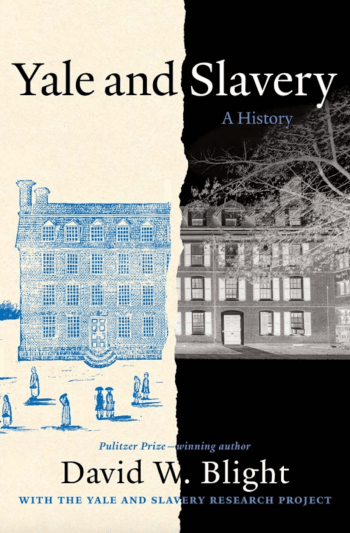 A comprehensive look at how slavery and resistance to it have shaped Yale University
Award-winning historian David W. Blight, with the Yale and Slavery Research Project, answers the call to investigate Yale University’s historical involvement with slavery, the slave trade, and abolition. This narrative history demonstrates the importance of slavery in the making of this renowned American institution of higher learning.
Drawing on wide-ranging archival materials, Yale and Slavery extends from the century before the college’s founding in 1701 to the dedication of its Civil War memorial in 1915, while engaging with the legacies and remembrance of this complex story. The book brings into focus the enslaved and free Black people who have been part of Yale’s history from the beginning—but too often ignored in official accounts. These individuals and their descendants worked at Yale; petitioned and fought for freedom and dignity; built churches, schools, and antislavery organizations; and were among the first Black students to transform the university from the inside.
Always alive to the surprises and ironies of the past, Yale and Slavery presents a richer and more complete history of Yale, the third-oldest college in the country, showing how pillars of American higher education, even in New England, emerged over time intertwined with the national and international history of racial slavery.
David W. Blight is Sterling Professor of History and director of the Gilder Lehrman Center for the Study of Slavery, Resistance, and Abolition at the MacMillan Center at Yale. The Yale and Slavery Research Project was convened in 2020.










 Enfilade
leave a comment