New Book | François Le Moyne (1688–1737)
From Silvana Editoriale (and on sale until 10 March) . . .
Jean-Luc Bordeaux, François Le Moyne (1688–1737), Opera completa: New Findings and Legacy (Milan: Silvana Editoriale, 2024), 352 pages, ISBN: 978-8836652310, €95.
 First Painter to the king in 1736 for only a few months before his tragic death, François Le Moyne had a career as short as it was prolific. A large number of works by this exceptional representative of French Rococo had been commissioned by the high clergy, the powerful Duke of Antin—official representative of King Louis XV—by members of the high aristocracy like the Prince of Conti or the Duke of Rohan or rich fermiers généraux like François Berger or Abraham Peyrenc de Moras, or even by the elite of great collectors or connoisseurs like Mariette, La Live de July, and Lempereur.
Teacher of Charles-Joseph Natoire and François Boucher and a contemporary of Antoine Watteau and Jean-François de Troy, Le Moyne reached the height of his glory with his Apotheosis of Hercules, painted between 1732 and 1736 on the immense ceiling of the Salon d’Hercule, located between La Chapelle Royale and the royal apartments of the Château de Versailles. After so many years spent in oblivion, Le Moyne is finally recognized today as one of the major artists of the 18th century, exerting a seminal influence on the following generations.
Unfortunately, only few of the works that Le Moyne realized at the beginning of his career, between 1710 and 1715, have been identified. Nonetheless, he left an important corpus of landscapes, religious works, and courtship scenes. He is considered one of the greatest draftsmen of all time and one of the best European artists of illusionistic ceiling painting since the time of Pietro da Cortona and Charles Le Brun. Moreover, Le Moyne contributed with his easel paintings and his technique to the creation of a new, more seductive model for the representation of the female nude in Europe. Lastly, on a technical level, he brightened the palette of French painting and realized sketches with a particularly quick and agile brushstroke.
Nearly forty years after his first monograph devoted to the painter, Professor Jean-Luc Bordeaux proposes a renewed survey of the oeuvre of François Le Moyne (1688–1737). Bordeaux analyses Le Moyne’s contributions to the French rococo as well as lesser-known aspects of his artistic production and career. With almost 140 paintings and 250 drawings, this new catalogue raisonné is an extended edition of the one published in 1984, with significant additions. It also includes an appendix of around twenty pages that describes a considerable amount of works by Le Moyne, now lost but attributed to him by famous collectors of the time and 18th century experts such as Gersaint, Mariette, Paillet, and Remy.
New Book | Colonial Watteau
From De Gruyter:
Charlotte Guichard, Watteau – kolonial: Herrschaft, Handel und Galanterie im Frankreich des Régence / Colonial Watteau: Empire, Commerce, and Galanterie in Regency France (Berlin: Deutscher Kunstverlag, 2022), 128 pages, ISBN: 978-3422990463, €17 / $20. English and German.
 What were the early visions of Empire in Regency France? The book offers a interpretation of Jean-Antoine Watteau’s Pilgrimage to the Isle of Cythera (1717) by framing it in the context of French colonial expansion in the years of the Regency. Born in Louis XIV’s reign, galant aesthetics contributed to frame the colonial encounter in French America. Fantasies of maritime departure, embarkation and/or debarkation, also expressed a longing for colonial travel and exploration. The imperial imagination fueled with codes of galanterie was very developed in the circles of Watteau’s amateurs. From Watteau’s Pilgrimage to the Isle of Cythera (1717) to its visual reenactment in 1763, the book argues that galanterie served as a visual and conceptual model of French commercial and colonial relations.
Wie sahen die frühen imperialen Visionen im Frankreich der Régence aus? Das Buch bietet eine neue und auch provokative Deutung von Jean-Antoine Watteaus Pilgerfahrt zur Insel Cythera (1717), indem es das Werk in den Kontext der französischen kolonialen Expansion in den Jahren der Régence stellt. Die galante Ästhetik, die während der Herrschaft und im Imperium Ludwigs XIV. entstand, trug dazu bei, die koloniale Begegnung in Französisch-Amerika zu gestalten. Die Fantasien vom Aufbruch zur See, vom Einschiffen oder Ausschiffen, allesamt Merkmale des Gemäldes, drückten auch die Sehnsucht nach kolonialen Reisen und Entdeckungen aus. Die imperiale Imagination, die sich aus den Codes der Galanterie speiste, war in den Kreisen von Watteaus amateurs, die ihrerseits den Modernen nahestanden, die neue ästhetische Formen in Kunst und Literatur förderten, sehr ausgeprägt. Von Watteaus Pilgerfahrt zur Insel Cythera (1717) bis zu ihrer visuellen Nachstellung im Jahr 1763 diente die Galanterie als visuelles und konzeptionelles Modell der französischen Handels- und Kolonialbeziehungen.
Charlotte Guichard, Research Professor at the Centre National de la Recherche Scientifique, Paris.
Oxford Art Journal, December 2023
The 18th century in the latest issue of the Oxford Art Journal:
Oxford Art Journal 46.3 (December 2023)
a r t i c l e s
• Aaron Wile, “Absolutism, the Royal Body, and the Origins of Mythologie galante: Charles de La Fosse at the Trianon,” pp. 327–55.

Charles de La Fosse, The Rest of Diana, 1688, oil on canvas, 128 × 160 cm (Versailles, Châteaux de Versailles et de Trianon).
Mythologie galante, a sensual mode of mythological painting that is one the defining developments of eighteenth-century French art, is usually associated with aristocratic resistance to Louis XIV. This article examines three mythological paintings created by Charles de La Fosse for one of the king’s pleasure palaces in 1688, long identified as a major turning point towards mythologie galante, in order to reassess the origins and meaning of the genre. Situating the paintings within the long arc of Louis XIV’s representational politics, I propose that the collapse of the fiction of the king’s two bodies during the second half of his reign and the subsequent redefinition of the king’s public and private spheres allowed La Fosse to develop a new mythological idiom based in touch, intimacy, and sentiment. The resulting works contravened painting’s traditional role under absolutism to form royal subjects, redefining it as a medium of sympathetic encounter. La Fosse’s paintings open up, from this perspective, an alternate account of modern art and subjectivity—one that took shape not in opposition to absolutist culture but from its very heart.
• Robert Jones, “Joshua Reynolds and Deafness: Listening, Hearing, and Not Hearing in Eighteenth-Century Portraiture,” pp. 357–77.
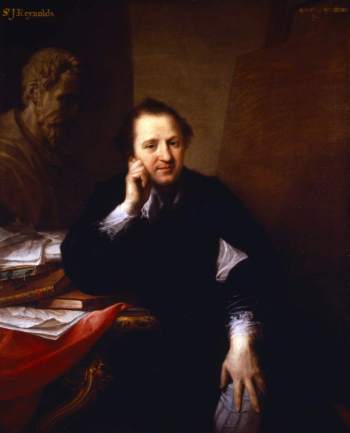
Angelica Kauffman, Portrait of Joshua Reynolds, 1767, oil on canvas, 127 × 102 cm (National Trust, Saltram).
This article examines the significance of deafness in painting and proposes a new trope for the form of picturing undertaken by eighteenth-century art, ‘the listening portrait’. As a first step it recovers and explores the significance of Sir Joshua Reynolds’s own deafness, as represented by his self-portraits as well as images by Nathanial Dance, Angelica Kauffman, and Johan Zoffany. Sound is necessarily absent from painting, audible speech impossible. Having explored these apparent limits (found in eighteenth-century theorizations of art) the essay asks more fundamentally what work is done by the representation of someone striving to listen. By considering this question, it is possible to understand these images as engaging in a more sensitive ethical enquiry concerned with what an aural impairment might mean, and how it is distinct from a refusal or unwillingness to listen. Deafness is consequently shown to be not merely something that paintings show, rather the issue of hearing or not hearing frames their pictorial and moral purpose. Throughout the article recognition of the specificity of Georgian sociability on the one hand, and eighteenth-century artistic theory and practice on the other, seeks to enable the claims of Medical Humanities to recognize previously hidden narratives.
r e v i e w s
• Andrew McClellan, “Purpose, Power, and Possibility: A History of Museums Past and Present,” pp. 493–501.
Review of Krzysztof Pomian, Le musée, une histoire mondiale, 3 volumes (Paris: Gallimard, 2020–22), volume 1: Du trésor au musée, 687 pages, ISBN: 978-2070742370, €35; volume 2: L’ancrage européen, 1789–1850, 546 pages, ISBN: 978-2072924705, €35; volume 3: À la conquête du monde, 1850–2020, 936 pages, ISBN: 978-2072982781, €45.










 Enfilade
leave a comment