Oxford Art Journal, December 2023
The 18th century in the latest issue of the Oxford Art Journal:
Oxford Art Journal 46.3 (December 2023)
a r t i c l e s
• Aaron Wile, “Absolutism, the Royal Body, and the Origins of Mythologie galante: Charles de La Fosse at the Trianon,” pp. 327–55.

Charles de La Fosse, The Rest of Diana, 1688, oil on canvas, 128 × 160 cm (Versailles, Châteaux de Versailles et de Trianon).
Mythologie galante, a sensual mode of mythological painting that is one the defining developments of eighteenth-century French art, is usually associated with aristocratic resistance to Louis XIV. This article examines three mythological paintings created by Charles de La Fosse for one of the king’s pleasure palaces in 1688, long identified as a major turning point towards mythologie galante, in order to reassess the origins and meaning of the genre. Situating the paintings within the long arc of Louis XIV’s representational politics, I propose that the collapse of the fiction of the king’s two bodies during the second half of his reign and the subsequent redefinition of the king’s public and private spheres allowed La Fosse to develop a new mythological idiom based in touch, intimacy, and sentiment. The resulting works contravened painting’s traditional role under absolutism to form royal subjects, redefining it as a medium of sympathetic encounter. La Fosse’s paintings open up, from this perspective, an alternate account of modern art and subjectivity—one that took shape not in opposition to absolutist culture but from its very heart.
• Robert Jones, “Joshua Reynolds and Deafness: Listening, Hearing, and Not Hearing in Eighteenth-Century Portraiture,” pp. 357–77.
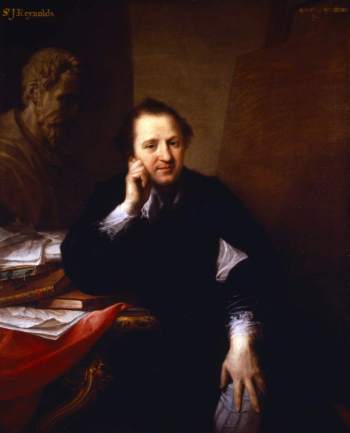
Angelica Kauffman, Portrait of Joshua Reynolds, 1767, oil on canvas, 127 × 102 cm (National Trust, Saltram).
This article examines the significance of deafness in painting and proposes a new trope for the form of picturing undertaken by eighteenth-century art, ‘the listening portrait’. As a first step it recovers and explores the significance of Sir Joshua Reynolds’s own deafness, as represented by his self-portraits as well as images by Nathanial Dance, Angelica Kauffman, and Johan Zoffany. Sound is necessarily absent from painting, audible speech impossible. Having explored these apparent limits (found in eighteenth-century theorizations of art) the essay asks more fundamentally what work is done by the representation of someone striving to listen. By considering this question, it is possible to understand these images as engaging in a more sensitive ethical enquiry concerned with what an aural impairment might mean, and how it is distinct from a refusal or unwillingness to listen. Deafness is consequently shown to be not merely something that paintings show, rather the issue of hearing or not hearing frames their pictorial and moral purpose. Throughout the article recognition of the specificity of Georgian sociability on the one hand, and eighteenth-century artistic theory and practice on the other, seeks to enable the claims of Medical Humanities to recognize previously hidden narratives.
r e v i e w s
• Andrew McClellan, “Purpose, Power, and Possibility: A History of Museums Past and Present,” pp. 493–501.
Review of Krzysztof Pomian, Le musée, une histoire mondiale, 3 volumes (Paris: Gallimard, 2020–22), volume 1: Du trésor au musée, 687 pages, ISBN: 978-2070742370, €35; volume 2: L’ancrage européen, 1789–1850, 546 pages, ISBN: 978-2072924705, €35; volume 3: À la conquête du monde, 1850–2020, 936 pages, ISBN: 978-2072982781, €45.










 Enfilade
leave a comment