Call for Papers | New Perspectives on Life Drawing
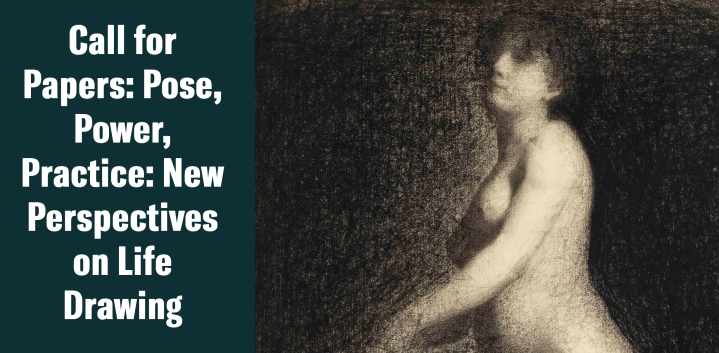
Georges Seurat, Female Nude, detail, ca. 1879–81, black conté crayon over preliminary drawing with stumped graphite
(London: The Courtauld, D.1948.SC.151)
◊ ◊ ◊ ◊ ◊
From the Call for Papers and The Courtauld:
Pose, Power, Practice: New Perspectives on Life Drawing
The Courtauld Institute of Art, Vernon Square, London, 20 June 2024
Proposals due by 22 March 2024
From the sixteenth century to the present, drawing the human body from life has remained a mainstay of Western institutional art practice. Despite significant shifts in the aesthetics, media, and purpose of art over the last five hundred years, life drawing endures in both the studio and the classroom. Pose, Power, Practice is a one-day symposium that seeks to reassess the state of the field on life drawing and apply new critical frameworks to this sustained practice. It aims to better understand life drawing in all its complexity, from its presumed advantages to its consequences. This is a practice deeply intertwined with concerns central to the discipline of art history, including but not limited to: the power dynamics of the gaze; the politics of representation; recognition of multiple forms of artistic labor; formulations of race, dis/ability, gender, and sexuality; and critiques of institutions. How has life drawing changed across time and place? How and why has it endured as a pedagogical practice, despite repeated dismissals of its ‘academicism’? What uses does it hold today, for artists and art historians alike?

Charles Joseph Natoire, The Life Class at the French Royal Academy of Painting and Sculpture, 1746, pen, black and brown ink, grey wash and watercolour, graphite over black chalk (Courtauld, D.1952.RW.3973).
We invite studies that unearth the specificities of life drawing to interrogate larger questions of ethics, labor, power, and potential in the life studio. Papers might attend to any and all aspects of this practice, from the models who pose, to the materials used, to the dynamics of the environments—formal and informal—in which life drawing takes place. We welcome papers that consider artistic engagements with drawing the human figure from life across all regions and periods, historical and contemporary.
This symposium aims to bridge connections and bolster dialogue across specialist scholarly communities by centring this shared subject of concern, while also inspiring broader understandings of what constitutes expertise in this field. We therefore encourage applications from all scholars and practitioners of life drawing, including students, artists, and models, in the UK and abroad. In addition to 20-minute conference papers, we welcome creative or collaborative submissions.
Pose, Power, Practice will take place at the Courtauld’s Vernon Square campus in person on Thursday, 20 June 2024. The programme will be recorded and subsequently shared on the Courtauld’s YouTube channel. Speakers will be further invited to participate in a workshop in The Courtauld’s Prints and Drawings Study Room on 21 June 2024. Partial reimbursement for travel and accommodation may be available. In addition, we are planning a remote component of the symposium earlier in the week in collaboration with The Drawing Foundation, so if you are unable to travel to Vernon Square please do submit an application and indicate this preference.
Applications are due via this Google form on 22 March and speakers will be notified by 5 April. If you have any questions, please contact Zoë Dostal (azd2103@columbia.edu) or Isabel Bird (isabelbird@g.harvard.edu).
7th Annual Ricciardi Prize from Master Drawings
Ian Hicks was the winner of the 2024 Ricciardi Prize for his ground-breaking reconsideration of a group of drawings by Giambattista Tiepolo, research that was begun during his term as the Moore Curatorial Fellow at the Morgan (2020–22). From Master Drawings:
Seventh Annual Ricciardi Prize from Master Drawings
Submissions due by 15 November 2024

Johann Schenau, The Crowning of the Rosiere, pen and brown ink and wash over graphite, on wove paper (New York: The Morgan Library & Museum, 2009.287).
Master Drawings is now accepting submissions for the 7th Annual Ricciardi Prize of $5,000. The award is given for the best new and unpublished article on a drawing topic (of any period) by a scholar under the age of 40. The winning submission will be published in a 2025 issue of Master Drawings. Information about essay requirements and how to apply can be found here. Information about past winners and finalists is available here.
The average length is between 2,500 and 3,750 words, with five to twenty illustrations. Submissions should be no longer than 10,000 words and have no more than 100 footnotes. All submissions must be in article form, following the format of the journal. Please refer to our Submission Guidelines for additional information. We will not consider submissions of seminar papers, dissertation chapters, or other written material that has not been adapted into the format of a journal article. Written material that has been previously published, or is scheduled for future publication, will not be eligible. Articles may be submitted in any language. Please be sure to include a 100 word abstract outlining the scope of your article with your submission.
New Book | Disegni di Prospettiva Ideale (1732)
This collection of drawings of Rome by Filippo Juvarra is published as part of the series FONTES: Text- und Bildquellen zur Kunstgeschichte 1350–1750, from arthistoricum.net, where the full PDF is available for free.
Cristina Ruggero, Disegni di Prospettiva Ideale (1732): Un omaggio di Filippo Juvarra ad Augusto il Forte e i rapporti fra le corti di Roma, Torino, Dresda (Heidelberg: arthistoricum.net, 2023), 456 pages, ISBN: 978-3985010851.
 Nella primavera del 1732 Filippo Juvarra spediva da Roma un album con 41 Disegni di Prospettiva Ideale destinato ad Augusto il Forte, principe elettore sassone e re di Polonia. Latore del dono doveva essere Antonio Giuseppe Gabaleone conte di Wackerbarth Salmour—il nobile torinese naturalizzato in Sassonia—che in quel momento era nella città pontificia in missione segreta per suo conto. L’album conservato nel Kupferstich-Kabinett di Dresda celebra l’esemplarità di Roma nei secoli, laddove, attraverso i temi affrontati, le composizioni scenografiche e la tecnica si sviluppa una narrazione di grande forza evocativa, a ulteriore conferma delle poliedriche qualità di Juvarra come grande regista delle arti. I disegni sono pubblicati qui per la prima volta integralmente assieme ad alcune lettere inedite che aiutano a far luce su un episodio artistico che coinvolse le corti di Roma, Torino e Dresda.
Cristina Ruggero è attualmente collaboratrice scientifica del progetto Antiquitatum Thesaurus presso la Berlin-Brandeburgische Akademie der Wissenschaften. Oltre alle sue pubblicazioni su Juvarra, studia da anni la ricezione dell’antico e le reti culturali e artistiche tra le corti europee nel XVIIe XVIII secolo. Ha collaborato con rinomate istituzioni internazionali quali la Bibliotheca Hertziana e l’Università La Sapienza di Roma, il Zentralinstitut für Kunstgeschichte di Monaco e l’Italian Academy at Columbia University di New York.
c o n t e n t s
Page preliminari
Indice
Ringraziamenti
• Introduzione
• Il libro di Disegni di Prospettiva Ideale nel Kupferstich-Kabinett di Dresda
• Catalogo dei disegni
• Filippo Juvarra (1678–1736): l’architetto e i suoi doni di grafica
• Augusto il Forte (1670–1733): un sovrano cultore delle arti
• Giuseppe Antonio Gabaleone conte di Wackerbarth–Salmour (1685–1761) e il suo ruolo di intermediario
• I Disegni di Prospettiva Ideale tra capriccio e seduzione
• Conclusione
• An homage from Filippo Juvarra to August the Strong and the relationships between the courts of Rome, Turin, and Dresden
Abbreviazioni
Bibliografia
Referenze fotografiche
Indice dei nomi
New Book | Specialized Dictionaries and Encyclopedias, 1650–1800
The latest from the Oxford University Studies in the Enlightenment series:
Jeff Loveland and Stéphane Schmitt, eds., Specialized Dictionaries and Encyclopedias, 1650–1800: A Tribute to Frank Kafker (Oxford: Voltaire Foundation with Liverpool University Press, 2024), 488 pages, ISBN: 978-1837641468, $99.
 • One of the first books to focus on specialized dictionaries and encyclopedias
• Complements case studies of specialized dictionaries and encyclopedias with a wide-ranging, analytical overview
• Covers a largely neglected but extremely important aspect of European encyclopedism
• Brings the history of specialized lexicography into touch with the history of science, book history, and the history of culture
During the seventeenth and eighteenth centuries, the number of specialized dictionaries and encyclopedias grew from a trickle to a flood, while the number of disciplines they were devoted to grew from a handful to dozens, representing many varieties of knowledge. Specialized dictionaries—as most were called, whether lexical or encyclopedic—were far more numerous than general encyclopedias. Yet despite their importance—as sources of knowledge, for example, and as definers of disciplines—they have not been much studied. Drawing on Frank Kafker’s methods for studying the period’s general encyclopedias, as pioneered in Notable Encyclopedias of the Seventeenth and Eighteenth Centuries (1981), this volume examines specialized dictionaries as commercial products, collections of content, and cultural artifacts. Specifically, it complements a wide-ranging, analytical introduction sketching out the characteristics of specialized dictionaries in general with a series of individually authored but standardized case studies. The latter deal with dictionaries on a variety of disciplines, from the Bible to mining, and in five European languages. The volume concludes with an essay on Frank Kafker’s influence on historiography.
Jeff Loveland is a visiting assistant professor of history at Utah Tech University. Much of his research concerns the history of encyclopedias, especially eighteenth-century European encyclopedias. His publications include The Early Britannica, 1768–1803, co-edited with Frank A. Kafker (2009) and The European Encyclopedia, from 1650 to the Twenty-First Century (2019).
Stéphane Schmitt is a research director at the Archives Henri Poincaré (French Centre National de la Recherche Scientifique) in Nancy. He works on the history of the life sciences, especially in the eighteenth and the nineteenth centuries. He has published many books and papers on the history of anatomy, embryology, and zoology, and is the main editor of Buffon’s Oeuvres completes (2007–, 17 volumes published to date).
c o n t e n t s
List of illustrations
Introduction
Appendix
• Augustin Calmet’s Dictionnaire historique, critique, chronologique, géographique et littéral de la Bible (1719) — Kathleen Hardesty Doig
• Étienne Chauvin’s Lexicon rationale (1692) and Lexicon philosophicum (1713) — Giuliano Gasparri
• A Medicinal Dictionary (1742–45) by Robert James: An Enlightenment Reference Work — Alexander Wright and R. W. McConchie
• John Barrow’s Dictionarium Polygraphicum (1735) — Craig Hanson
• Noël Chomel’s Dictionnaire oeconomique (1708) — Clorinda Donato
• The Dictionnaire raisonné universel d’histoire naturelle (1764) — Stéphane Schmitt
• The Reales Staats- und Zeitungs-Lexicon (1704) — Jeff Loveland
• The Curieuses Natur- Kunst- Gewerck- und Handlungs-Lexicon (1712) — Ines Prodöhl
• The Dictionnaire universel de commerce (1723–30) — Jeff Loveland
• Nicolas Desroche’s Dictionaire des termes propres de marine (1687): A Linguistic Tool for Seafarers? — Élisabeth Ridel-Granger and Michel Daeffler
• Sven Rinman’s Bergwerks Lexicon (1788–89) and the Emergence of Mining Encyclopedias in Preindustrial Europe — Linn Holmberg
• Frank Kafker and the Social History of Eighteenth-Century Encyclopedism — Gregory S. Brown and Melanie Conroy
Bibliography
Online Symposium | New Work on Old Dance
The conference program includes a handful of intriguing 18th-century talks:
New Work on Old Dance: A Pre-1800 Dance Studies Symposium
Online, 22–24 February 2024
It is with great pleasure that we share the program for New Work on Old Dance, an international early dance symposium jointly sponsored by Dance Studies Association and the University of Pennsylvania, to be held via Zoom 22–24 February 2024. Organized by the Early Dance Working Group of DSA, the symposium will feature a tremendous diversity of dance scholarship and practitioner workshops over the course of three days. Registration is free. Please address any questions to Amanda Danielle Moehlenpah (amanda.moehlenpah@slu.edu), Emily Winerock (contact@winerock.com), or Mary Channen (Caldwell maryca@sas.upenn.edu). We hope to see many of you on Zoom soon!
New Book | First Among Men
Published by Johns Hopkins UP, First Among Men was awarded the George Washington Prize last fall:
Maurizio Valsania, First Among Men: George Washington and the Myth of American Masculinity (Baltimore: Johns Hopkins University Press, 2022), 416 pages, ISBN: 978-1421444475, $32.
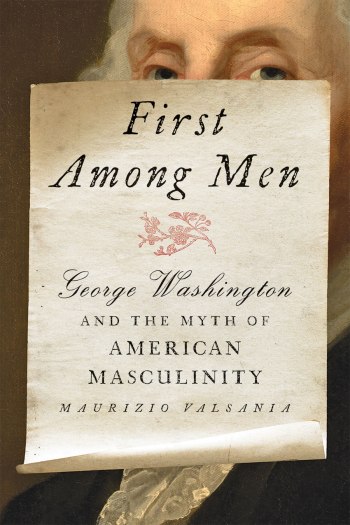 George Washington—hero of the French and Indian War, commander in chief of the Continental Army, and first president of the United States—died on December 14, 1799. The myth-making began immediately thereafter, and the Washington mythos crafted after his death remains largely intact. But what do we really know about Washington as an upper-class man?
Washington is frequently portrayed by his biographers as America at its unflinching best: tall, shrewd, determined, resilient, stalwart, and tremendously effective in action. But this aggressive and muscular version of Washington is largely a creation of the nineteenth century. Eighteenth-century ideals of upper-class masculinity would have preferred a man with refined aesthetic tastes, graceful and elegant movements, and the ability and willingness to clearly articulate his emotions. At the same time, these eighteenth-century men subjected themselves to intense hardship and inflicted incredible amounts of violence on each other, their families, their neighbors, and the people they enslaved. In First Among Men: George Washington and the Myth of American Masculinity, Valsania considers Washington’s complexity and apparent contradictions in three main areas: his physical life (often bloody, cold, injured, muddy, or otherwise unpleasant), his emotional world (sentimental, loving, and affectionate), and his social persona (carefully constructed and maintained). In each, he notes, the reality diverges from the legend quite drastically. Ultimately, Valsania challenges readers to reconsider what they think they know about Washington.
Aided by new research, documents, and objects that have only recently come to light, First Among Men tells the fascinating story of a living and breathing person who loved, suffered, moved, gestured, dressed, ate, drank, and had sex in ways that may be surprising to many Americans. In this accessible, detailed narrative, Valsania presents a full, complete portrait of Washington as readers have rarely seen him before: as a man, a son, a father, and a friend.
Maurizio Valsania is a professor of American history at the University of Turin. He is the author of Jefferson’s Body: A Corporeal Biography.
c o n t e n t s
1 The American Giant
Part I | Physical
2 Testing Himself
3 A Taste for Cruelty and War
4 A Body in Pain
5 Checking the Body
Part II | Emotional
6 The Love Letters
7 The Meaning of Love (and Marriage)
8 A Sentimental Male
9 A Maternal Father
Part III | Social
10 A Person of Fine Manners
11 The Message of His Clothing
12 Astride the Great Stage
13 Consummation
14 Giants Die as Well
Exhibition | Witness to Revolution: Washington’s Tent
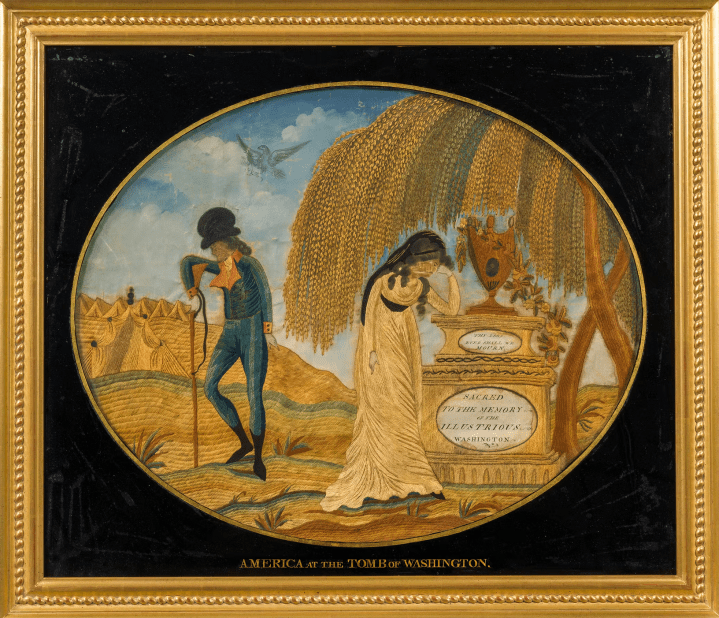
Needlework Mourning Picture, Philadelphia, ca. 1802, silk and paint on silk
(Philadelphia: Museum of the American Revolution, 2017.27.01)
◊ ◊ ◊ ◊ ◊
From the press release for the exhibition:
Witness to Revolution: The Unlikely Travels of Washington’s Tent
Museum of the American Revolution, Philadelphia, 17 February 2024 — 5 January 2025
Called “the crown jewel in the collection” by The Washington Post and the “rock-star object” by The New York Times, General George Washington’s headquarters tent from the Revolutionary War is the centerpiece of the Museum of the American Revolution, where more than a million visitors have experienced the tent’s power in an immersive theater experience. Now, in the Museum’s special exhibition, Witness to Revolution: The Unlikely Travels of Washington’s Tent, more than 100 artifacts from across the country have been brought together to explore the tent’s inspiring journey from the Revolutionary War to today.
Using objects, documents, works of art, touchscreen interactives, and audio and video elements, the exhibition brings to life the stories of individuals from all walks of life who saved Washington’s tent from being lost over the generations and who ultimately fashioned this relic into a symbol of our fragile but enduring American republic. The exhibit explores these personal stories, from well-known names like Alexander Hamilton, the Marquis de Lafayette, and Martha Washington, to lesser-known individuals like Washington’s enslaved valet William Lee, who lived alongside him in the tent, and Selina Gray, the enslaved housekeeper at Arlington House in Virginia who saved the tent during the Civil War.
“Since the Museum’s opening, visitors who have viewed our dramatic Washington’s War Tent presentation are often moved to tears and want to know more about the tent’s role as George Washington’s wartime home and about the diverse people who ensured that it survived to the present day,” said Dr. R. Scott Stephenson, Museum President and CEO. “Witness to Revolution will take visitors on a surprising journey of nearly 250 years, including stories of leadership, conflict, patriotism, and preservation. Washington’s tent helps us tell the American story.”
Visitors will follow Washington’s decision to leave the ‘tented field’ in 1783, packing up his military belongings (including the tent) and returning to private life at Mount Vernon. After General Washington’s death in 1799, the tent remained in the care of Martha Washington and her descendants. It was routinely displayed in the 1800s, most dramatically during Lafayette’s return to the United States in 1824. The exhibition explores how the tent became a ‘relic’ and a family heirloom, inherited by Martha Washington’s great-granddaughter, Mary Anna Randolph Custis, who married future Confederate General Robert E. Lee in 1831.
Witness to Revolution continues through the era of the Civil War, when the United States Army occupied the Custis-Lee home (Arlington House) and government officials confiscated the tent and placed it on display in Washington, D.C. The tent’s journey continues through Philadelphia’s Centennial International Exhibition of 1876 and a decades-long campaign by the Custis-Lee descendants to secure the return of their family heirlooms taken during the Civil War. Ultimately, a 1906 newspaper article sparked a friendship between Mary Custis Lee (1835–1918) and Episcopalian priest Rev. W. Herbert Burk (1867–1933), bringing Washington’s headquarters tent into the collection that is now on display at the Museum of the American Revolution.
The exhibition includes a recreation of the end of the headquarters tent to give visitors a sense of the tent’s size and scale. General Washington’s foldable field bedstead from the Revolutionary War, on loan from Mount Vernon, is displayed nearby. A tactile 3D-printed diorama of Washington’s sleeping and dining tents will be available for use by guests who are blind or low vision, created and donated by Clovernook Center for the Blind & Visually Impaired.
Key Artifacts on Display
Created by the Museum’s in-house curatorial team, the exhibition features works of art, rare documents, and significant historical objects from nearly 25 public and private collections across the United States, including Mount Vernon, Arlington House, Tudor Place, the Virginia Museum of History & Culture, and the Library of Congress.
• George Washington’s foldable field bedstead, which was used inside his headquarters tent during the Revolutionary War. On loan from the Mount Vernon Ladies’ Association.
• An 1872 letter written by Selina Gray to Mary Anna Randolph Custis Lee (wife of Robert E. Lee) describing the occupation of Arlington House by United States troops during the Civil War. At the time, Gray was the enslaved housekeeper at Arlington where Washington’s headquarters tent and other historical relics were stored and then confiscated by the United States Army. This manuscript is one of the few of Gray’s letters that survive. On loan from the Virginia Museum of History & Culture.
• The 1897 painting In the Presence of Washington by Howard Pyle, which depicts General Washington inside his headquarters tent during the Revolutionary War. On loan from the Biggs Museum of American Art.
• Pierre Charles L’Enfant’s panoramic watercolor of the Continental Army’s 1782 encampment at Verplanck’s Point, New York. This watercolor includes the only known eyewitness image of Washington’s headquarters tent in the field during the Revolutionary War. Collection of the Museum of the American Revolution.
• An 1844–49 daguerreotype of George Washington Parke Custis (Martha Washington’s grandson) who owned Washington’s headquarters tent during the early 1800s. On loan from the Library of Congress.
• A silver camp cup that General Washington ordered from Philadelphia silversmith Richard Humphreys in 1780 for use in his wartime headquarters and a large fragment cut from the roof of Washington’s headquarters tent. On loan from Yale University Art Gallery.
• Epaulets worn by Tench Tilghman, General Washington’s aide-de-camp, during the Revolutionary War. On loan from the Society of the Cincinnati.
• An iron hook cut from George Washington’s tent when the Marquis de Lafayette saw the tent set up at Fort McHenry in 1824 as part of his tour of the United States. The hook was cut by William B. Barney, a member of the Society of the Cincinnati of Maryland who was in the tent with Lafayette at the event. On loan from the DAR Museum.
• Fragments of the original headquarters tent and dining tent. On loan from various lenders and the Museum’s own collection.
• The original contract for purchase of the tent from 1909 and the visitor register from the Washington Memorial Chapel in Valley Forge where the tent was displayed in the early 1900s. Collection of the Museum of the American Revolution.
• A painted silk banner with a portrait of the Marquis de Lafayette at its center that was created in Philadelphia for the parade celebrating Lafayette’s return to the United States in 1824. Collection of the Museum of the American Revolution.
New Book | Objects of Liberty
From the University of Delaware Press:
Pamela Buck, Objects of Liberty: British Women Writers and Revolutionary Souvenirs (Newark: University of Delaware Press, 2024), 202 pages, ISBN: 978-16445333338 (hardback), $150 / ISBN: 978-1644533321 (paperback), $43.
 While souvenir collecting was a standard practice of privileged men on the eighteenth-century Grand Tour, women began to partake in this endeavor as political events in France heightened interest in travel to the Continent. Objects of Liberty: British Women Writers and Revolutionary Souvenirs explores the prevalence of souvenirs in British women’s writing during the French Revolution and Napoleonic era. It argues that women writers employed the material and memorial object of the souvenir to circulate revolutionary ideas and engage in the masculine realm of political debate. Looking at travel accounts by Helen Maria Williams, Mary Wollstonecraft, Catherine and Martha Wilmot, Charlotte Eaton, and Mary Shelley, this study reveals how they used souvenirs to affect political thought in Britain and contribute to conversations about individual and national identity. Objects of Liberty is a story about the ways that women established political power and agency through material culture. Easily transported across borders due to their small size, souvenirs allowed women to provide visual representations of the distant conflict in France and encourage sympathy for and remembrance of revolutionary ideals. At a time when gendered beliefs precluded women from full citizenship, they used souvenirs to redefine themselves as legitimate political actors. By establishing networks of sociability, women’s exchange of souvenirs helped Britain develop international alliances and redefine itself as a more powerful and global nation.
Pamela Buck is Associate Professor of English at Sacred Heart University in Fairfield, Connecticut. Her research focuses primarily on women’s writing and material culture in late eighteenth- and early nineteenth-century British literature.
c o n t e n t s
List of Figures
Acknowledgements
Introduction
1 Helen Maria Williams’ Sentimental Objects in Letters from France
2 Mary Wollstonecraft and Political Spectacle in An Historical and Moral View of the French Revolution
3 Imperial Collecting in Catherine and Martha Wilmot’s Travel Journals
4 Charlotte Eaton’s Battlefield Relics in Narrative of a Residence in Belgium
Conclusion: Refiguring the Revolution in Mary Shelley’s Rambles in Germany and Italy
Notes
Bibliography
Index
New Book | Bluestockings
Susannah Gibson will give a lunchtime lecture related to her new book at London’s National Portrait Gallery on 7 March 2024. The volume is scheduled for publication in the United States this summer. From John Murray Press:
Susannah Gibson, Bluestockings: The First Women’s Movement (London: John Murray Press, 2024), 352 pages, ISBN: 978-1529369991, £25 / $30.
 In Britain in the 1750s, women had no power and no rights—all money and property belonged to their fathers or husbands. A brave group risked everything to think and live as they wished, despite the sneers of contemporaries who argued that books frazzled female brains and damaged their wombs.
Meet the Bluestockings:
• Elizabeth Montagu hosted a series of glittering salons in her London drawing room, where a circle of women and men discussed theatre, philosophy and the classics, competing to outdo each other in wit and brilliance. Discover how she took on Voltaire and won.
• Whilst nursing twelve children and helping run her bullying husband’s brewery, Hester Thrale took key writers under her wing—Dr Johnson moved into her house for several years. Her vivid diaries offer a powerful chronicle of what happened when she finally decided to follow her heart.
• Find out how poetess and former milkmaid Ann Yearsley fought back when her snobbish patron refused to hand over her earnings because she was working class and thus irresponsible . . .
• Or how Catherine Macauley’s eight-volume history of England caused such a sensation that she became a leading light in the American Revolution—while her unorthodox love-life scandalised her contemporaries . . .
Susannah Gibson explores the lives and legacies of these and other figures who went on to inspire writers and thinkers from Mary Wollstonecraft to Virginia Woolf and lead the way for feminism.
Susannah Gibson is an Irish writer and historian. She is the author of The Spirit of Inquiry and Animal, Vegetable, Mineral? She holds a PhD from the University of Cambridge in eighteenth-century history and lives in Cambridge, England.
Lecture | Women Artists at Goodwood
Next month at Goodwood (as noted at Art History News). . .
Clementine de la Poer Beresford | Women Artists at Goodwood
Goodwood House, Chichester, West Sussex, 19 March 2024
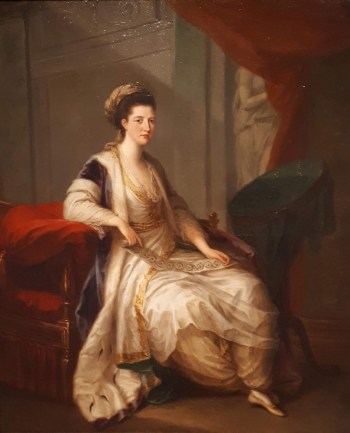
Angelica Kauffman, Portrait of Mary Bruce, Duchess of Richmond, ca. 1775, oil on canvas, 75 × 62 cm (Goodwood House).
Join us for a talk by Goodwood’s Curator, Clementine de la Poer Beresford about women artists at Goodwood, with a welcome by the Duchess of Richmond and a champagne and canapé reception in the State Apartments of Goodwood House on Tuesday, 19 March at 6.30pm.
The Goodwood Collection has works by 18th-century female artists including Angelica Kauffman, Anne Damer, and Katherine Read, as well as pictures by contemporary artist Holly Frean. The evening is an opportunity to hear about these women and to see some of their works. A highlight includes Angelica Kauffmann’s portrait of Mary, Duchess of Richmond, which is not usually on public display. £45.










 Enfilade
leave a comment