Online Talk | Brian Cowan on Extra-Illustration

◊ ◊ ◊ ◊ ◊
Today, from YCBA:
Brian Cowan | Extra-Illustration and the British Historical Imagination, ca. 1660–1850
Online, 30 April 2024, 12.30pm (Eastern Time)
Extra-illustration was a practice that developed in the later eighteenth century as a means by which collectors added imagery (most often prints, but sometimes manuscripts, objects, or original artworks) to existing books. In this talk, Brian Cowan will examine the practice of extra-illustration as a means of understanding the varieties of British historical imagination in the long eighteenth century. His project explores the relationships between political history, secret history, and biography as these genres developed over the course of the long eighteenth century in Britain.
The session is part of YCBA’s Art in Context series. Presented by faculty, staff, Student Guides, and Visiting Scholars, these talks focus on a particular work of art—often in the museum’s collections or special exhibitions—through an in-depth look at its style, subject matter, technique, or time period.
Registration is available here»
Brian Cowan is an associate professor of history at McGill University. He has published widely on early modern British and European history and is a founding member and inaugural president of the board for the international research group devoted to the history of sociability in the long eighteenth century. This group recently launched DIGIT.EN.S, an online encyclopedia of the history of sociability. Cowan’s publications include The Social Life of Coffee: The Emergence of the British Coffeehouse (2005), The State Trial of Doctor Henry Sacheverell (2012), and as a member of the twenty-two-person ‘multigraph collective’ Interacting with Print: Elements of Reading in the Era of Print Saturation (2018). His edited collection on The Cultural History of Fame in the Age of Enlightenment is forthcoming from Bloomsbury Academic, and he is currently editing (with Valerie Capdeville) The Oxford Handbook of the History of the European Enlightenment for Oxford University Press.
Image: Edward Hyde Clarendon, The History of the Rebellion and Civil Wars in England begun in the year 1641: with the precedent passages, and actions, that contributed thereunto, and the happy end, and conclusion thereof by the king’s blessed restoration and return upon the 29th of May, in the year 1660 (Oxford, 1702–04).
Exhibition | High Strung: 500 Years of Keyboard Instruments
One of the world’s finest musical instrument collections (boasting the world’s oldest cello as well as significant archival resources) is housed on the campus of the University of South Dakota in Vermillion, in the southeast corner of the state, about 40 miles from Sioux City, Iowa. Founded in 1973 around Arne Larson’s collection of some 2500 instruments, the National Music Museum recently finished a major renovation and re-installation project. In January, Elizabeth Rembert provided a profile for NPR’s All Things Considered (2 January 2024), and later that month the museum announced the acquisition of five cellos (including 17th- and 18th-century instruments), 27 bows, archival materials, and a Hawaiian guitar previously owned by the late cellist Robert Cancelosi. In addition to the NMM’s regular exhibitions, this special exhibition is on view through the end of the year:
High Strung: Five Centuries of Stringed Keyboard Instruments
National Music Museum, Vermillion, South Dakota, March — December 2024
 For over 600 years, stringed keyboard instruments have served as repositories for human imagination, science, technology, craft, artistry, and music. They are admired for their stature—and oftentimes stunning beauty—alongside their ability to play both melody and harmony. Keyboard innovation has continuously expanded throughout the world, throughout time. The special exhibition High Strung: Five Centuries of Stringed Keyboard Instruments explores the form, function, and development of keyboard instruments from early harpsichords to the modern piano. The special exhibition brings together nearly 20 keyboard instruments from the NMM’s collections—some of which have never before been exhibited.
Exhibition | 18th-Century Masterpieces from the Uffizi
This is the fourth of ten planned exhibitions to emerge from a 2021 partnership between the Uffizi and the Bund One Art Museum (with thanks to Art History News for noting it). From coverage in Shine, an affiliate of Shanghai Daily:
18th-Century Masterpieces from the Uffizi
Bund One Art Museum, Shanghai, 11 April — 25 August 2024
 The exhibition reveals the artistic evolution brought by the political and social changes in the 18th century through the presentation of the Uffizi’s 18th-century collection of treasures, varying from grand historical themes to detailed common customs, showing a panoramic view of the splendid artistic development during that pivotal period in Western history.
Many modern and even contemporary features began to take shape at this time. It was also the Age of Enlightenment, illuminated by the light of reason, a new secular way of thinking that broke through prejudice and brought an irreversible and progressive change that encompassed culture, economy and society.
The Uffizi’s collection of 18th-century art comes mainly from the customizations and collections of the last descendants of the Medici family (rulers of the Grand Duchy of Tuscany until 1737) and of the Habsburg-Lorraine family, the successors of the Grand Duchy. The exhibition features 80 masterpieces . . .
Call for Papers | Watercolour & Weather, 1750–1850

Louis Ducros, View of the Grand Port of Valette, detail, ca. 1800–01, black ink (pen), watercolor, heightened with gouache and oil on paper, 78 × 127 cm (Lausanne: MCBA).
◊ ◊ ◊ ◊ ◊
From the conference website:
Watercolour & Weather, 1750–1850 / Aquarelle & phénomènes météorologiques, 1750–1850
Musée cantonal des Beaux-Arts, Lausanne, 5–6 June 2025
Organized by Bérangère Poulain and Desmond Kraege
Proposals due by 15 June 2024
Simultaneously with a resurgence of landscape painting, the period 1750–1850 in European art witnessed an increased interest in the weather, not only as concerns its momentary states (clouded skies, lightning), but also the broader study of meteorological phenomena and of their unfolding over time. Besides the more radical events—such as storms—that were frequently represented, this period thus developed a keen observation of subtle moments of changing weather, allowing artists to combine varied effects of light. This is true not only of the most famous British painters (Joseph Mallord William Turner, John Constable, Alexander and John Robert Cozens) but also of figures from further afield, such as Giovanni Battista Lusieri, Caspar David Friedrich, and Abraham Louis Rodolphe Ducros.
In close connection to this artistic evolution, the period under scrutiny also witnessed the development of meteorology and climatology as scientific disciplines. This led both to Luke Howard’s classification of clouds (1804) that remains in use to this day, and to the theorisation of the greenhouse effect by Joseph Fourier in 1824. A new consciousness of the atmosphere and of its complexities, leading directly to present concerns regarding climate change, can thus be traced back to this cultural environment.
Luke Howard’s study of clouds rested partly upon watercolour sketches representing nebulous formations, revealing that the multiplication of weather-related images extended beyond the professional field of landscape painting to encompass works by scientists. Likewise, architects were not to be excluded: Pierre François Léonard Fontaine, chiefly known for his role in Napoleon I’s ambitious construction projects, chose to cover his design for a monumental cemetery on Montmartre with a stormy sky (Paris, ENSBA, PC 82161); whereas in Joseph Gandy’s cutaway view of Sir John Soane’s Bank of England (London, Sir John Soane’s Museum, P267), rays of sunlight part the clouds to illuminate the sprawling structure. These works confirm that watercolour, together with closely related techniques such as wash drawing, gouache, and hand-coloured etching, constituted the chief medium for the pictorial exploration of weather conditions by figures hailing from varied disciplinary horizons. As a water-based technique, comparatively rapid in uptake and highly adapted to outdoor use, it was particularly suitable for capturing fleeting atmospheric variations on the spot. Professional painters’ preparatory watercolor sketches for oil paintings also ensured that a strong connexion was maintained with this more highly specialised technique. More generally, parallels emerge between representations of the weather in watercolour and in other media such as oil and pastel, each technique furthermore being used to produce both studies and finished works.
While considerable attention has been paid to representations of meteorological conditions by the most famous British landscape painters, the broader development of this phenomenon remains to be studied, both in British, Continental, and non-Western art: how can Swiss painter Abraham Louis Rodolphe Ducros’s sudden interest in increasingly dramatic skies around 1790 be explained, and what impact did his work exert on his younger contemporaries? Likewise, what interactions emerge between the works of Indian artist Sita Ram and the evolving British watercolour? What role was performed by the exchange of ideas and artworks in connection with the Grand Tour or other travels?
This conference will attempt to elucidate some of these questions, along axes of enquiry that might include—but are not limited to—the following:
• The evolving concern for the representation of weather conditions in watercolour painting (or wash drawing, gouache, or hand-coloured etching) between 1750 and 1850
• Convergences or divergences between the practice of watercolour painting and the development of meteorology as a science
• Watercolour representations of weather conditions outside the field of professional landscape painting; for instance in works by amateurs, architects, scientists, or their draughtsmen
• Individual painters’ evolving engagement with the weather, including their affinity or familiarity with specific meteorological phenomena
• Interactions between representations of the weather in watercolour and in other pictorial techniques (including oil painting, oil studies, and pastel), and between open-air and workshop-based practice
• Weather conditions and (traces of) human presence in a landscape
• Reflections in watercolour painting of broader cultural (including literary) pairings between weather and emotion
• Continuities and/or distinctions between topographical representation (including the veduta tradition) and the integration of weather conditions in the image, particularly as regards historical perceptions of the ‘objectivity’ or ‘subjectivity’ of these representations
• Women artists’ contributions to the pictorial exploration of meteorological phenomena
• The possible impact on watercolour painting of maritime knowledge and of seafarers’ preoccupations regarding weather conditions
This conference forms part of a broader research and teaching project at the Universities of Lausanne and Geneva concerning Swiss watercolour artist Abraham Louis Rodolphe Ducros, whose personal collection forms the original nucleus of the Lausanne MCBA Museum. The conference will include a viewing of a selection of his works.
The conference will be held on 5 and 6 June 2025 at the Lausanne MCBA Museum. We look forward to receiving proposals (max. 400 words) for 20-minute papers until 15 June 2024 at the following addresses: berangere.poulain@unige.ch and desmond-bryan.kraege@unil.ch. Accommodation in Lausanne will be provided, as well as reimbursement of travel expenses within Europe. The primary conference language is English, though proposals in French will also be accepted. A collective publication is planned.
Organisers
Bérangère Poulain (University of Geneva)
Desmond Kraege (University of Lausanne)
Scientific Committee
Basile Baudez (Princeton University)
Jan Blanc (University of Geneva)
Werner Busch (Freie Universität Berlin)
Ketty Gottardo (The Courtauld Gallery, London)
Catherine Lepdor (Lausanne MCBA Museum)
Camille Lévêque-Claudet (Lausanne MCBA Museum)
Constance McPhee (The Metropolitan Museum of Art, New York)
Christian Michel (University of Lausanne)
Perrin Stein (The Metropolitan Museum of Art, New York)
New Book | Life of Adélaïde Labille-Guiard
From Chronicle Books:
Bridget Quinn, Portrait of a Woman: Art, Rivalry, and Revolution in the Life of Adélaïde Labille-Guiard (New York: Chronicle Books, 2024), 224 pages, ISBN: 978-1797211879, $30.
 Discover the story of Adélaïde Labille-Guiard—a long-ignored artist and feminist of eighteenth-century France—in this imaginative and illuminating biography from an award-winning writer.
Summer in Paris, 1783. The Louvre steps, too hot and no breeze, the air electric with the heady anticipation of a coming storm: the year’s Royal Salon. Bewigged and powdered Parisians mill amid pigeons, dogs, and detritus; food and flower sellers; pamphleteers and propagandists. Men and women of every estate (clergy, nobles, commoners) are united under art: to love it, to despise it, to gossip endlessly about it.
Exhibiting at the Royal Salon was not for the faint of heart, and it was never intended for women.
Enter Adélaïde Labille-Guiard . . .
Born in Paris in 1749, Adélaïde Labille-Guiard rose from shopkeeper’s daughter to an official portraitist of the royal court—only to have her achievements reduced to ash by the French Revolution. While she defied societal barriers to become a member of the exclusive Académie Royale and a mentor for other ambitious women painters, she left behind few writings, and her legacy was long overshadowed by celebrated portraitist and memoirist Élisabeth Vigée-Lebrun.
But Adélaïde Labille-Guiard’s story lives on. In this engaging biography, Bridget Quinn applies her insightful interpretation of art history to Labille-Guiard’s life. She offers a fascinating new perspective on the artist’s feminism, her sexuality, and her vision of the world. Quinn expertly blends close analyses of paintings with broader context about the era and inserts delicately fictionalized interpersonal scenes that fill the gaps in the historical record. This is a compelling and inspiring look at an artist too long overlooked. Despite numerous setbacks, Labille-Guiard built a legacy as an accomplished royal portraitist and a mentor to other young women artists of her era. This tale of solidarity, self-belief, and true passion for painting is sure to inspire contemporary creatives and women today.
Bridget Quinn is a writer, art historian, and critic. She is the author of the award-winning Broad Strokes: 15 Women Who Made Art and Made History (in That Order) and She Votes: How U.S. Women Won Suffrage, and What Happened Next. A graduate of New York University’s Institute of Fine Arts and a regular contributor to the arts magazine Hyperallergic, Quinn is a sought-after speaker on women and art. She lives in the San Francisco Bay Area with her family.
At Christie’s | Sale Results for A Park Avenue Collection
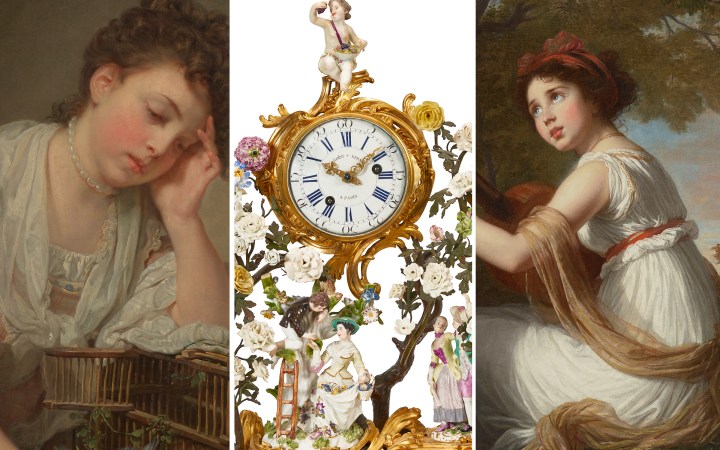
Left: Jean-Baptiste Greuze, A Girl Weeping over Her Dead Bird, detail, 1757, oil on oval canvas, 71 × 60 cm (estimate: $600,000–800,000; sold for $2,470,000). Center: Benoist Gerard, Louis XV Meissen and French porcelain-mounted ormolu and tole peinte mantel clock, 1740, porcelain, ormolu, 54 × 38 × 17 cm (estimate: $50,000–80,000; sold for $75,600). Right: Élisabeth-Louise Vigée Le Brun, Portrait of the Artist’s Daughter, Jeanne-Julie-Louise Le Brun, Playing a Guitar, detail, oil on canvas, 100 × 83 cm (estimate: $300,000–500,000; sold for $441,000).
◊ ◊ ◊ ◊ ◊
From the press release, detailing sale highlights, via Art Daily:
A Park Avenue Collection, Sale #23048
Christie’s New York, 17 April 2024
Christie’s made strong results for a single-owner sale that featured a rich array of 18th-century French furniture, Old Master paintings and drawings, and Chinese works of art. A Park Avenue Collection totaled $8,890,582, which was 130 percent above the low estimate, with 79 percent of lots sold. There were outstanding results across categories. The top lot of the sale was an Old Master painting, Jean-Baptiste Greuze’s Girl Weeping over Her Dead Bird (Une jeune fille qui pleure la mort de son oiseau), which made $2,470,000, setting a new world record for the artist and more than doubling the prior record set in 2013. The top furniture lot was a pair of late Louis XVI ormolu-mounted ebony, ebonized, and boulle marquetry meubles d’appui, which brought $176,400. A Chinese famille verte porcelain rouleau vase of the Kangxi Period (1662–1722) topped the Chinese offerings at $151,200. A drawing by Michelangelo, which received worldwide attention, made $201,600, more than 33 times its low estimate of $6,000.
Deputy Chairman for English Furniture and Works of Art, William Strafford, said, “The outstanding results of today’s sale pay tribute to this collector’s connoisseurship and passionate pursuit of rare treasures in so many fields during over 40 years of collecting.”
Specialist for Old Masters, Joshua Glazer, said, “The superb group of French 18th-century paintings in the collection were universally admired, and we were thrilled to have set a new world auction record for the magnificent Greuze, Girl Weeping over Her Dead Bird.”
More information is available from this preview article from Christie’s»
Exhibition | Works from Notre Dame Restored
The exhibition includes 21 paintings, including some of the ‘May’ pictures commissioned for the cathedral of Notre-Dame de Paris by the goldsmiths’ guild each spring from 1630 to 1707. More information is available from Artnet.

Interior of Notre-Dame at the Transept Crossing, ca. 1780, oil on canvas, 47 × 58 cm
(Société des amis de Notre-Dame de Paris)
◊ ◊ ◊ ◊ ◊
Grands décors restaurés de Notre-Dame
Galerie des Gobelins, Paris, 24 April — 21 July 2024
Curated by Caroline Piel and Emmanuel Pénicaut
À la veille de la réouverture de la cathédrale Notre-Dame de Paris, le 8 décembre prochain, le Mobilier national et la direction régionale des Affaires culturelles d’Île-de-France (ministère de la Culture) s’associent pour présenter au public les chefs-d’œuvre du décor intérieur de l’édifice, soit vingt et un tableaux de grand format, parmi lesquels treize grands « mays », restaurés dans le cadre d’un chantier mené avec l’appui du Centre de recherche et de restauration des musées de France (C2RMF).
D’autres objets remarquables complètent cet ensemble : la tenture de la vie de la Vierge tissée pour orner le chœur au XVIIe siècle, en quatorze pièces, aujourd’hui conservée à la cathédrale de Strasbourg, et l’immense tapis de Savonnerie offert à la cathédrale par le roi Charles X, dont la restauration vient de s’achever au Mobilier national.
 Enfin, en accord avec le diocèse de Paris, sont aussi présentées les maquettes du futur mobilier liturgique actuellement en cours de réalisation. Restauration et création se mêlent ainsi, du XVIIe au XXIe siècle, pour faire de la cathédrale non seulement un fleuron de l’art gothique mais aussi un écrin d’objets d’art et de piété de qualité exceptionnelle.
Depuis l’incendie de 2019, près de 1 000 artisans travaillent au quotidien à la restauration de la cathédrale. Parmi eux, les restaurateurs de peintures ne sont pas les moins actifs. Ce sont eux qui ont redonné vie et couleur aux grands « mays », ces chefs-d’œuvre de peinture religieuse offerts chaque année au mois de mai, entre 1630 et 1707, par la confrérie des orfèvres de la ville de Paris. Leurs auteurs sont les plus grands peintres français de l’époque : Laurent de La Hyre, Aubin Vouet, Charles Le Brun, Eustache Le Sueur…). Accrochés à l’origine côte à côte dans la nef de la cathédrale, ils formèrent une collection unique en France, dispersée à la Révolution, puis partiellement rassemblée et replacée dans l’édifice.
La restauration de ces grands mays et des autres œuvres peintes, françaises et italiennes, conservées dans l’édifice à la veille de l’incendie et restauration, a été confiée par la DRAC Île-de-France confiée à trois groupements de restaurateurs du patrimoine, avec le soutien du Centre de recherche et de restauration des musées de France. Les treize mays restaurés sont présentés dans un ordre qui évoque leur accrochage originel dans la nef de la cathédrale. Des esquisses et des dessins sont aussi présentés, accompagnés de textes, de multimédia et d’explications qui aident à comprendre la richesse propre de chaque œuvre et le savoir-faire exceptionnel des restaurateurs du patrimoine.
Commissaires
• Caroline Piel, inspectrice des patrimoines, collège Monuments historiques (h)
• Emmanuel Pénicaut, directeur des collections du Mobilier national
assistés de
• Marie-Hélène Didier, conservatrice des Monuments historiques, DRAC Île-de-France
• Oriane Lavit, conservatrice du patrimoine, Centre de recherche et de restauration des musées de France (C2RMF)
Caroline Piel and Emmanuel Pénicaut, eds., Grands décors restaurés de Notre-Dame de Paris (Milan: Silvana Editoriale, 2024), 112 pages, ISBN: 978-8836656820, €15.
Note (added 28 January 2025) — The posting was updated to include the accompanying publication.
Lecture | Emmanuelle Chapron on Readers at the Royal Library of Paris
From the School of Advanced Study, University of London:
Emmanuelle Chapron | The Loan Registers of the 18th-Century Royal Library of Paris: A History of Readers, Books, and Institutions
Online, via Zoom, 4 June 2024, 5.30pm
The study of the loan registers of the Royal Library of Paris helps us to understand the use of the library and manuscripts in the 18th century, leading to a history of institutional trust and the library as archive.
In association with the History of Libraries seminar series. All are welcome; those wishing to attend should book a free ticket here.
Emmanuelle Chapron is Professor of Modern History at Aix-Marseille Université and Ecole pratique des hautes études, Paris. She is a specialist of the history of the book and libraries as well as history of scholarship in early modern times, in France and Italy. Among her publications are Ad utilità pubblica : politique des bibliothèques et pratiques du livre à Florence au XVIIIe siècle (Geneva, 2008) and Livres d’école et littérature de jeunesse en France au XVIIIe siècle (Liverpool, 2021). She is the curator of the digital edition of the letters and papers of Jean Jean-François Séguier (1704–1783). She is currently working in archives in libraries from the 17th century onwards.
Lecture | Andrew Foster on Chichester Cathedral Library, 1670–1735
From the School of Advanced Study, University of London:
Andrew Foster | The Restoration and Revival of Chichester Cathedral Library, 1670–1735
Lambeth Palace Library, London, 7 May 2024, 5.30pm
For the redoubtable Dr Mary Hobbs (1923–1998), the return of Bishop Henry King’s Library marked the rebirth of Chichester Cathedral Library post 1671; yet close analysis of The Old Catalogue before 1735 reveals other stories of benefactors and books in what was quite a renaissance for cathedral, city, and the surrounding region at the end of the seventeenth century.
In association with the History of Libraries seminar series. All are welcome; those wishing to attend should book a free ticket here.
Andrew Foster was formerly Director of Research at the University of Chichester and is now an Honorary Research Fellow of the University of Kent, and a Visiting Researcher with ‘Lincoln Unlocked’, Lincoln College, Oxford. He is a Fellow of the Society of Antiquaries, an ecclesiastical historian with a special interest in the history of the Church of England c.1540–1700, a former Vice-President of the Royal Historical Society, founding chair of the Public History Committee of the Historical Association, and Literary Director of the Sussex Record Society for 33 years until 2018.
St Paul’s Cathedral Library Restored
Following a five-year restoration, the 18th-century library at St Paul’s Cathedral is once again open to researchers and tourists (look for the the special Triforium Tour). From Architecture Today (6 November 2023).

Christopher Wren, St Paul’s Cathedral Library, following restoration; completed in 1709, the library is on the Triforium level, behind the southwest tower ((Photo by Graham Lacdao for St Paul’s Cathedral).
◊ ◊ ◊ ◊ ◊
Completed in 1709, the library reaches two stories high and contains more than 13,000 volumes of books and manuscripts, the oldest of which dates back to 1313. Here, Portland stone panelling surround a gallery, with these panels enamoured with deep, ornate carvings. Beneath, an array of brackets supporting the gallery enjoy decoration of equal measure, this time carved out of wood. (Recent research, however, uncovered the fact that the gallery walkway is cantilevered from the wall, with the brackets being purely decorative).

Christopher Wren, Dean’s Staircase, with ironwork by Jean Tijou (Photo by Richard Holltum, from August 2007, from the website of the World Monuments Fund).
Before work began on the restoration in 2018, the most significant changes to the library were the addition of electrical lights and a heating system in the early 1900s. In fact, the cathedral nearly didn’t have a library at all, with its collection almost entirely destroyed by the Great Fire of London in 1666. Following the damage, however, Sir Christopher Wren’s Library chamber was restocked by the cathedral’s Commissioners for rebuilding St Paul’s following the damage.
The £800,000 refurbishment, funded mostly through donations and benefactors of St Paul’s, saw books cleaned, walls re-painted, a new lighting scheme put in place, new desks for readers, as well as a new display case. Work was also done to the cantilevered gallery which was showing signs of sagging. . . .
“The Cathedral Library is a remarkable room, and remains one of Sir Christopher Wren’s great achievements. It is fitting that, as we mark 300 years since his death, his Library is able to reopen after five years of painstaking restoration,” the Dean of St Paul’s Cathedral, the Very Reverend Andrew Tremlett said in a statement. . . .
The full article is available here»










 Enfilade
leave a comment