Conference | Immanuel Kant and Hull
Immanuel Kant was born this month 300 years ago (April 22). From the conference registration form:
Immanuel Kant and Hull
Hull History Centre, East Yorkshire, 15 June 2024
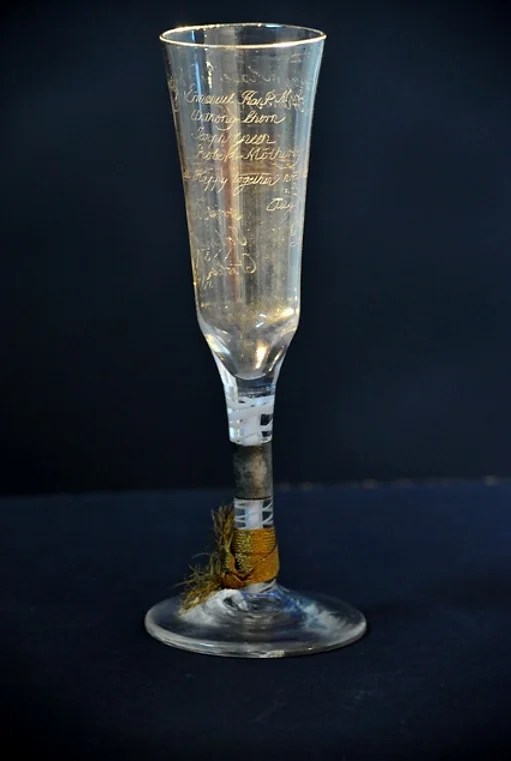
Drinking glass engraved with the names of Immanuel Kant and four men from Hull, 1763 (Lüneburg: East Prussian State Museum).
Presented by the Georgian Society for East Yorkshire and Friends of Kant and Königsberg, in association with Hull History Centre and University of Hull Maritime History Trust
This conference commemorates the tercentenary of the birth of the most important German philosopher, Immanuel Kant (1724–1804), and celebrates his close friendship with Joseph Green and Robert Motherby, merchants from Hull. It has been said that Green’s effect on the philosopher “cannot be overestimated.” The Königsberg firm of Green and Motherby managed Kant’s finances, and Kant had a great influence on the education of Robert Motherby’s children, one of whom, William, founded The Friends of Kant in 1805.
The fee of £30 (Georgian Society for East Yorkshire and Friends of Kant and Königsberg members £25) includes all refreshments. Book early, as places limited. Please direct questions to to Susan Neave, susananeave@gmail.com.
p r o g r a m m e
11.00 Introduction – Gerfried Horst (Chairman, Friends of Kant and Königsberg)
11.15 Morning Session
• Life and Work of Immanuel Kant – Tim Kunze (Curator, Immanuel Kant Department, East Prussian State Museum, Lüneburg)
• Königsberg Kant’s Home – Max Egremont (author of Forgotten Land: Journeys among the Ghosts of East Prussia)
1.00 Lunch
1.45 Afternoon Session
• Kant and Slavery – Judith Spicksley (Wilberforce Institute for the Study of Slavery and Emancipation, University of Hull)
• Hull’s Baltic Trade – Nick Evans (School of Humanties, University of Hull)
• Hull Merchants and Immanuel Kant – David Neave (Georgian Society for East Yorkshire)
• The Motherby Family of Hull and Königsberg – Marianne Motherby (Friends of Kant and Königsberg)
4.00 Tea and Cakes
Conference | Fragile Things
From Yale’s Program in Russian, East European, and Eurasian Studies at the MacMillan Center:
Fragile Things: Material Culture and the Russian Empire
Whitney and Betty MacMillan Center, Yale University, New Haven, 12–13 April 2024
 In February 2022, Russian forces set ablaze the Museum of History in Ivankiv, Ukraine. Locals struggled to save paintings by the celebrated folk artist Maria Primachenko, but other collections were lost: cutlery, textiles, fossils, stamps. In the museum’s burnt-out frame, metals, fibers, and bones mixed in the self-same gray of ashy heaps. Plucked from homes, factories, and workshops, these humbler objects so redolent of 19th- and 20th-century life in Ivankiv became the target of imperial erasure.
Today’s imperial violence highlights the fragility of objects like these, and urgently asks us to reconsider the frameworks by which we study the material culture of the Russian empire. How might such a landscape of endangered things resist the traditional presumptions with which we approach historical objects? In place of tactility, materiality, and presence, this conference offers a slipperier view. Objects can be hidden, stolen, destroyed. But such physical precarity belies other, intangible, mutabilities: ideologies shift, meanings elude, objects slip from our scholarly grasp. What would it mean to see material culture—and our study of it—as fragile? Fragility can be the threat of collapse or loss; it is also the gleam of volatile possibility. Where recent literary and art historical trends see matter as ‘vibrant’ or ‘powerful’, this conference proposes fragility as a model and a mood for understanding the Russian empire’s things.
In the past two decades the humanities has experienced a marked ‘material turn’, a new materialism that has brought fresh methods and theories to the study of objects. With amplified attention not only to matter itself, but to the ideological, social, economic, political, and ecological dimensions of material objects, historians and theorists of culture have imagined the deep human and environmental networks that make, shape, and mediate things. This conference will explore these materialities as defining of the Russian empire, comprised as it was not only of matryoshka nesting dolls and Faberge eggs, but of the artistic, industrial, and religious objects of the imperial peripheries, Central Asia, the Baltic region, the Caucasus, and Ukraine. How, for example, are stories of colonial expansion or class violence retained in the crumbling relics of imperial everyday life? Can we discern shifting social and political ideologies in the migration of ornamental forms across the decorative arts? In which materials might we seek inscriptions of ecological transformation and vulnerability? And how does the researcher engage materiality when objects are lost or made inaccessible by geopolitical upheaval? In asking these and other questions, Fragile Things will attend to three main goals: to propose the concept of ‘fragility’ as generative for material cultural scholars across a range of disciplines and methodologies; to explore the potential of new materialism to excavate previously overlooked objects, experiences, and frameworks of the Russian empire; and to leverage the framework of materiality in the project of decolonizing the study of Russia, Eastern Europe, and Eurasia.
f r i d a y , a p r i l 1 2
2.00 Welcome
2.15 Panel 1 | Animal Materialities
Moderator: Emily Ziffer
• Matthew Romaniello — Creation through Destruction: Animal Materials and their Afterlives in the 18th Century
• Philippe Halbert — ‘There’s no Rushia in Town’: Rethinking Russia’s Leather Empire
• Bart Pushaw — Otter Offerings: The Materials of Indigenous Insurgency in Russian-Occupied Alaska
4.30 Conference Keynote
• Michael Yonan — From Material Culture to Materiality: Conceiving Meaning for Historical Things
6.00 Reception
s a t u r d a y , a p r i l 1 3
9.00 Welcome
9.15 Panel 2 | Migrating Orientalisms
Moderator: John Webley
• Michael Kunichika — Ornament and Orient: Migration and the Fragility of National Identity
• Mary Roberts — The Fragile Things of Stanisław Chlebowski’s Epistolary Interiors
• Mollie Arbuthnot — Museums against Fragility: Material Heritage and Imperial Legacies in Revolutionary Turkestan
11.15 Panel 3 | Fragile Icons
Moderator: Molly Brunson
• Christine Worobec — The Ukrainian Okhtyrka/Akhtyrka Icon of the Mother of God: A Russian Imperial Project
• Wendy Salmond — The Fragile Icon
1.30 Panel 4 | Tastemaking
Moderator: Liliya Dashevski
• Margaret Samu — Fragile Clay, Firm Aspirations: A Safronov Teapot
• Karen Kettering — How ‘Russian’ Is a ‘Fabergé Egg’ and What Can They Actually Tell Us?
• Wilfried Zeisler — ‘You may rest assured that we will take the best care of them.’ – Marjorie Post to Colonel Serge Cheremeteff, 1964
3.30 Panel 5 | Peripheries Centered
Moderator: Emily Cox
• Christianna Bonin — Konstantin Korovin’s Borderline Modernism
• Ismael Biyashev — Mobile Pasts//Tethered Poetics: Archaeology, Nomadism, and Material Culture in Late Imperial Siberia
• Rosalind Blakesley — Vasily Surikov and the Precarity of Materializing History
5.15 Concluding Remarks
Telescope by James Short on Display at the Herschel Museum
On a day when many of us are looking to the skies . . . Press release from Bath’s Herschel Museum of Astronomy:

James Short, Gregorian reflector telescope, 1738–68 (Collection of Richard Blythe, on loan to the Herschel Museum of Astronomy).
The Herschel Museum of Astronomy recently revealed a new display: a Gregorian Reflector telescope created by James Short, the preeminent telescope maker of the 18th century. The brass telescope, on long-term loan to the museum from Richard N. Blythe of Shropshire, was created between 1738 and 1768. It has a focal length of 18 inches and sits on an equatorial mount. Similar telescopes made by Short were used to observe the transit of Venus in 1761 and 1769.
Gregorian Reflector telescopes are constructed with two concave mirrors. The primary mirror collects incoming light and brings it to a focal point. This focused light is then reflected off the secondary mirror, after which the light passes through a central aperture within the primary mirror. Ultimately, the light emerges from the bottom of the instrument, facilitating observation through the eyepiece.
In his 30-year career, Short made at least 1300 telescopes. Considered the finest available, they were sought after by observatories and customers all over the world. Short had no assistant, and when he died in 1768 his method of polishing mirrors was lost. Separately, William Herschel started experimenting with making telescopes in 1773 and went on to produce telescopes of even greater quality than those by Short.

Herschel Museum of Astronomy, 19 New King Street, Bath (Photo by Nick Veitch, Wikimedia Commons, August 2005). Brother and sister, William and Caroline Herschel moved into what was then a new town house in 1777, just a few years before William discovered Uranus (in March 1781). The Herschel museum was established in 1981.
Patrizia Ribul, Director of Museums for Bath Preservation Trust says: “The story of the Herschel siblings William and Caroline is very special, and our acquisitions policy is focused on objects that either belonged to them, or that add important context from the time. The James Short telescope provides visitors with an excellent example of the type of telescope that would have been known to William Herschel. The fact that William, with Caroline’s assistance, went on to create telescopes superior even to this excellent example by James Short, really underlines his expertise and dedication in the field of astronomy.”
The James Short telescope is the latest in a line of exciting long-term loans and acquisitions at the museum, including Caroline’s visitor book, a full-sized replica of William’s seven-foot reflecting telescope, and Caroline’s original memoir manuscript.
The Herschel Museum of Astronomy is dedicated to the achievements of the Herschels: distinguished astronomers and talented musicians. It was from this house that William discovered Uranus in 1781.










 Enfilade
leave a comment