Call for Papers | Securities of Art: The History of Authentication
From the ArtHist.net announcement, which includes the German:
Securities of Art: On the History of Authentication between Work, Text, and Context
Carl von Ossietzky Universität Oldenburg, 5–7 December 2024
Organized by Tobias Vogt and Lukas Töpfer
Proposals due by 15 June 2024
Workshop as part of the DFG project Wertpapiere der Kunst. Authentifizierung als künstlerisches Konzept in Zeiten von Finanzkrisen, 1720–2020 (Securities of art. Authentication as an artistic concept in times of financial crises, 1720–2020), Prof. Dr. Tobias Vogt and Lukas Töpfer M.A., Institute for Art and Visual Culture, Carl von Ossietzky University Oldenburg.
The workshop Securities of Art: On the History of Authentication between Work, Text, and Context (Wertpapiere der Kunst: Zur Geschichte künstlerischer Authentifizierung zwischen Werk, Text und Kontext) will examine artistically conceived authentications that have become constitutive for the status and value of artworks since the early 18th century. The guiding assumption is that artists in particular interrogate specific methods of authentication—such as signatures and titles, but also certificates, contracts, and other securities in the broadest sense—and integrate them into the structure of their works. Examples range from specially designed subscription tickets for the purchase of prints in the early 18th century to images of real and fake paper money dating from the French Revolution, from designs and caricatures of bonds since 1900 to certificates and contracts in works of contemporary art that comment on or criticize the changing financial system.
The focus is on exploring an art history of authentication in overarching social, economic, and legal-historical contexts on the one hand, and on the other, delineating the theoretical contours of the relationship between the authenticating and the authenticated, between work and parergon, and between text, paratext, and context. We will engage in a historical and theoretical analysis of the shift from the authentication of art to authentication as art and how this led to a corresponding blurring or reorganization of the relationships between ergon and parergon. Another important question is the extent to which authentications are particularly likely to emerge as artistically conceived in the face of radical changes to a prevailing value structure: in times of financial crises.
The presentations should last approximately 25 minutes in English or German and preferably focus on individual case studies of artistically designed authentications. We are particularly (but not exclusively) interested in the following questions:
• What are the pictorial and textual characteristics of a specific artistically conceived authentication?
• What procedures and constellations (of works and parerga) is it integrated into?
• How does authentication generate value not only as an element of economic practice, but also and especially within its own syntax and semantics, materiality, and mediality as determined by visual artistic practice?
• How does it respond in terms of form and function to the contemporary financial world? How does it perhaps even operate inside it?
• How does it specifically place the authenticating and the authenticated in relation to each other?
• What qualifies as an authentic work of art? How is it created—parergonally? How do artists themselves address this question, whether directly or indirectly?
• How does the question of the work relate to the creation, formation and preservation of value in general, where the intersection between art and finance is particularly relevant?
Please send an abstract of approximately 200 words, together with a short biographical note, to tobias.vogt@uni-oldenburg.de and lukas.mathis.toepfer@uni-oldenburg.de by 15 June 2024. Travel and accommodation costs will be covered within reason.
Exhibition | Timeless Beauty: A History of Still Life
From the Staatliche Kunstsammlung Dresden:
Timeless Beauty: A History of Still Life / Zeitlose Schönheit: Eine Geschichte des Stilllebens
Gemäldegalerie Alte Meister, Zwinger, Dresden, 17 November 2023 — 1 September 2024
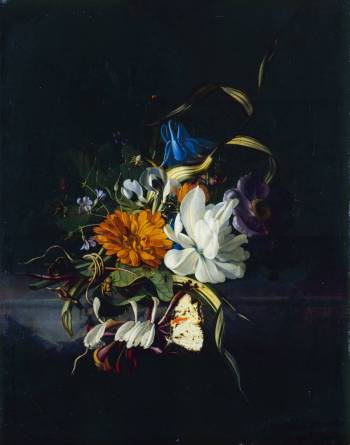
Rachel Ruysch (1664–1750), Floral Still Life, 1690, oil on canvas on oak panel, 35 × 27 cm (Dresden: Museum Gemäldegalerie Alte Meister, 3149).
In the Winckelmann Forum of the Semper Building, the Gemäldegalerie Alte Meister presents around 80 works from its own collection in the exhibition Timeless Beauty: A History of Still Life. The wide-ranging presentation—with masterpieces by painters such as Frans Snyders, Balthasar van der Ast, Jan Davidsz. de Heem, Adriaen van Utrecht, Willem Claesz. Heda, Abraham Mignon, and Rachel Ruysch—comprehensively illuminates the genre ‘still life’. Since when has it existed? What exactly constitutes a still life? What meaning, what content and what function did they have and still have today? What allegories and symbols are hidden in these motifs?
Still lifes were not only showpieces of decorative room furnishings, in which the overall effect was in the foreground. They also bear witness to natural scientific interests: the depicted object is regarded as a scientifically object and ‘document’—today as in the Age of Enlightenment. At the same time, however, still lifes are also an illusion, a game with the eye (trompe-l’œuil), in which the optical effect of the entire motif takes center stage. Through the bravura of painting, the ephemeral is immortalized. Many of the works on display, some of them recently restored, allow visitors to rediscover this fascinating genre, as only a few of the more than 100 still lifes in the Gemäldegalerie Alte Meister are on permanent display.
Konstanze Krüger, ed., Stillleben: Zeitlose Schönheit (Berlin: Hatje Cantz Verlag, 2023), 160 pages, ISBN: 978-3775751131, $50.
Konstanze Krüger, ed., Still Life: Timeless Beauty (Berlin: Hatje Cantz Verlag, 2024), 144 pages, ISBN: 978-3775751148, $40.










 Enfilade
leave a comment