Exhibition | Silver Treasures from Norway
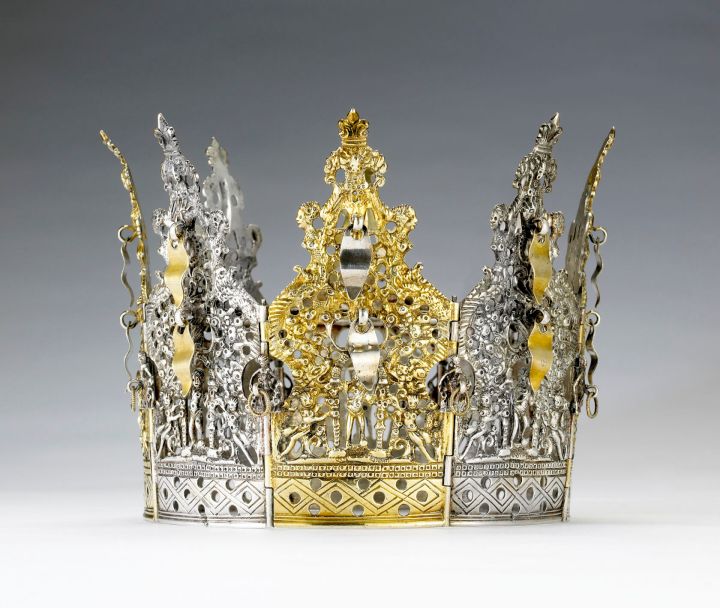
Bridal Crown, 1590–1610, silver and silver- gilt
(Christen Sveaas Collection)
◊ ◊ ◊ ◊ ◊
From the press release (8 January 2024) for the exhibition . . .
Crowning the North: Silver Treasures from Bergen, Norway
Museum of Fine Arts, Houston, 11 February — 5 May 2024
Spanning the 16th to the early 20th century, this exhibition of some 200 objects reveals the evolution of a uniquely Norwegian approach to silversmithing over centuries of global change.
For centuries, Bergen, one of the largest port cities in Scandinavia, was a thriving hub of global commerce, with a burgeoning export of fish, timber, and fur. That trade in turn spurred the development of a uniquely Norwegian approach to a timeless craft: gold and silver smithing. Crowning the North: Silver Treasures from Bergen, Norway explores the art of the Bergen silversmiths from the 16th to early 20th century and examines the evolution of the craft against the backdrop of greater political, social, and economic change in Norway and other parts of the world. Some 200 objects—from spoons, tankards, sugar bowls, and salt cellars, to elaborate ceremonial wedding crowns and fantastical vessels—are on exclusive loan to the U.S. from three public and private Norwegian collections: Kode Bergen Art Museum, the Bergen University Museum, and the private collection of Christen Sveaas.
“This presentation of objects from three prestigious Norwegian collections of art, craft, and design is an exceptional opportunity to discover Nordic history and aesthetics across centuries and across the intersecting forces of global trade, taste, and fashion,” commented Gary Tinterow, director and Margaret Alkek Williams Chair, the Museum of Fine Arts, Houston. “We are pleased to collaborate with the Kode Bergen Art Museum in bringing these remarkable objects to Houston, where they will be seen by U.S. audiences for the first time.”
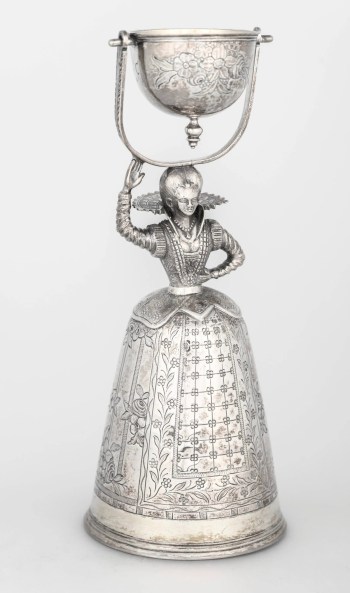
Johan Helmich Hoff, Silver Maiden Beaker, 1782, silver and silver-gilt (Kode Bergen Art Museum).
By the 16th century, Bergen had become a critically important global economic center in the trade of grain and salts for lumber and stock fish from the North. At the time ruled by Denmark, Bergen and its commerce operated under the jurisdiction of the Hanseatic League, a confederation of merchant guilds and market towns across central and northern Europe established by German traders in the 13th century. The league’s dominant global exchange network brought together two factors that fostered what would become a unique artistic heritage in Bergen: the availability of enormous quantities of silver mined from the Spanish Americas, and an influx of immigrants and their craft traditions from Germany and other European countries.
Bergen goldsmiths formed their own Goldsmith’s Guild in 1568. The goldsmith tradition that evolved in the city allowed artisans, both men and women, to craft a range of decorative and functional objects of extraordinary quality. Bergen goldsmiths’ sensibilities in the 16th century reflected the Renaissance and, later, Baroque styles of the time. Over the course of the 18th century, the influx of global commodities like tobacco and coffee from European colonies inspired goldsmiths to craft elegant objects for daily use to meet consumer demand. By the 19th century, with the excavations of three Viking ships and agitation for independence from Sweden, a growing sense of revivalism in art, literature, and popular culture inspired Norway’s goldsmiths to create fantastical objects harkening back to the Viking and medieval era. For centuries, with no banking system in place until 1816 following Norway’s union with Sweden in 1814, these silver and gold items—spoons, tankards, sugar bowls, and salt cellars, along with ceremonial objects such as brides’ wedding crowns—also functioned as a means of building personal wealth.
Crowning the North: Silver Treasures from Bergen, Norway is organized by the Museum of Fine Arts, Houston, in collaboration with the Kode Bergen Art Museum.
Kode Bergen Art Museum is one of the largest museums for art, crafts, design, and music in the Nordic region. Kode offers a unique combination of art museums and composers’ homes, showcasing contemporary art, historical collections, concerts, and parklands. The museum stewards over 50,000 objects, including paintings, works on paper, sculptures, installations, videos, musical instruments, furniture, textiles, ceramics, glass, and metal. These objects can be experienced in four different neighboring art museums in the heart of Bergen and the three beautifully located homes of the composers Ole Bull, Harald Sæverud, and Edvard Grieg.










 Enfilade
leave a comment