On Display | Quapaw Treaty of 1818
From the press release:
Nation to Nation: Treaties between the United States and American Indian Nations — Quapaw Treaty of 1818
National Museum of the American Indian, Washington, DC, April–October 2024
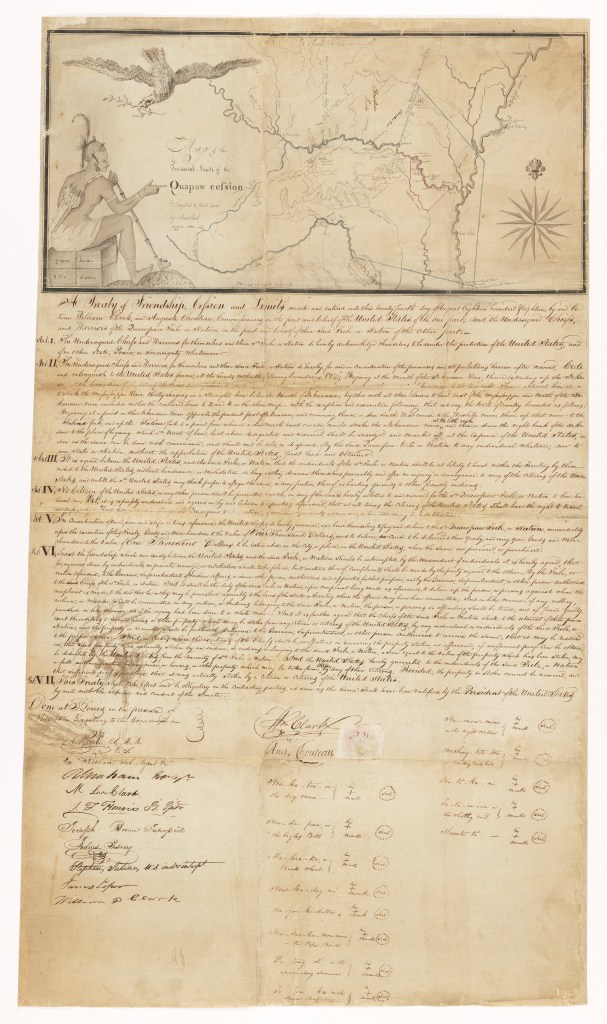
Quapaw Treaty, 24 August 1818 (Washington, DC: National Archives). Transcript originally published in Indian Affairs: Laws and Treaties, compiled and edited by Charles J. Kappler, 1904; digitized by Oklahoma State University.
The National Museum of the American Indian, in partnership with the National Archives and Records Administration, is displaying the Quapaw Treaty of 1818 as part of the exhibition Nation to Nation: Treaties between the United States and American Indian Nations (2014–28). The Quapaw Treaty will be on view until October 2024.
When the U.S. negotiated the Treaty of 1818, the Quapaw lived in four towns along the lower Arkansas River, although their hunting territories extended broadly to the west. The U.S. wished to acquire rights to these territories, which they considered excess Quapaw land, with the idea that those lands might be used for the resettlement of eastern tribes dispossessed by removal. The U.S. offered a lump-sum payment, promises of more payments annually for perpetuity, and a reservation composed of the territories occupied by the Quapaw towns. Just six years after the treaty was ratified, U.S. negotiators returned in 1824 at the behest of white settlers who desired the prime agricultural land of the lower Arkansas. The Quapaw were forced to abandon the 1818 reservation and move further west. Quapaw leader Heckaton, who felt compelled to agree to removal, said, “Since you have expressed a desire for us to remove, the tears have flowed copiously from my aged eyes.”
Displaying original treaties in Nation to Nation is made possible by the National Archives and Records Administration, an exhibition partner. Several of the treaties required extensive conservation treatment by the National Archives’ conservator prior to loan. Treaties can only be displayed for a short amount of time in order to conserve them for the future. There are a total of more than 370 ratified Indian treaties in the National Archives; more information about these treaties is available through its website.
Treaty Exhibition Schedule
September 2014–February 2015 — Treaty of Canandaigua, 1794
March–August 2015 — Muscogee Treaty, 1790
September 2015–February 2016 — Horse Creek (Fort Laramie) Treaty, 1851
March–August 2016 — Treaty with the Potawatomi, 1836
September 2016–February 2017 — Unratified California Treaty K, 1852
March–August 2017 — Medicine Creek Treaty, 1854
September 2017–January 2018 — Treaty of Fort Wayne, 1809
February–April 2018 — Navajo Treaty, 1868
May–October 2018 — Treaty with the Delawares, 1778
November 2018–March 2019 — Fort Laramie Treaty, 1868
April–September 2019 — Treaty of New Echota, 1835
October 2019–March 2020 — Treaty of Fort Stanwix, 1784
October 2020–March 2021 — Treaty of Fort Jackson, 1814
November 2021–May 2022 — Treaty of Fort Harmar with the Six Nations, 1789
May–November 2022 — Treaty with the Nez Perce, 1868
November 2022–April 2023 — Prairie du Chien Treaty, 1829
May–October 2023 — Treaty with Cheyenne and Arapaho, 1865
October 2023–April 2024 — Medicine Lodge Creek Treaty, 1867
April–October 2024 — Treaty with the Quapaw, 1818
Museum of the American Revolution Acquires Continental Army Drawing
Press release (26 March) from the Museum of the American Revolution, with coverage appearing in The Washington Post over the weekend (14 April 2024) . . .

Attributed to Pierre Eugène du Simitière, Soldiers and Camp Followers of the Continental Army’s North Carolina Brigade Marching through Philadelphia on 25 August 1777, pen and ink on paper (Philadelphia: Museum of the American Revolution).
◊ ◊ ◊ ◊ ◊
An eyewitness pen-and-ink sketch depicting Continental Army soldiers and camp followers marching through Philadelphia on 25 August 1777, which has never been documented or published by historians, has been donated to the Museum of the American Revolution. This sketch is the first wartime depiction of North Carolina troops known to exist, and only the second-known depiction of female camp followers of the Continental Army drawn by an eyewitness.
“This sketch is extremely important to our understanding of the daily operations of the Continental Army,” said Matthew Skic, Curator of Exhibitions at the Museum, who worked to authenticate the sketch and identify its creator after discovering it in a private collection. “It helps us visualize the everyday lives of these troops—the joyous, the difficult, and the mundane.”
This discovery brings to light a lively scene that newspaper accounts confirm occurred the morning of 25 August 1777, as the North Carolina Brigade and its commander, Brigadier General Francis Nash, marched to join the rest of General George Washington’s army before seeing action in both the Battle of Brandywine (11 September 1777) and the Battle of Germantown (4 October 1777).
The drawing shows two soldiers marching alongside an open-sided wagon, as well as a commissioned officer and a wagon driver mounted on horseback. Inside the wagon sit two women, one holding an infant, amongst various equipment and baggage of the brigade. Two men are also depicted riding on the back of the wagon. The inclusion of female camp followers—who shared life on campaign with enlisted husbands and fathers and supported the troops by sewing, doing laundry, and selling food—exemplifies a direct defiance of known regulations at the time about how women following the army could use wagons. Earlier in August, before the march depicted in the sketch took place, Washington himself brought up issues of women and children slowing down his troops, calling them “a clog upon every movement.”

Reverse side of the sketch of the North Carolina Brigade showing five male figure studies.
◊ ◊ ◊ ◊ ◊
On the reverse of the North Carolina Brigade sketch are five studies of two male figures, one brandishing a sword and the other engaged in a fist fight. Artists frequently sketched studies like these when they were working on larger works, as it allowed them to try out different poses or details and to get a sense of the scale of the larger drawing or painting.
The sketch was acquired by Judith Hernstadt, a Manhattan-based urban and regional planner and former television executive, in the late 1970s from a New York City antiques dealer. Hernstadt donated the sketch to the Museum in 2023, but at the time, the identity of the artist who drew it was still unknown. An ink inscription below the vignette of the North Carolina Brigade reads, “an exact representation of a waggon belonging to the north carolina brigade of continental troops which passed thro Philadelphia august done by …” with the rest of the lettering cut away due to an old paper repair.
After detailed research, handwriting analysis, and comparison to similar sketches, Skic identified the sketch’s creator as Switzerland-born artist and collector Pierre Eugène du Simitière (1737–1784), who settled in Philadelphia in about 1774 and is now known for documenting the rising American Revolution as it happened. Du Simitière went on to create from-life profile portraits of prominent Revolutionary leaders including Washington and he suggested the motto “E Pluribus Unum” through his rejected design for the Great Seal of the United States in 1776. In 1782, he founded the first museum in the United States that was open to the public.
Many of Du Simitière’s significant manuscripts and drawings still exist and are available for researchers to study at both The Library Company of Philadelphia and the Library of Congress. It is yet to be determined if either sketch relates to another work by du Simitière, but research is ongoing.
We were thrilled to piece together the many illuminating and significant parts of this sketch’s history through our unparalleled scholarship here at the Museum of the American Revolution,” said Dr. R. Scott Stephenson, President and CEO of the Museum. “As we round out our celebration of Women’s History Month, we revel in the discovery of this new depiction of female camp followers as highlighting the lesser-known stories and critical roles of women throughout the American Revolution are at the heart of the Museum’s offerings.”
The sketch was conserved due to generous contributions from the North Carolina Society of the Cincinnati, which is comprised of descendants of officers of the North Carolina Continental Line.
“The North Carolina Society of Cincinnati is proud to support the conservation and framing of this important discovery, which serves as an important reminder that the intricate history of both our state and our nation is still unfolding,” said Society President George Lennon.










 Enfilade
leave a comment