New Book | Antiquity in Print
Forthcoming from Bloomsbury:
Daniel Orrells, Antiquity in Print: Visualizing Greece in the Eighteenth Century (London: Bloomsbury Academic, 2024), 368 pages, ISBN: 978-1350407763 (hardback), $95 / ISBN: 978-1350407770 (paperback), $31.
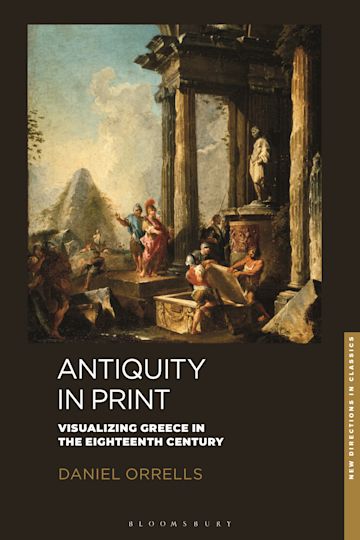 Daniel Orrells examines the ways in which the ancient world was visualized for Enlightenment readers and reveals how antiquarian scholarship emerged as the principal technology for envisioning ancient Greek culture, at a time when very few people could travel to Greece which was still part of the Ottoman Empire. Offering a fresh account of the rise of antiquarianism in the 18th century, Orrells shows how this period of cultural progression was important for the invention of classical studies. In particular, the main focus of this book is on the visionary experimentalism of antiquarian book production, especially in relation to the contentious nature of ancient texts. With the explosion of the Quarrel between the Ancients and the Moderns, eighteenth-century intellectuals, antiquarians, and artists such as Giambattista Vico, Johann Joachim Winckelmann, the Comte de Caylus, James Stuart, Julien-David Leroy, Giovanni Battista Piranesi, and Pierre-François Hugues d’Hancarville all became interested in how printed engravings of ancient art and archaeology could visualize a historical narrative. These figures theorized the relationship between ancient text and ancient material and visual culture—theorizations which would pave the way to foundational questions at the heart of the discipline of classical studies and neoclassical aesthetics.
Daniel Orrells is Professor of Classics at King’s College London. He is author of Sex: Antiquity and Its Legacy (2015) and Classical Culture and Modern Masculinity (2011), and is co-editor of The Mudimbe Reader (2016) and African Athena: New Agendas (2011).
c o n t e n t s
Introduction: Historicity, Disciplinarity, and Materiality
1 Achilles’ Shield and Vico’s Frontispiece
2 Visualising Philhellenism
3 Putting Ancient Greece into the Picture
Epilogue: From Lessing to Kauffmann: Awaiting the Return of Ancient Greece
Notes
Bibliography
Index
Workshop | The Reception of the Belvedere Torso

William Hogarth, The Analysis of Beauty, Plate 1, detail, 1753.
◊ ◊ ◊ ◊ ◊
From ArtHist.net and the Freie Universität Berlin:
Centre/Pieces: De- and Recentring the Belvedere Torso
Berlin, 25–26 April 2024
Organized by Anna Degler and Katherine Harloe
Registration due by 22 April 2024
This two-day workshop is held as a cooperation between the EXC 2020 project The Travelling Torso by Anna Degler (EXC 2020, Freie Universität Berlin) and Katherine Harloe (Institute of Classical Studies, University of London School of Advanced Study). It is dedicated to the post-antique reception of one of the most canonised and well-known antique sculptures within ‘Western’ culture, the so-called Belvedere Torso, which is kept in the Vatican Museums in Rome. Since at least the early sixteenth century, this larger-than-life marble sculpture has been the centrepiece of a classical canon. It has also at the same time always only been known in its fragmentary state, as a powerful body in pieces.
Exploring scholarly, artistic, and curatorial engagement with this centrepiece of classical Greco-Roman antiquity allows for a deeper insight into complex temporal, normative, and political reference systems that are constitutive of classical receptions. The workshop will focus on the relation of body politics and classical sculpture over the five centuries since the Torso entered the European art historical canon in order to explore the entanglements of these engagements with ideals of freedom, humanity, and gender, as well as racial and ableist discourses.
Following the research agenda of EXC 2020, the reception of the Belvedere Torso serves as one paradigmatic case study of intermediary literary and artistic practices. In the workshop we will discuss how its reception within art, literature, scholarship, and museums have produced or reproduced a variety of (political) temporalities and a set of norms. We will examine collection displays, the history of copies in plaster casts and other media, the Torso’s material transformations, and the many literary and artistic attempts at its completion, as well as comparing its reception with that of other famous antique sculptures (such as Laocoön and Venus of Milo). Invited practitioner Stephe Harrop will engage with the Torso from the perspective of contemporary storytelling with a new piece, to be performed during the workshop.
This two-day workshop—held on split sites between the Cluster Villa and the Abguss-Sammlung Antiker Plastik in Charlottenburg—will bring together international and local guest speakers working at the interface of a variety of disciplines (classics, literary studies, art history, archaeology, and performance studies) to investigate and reflect upon the manifold temporalities and asynchronies that constitute and complicate processes of classical reception. Given the Belvedere Torso’s central position in ‘Western’ canons up until today, the workshop aims at de- and possibly recentring the Torso by self-critically exploring classical reception and canonisation as a powerful practice. The workshop hereby raises the question how those practices actively shape temporal communities. This free event will be conducted in English. Please register with anna.degler@fu-berlin.de before 22 April 2024.
t h u r s d a y , 2 5 a p r i l
Morning at Cluster Villa, Otto-von-Simson Strasse 15
9.30 Registration
9:45 Introduction by Katherine Harloe (London, Institute of Classical Studies) and Anna Degler (Berlin, EXC 2020)
10.15 Morning Presentations
Chair: Anna Degler (Berlin)
• Elisabeth Décultot (Halle) — Winckelmann’s Invention of the Belvedere Torso: Epistemological Foundations and Strategic Interests
• Andrew James Johnston (Berlin, EXC 2020) — Making the Torso Move: The Torso Belvedere, the Uffizi Wrestlers, and Courbet
12.30 Lunch at Clustervilla
Afternoon at the Abguss-Sammlung Antiker Plastik (Greek and Roman Plaster Cast Collection), Freie Universität, Schloss Charlottenburg
2.30 Check-in
3.00 Afternoon Presentations
• Lorenz Winkler-Horaček (Berlin) — The Belvedere Torso in Berlin: Between Display, Distribution, and Disappearance
• Stephe Harrop (Liverpool) — Storytelling Performance Speaking Stone: Broken Stories from the Belvedere Torso
• Leonard Barkan (Princeton) — If the Torso Belvedere Could Talk, What Would It Say?
6.30 Reception
f r i d a y , 2 6 a p r i l
Cluster Villa, Otto-von-Simson Strasse 15
9.15 In conversation with Stephe Harrop
10.00 Morning Presentations
• Allannah Karas (Miami) — Black Artists and ‘White’ Sculptures: Reconfiguring the Classical Tradition
• Ryan Sweet (Swansea) — Prosthesis Narratives: Constructing and Complicating Physical Wholeness in Victorian Literature and Culture
12.15 Lunch
1.00 Afternoon Presentations
• Anna Degler (Berlin) — Modes of Thinking or Thinkers beyond Rodin: The Torso Belvedere in the United States, c. 1853–63
• Closing Discussion










 Enfilade
leave a comment