Byron 200 Years after His Death
George Gordon Byron (1788–1824) died 200 years ago on Friday (19 April). Writing this week for The Washington Post, Michael Dirda reviews two new books about the poet (noted below), while Benjamin Markovits, in a New York Times essay, grapples with how (and whether) people still read him. A Byron Festival is being held at Trinity College, Cambridge (yesterday and today) while the Keats-Shelley House presents the exhibition, Byron’s Italy: An Anglo-Italian Romance, along with a series of talks and other events throughout the year. Finally (for now), Liverpool UP has discounted some of its Byron books.
The Byron Festival at Trinity
Trinity College Cambridge 19–20 April 2024
 Trinity College Cambridge will host a two-day festival to coincide with the 200th anniversary of Lord Byron’s death on 19 April 1824, in Missolonghi, Greece. Byron was a student at Trinity College and is one of its most celebrated alumni. While enrolled as an undergraduate, Byron published his collection of poetry, Hours of Idleness, and began the satirical poem that would become English Bards and Scotch Reviewers, a scathing provocation of the literary establishment.
Described by the College’s Senior Tutor of the time as a “young man of tumultuous passions,” Byron became one of the most controversial, celebrated, and influential poets of his age. When Westminster Abbey declined to accept the magnificent statue of Byron, created after his death by the Danish sculptor Thorvaldsen, Trinity gave it a home in the Wren Library, where the poet still stands—an impressive presence for students, scholars, and visitors.
But what kinds of presence does Byron have now? This question is the focus of an exciting programme of talks, readings, music, and exhibited work, which will address, and mediate, the legacy and status of Byron now, within the contexts of today’s culture and scholarship. The Byron Festival Conference programme includes talks about Byron, by academics and writers including Bernard Beatty, Drummond Bone, Clare Bucknell, Will Bowers, Christine Kenyon Jones, Mathelinda Nabugodi, Seamus Perry, Diego Saglia, Dan Sperrin, Jane Stabler, Fiona Stafford, A.E. Stallings, Andrew Stauffer, Corin Throsby, Clara Tuite, Ross Wilson.
◊ ◊ ◊ ◊ ◊
Fiona Stafford, ed., Byron’s Travels: Poems, Letters, and Journals (New York: Everyman’s Library, 2024), 728 pages, ISBN: 978-1101908426, $35.
 George Gordon, Lord Byron, was one of the leading figures of British Romanticism. The Byronic hero he gave his name to—the charming, dashing, rebellious outsider—remains a powerful literary archetype. Byron was known for his unconventional character and his extravagant and flamboyant lifestyle: he had numerous scandalous love affairs, including with his half-sister Augusta Leigh. Lady Caroline Lamb, one of his lovers, famously described him as “mad, bad and dangerous to know.”
His letters and journals were originally published in two volumes; this new one-volume selection includes poems and provides a vivid overview of his dramatic life arranged to reflect his travels through Scotland, Italy, Spain, Turkey, Albania, Switzerland, and of course Greece, where he died. It contains a new introduction by scholar Fiona Stafford highlighting Byron’s enduring significance and the ways in which he was ahead of his time.
Fiona Stafford is a professor of English literature at Oxford University. The author of many books, including a biography of Jane Austen, she also wrote and presented the highly acclaimed The Meaning of Trees for BBC Radio 3’s The Essay. Her book The Long, Long Life of Trees, published in 2017, was a Sunday Times Nature Book of the Year.
◊ ◊ ◊ ◊ ◊
Andrew Stauffer, Byron: A Life in Ten Letters (Cambridge: Cambridge University Press, 2024), 300 pages, ISBN: 978-1009200165, $30.
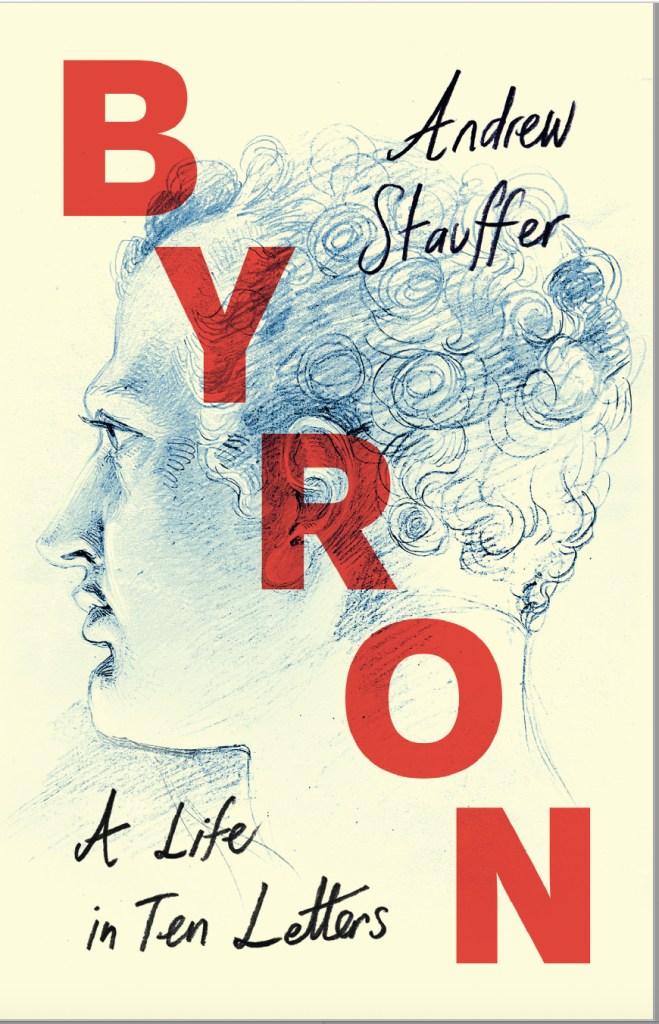
Lord Byron was the most celebrated of all the Romantic poets. Troubled, handsome, sexually fluid, disabled, and transgressive, he wrote his way to international fame—and scandal—before finding a kind of redemption in the Greek Revolution. He also left behind the vast trove of thrilling letters (to friends, relatives, lovers, and more) that form the core of this remarkable biography. Published to coincide with the 200th anniversary of Byron’s death, and adopting a fresh approach, it explores his life and work through some of his best, most resonant correspondence. Each chapter opens with Byron’s own voice—as if we have opened a letter from the poet himself—followed by a vivid account of the emotions and experiences that missive touches. This gripping life traces the meteoric trajectory of a poet whose brilliance shook the world and whose legacy continues to shape art and culture to this day.
Andrew M. Stauffer is a professor in the English Department at the University of Virginia, where he specializes in nineteenth-century literature, especially poetry.










 Enfilade
leave a comment