Call for Papers | Hand-Colouring of Natural History Illustrations

◊ ◊ ◊ ◊ ◊
From ArtHist.net:
The Hand-Colouring of Natural History Illustrations in Europe, 1600–1850
In-person and online, University of Konstanz, 26–27 February 2025
Organized by Joyce Dixon and Giulia Simonini
Proposals due by 21 June 2024
From the first instances of coloured engravings depicting botanical and zoological subjects, the usefulness and effectiveness of the printed image was transformed. In the seventeenth century the practice of hand-painting prints in watercolour was pioneered in luxurious and costly works such as Basilius Besler’s Hortus Eytettensis (1613). A century later this technique allowed for the publication of Maria Sibylla Merian’s exquisite Metamorphosis Insectorum Surinamensium (1705), and the first British collection of hand-coloured zoological engravings, A Natural History of English Insects (1714–1720) by Eleazar Albin. Color, pictorially represented, had become crucial to the project of natural knowledge-making: as Mark Catesby commented in 1731, “a clearer Idea may be conceiv’d from the Figures of Animals and Plants in their proper Colours, than from the most exact Description without them.”
The proliferation of hand-coloured impressions continued into the nineteenth century and yielded a highly-productive cottage industry. Even with the advent of colour printing, chromatic details of biological subjects were usually finished by hand (Friedman, 1978). Yet despite their vital role in the formation and dissemination of natural knowledge, the activities of hand-colourers—known also as ‘colourists’, ‘afzetters’ (in Dutch), and ‘illuminist’ (in German)—remain poorly understood (Jackson, 2011; Oltrogge 2000). This workshop aims to shed light on this vital aspect of European image-making and hopes to attract researchers investigating diverse areas of natural history.
The workshop will take place at the University of Konstanz on Thursday–Friday, 26–27 February 2025, with Dr. Alexandra Loske delivering a keynote address. We are accepting proposals for 20-minute papers in English. We welcome contributions on the following themes and topics:
• Materiality: paints and pigments, colouring techniques, equipment
• Semantics: methods of image replication, proofing processes, modes of pictorial translation
• Economy: working conditions and wages, guilds, case studies of individual enterprises
• Afterlife: consumption and circulation, amateur colourers, reception and significance
Please send your title, a 200-word abstract, and a short biography (150 words) to Joyce Dixon, joyce.dixon@ed.ac.uk, and Giulia Simonini, giulia.simonini@tu-berlin.de, by Friday, 21 June 2024. Papers can be given in person or virtually; please indicate your preferred method of delivery when submitting your abstract.
Call for Articles | Casting Art
From ArtHist.net:
Casting Art
Volume published by De Gruyter and edited by Yaëlle Biro and Noémie Etienne
Proposals due by 1 September 2024, with full articles due by February 2025
Plaster casts molded from artworks are ubiquitous in museum and university collections. In the art history department at the university of Vienna, for instance, a small vitrine surrounded by plants displays old plaster casts of medieval ivories. The installation functions simultaneously as an educational tool from the past, an archive of the department history, and a decorative ensemble. The German anthropologist Leo Frobenius had multiple plaster casts made of several terracottas he excavated in 1910 in Ife, Nigeria, marked them with his name and donated them to European ethnographic museums. He thus transformed masterpieces of an ancient West African civilization into his own vanity pieces-carte de visite and subjects of scientific research.
As can be seen in many museum storage and gypsotheques, over centuries, plaster casts have been molded on art works, architectural elements, and even human beings. The Italian Renaissance and the 19th century are two contexts often discussed in the framing of the importance of casting as part of broader creative processes but their presence and impact goes beyond. Since the 1990s and the work by Georges Didi-Huberman (e.g. L’empreinte, 1997), plaster casts have stimulated art historical research and have expanded thinking about heritage.
In this edited volume from De Gruyter (new series Traces), we propose to redefine collectively what plaster casts are across different geographies and time periods, focusing mainly on the reproduction of objects. As the use of 3D printing of works of art is becoming common practice as a tool to the current debate on restitution of cultural patrimony, we would like to interrogate how this replication practice differs conceptually from the earlier one. We will explore what plaster casts were upon production and what they have become, what they enable, and how they impact original productions as well as discourses surrounding them.
Topics of interest can include
1. Past: Plaster copies were highly circulated between institutions and continents. How were they traded, commercialized, and commodified? How did plaster cast enable the forging of specific disciplines, in which context and for whose profit? How were plaster casts used in teaching and study collections? How were they produced, circulated, and exhibited?
2. Present: We believe that plaster casts, and casts in general, need to be better defined in a global theoretical framework. Despite the numerous single studies focusing on specific contexts, in both art history and anthropology, the topic per se lacks broader conceptualization. How should this type of object be defined? What do they convey? How do they transform the casted original, be it an artwork (or even sometimes a human being)? Topics can also include the connection between artistic and anthropological castings, as well as the use of casts in contemporary art.
3. Future: Plaster is a very sensitive material prone to degradation. What are the specific challenges of exhibiting and preserving plaster cast today? Should they be preserved at all as parts of the museums’ collections? Does today’s proliferation of 3D printing of works of art, and their possible use in the context of restitution practices, present similar challenges and should these processes be submitted to better control?
Guest editors: Yaëlle Biro and Noémie Etienne
Publisher: De Gruyter
In the New Series: Traces. Public History and Cultural Heritage Studies
Publication date: 2026
Abstracts expected (c. 300 words): September 1st 2024
Please send your abstracts to: yaellebiro@gmail.com and noemie.etienne@univie.ac.at
Full articles (if abstracts are accepted): February 2025
A peer-reviewed evaluation will take place
Final versions of the articles are expected for April 2025
New Book | John Soane’s Cabinet of Curiosities
Forthcoming from Yale UP:
Bruce Boucher, John Soane’s Cabinet of Curiosities: Reflections on an Architect and His Collection (New Haven: Yale University Press, 2024), 224 pages, ISBN: 978-0300275698, £35 / $45.
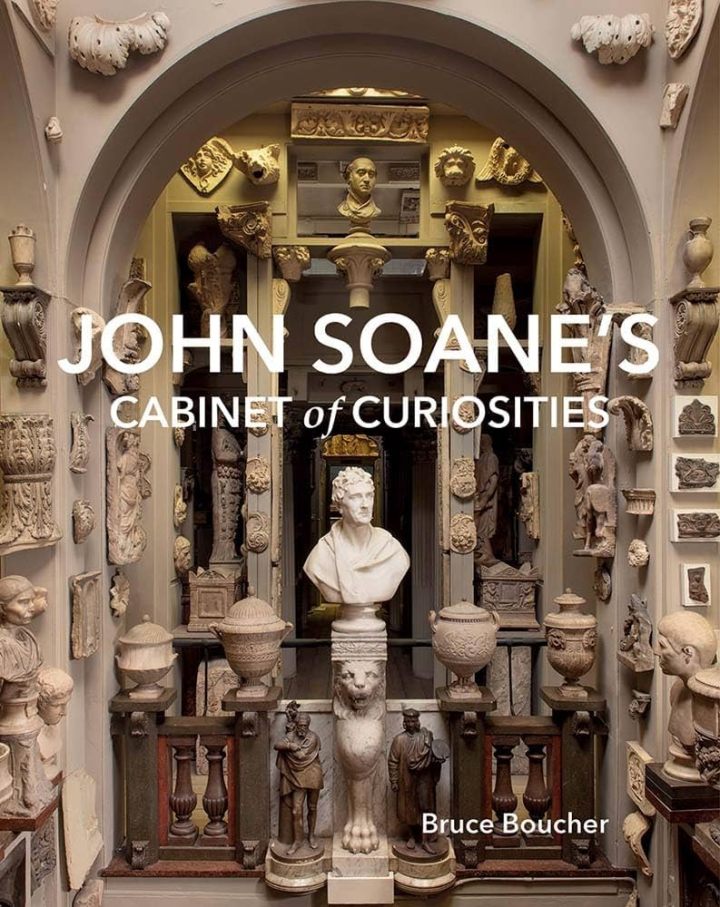 An in-depth study that sheds a fascinating new light on Sir John Soane (1753–1837) and his world-renowned collection
Sir John Soane’s architecture has enjoyed a revival of interest over the last seventy years, yet Soane as a collector—the strategy behind and motivation for Soane’s bequest to the nation—has remained largely unexplored. While Soane referred to the display of objects in his house and museum as “studies for my own mind,” he never explained what he meant by this, and the ambiguity surrounding his motivation remains perennially fascinating. This book illuminates a side of Soane’s personality unfamiliar to most students of his life and work by examining key strands in his collection and what they reveal about Soane and the psychology of collecting. Topics include the display of antiquities; his fascination with ruins, both literal and figurative; his singular response to Gothic architecture; and his investment in modern British painting and sculpture. These aspects are bookended by an introductory biographical chapter that highlights the ways in which his family and career informed his collecting habits as well as an epilogue that analyses the challenges of turning a private house and collection into a public museum.
Bruce Boucher is an art historian and curator who served as director of Sir John Soane’s Museum from 2016 to 2023. Specializing in Italian Renaissance, Baroque, and Neo-classical art and architecture, he is the author of a number of books, including The Sculpture of Jacopo Sansovino, Andrea Palladio: The Architect in his Time, and Earth and Fire: Italian Terracotta Sculpture from Donatello to Canova.
Tour and Talk | Pitzhanger Manor
From Pitzhanger Manor & Gallery:
Collecting in 18th-Century London’s Grand Houses: Pitzhanger Manor, Orleans House, and More
Pitzhanger Manor & Gallery, London, 2 May 2024, 5.30–9pm
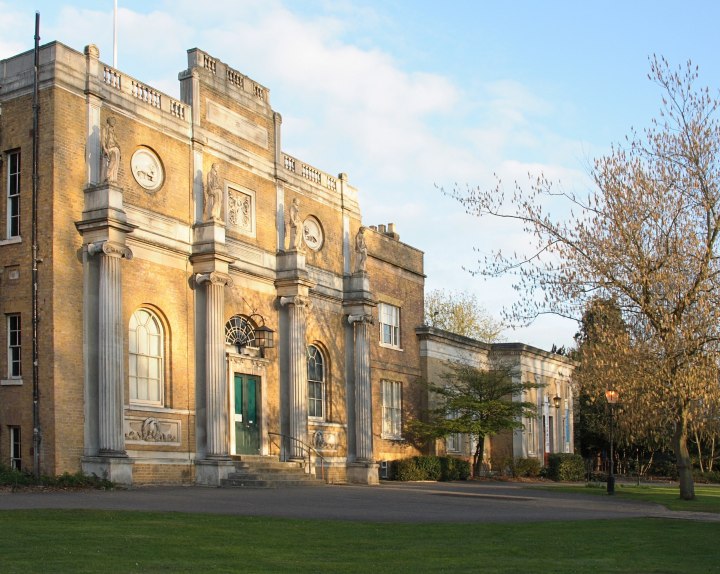
John Soane, Pitzhanger Manor, Walpole Park, Ealing, London, 1800–04 (Photo: Wikimedia Commons, April 2008).
Experience the first-ever in-person event presented by London Luminaries
The evening will include guided tours of Pitzhanger Manor, showcasing Sir John Soane’s architectural marvels, followed by an enlightening talk. Experts in historic estates—Clare Gough, Director of Pitzhanger Manor & Gallery; Tim Corum, Head of Richmond Arts Service; and Emily Burns, Curator of Collections and Interiors for English Heritage—will illuminate the art of collecting in 18th-century London, offering insights into the prestigious collections in Pitzhanger Manor, Orleans House, Marble Hill, Chiswick House, and more. Join us for an evening of history, art, and connectivity.
• Guided tours of the house commence at either 5.30 or 6pm. Guests are welcome to explore freely should they wish to arrive earlier or attend solely for the talk, which starts at 6.45.
• Tickets are £12, with all profits supporting the London Luminaries properties, an initiative born during the COVID lockdown to enhance connections between properties and people.
• Drinks and refreshments will be available for purchase at Soane’s Garden Room until 9pm, not included in the ticket price.
Pitzhanger Manor was the country home of Sir John Soane, one of the most influential architects in British history. Soane designed many extraordinary buildings, but Pitzhanger is unique as a building because it was designed, built and lived in by Soane himself. Following a major three-year conservation project, Pitzhanger reopened in March 2019. The Manor has been revitalised to take it back to Soane’s original designs, its extraordinary architecture restored for the public to see. Pitzhanger Gallery, housed in the 1939 library building, has been improved to allow for major loans and a series of contemporary exhibitions by artists, architects, and designers.
Emily Burns is the Curator of Collections & Interiors (West London) for English Heritage. Properties in her portfolio include Marble Hill, Chiswick House, and the Jewel Tower. Previously, she was a Curator at Watts Gallery – Artists’ Village (2021–23), Vivmar Curatorial Fellow at the National Gallery (2018–20), and Assistant Curator at the National Portrait Gallery (2013–18). Emily’s specialism is in British and Old Master painting and collecting. She holds degrees from the University of Cambridge and UCL and completed her AHRC-funded PhD on art and collecting in England during the Civil Wars and Interregnum, c.1640–1660 (University of Nottingham, 2018). Emily was a contributor to the Paul Mellon Centre’s research project Art and the Country House (2020), and she is the founding Editor of the Jordaens Van Dyck Journal (2021–present).
Tim Corum has worked in the arts for over 30 years, principally in museums and galleries, developing museum exhibitions and festivals at Oldham, Leeds, Bristol, the Horniman in London, and now with Richmond Arts Service. In Leeds and Oldham, he worked on developing international art programmes and a series of major capital projects. In Bristol, Tim led the development of the City Museum and Art Gallery, encouraging artists to intervene in and reframe the museum and art gallery. Though most widely known for the exhibition Banksy versus Bristol Museum, this programme also embraced a diversity of projects with both local and international partners. At the same time, he developed a new international contemporary art collection, building on Bristol’s rich historic art collection. He also led the creative team that developed the new museum, M Shed. In 2015, Tim became a director at the Horniman, where his work focussed on developing participatory programmes, bringing artists and scientists from a wide variety of backgrounds together with communities to create exhibitions and festivals that cast new light on the museum’s internationally significant collections. Tim moved to Richmond during the pandemic to lead the Borough’s Arts Service and direct the development of Orleans House Gallery.
Clare Gough is Director of Pitzhanger Manor & Gallery, architect Sir John Soane’s ‘country’ house in Ealing, West London and its adjacent contemporary gallery. Clare led Pitzhanger through a major conservation project to restore the house to Soane’s innovative design and upgrade the gallery, so it now stages exhibitions with artists ranging from Anish Kapoor to Es Devlin and Rana Begum. Clare is a Trustee of the Art Fund and was previously a Trustee of the Museum of the Home. She formerly worked at the National Gallery and National Gallery Co. Ltd before setting up an art consultancy working with the V&A and other art institutions.
Judith Hawley is Professor of Eighteenth-Century Literature in the Department of English, Royal Holloway, University of London. She frequently appears on BBC radio and TV and is a Trustee of the Pope’s Grotto Preservation Trust. Her research interests range from gin to Grub Street, and she has a particular interest in the history of amateur performance.
New Book | Libertine London
Forthcoming from Reaktion, with distribution by The University of Chicago Press:
Julie Peakman, Libertine London: Sex in the Eighteenth-Century Metropolis (London: Reaktion Books, 2024), 352 pages, £25 / $40.
 An eye-opening and richly detailed history of women’s sexuality that upends entrenched perceptions of the long eighteenth century.
Libertine London investigates the sex lives of women throughout the period 1680 to 1830, known as the long eighteenth century. The book uncovers the various experiences of women, whether as mistresses, adultresses, or as participants in the sex trade. From renowned courtesans to downtrodden streetwalkers, it examines the multifaceted lives of these women within brothels, on stage, and even behind bars. Based on new research in court transcripts, asylum records, magazines, pamphlets, satires, songs, theater plays, and erotica, Libertine London reveals the gruesome treatment of women who were sexually active outside of marriage. Julie Peakman looks at sex from women’s points of view, undercutting the traditional image of the bawdy eighteenth century to expose a more sordid side, which often left women distressed, ostracized, and vilified for their sexual behavior.
Julie Peakman is a historian and author of many books on the history of sexuality, including Amatory Pleasures: Explorations in Eighteenth-Century Sexual Cultures. She lives in London.
c o n t e n t s
Prologue
1 Rambles through London
2 Street-Walkers
3 Brazen Bawds
4 Courtesans
5 Public Opinion: The Way with Whores
6 Stage Strumpets
7 Libertines and Their Fashions
8 Quacks, the Pox, and the New Sexual Predators
9 Mad about the Boy
10 Rape on Trial
11 Seduction, Abduction, and Adultery
12 Royal Mistresses
References
Acknowledgements
Photo Acknowledgements
Index
New Book | Lady Caroline Lamb
From Simon & Schuster:
Antonia Fraser, Lady Caroline Lamb: A Free Spirit (New York: Pegasus Books, 2023), 224 pages, ISBN: 978-1639364053, $29.
 The vivid and dramatic life of Lady Caroline Lamb, whose scandalous love affair with Lord Byron overshadowed her own creativity and desire to break free from society’s constraints.
From the outset, Caroline Lamb had a rebellious nature. From childhood she grew increasingly troublesome, experimenting with sedatives like laudanum, and she had a special governess to control her. She also had a merciless wit and talent for mimicry. She spoke French and German fluently, knew Greek and Latin, and sketched impressive portraits. As the niece of Georgiana, Duchess of Devonshire, she was already well connected, and her courtly skills resulted in her marriage to the Hon. William Lamb (later Lord Melbourne) at the age on nineteen. For a few years they enjoyed a happy marriage, despite Lamb’s siblings and mother-in-law detesting her and referring to her as “the little beast.” In 1812 Caroline embarked on a well-publicised affair with the poet Lord Byron—he was 24, she 26. Her phrase “mad, bad and dangerous to know” became his lasting epitaph. When he broke things off, Caroline made increasingly public attempts to reunite. Her obsession came to define much of her later life, as well as influencing her own writing—most notably the Gothic novel Glenarvon—and Byron’s. Antonia Fraser’s vividly compelling biography animates the life of ‘a free spirit’ who was far more than mad, bad, and dangerous to know.
Antonia Fraser is the author of many widely acclaimed historical works which have been international bestsellers. She was awarded the Medlicott Medal by the Historical Association in 2000 and was made a DBE in 2011 for services to literature. Her previous books include Mary Queen of Scots; King Charles II; The Weaker Vessel: Woman’s Lot in Seventeenth-Century England, which won the Wolfson History Prize; Marie Antoinette: The Journey; Perilous Question; The King and the Catholics; and The Wives of Henry VIII. Must You Go?, a memoir of her life with Harold Pinter, was published in 2010, and My History: A Memoir of Growing Up in 2015. Fraser’s The Case of the Married Woman is available from Pegasus Books. She lives in London.
Byron 200 Years after His Death
George Gordon Byron (1788–1824) died 200 years ago on Friday (19 April). Writing this week for The Washington Post, Michael Dirda reviews two new books about the poet (noted below), while Benjamin Markovits, in a New York Times essay, grapples with how (and whether) people still read him. A Byron Festival is being held at Trinity College, Cambridge (yesterday and today) while the Keats-Shelley House presents the exhibition, Byron’s Italy: An Anglo-Italian Romance, along with a series of talks and other events throughout the year. Finally (for now), Liverpool UP has discounted some of its Byron books.
The Byron Festival at Trinity
Trinity College Cambridge 19–20 April 2024
 Trinity College Cambridge will host a two-day festival to coincide with the 200th anniversary of Lord Byron’s death on 19 April 1824, in Missolonghi, Greece. Byron was a student at Trinity College and is one of its most celebrated alumni. While enrolled as an undergraduate, Byron published his collection of poetry, Hours of Idleness, and began the satirical poem that would become English Bards and Scotch Reviewers, a scathing provocation of the literary establishment.
Described by the College’s Senior Tutor of the time as a “young man of tumultuous passions,” Byron became one of the most controversial, celebrated, and influential poets of his age. When Westminster Abbey declined to accept the magnificent statue of Byron, created after his death by the Danish sculptor Thorvaldsen, Trinity gave it a home in the Wren Library, where the poet still stands—an impressive presence for students, scholars, and visitors.
But what kinds of presence does Byron have now? This question is the focus of an exciting programme of talks, readings, music, and exhibited work, which will address, and mediate, the legacy and status of Byron now, within the contexts of today’s culture and scholarship. The Byron Festival Conference programme includes talks about Byron, by academics and writers including Bernard Beatty, Drummond Bone, Clare Bucknell, Will Bowers, Christine Kenyon Jones, Mathelinda Nabugodi, Seamus Perry, Diego Saglia, Dan Sperrin, Jane Stabler, Fiona Stafford, A.E. Stallings, Andrew Stauffer, Corin Throsby, Clara Tuite, Ross Wilson.
◊ ◊ ◊ ◊ ◊
Fiona Stafford, ed., Byron’s Travels: Poems, Letters, and Journals (New York: Everyman’s Library, 2024), 728 pages, ISBN: 978-1101908426, $35.
 George Gordon, Lord Byron, was one of the leading figures of British Romanticism. The Byronic hero he gave his name to—the charming, dashing, rebellious outsider—remains a powerful literary archetype. Byron was known for his unconventional character and his extravagant and flamboyant lifestyle: he had numerous scandalous love affairs, including with his half-sister Augusta Leigh. Lady Caroline Lamb, one of his lovers, famously described him as “mad, bad and dangerous to know.”
His letters and journals were originally published in two volumes; this new one-volume selection includes poems and provides a vivid overview of his dramatic life arranged to reflect his travels through Scotland, Italy, Spain, Turkey, Albania, Switzerland, and of course Greece, where he died. It contains a new introduction by scholar Fiona Stafford highlighting Byron’s enduring significance and the ways in which he was ahead of his time.
Fiona Stafford is a professor of English literature at Oxford University. The author of many books, including a biography of Jane Austen, she also wrote and presented the highly acclaimed The Meaning of Trees for BBC Radio 3’s The Essay. Her book The Long, Long Life of Trees, published in 2017, was a Sunday Times Nature Book of the Year.
◊ ◊ ◊ ◊ ◊
Andrew Stauffer, Byron: A Life in Ten Letters (Cambridge: Cambridge University Press, 2024), 300 pages, ISBN: 978-1009200165, $30.
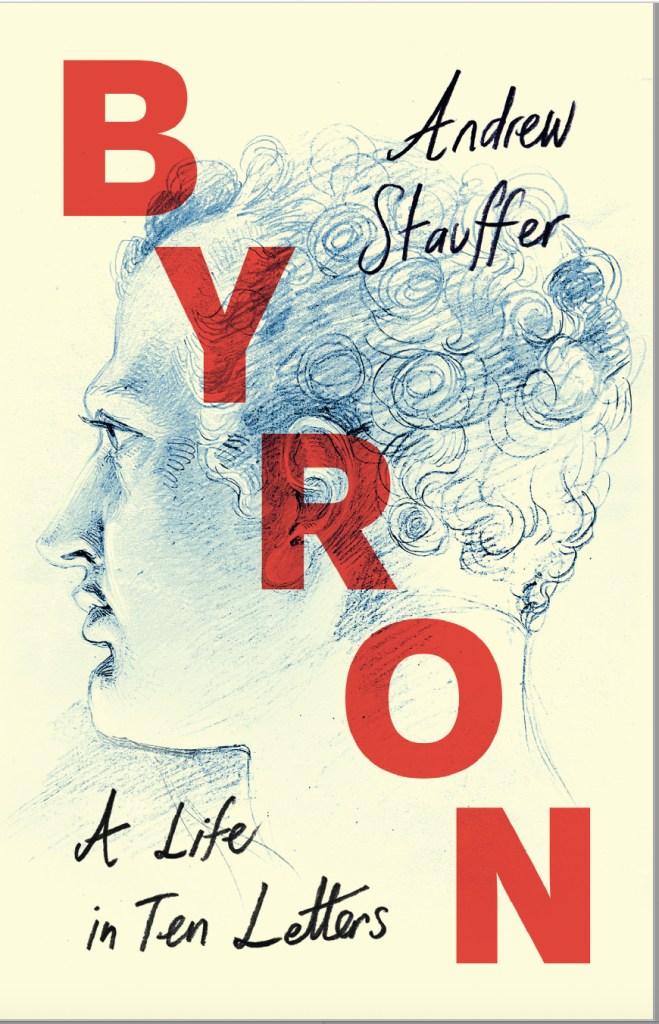
Lord Byron was the most celebrated of all the Romantic poets. Troubled, handsome, sexually fluid, disabled, and transgressive, he wrote his way to international fame—and scandal—before finding a kind of redemption in the Greek Revolution. He also left behind the vast trove of thrilling letters (to friends, relatives, lovers, and more) that form the core of this remarkable biography. Published to coincide with the 200th anniversary of Byron’s death, and adopting a fresh approach, it explores his life and work through some of his best, most resonant correspondence. Each chapter opens with Byron’s own voice—as if we have opened a letter from the poet himself—followed by a vivid account of the emotions and experiences that missive touches. This gripping life traces the meteoric trajectory of a poet whose brilliance shook the world and whose legacy continues to shape art and culture to this day.
Andrew M. Stauffer is a professor in the English Department at the University of Virginia, where he specializes in nineteenth-century literature, especially poetry.
New Book | Antiquity in Print
Forthcoming from Bloomsbury:
Daniel Orrells, Antiquity in Print: Visualizing Greece in the Eighteenth Century (London: Bloomsbury Academic, 2024), 368 pages, ISBN: 978-1350407763 (hardback), $95 / ISBN: 978-1350407770 (paperback), $31.
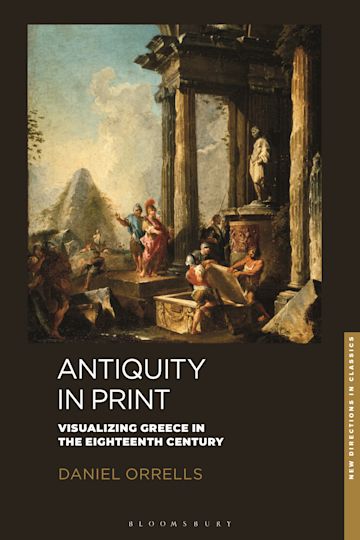 Daniel Orrells examines the ways in which the ancient world was visualized for Enlightenment readers and reveals how antiquarian scholarship emerged as the principal technology for envisioning ancient Greek culture, at a time when very few people could travel to Greece which was still part of the Ottoman Empire. Offering a fresh account of the rise of antiquarianism in the 18th century, Orrells shows how this period of cultural progression was important for the invention of classical studies. In particular, the main focus of this book is on the visionary experimentalism of antiquarian book production, especially in relation to the contentious nature of ancient texts. With the explosion of the Quarrel between the Ancients and the Moderns, eighteenth-century intellectuals, antiquarians, and artists such as Giambattista Vico, Johann Joachim Winckelmann, the Comte de Caylus, James Stuart, Julien-David Leroy, Giovanni Battista Piranesi, and Pierre-François Hugues d’Hancarville all became interested in how printed engravings of ancient art and archaeology could visualize a historical narrative. These figures theorized the relationship between ancient text and ancient material and visual culture—theorizations which would pave the way to foundational questions at the heart of the discipline of classical studies and neoclassical aesthetics.
Daniel Orrells is Professor of Classics at King’s College London. He is author of Sex: Antiquity and Its Legacy (2015) and Classical Culture and Modern Masculinity (2011), and is co-editor of The Mudimbe Reader (2016) and African Athena: New Agendas (2011).
c o n t e n t s
Introduction: Historicity, Disciplinarity, and Materiality
1 Achilles’ Shield and Vico’s Frontispiece
2 Visualising Philhellenism
3 Putting Ancient Greece into the Picture
Epilogue: From Lessing to Kauffmann: Awaiting the Return of Ancient Greece
Notes
Bibliography
Index
Workshop | The Reception of the Belvedere Torso

William Hogarth, The Analysis of Beauty, Plate 1, detail, 1753.
◊ ◊ ◊ ◊ ◊
From ArtHist.net and the Freie Universität Berlin:
Centre/Pieces: De- and Recentring the Belvedere Torso
Berlin, 25–26 April 2024
Organized by Anna Degler and Katherine Harloe
Registration due by 22 April 2024
This two-day workshop is held as a cooperation between the EXC 2020 project The Travelling Torso by Anna Degler (EXC 2020, Freie Universität Berlin) and Katherine Harloe (Institute of Classical Studies, University of London School of Advanced Study). It is dedicated to the post-antique reception of one of the most canonised and well-known antique sculptures within ‘Western’ culture, the so-called Belvedere Torso, which is kept in the Vatican Museums in Rome. Since at least the early sixteenth century, this larger-than-life marble sculpture has been the centrepiece of a classical canon. It has also at the same time always only been known in its fragmentary state, as a powerful body in pieces.
Exploring scholarly, artistic, and curatorial engagement with this centrepiece of classical Greco-Roman antiquity allows for a deeper insight into complex temporal, normative, and political reference systems that are constitutive of classical receptions. The workshop will focus on the relation of body politics and classical sculpture over the five centuries since the Torso entered the European art historical canon in order to explore the entanglements of these engagements with ideals of freedom, humanity, and gender, as well as racial and ableist discourses.
Following the research agenda of EXC 2020, the reception of the Belvedere Torso serves as one paradigmatic case study of intermediary literary and artistic practices. In the workshop we will discuss how its reception within art, literature, scholarship, and museums have produced or reproduced a variety of (political) temporalities and a set of norms. We will examine collection displays, the history of copies in plaster casts and other media, the Torso’s material transformations, and the many literary and artistic attempts at its completion, as well as comparing its reception with that of other famous antique sculptures (such as Laocoön and Venus of Milo). Invited practitioner Stephe Harrop will engage with the Torso from the perspective of contemporary storytelling with a new piece, to be performed during the workshop.
This two-day workshop—held on split sites between the Cluster Villa and the Abguss-Sammlung Antiker Plastik in Charlottenburg—will bring together international and local guest speakers working at the interface of a variety of disciplines (classics, literary studies, art history, archaeology, and performance studies) to investigate and reflect upon the manifold temporalities and asynchronies that constitute and complicate processes of classical reception. Given the Belvedere Torso’s central position in ‘Western’ canons up until today, the workshop aims at de- and possibly recentring the Torso by self-critically exploring classical reception and canonisation as a powerful practice. The workshop hereby raises the question how those practices actively shape temporal communities. This free event will be conducted in English. Please register with anna.degler@fu-berlin.de before 22 April 2024.
t h u r s d a y , 2 5 a p r i l
Morning at Cluster Villa, Otto-von-Simson Strasse 15
9.30 Registration
9:45 Introduction by Katherine Harloe (London, Institute of Classical Studies) and Anna Degler (Berlin, EXC 2020)
10.15 Morning Presentations
Chair: Anna Degler (Berlin)
• Elisabeth Décultot (Halle) — Winckelmann’s Invention of the Belvedere Torso: Epistemological Foundations and Strategic Interests
• Andrew James Johnston (Berlin, EXC 2020) — Making the Torso Move: The Torso Belvedere, the Uffizi Wrestlers, and Courbet
12.30 Lunch at Clustervilla
Afternoon at the Abguss-Sammlung Antiker Plastik (Greek and Roman Plaster Cast Collection), Freie Universität, Schloss Charlottenburg
2.30 Check-in
3.00 Afternoon Presentations
• Lorenz Winkler-Horaček (Berlin) — The Belvedere Torso in Berlin: Between Display, Distribution, and Disappearance
• Stephe Harrop (Liverpool) — Storytelling Performance Speaking Stone: Broken Stories from the Belvedere Torso
• Leonard Barkan (Princeton) — If the Torso Belvedere Could Talk, What Would It Say?
6.30 Reception
f r i d a y , 2 6 a p r i l
Cluster Villa, Otto-von-Simson Strasse 15
9.15 In conversation with Stephe Harrop
10.00 Morning Presentations
• Allannah Karas (Miami) — Black Artists and ‘White’ Sculptures: Reconfiguring the Classical Tradition
• Ryan Sweet (Swansea) — Prosthesis Narratives: Constructing and Complicating Physical Wholeness in Victorian Literature and Culture
12.15 Lunch
1.00 Afternoon Presentations
• Anna Degler (Berlin) — Modes of Thinking or Thinkers beyond Rodin: The Torso Belvedere in the United States, c. 1853–63
• Closing Discussion
Exhibition | The Tiepolos: Invention and Virtuosity in Venice
Now on view at the Beaux-Arts de Paris:
The Tiepolos: Invention and Virtuosity in Venice
Beaux-Arts de Paris, 22 March — 30 June 2024
Curated by Hélène Gasnault and Giulia Longo
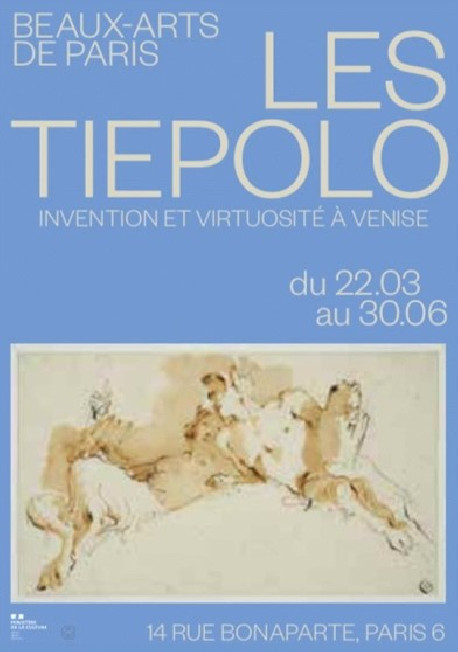 This exceptional exhibition brings together drawings and etchings by Giambattista Tiepolo and his two sons, Giandomenico and Lorenzo Tiepolo, a family of virtuoso artists in 18th-century Venice.
The Beaux-Arts de Paris owns a remarkable collection of ten works by Giambattista Tiepolo (1696–1770), making it the second-largest public collection of the artist’s drawings in France. Above all, this collection is the only one in France to include drawings not only by Giambattista, but also by his two painter sons, Giandomenico (1727–1804) and Lorenzo (1736–1776), as well as another of Tiepolo’s assistants in the 1730s, Giovanni Raggi. This collection alone provides an overview of graphic practices within the family and the studio.
The study of these sheets and prints, combined with works by other artists—sources of inspiration such as Rembrandt, masters such as Piazzetta, and contemporaries such as Canaletto, Guardi, and Novelli—highlights the great modernity of their art. This is particularly evident in their ability to produce variations on the same theme, both in traditional religious and mythological subjects and in figure studies, particularly caricatures, as well as scenes from Venetian life. The exhibition also explores the relationship between the father and his sons, and the work within a family of artists.
The exhibition opens with a series of studies of heads and faces that raise the question of training in the Tiepolo studio. It then moves on to religious paintings and large-scale secular decors produced by the Tiepolos and their contemporaries in Venice, followed by autonomous graphic works conceived outside of any painted project, as pure graphic exercises or pleasures, based on iconographic themes repeated almost obsessively, in multiple variants. It is the exceptional inventiveness of Giambattista and Giandomenico Tiepolo, one of the most fascinating facets of their artistic personalities, that these drawings and prints allow us to rediscover.
Curated by Hélène Gasnault, curator of drawings at Beaux-Arts de Paris, and Giulia Longo, curator of engravings and photos at Beaux-Arts de Paris.
Hélène Gasnault, ed., with additional texts by Catherine Loisel and Giulia Longo, Les Tiepolo: Invention et virtuosité à Venise (Paris: Beaux-Arts de Paris éditions, 2024), 112 pages, ISBN: 978-2840568780, €25.










 Enfilade
leave a comment