New Book | Charles Bridgeman (c.1685–1738)
From Boydell & Brewer:
Susan Haynes, Charles Bridgeman (c.1685–1738): A Landscape Architect of the Eighteenth Century (London: Boydell & Brewer, 2023), 270 pages, ISBN: 978-1837651177, £75 / $115.
 An examination of the garden plans of eighteenth-century landscape architect Charles Bridgeman, shedding light on his artistic vision and contributions to English garden history.
Charles Bridgeman was a popular and highly successful landscape architect in the first part of the eighteenth century. He was Royal Gardener to George I and George II, designing the gardens at Kensington Palace for them and working for many of the ruling Whig elite, including Sir Robert Walpole at Houghton Hall in Norfolk. His landscapes were audacious and monumental, but he is barely known outside the world of academic garden history; most of his gardens have disappeared, changed out of all recognition to chime with later tastes shaped by Lancelot Brown’s vision of a more ‘natural’ landscape, or buried under housing developments and golf courses; and there is little archaeological or written evidence of his work. This book aims to redress this injustice and rescue his legacy. It draws on the only significant body of evidence which survived him: an extensive but wildly heterogenous corpus of garden plans. Close examination of them reveals an artistic vision heavily influenced by the late seventeenth-century geometric garden but deeply rooted in the ‘genius of the place’, and working methods that include a proto-business model which prefigures the gentleman improvers who followed him. The volume brings Bridgeman from obscurity to demonstrate his skill as an artist, a manipulator of space on a grand scale, and a consummate practitioner, a deserved member of the canon of famous and revered English landscape gardeners.
Susan Haynes is a retired teacher with a PhD in landscape history from the University of East Anglia. Her principal interest is seventeenth- and eighteenth-century garden history.
c o n t e n t s
List of Illustrations
Acknowledgements
List of Abbreviations
Introduction
1 Who Was Charles Bridgeman?
2 Towards A Reliable Corpus
3 A Revised Catalogue
4 Reading The Plans
5 The Art-Historical Context Revisited
6 The ‘Ingenious Mr Bridgeman’
7 Building a Landscape
8 A Commercial Enterprise
Conclusion
Appendices
I A Summary of Willis’s Catalogue from Charles Bridgeman and the English Landscape Garden
II A Revised Catalogue
III Bridgeman’s Projects by Year
IV Bridgeman’s Income
Gazetteer of Bridgeman Sites
Glossary
Bibliography
Index
New Book | Chatsworth: The Gardens
From Penguin Books:
Alan Titchmarsh, with photography by Jonathan Buckley, Chatsworth: The Gardens and the People Who Made Them (London: Ebury Spotlight, 2023), 288 pages, ISBN: 978-1529148213, £35 / $65.
 Follow Alan Titchmarsh into Chatsworth’s irresistible world of visionaries, pioneers, heroes, villains, and English eccentrics and celebrate the men and women who have shaped the history of the estate over five centuries. With his passionate knowledge of both the house and gardens, as well as his long-established relationship with the Cavendish family, Alan is the perfect guide with whom to explore the Palace of the Peaks. Featuring stunning, specially commissioned photography of the gardens and parkland, alongside long-forgotten images and memorabilia newly unearthed in the estate archives, this vivid companion, crowded with character and colour, is a book to treasure and revisit over and over again.
Alan Titchmarsh MBE is an English gardener, broadcaster, and author of over 40 books, many of which have been bestsellers. He has twice been named Gardening Writer of the Year and for four successive years was voted Television Personality of the Year by the Garden Writers’ Guild.
Wentworth Woodhouse Visit
From the York Georgian Society:
Wentworth Woodhouse Visit with the York Georgian Society
24 April 2024
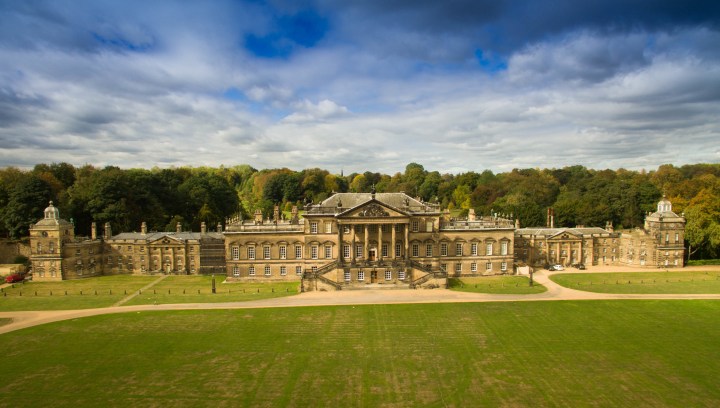
Wentworth Woodhouse, South Yorkshire.
An opportunity to visit one of England’s greatest Georgian country houses—rebuilt by the 2nd Marquess of Rockingham in the mid-18th century—to view the latest developments in its ambitious conservation and restoration programme.
The day will begin with a guided tour of the State Rooms on the main floor. Lunch will be followed by a look at the newly restored Camellia House in the company of Dorian Proudfoot, lead conservation architect for the Wentworth Woodhouse Restoration Project. Originally built in 1738 as an orangery and tea room, the building was later converted to house camellias and other rare plants from China and Japan. After complete restoration from dereliction it is now back in use as a tea room and events venue. Dorian will then take us to the magnificent stable block, originally built in 1782 to house 84 horses and more than 30 staff, together with a riding school, carriage house, and saddlery. The stables and courtyard are being transformed in a £5 million regeneration plan to accommodate a visitors’ centre, kitchen, café, and events venue.
Bookings: YGS members and Friends of York Art Gallery: £43; non-members: £48. Places are limited to 25 persons. The cost includes tea/coffee and biscuits on arrival, lunch, and tours of the State Rooms, Camellia House, and Stables. Book your place here.
Conference | Immanuel Kant and Hull
Immanuel Kant was born this month 300 years ago (April 22). From the conference registration form:
Immanuel Kant and Hull
Hull History Centre, East Yorkshire, 15 June 2024
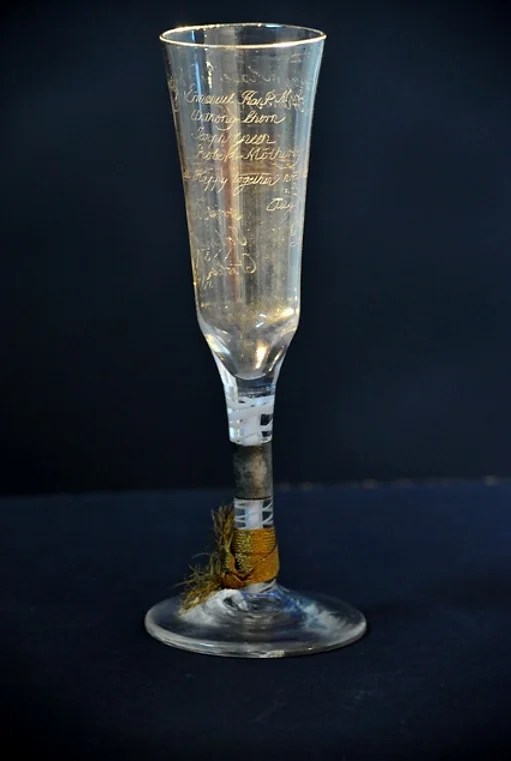
Drinking glass engraved with the names of Immanuel Kant and four men from Hull, 1763 (Lüneburg: East Prussian State Museum).
Presented by the Georgian Society for East Yorkshire and Friends of Kant and Königsberg, in association with Hull History Centre and University of Hull Maritime History Trust
This conference commemorates the tercentenary of the birth of the most important German philosopher, Immanuel Kant (1724–1804), and celebrates his close friendship with Joseph Green and Robert Motherby, merchants from Hull. It has been said that Green’s effect on the philosopher “cannot be overestimated.” The Königsberg firm of Green and Motherby managed Kant’s finances, and Kant had a great influence on the education of Robert Motherby’s children, one of whom, William, founded The Friends of Kant in 1805.
The fee of £30 (Georgian Society for East Yorkshire and Friends of Kant and Königsberg members £25) includes all refreshments. Book early, as places limited. Please direct questions to to Susan Neave, susananeave@gmail.com.
p r o g r a m m e
11.00 Introduction – Gerfried Horst (Chairman, Friends of Kant and Königsberg)
11.15 Morning Session
• Life and Work of Immanuel Kant – Tim Kunze (Curator, Immanuel Kant Department, East Prussian State Museum, Lüneburg)
• Königsberg Kant’s Home – Max Egremont (author of Forgotten Land: Journeys among the Ghosts of East Prussia)
1.00 Lunch
1.45 Afternoon Session
• Kant and Slavery – Judith Spicksley (Wilberforce Institute for the Study of Slavery and Emancipation, University of Hull)
• Hull’s Baltic Trade – Nick Evans (School of Humanties, University of Hull)
• Hull Merchants and Immanuel Kant – David Neave (Georgian Society for East Yorkshire)
• The Motherby Family of Hull and Königsberg – Marianne Motherby (Friends of Kant and Königsberg)
4.00 Tea and Cakes
Conference | Fragile Things
From Yale’s Program in Russian, East European, and Eurasian Studies at the MacMillan Center:
Fragile Things: Material Culture and the Russian Empire
Whitney and Betty MacMillan Center, Yale University, New Haven, 12–13 April 2024
 In February 2022, Russian forces set ablaze the Museum of History in Ivankiv, Ukraine. Locals struggled to save paintings by the celebrated folk artist Maria Primachenko, but other collections were lost: cutlery, textiles, fossils, stamps. In the museum’s burnt-out frame, metals, fibers, and bones mixed in the self-same gray of ashy heaps. Plucked from homes, factories, and workshops, these humbler objects so redolent of 19th- and 20th-century life in Ivankiv became the target of imperial erasure.
Today’s imperial violence highlights the fragility of objects like these, and urgently asks us to reconsider the frameworks by which we study the material culture of the Russian empire. How might such a landscape of endangered things resist the traditional presumptions with which we approach historical objects? In place of tactility, materiality, and presence, this conference offers a slipperier view. Objects can be hidden, stolen, destroyed. But such physical precarity belies other, intangible, mutabilities: ideologies shift, meanings elude, objects slip from our scholarly grasp. What would it mean to see material culture—and our study of it—as fragile? Fragility can be the threat of collapse or loss; it is also the gleam of volatile possibility. Where recent literary and art historical trends see matter as ‘vibrant’ or ‘powerful’, this conference proposes fragility as a model and a mood for understanding the Russian empire’s things.
In the past two decades the humanities has experienced a marked ‘material turn’, a new materialism that has brought fresh methods and theories to the study of objects. With amplified attention not only to matter itself, but to the ideological, social, economic, political, and ecological dimensions of material objects, historians and theorists of culture have imagined the deep human and environmental networks that make, shape, and mediate things. This conference will explore these materialities as defining of the Russian empire, comprised as it was not only of matryoshka nesting dolls and Faberge eggs, but of the artistic, industrial, and religious objects of the imperial peripheries, Central Asia, the Baltic region, the Caucasus, and Ukraine. How, for example, are stories of colonial expansion or class violence retained in the crumbling relics of imperial everyday life? Can we discern shifting social and political ideologies in the migration of ornamental forms across the decorative arts? In which materials might we seek inscriptions of ecological transformation and vulnerability? And how does the researcher engage materiality when objects are lost or made inaccessible by geopolitical upheaval? In asking these and other questions, Fragile Things will attend to three main goals: to propose the concept of ‘fragility’ as generative for material cultural scholars across a range of disciplines and methodologies; to explore the potential of new materialism to excavate previously overlooked objects, experiences, and frameworks of the Russian empire; and to leverage the framework of materiality in the project of decolonizing the study of Russia, Eastern Europe, and Eurasia.
f r i d a y , a p r i l 1 2
2.00 Welcome
2.15 Panel 1 | Animal Materialities
Moderator: Emily Ziffer
• Matthew Romaniello — Creation through Destruction: Animal Materials and their Afterlives in the 18th Century
• Philippe Halbert — ‘There’s no Rushia in Town’: Rethinking Russia’s Leather Empire
• Bart Pushaw — Otter Offerings: The Materials of Indigenous Insurgency in Russian-Occupied Alaska
4.30 Conference Keynote
• Michael Yonan — From Material Culture to Materiality: Conceiving Meaning for Historical Things
6.00 Reception
s a t u r d a y , a p r i l 1 3
9.00 Welcome
9.15 Panel 2 | Migrating Orientalisms
Moderator: John Webley
• Michael Kunichika — Ornament and Orient: Migration and the Fragility of National Identity
• Mary Roberts — The Fragile Things of Stanisław Chlebowski’s Epistolary Interiors
• Mollie Arbuthnot — Museums against Fragility: Material Heritage and Imperial Legacies in Revolutionary Turkestan
11.15 Panel 3 | Fragile Icons
Moderator: Molly Brunson
• Christine Worobec — The Ukrainian Okhtyrka/Akhtyrka Icon of the Mother of God: A Russian Imperial Project
• Wendy Salmond — The Fragile Icon
1.30 Panel 4 | Tastemaking
Moderator: Liliya Dashevski
• Margaret Samu — Fragile Clay, Firm Aspirations: A Safronov Teapot
• Karen Kettering — How ‘Russian’ Is a ‘Fabergé Egg’ and What Can They Actually Tell Us?
• Wilfried Zeisler — ‘You may rest assured that we will take the best care of them.’ – Marjorie Post to Colonel Serge Cheremeteff, 1964
3.30 Panel 5 | Peripheries Centered
Moderator: Emily Cox
• Christianna Bonin — Konstantin Korovin’s Borderline Modernism
• Ismael Biyashev — Mobile Pasts//Tethered Poetics: Archaeology, Nomadism, and Material Culture in Late Imperial Siberia
• Rosalind Blakesley — Vasily Surikov and the Precarity of Materializing History
5.15 Concluding Remarks
Telescope by James Short on Display at the Herschel Museum
On a day when many of us are looking to the skies . . . Press release from Bath’s Herschel Museum of Astronomy:

James Short, Gregorian reflector telescope, 1738–68 (Collection of Richard Blythe, on loan to the Herschel Museum of Astronomy).
The Herschel Museum of Astronomy recently revealed a new display: a Gregorian Reflector telescope created by James Short, the preeminent telescope maker of the 18th century. The brass telescope, on long-term loan to the museum from Richard N. Blythe of Shropshire, was created between 1738 and 1768. It has a focal length of 18 inches and sits on an equatorial mount. Similar telescopes made by Short were used to observe the transit of Venus in 1761 and 1769.
Gregorian Reflector telescopes are constructed with two concave mirrors. The primary mirror collects incoming light and brings it to a focal point. This focused light is then reflected off the secondary mirror, after which the light passes through a central aperture within the primary mirror. Ultimately, the light emerges from the bottom of the instrument, facilitating observation through the eyepiece.
In his 30-year career, Short made at least 1300 telescopes. Considered the finest available, they were sought after by observatories and customers all over the world. Short had no assistant, and when he died in 1768 his method of polishing mirrors was lost. Separately, William Herschel started experimenting with making telescopes in 1773 and went on to produce telescopes of even greater quality than those by Short.

Herschel Museum of Astronomy, 19 New King Street, Bath (Photo by Nick Veitch, Wikimedia Commons, August 2005). Brother and sister, William and Caroline Herschel moved into what was then a new town house in 1777, just a few years before William discovered Uranus (in March 1781). The Herschel museum was established in 1981.
Patrizia Ribul, Director of Museums for Bath Preservation Trust says: “The story of the Herschel siblings William and Caroline is very special, and our acquisitions policy is focused on objects that either belonged to them, or that add important context from the time. The James Short telescope provides visitors with an excellent example of the type of telescope that would have been known to William Herschel. The fact that William, with Caroline’s assistance, went on to create telescopes superior even to this excellent example by James Short, really underlines his expertise and dedication in the field of astronomy.”
The James Short telescope is the latest in a line of exciting long-term loans and acquisitions at the museum, including Caroline’s visitor book, a full-sized replica of William’s seven-foot reflecting telescope, and Caroline’s original memoir manuscript.
The Herschel Museum of Astronomy is dedicated to the achievements of the Herschels: distinguished astronomers and talented musicians. It was from this house that William discovered Uranus in 1781.
Conference | Edo Outsiders: Ainu and Ryūkyūan Art
From ArtHist.net:
Edo Outsiders: Ainu and Ryūkyūan Art
University of California, Los Angeles, 19 April 2024

Panoramic Map of the Tōkaidō Highway, Shōtei Kinsui, drawn by Kuwagata (better known as Keisai). Published by Sanoya Ichigorō, Izumiya Hanbei, and Izumoji Manjirō, n.d. (likely 1810). Polychrome xylography, 52 × 24 inches (Los Angeles: Richard C. Rudolph Collection of Japanese Maps, Special Collections, UCLA Library).
◊ ◊ ◊ ◊ ◊
On Friday, April 19, the William Andrews Clark Memorial Library at UCLA will host Edo Outsiders: Ainu and Ryūkyūan Art, the third of three conferences at UCLA this year on the theme of Edo-period art. The conference is free and open to the public. If interested in attending, please do register, as space is limited in the Clark Library (also, note that the Clark is housed in a villa in West Adams, some ten miles east of the main UCLA campus in Westwood). Parking is free, and lunch is provided. To register, follow this link. While there will be no livestream or recording, an edited volume should follow.
p r o g r a m
9.30 Coffee and Registration
10.00 Welcome and Opening Remarks
• Bronwen Wilson (UCLA) and Kristopher Kersey (UCLA)
10.15 Panel 1 | Ainu Material and Visual Cultures: History, Materiality, and Practice
Moderator: Julia H. Clark (UCLA)
• Christina M. Spiker (St. Olaf College), Carving Identity: Early Ainu Woodcarving, Cultural Revitalization, and the Patchwork of History
• Fuyubi Nakamura (The University of British Columbia), Art and Sinuye with Ainu Artist Mayunkiki
• Katsuya Hirano (UCLA), The Eye of Kelp: Ainu-Japanese Trade and the Formation of a Culinary Culture in the Eighteenth and Nineteenth Centuries
12.15 Lunch — Display of Clark Library materials in the North Book Room
1.15 Panel 2 | The Circulation and Dynamism of Ryūkyūan Textiles and Lacquerware
Moderator: Kristopher Kersey (UCLA)
• Setsuko Nitta (Okinawa Prefectural University of Arts), The Dyeing in Ryūkyū: The Relationship with Overseas
• Monika Bincsik (The Metropolitan Museum of Art), Lacquer Art at the Crossroads: Ryūkyū Ware
2.45 Coffee Break
3.15 Panel 3 | Ryūkyūan Painting: Heritage, Afterlives, and Restorations
Moderator: Rika Hiro (Los Angeles County Museum of Art)
• Eriko Tomizawa-Kay (University of East Anglia and University of Michigan), Tracing the Artistic Heritage: The Development of Ryūkyūan Painting from the Seventeenth to the Early Eighteenth Century
• Heeyeun Kang (UCLA), Ryūkyū Royal Portraits: Restoring and Contextualizing Lost Ryūkyū Art
4.45 Break
5.00 Plenary Discussion (all speakers and moderators)
5.30 Reception
Exhibition | Glamorous Women: Gender and Fashion in Chinese Art
Now on view at The Nelson-Atkins:
Glamorous Women: Gender and Fashion in Chinese Art
The Nelson-Atkins Museum of Art, Kansas City, 18 November 2023 — 19 May 2024
Curated by Ling-en Lu
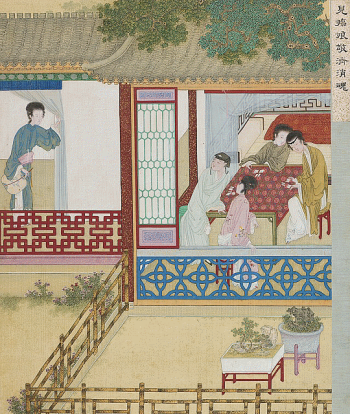
Jingju Losing His Mind upon Seeing Golden Lotus, from the album Illustrations of Scenes from ‘The Plum in the Golden Vase’, Chinese, 18th century, album leaf, ink and color on silk, 39 × 32 cm (Kansas City: The Nelson-Atkins Museum of Art, 2006.18.7).
As early as 600 BCE, Chinese women’s roles in society were primarily centered within the home. These roles were informed by Confucianism, which promoted their view of a harmonious societal order, elevating men as the household authorities and assigning women to domestic roles. As a result, women’s contributions to society were largely overlooked.
However, art depicting women and fashions created by and for women underscore their crucial impact as tastemakers in visual culture from the 1100s to 1800s. Early works like shinühua (painting of gentlewomen) portrayed women as exemplary models of beauty and femininity. Artists later revamped this tradition to illustrate women as provocative seductresses in popular Chinese stories. By the 1800s, women used fashion and accessories to transform themselves from muted muses to fashionable trendsetters in Chinese society.
By looking closely at visual clues and symbolism embedded within these works, we can learn more about women’s lives, their beauty ideals, and their overall influence on art and culture. Viewed together, we see how women impacted Chinese art and culture much more fully than what we know from written history.
Organized by The Nelson-Atkins Museum of Art. Generous support provided by the E. Rhodes and Leona B. Carpenter Foundation.
New Book | Chinese Dress in Detail
From Thames & Hudson:
Sau Fong Chan, with photographs by Sarah Duncan, Chinese Dress in Detail (London: Thames & Hudson, 2023), 224 pages, ISBN: 978-0500480939, £30 / $40.
 A head-to-toe exploration of Chinese dress through sumptuous, detailed photography of some of the most fascinating historic and contemporary pieces in the V&A’s outstanding collection (part of the V&A Fashion in Detail series)
Chinese Dress in Detail reveals the beauty and variety of Chinese dress for women, men, and children, both historically and geographically, showcasing the intricacy of decorative embroidery and rich use of materials and weaving and dyeing techniques. The reader is granted a unique opportunity to examine historical clothing that is often too fragile to display, from quivering hair ornaments, stunning silk jackets and coats, festive robes, and pleated skirts, to pieces embellished with rare materials such as peacock-feather threads or created through unique craft skills, as well as handpicked contemporary designs. A general introduction provides an essential overview of the history of Chinese dress, plotting key developments in style, design, and mode of dress, and the traditional importance of clothing as social signifier, followed by eight thematic chapters that examine Chinese dress in exquisite detail from head to toe. Each garment is accompanied by a short text and detail photography; front-and-back line drawings are provided for key items.
Sau Fong Chan is a curator in the V&A’s Asian department and looks after the textiles and dress collections from China and Southeast Asia.
c o n t e n t s
Introduction
1 Headwear
2 Necklines and Shoulders
3 Sleeves
4 Pleats
5 Edgings
6 Buttons
7 Embroidery
8 Footwear
Glossary
Further Reading
Acknowledgments
Picture Credits
Index
Conference | Imaging Religious Ceremonies in Early Modern Europe
From ArtHist.net:
Performing Theatricality and Imaging Religious Ceremonies in Early Modern Western Europe
Centre for Architecture and Art, Ghent University, Vandenhove, 15–17 May 2024
Registration due by 8 May 2024

Bernard Picard, Le Bairam ou la Paque des Mahometans (The Bairam or the Passover of the Muhammadans), from Cérémonies et coutumes religieuses de tous les peuples du monde, volume 5: Cérémonies des mahométans, &c. (1737).
2023 marks the 300th anniversary of the publication of the early eighteenth-century book series Cérémonies et coutumes religieuses de tous les peuples du monde, a work on all the world’s religions known to Europe at that time and originally published in seven volumes between 1723 and 1737 in Amsterdam. Edited by the exiled French Huguenot Jean Frederic Bernard, the original seven volumes of the Cérémonies knew a vast distribution across European readers in the Netherlands, France, England, and the Holy Roman Empire, among other countries. Its popularity was at least partly due to the impressive set of prints included within the books. After all, the engravings were for the most part manufactured by the exiled Parisian artist, Bernard Picart, who was known as one of Europe’s most distinguished engravers at that time.
More than ten years after the publication of some pioneering studies on the project—Religionsbilder der frühen Aufklärung (2006), The Book That Changed Europe (2010), and The First Global Vision of Religion (2010)—the intriguing ceremonies and customs of the various religions depicted in the books still capture the imagination. This is not only caused by their ingenuity regarding the comparative method of inquiry into religion in general, as earlier research widely acknowledged, but also because of their importance as an early modern compendium of imaging religious ceremonies. After all, as the title already indicates, the Cérémonies discusses global religious ceremonies and customs. It focuses on performing religion, instead of on religion as such.
In line with Picart and Bernard’s project, this conference aims to focus on the ways in which early modern Europeans related to religious ceremonies of all kinds, ranging from customs that were familiar to Western Europe’s everyday religious life, to rituals from peoples across the globe that were still rather alien to early modern Europeans. How did early modern Europeans perceive religious rituals practiced in other parts of the world, particularly those in overseas territories? To what extent did early modern knowledge production on religious customs contribute to the development of early anthropology and ethnography in the latter half of the eighteenth century? How did representations of religious rituals either endorse or challenge existing knowledge on various religious practices? In what ways did the early modern period witness a shift toward a more encyclopedic approach to representing the ceremonies and customs of various religions, and how did this reflect broader intellectual trends of the Enlightenment era?
Registration is available here»
w e d n e s d a y , m a y 1 5
9.00 Keynote
• Inger Leemans (Vrije Universiteit Amsterdam) — Bernard Picart, Nil Volentibus Arduum, and the Concept of Imagineering
10.30 Panel 1 | Imag(in)ing Religious ‘Otherness’
1 Katherine Kelaidis (National Hellenic Museum / Center for Orthodox Christian Studies) — The Familiar Other: Re/Imagining Eastern Christian Religious Ceremony in Richard Chandler’s Journey to Mount Athos
2 Alexander McCargar (University of Vienna) — A Fascinating Enemy: Ottoman Depictions in the Work of Lodovica Ottavio Burnacini
3 Matthieu Guy Michel Somon (UC Louvain) — Scenes from the Religious Life according to Alessandro Magnasco
1.30 Panel 2 | Switching up Perspectives
4 Daniel Purdy (Pennsylvania State University) — The Spectacle of Chinese Idolatry: Dutch Book Illustrations contra Jesuit Accommodation
5 Philipp Stenzig (Institut für Geschichtswissenschaften) — Jean-Baptiste Le Brun des Marettes (1651–1731)
3.30 Panel 3 | Religious Ceremonies in New Spain
6 Luis Javier Cuesta Hernandez (Universidad Iberoamericana) — A Global History of Funeral Ceremonies for Philip IV of Spain: America and Africa
7 Tomas Macsotay (Universitat Pompeu Fabra) — Between Concealing and Domesticizing: Ceremony and Community in Dominican Spaces of the Viceroyalty of New Spain (Mexico)
t h u r s d a y , m a y 1 6
9.00 Keynote
Agnès Guiderdoni (Université Catholique de Louvain) — The Hagiographic Spectacle in Seventeenth-Century France
10.30 Panel 4 | Ceremony, Festivity, and Cultures of Commemoration
8 Maria João Pereira Coutinho (Universidade Nova de Lisboa) — Fiat Ignatio, Fida Ignatio: Visual and Performative Culture of Ignatius of Loyola’s Beatification Festivals in Brussels and Douai (1610)
9 Marek Walczak (Jagiellonian University) — ‘It Is a Memorial to Posterity that All These Adornments Have Been Set Up’: Glorification of the Past in the Celebrations Commemorating the Canonisation of St. John Cantius Held in Cracow in 1775
10 Ivo Raband (University of Hamburg) — 100 Years of Faith: The Festivities for the Centennial of the Recatholicization of Antwerp (1685)
1.30 Panel 5 | The Dramaturgy of the Pilgrimage
11 Barbara Uppenkamp and Anke Naujokat (Muthesisu Kunsthochschule Kiel & RWTH Aachen University) — The Heptagonal Pilgrimage Church in Scherpenheuvel and Its Three Image Programs
12 Jaroslaw Pietzrak (Pedagogical University of Kraków) — The Spectacle of Power: Religious Ceremonies and Rituals on the Court of Queen Maria Kazimiera d’Arquien Sobieska (1699–1714)
3.30 Panel 6 | Rituality and Ceremoniality in Late Medieval and Early Modern France
13 Margaret Aziza Pappano (Queen’s University) — The Priest in the Execution Ritual: Performing Pain and Penance in Late Medieval France
14 Joy Palacios (University of Calgary) — The Mass and Entertainments in Seventeenth-Century France’s Courtly Ritual System
f r i d a y , m a y 1 7
9.00 Keynote
Paola Von Wyss-Giacosa (University of Zurich) — Staging Religion(s) in the Early Enlightenment: Bernard Picart’s Frontispiece for Cérémonies et coutumes religieuses de tous les peuples du monde
10.30 Panel 7 | Re-considering Picart and Bernard’s Cérémonies et coutumes religieuses I
15 Steff Nellis (Ghent University) — Aspects of Theatricality in Picart and Bernard’s Cérémonies et coutumes religieuses
16 Margaret Mansfield (University of California) — Encore! Encore! Picart’s Repetitions of Religious Excess and Austerity in India
17 Sara Petrella (University of Fribourg) — Embodying Americas: From Western Representations to Indigenous Material Culture
1.30 Panel 8 | Re-considering Picart and Bernard’s Cérémonies et coutumes religieuses II
18 Rachel Kupferman (Bar Ilan University) — The Twin Sets of The Kehilot Moshe Bible
19 Nicolas Kwiátkowski (UPF) — From the Son of Adam and Eve to an All-Devouring Deity: Ganesha in Early Modern European Culture
20 Pascal Rihouet (Rhode Island School of Design) — The Pope’s Triumph: Plagiarized Prints from Rome to Amsterdam










 Enfilade
leave a comment