Maratti’s Birth of the Virgin Arrives at Notre Dame
From the press release (via Art Daily) . . .

Carlo Maratti, The Birth of the Virgin, ca. 1684, oil on canvas, 254 × 159 cm (South Bend: Raclin Murphy Museum of Art, Notre Dame: On loan from the Cummins Collection L2024.001).
The Raclin Murphy Museum of Art announced the arrival and installation of a major altarpiece, The Birth of the Virgin, by the Italian Baroque painter Carlo Maratti. The painting is a long-term loan from the Cummins family.
Originally commissioned in 1681 or 1682 by the canons of the Church of Santa Maria dell’Anima in Rome, the painting shows attendants caring for the newborn Mary, who turns to look at us. In the background, Anne rests in bed, her husband Joachim at her side, his hands clasped in prayer. The church for which it was commissioned is and remains the German parish in Rome.
“Impressive for both its masterful execution and grand scale, Carlo Maratti’s Birth of the Virgin adds significantly to the collection of sacred art featured at the Raclin Murphy Museum,” said Cheryl Snay, curator of European and American Art before 1900. “Seventeenth-century patrons admired the baroque artist’s sensitive handling of this favorite subject matter, making him one of the leading painters in Rome. We are fortunate to be able to present such a coveted example to our community.”
Maratti is often seen as the last major artist of the classical tradition in Rome, which originated with Raphael and Michelangelo. From his studio in Rome, he executed numerous international commissions. In 1664, he became the director of the Accademia di San Luca, Rome.
The altarpiece hung in the church until 1685, when the canons decided to decline the commission as too costly. Maratti then sold the painting to Count Friedrich Christian von Schaumburg-Lippe, who moved it to his home in Germany. Numerous preparatory sketches for the altarpiece survive in Madrid, Windsor, and Düsseldorf.
“This extraordinary work of art by one of the great masters of the late Roman Baroque is an exquisite opportunity for all visiting the Raclin Murphy Museum of Art,” shares Museum Director Joseph Antenucci Becherer. “The generosity of the Cummins family celebrates the newly opened Museum and the ever-increasing role of the life of the arts at the University of Notre Dame and the entire region.”
The monumental altarpiece is installed on the balcony flanked by the entrances to the Gallery of European Art before 1700 and the Mary, Queen of Families Chapel. Although the origins of a museum collection at the University date to 1875 and include many liturgical images, the scale and grandeur of this altarpiece is an exceptional addition.
Call for Papers | Beauty and Aesthetic Canons within Hispanic Painting
From Le Blog de l’ApAhAu:
A Beautiful Painting? Aesthetic Canons and Pictorial Production within Spanish Crown Territories, 16th–19th Centuries
Lo bello en la pintura? Cánones estéticos y producción pictórica en los territorios de la Corona española, siglos XVI–XIX
Une belle peinture? Canon(s) esthétique(s) et production picturale dans les territoires de la Couronne d’Espagne, XVIe–XIXe siècle
Paris, 9–11 December 2024
Proposals due by 30 April 2024
The beautiful in the field of Hispanic painting (in the sense of painting produced in the territories of the Spanish Crown) is a notion that is not precisely defined and debated regarding its fundamental character in art history in general, and this in favor of an approach that focuses mainly on the realistic canon of this painting. The Spanish Golden Age, religious painting, still life and its great names (Velázquez, Zurbarán, Ribera, etc.) are all linked to a form of realism or naturalism presented as the most characteristic feature of Spanish painting.
However, some recent publications on the Golden Age itself show a renewed interest and a new approach to the subject, which are also evidenced by the new directions of young researchers in the field of Hispanic painting of the 15th–19th centuries. Moreover, exciting works have already been devoted to the painting produced within colonial America, which highlight the importance of adopting a periodization in which 1700 is not a breaking point for American territories, research on painting in the colonial Philippines is hardly sketched out, and for the other territories of the Crown also it seems obvious that periodization cannot be a fixed given. Finally, a renewed interest in a historiographical approach to Spanish art history has emerged in the last decade. The history of Hispanic art is therefore undergoing a period of change.
This symposium is devoted to the question of the beautiful in painting produced within the territories of the Spanish Crown (Spain, but also Sicily, Naples, Milan, South Netherlands, Artois, Franche-Comté, as well as the American and Filipino territories) from the 16th century to the early 19th century. It aims to question both the way in which an ideal has been forged in the painting produced in these territories, often associated in historiography with a «realistic» or «naturalist» canon, with all the problems that these terms imply, and the way in which this canon was perceived and received, or even adapted, transformed to the different periods. What was considered beautiful in the paintings produced in the territories under Spanish rule during modern times? What was the aesthetic ideal of the painter and the viewer? Was beauty really the painters’ first objective? What about the 18th century, particularly after the dynastic change, and the arrival at the Court of artists from France and Italy? What about the 16th century?
From the historiographic point of view, have the paradigms of Beauty been so modified that they have made Spanish painting lose its signs of recognition (realism, predominance of the religious), and have made it forget? What place should be given in this context to the greatest names in painting (Morales, Ribera, Zurbarán, Velázquez, Goya, etc.)? Can we think of the history of Spanish art by giving them less space in the aesthetic canons associated with it?
This event is dedicated to young researchers, and more specifically to doctoral and postdoctoral students working on one of the aspects described above. These French researchers will be able to enter into dialogue with foreign doctoral students, in particular Spanish ones, who are of course also expected: their presence will make it possible to assess whether there are gaps in their approaches, particularly because of the historiographic traditions on which they are based.
Contribution proposals in the form of an abstract of a maximum of 200 words and a brief biographical profile must be sent before the 30th April 2024 to clemence.raccah@inha.fr, iris.romagne@louvre.fr, and cecile.vincent-cassy@cyu.fr. Travel and living expenses (3 nights) will be covered by the organization of the meeting.
Places
Maison du Patrimoine et de la Photographie, Charenton (9th December), Institut national d’histoire de l’art, Paris, Vasari room (10th December), Centre Dominique-Vivant Denon, Paris (11th December)
Organization Committee
• Clémence Raccah (INHA)
• Iris Romagné (CY Université and Musée du Louvre)
• Cécile Vincent-Cassy (CY Cergy Paris Université)
Scientific Committee
• Luisa Elena Alcalá (Universidad Autónoma de Madrid)
• Charlotte Chastel-Rousseau (Musée du Louvre)
• Elsa Espin (CY Cergy Paris Université)
• Pablo González Tornel (Museo de Bellas Artes de Valencia)
• Álvaro Molina Martín (UNED)
• Felipe Pereda (Harvard University)
• Cécile Vincent-Cassy (CY Cergy Paris Université)
Call for Papers | Historically Free African Americans in Representation
From ArtHist.net:
Historically Free African Americans in Visual and Spatial Representation
Ludwig-Maximilians-Universität, Munich, 2–3 September 2024
Proposals due by 20 April 2024
Organized by Andrea Frohne
Art historians have overwhelmingly focused on representations of enslavement. In her 2015 book Picture Freedom: Remaking Black Visuality in the Early Nineteenth Century, Jasmine Nichole Cobb calls for a “disentangling [of] Blackness from slavery within the shared space of the nation” (6). This workshop focuses on free African American people through art, visual culture, and studies of space. It investigates circumstances of freedom and the disconnection from slavery prior to the Civil War, representations of free people of colour and descendants in visual culture and studies of space into the 21st century, and 17th- and 18th-century White European immigration into Black America.
For pre-Civil War processes and circumstances of legalising freedom, presentations may address free Black life from birth, manumission, or the Underground Railroad. Freedom at birth occurred when children born of free mothers were immediately free at birth regardless of racial categorisation. Second, manumission processes included documents or wills written by enslavers and enslaved people purchasing their and their family members’ own freedom. Third, freedom seekers escaped on the Underground Railroad into lands where slavery was illegal. Once liberated or free at birth, descendants of all of the above remained free through the centuries.
Presentations may focus on artworks made by free people of colour, such as sculptor Edmonia Lewis, portrait photographer J.P. Ball, landscape artist Robert S. Duncanson, and painters Henry Ossawa Turner and Edward Mitchell Bannister. How did their status as free play a role in their artistic careers or impact the content of their artworks? Papers may also focus on mobility and migration into free Black settlements across the United States and Canada. Topics include visual and spatial analyses of Black churches and schools, ownership of property shown in land surveys, rural roads named after free families of colour, or cemeteries in areas such as Black Philadelphia, Seneca Village in Manhattan, the Ohio River Valley (Lett Settlement, Tablertown, Berlin Crossroads, Cutler, Blackfork, Barnett Ridge), Beech Settlement in Indiana, Nicodemus in Kansas, Mecosta County in Michigan, Chestnut Ridge in West Virginia, Amherstburg in Ontario, Buxton in Ontario, etc.
Finally, with our location in Germany for the workshop, we seek to explore European migration into enslaving territories. What are the through lines of White families who become Black in the new world? They may have become enslavers who bore liberated children of colour. Or they may be indentured servants who bore free children of colour. Some free people of colour in the United States descended from German, British, Irish, and Scottish forebears. What are the global ramifications of such disrupted, disconnected genealogies? Overall, the workshop seeks to contribute new scholarship to the underrecognised subject of free African Americans and descendant populations in visual and spatial representation.
Please note that the language of the workshop is in English. Abstracts (fewer than 250 words) with short bio-notes (fewer than 150 words) for 25-minute presentations are invited for this in-person event at the Käte Hamburger Research Centre global dis:connect at Ludwig-Maximilians-Universität München. Accommodations in Munich and meals during the workshop will be provided, and some support for travel may be available.
Andrea Frohne, Fellow Alumna of the Käte Hamburger Centre and Professor at Ohio University, is the workshop convener. To apply, please email Dr Frohne at frohne@ohio.edu by 20 April 2024. Decisions will be conveyed by 1 May.
Conference | American Historical Print Collectors Society
From the AHPCS website.:
American Historical Print Collectors Society 48th Annual Meeting
Williamstown, MA, 15–17 May 2024
Registration due by 15 April 2024
The 48th annual meeting of the American Historical Print Collectors Society—open to both members and non-members—will take place in Williamstown, Massachusetts.
Williamstown, a charming college town, located in the shadow of Mount Greylock, the highest point in the Berkshire Mountains of northwestern Massachusetts, is home to Williams College and the Clark Art Institute. The surrounding area abounds historic associations and cultural attractions, including the homes and studios of artists Daniel Chester French and Norman Rockwell and authors Hermann Melville, William Cullen Bryant, and Edith Wharton. Nathaniel Hawthorne completed The House of the Seven Gables while living in a little red house now located on the grounds of the Tanglewood Music Center, the summer home of the Boston Symphony Orchestra. Other nearby attractions include Hancock Shaker Village, the Berkshire Atheneum, and the Massachusetts Museum of Contemporary Art (MassMOCA). The AHPCS has arranged special tours of several of the region’s outstanding cultural collections for this year’s annual meeting, as well as lining up a program of first-rate speakers, including Georgia Barnhill, Robert Emlen, Michael McCue, Rebecca Szantyr, and Christina Michelon.
w e d n e s d a y , m a y 1 5
Historic Deerfield
The meeting will begin on Wednesday with a full-day trip to Deerfield, Massachusetts, to visit Historic Deerfield, an outdoor museum that interprets the history and culture of western Massachusetts from the earliest English settlers through the arts and crafts movement. The visit will include special tours of the Flynt Center of New England Life and the Henry N. Flynt Library to view highlights of those collections, a buffet lunch at the Deerfield Inn, and ample time to explore the twelve historic buildings on the site.
t h u r s d a y , m a y 1 6
Williams College, Williams College Museum of Art
A continental breakfast will be provided before the morning session at the Williams Inn.
Morning session:
• Georgia Barnhill on illustrated books
• Robert Emlen on prints of the Shakers
• Michael McCue on Louis Harlow
• Christina Michelon on the Great Boston Fire
The session will be followed by a buffet lunch at the Inn. The afternoon will be spent at Williams College, a liberal arts college founded in 1793. While primarily an undergraduate institution, the college offers a graduate program in art history in conjunction with the Clark Art Institute and MassMOCA. The Williams College Museum of Art began collecting in the mid-nineteenth century and is especially well known for its collection of works by Maurice and Charles Prendergast, the largest collection of the Prendergasts’ works in existence. In addition to the WCMA, there will be a curator-led program at the Chapin Library, featuring its extensive collection of Americana, including prints, illustrated books, and ephemera. Back at the Williams Inn, a buffet dinner will be preceded by the Print Mart.
f r i d a y , m a y 1 7
The Clark Art Institute
Friday’s program at the Williams Inn will begin with a continental breakfast, followed by the annual business meeting. Following the meeting:
Rebecca Szantyr will deliver a talk on Atmosphere in Prints, focusing on the collections at the Clark Art Institute
Immediately after Rebecca’s talk, there will be a buffet lunch at the Clark, where the afternoon will be spent in curator-led tours of the exhibition Paper Cities, visits to the Manton Study Center to view a selection of American prints, and tours of the Williamstown Art Conservation Center (WACC).
The Clark Art Institute, which opened to the public in 1955, has expanded greatly through the years, adding to the collections donated by Sterling and Francine Clark, renovating the original museum building and adding the Manton Research Center and two new buildings designed by Tadao Ando, the Clark Center and the Lunder Center at Stone Hill.
That evening, the meeting will culminate with a plated dinner at the Williams Inn, followed by the annual auction to benefit the AHPCS.
For more information and to register, please visit the AHPCS website.
AHRC Studentship | The Status of Prints at the British Library
◊ ◊ ◊ ◊ ◊
From Birkbeck:
Re-evaluating the Status of Prints at the British Library
AHRC Collaborative Doctoral Studentship, The British Library and Birkbeck, University of London
Applications due by 29 April 2024
Birkbeck, University of London, and the British Library are pleased to announce the availability of a fully funded Collaborative Doctoral Studentship from 1 October 2024 under the AHRC Collaborative Doctoral Partnership Scheme. The focus of this project is on identifying, researching, and analysing the provenance, changing status, and visibility of about 500 books of prints in the British Library’s collection, using an 1812 unpublished finding list as a starting point. This project will be jointly supervised by Kate Retford at Birkbeck (Professor of History of Art, School of Historical Studies) and Felicity Myrone at the British Library (Lead Curator, Western Prints and Drawings). The student will spend time with both Birkbeck and the British Library and will become part of the wider cohort of AHRC CDP funded PhD students across the UK.
More information and directions for applying are available here»
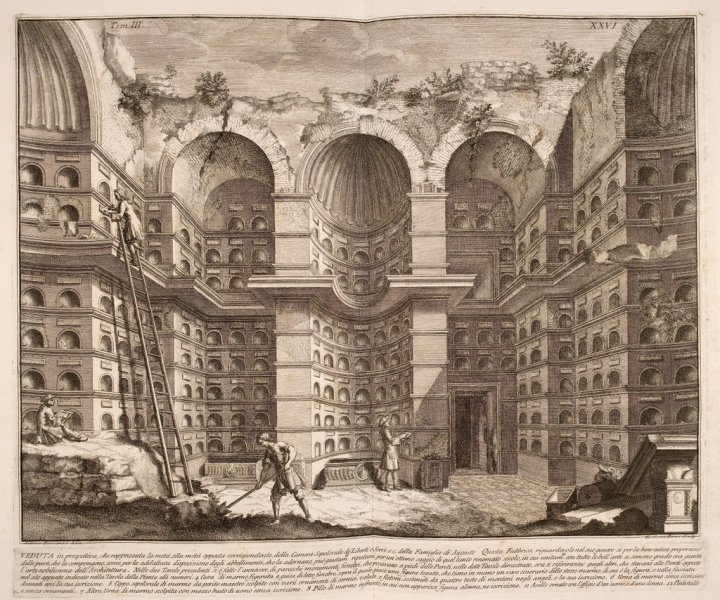
Image: Giovanni Piranesi, Illustration of an aviary, from Le Antichità romane, opera di Giambatista Piranesi, etc. (London: British Library, c13091-59; shelfmark: 744.f.2 26).
Call for Papers | The Global History of Knowledge, 1450–1750
From ArtHist.net and Scientiae:
Scientiae Fall Conference: The Global History of Knowledge, 1450–1750
Brown University, Providence, 25–26 October 2024
Proposals due by 15 May 2024

Samuel de Champlain, Brief discours des choses plus remarquables que Samuel Champlain de Brouage á reconneues aux Indes occidentales, 1602, 35r (igre. Loupcervier Leopard). Providence: John Carter Brown Library, Codex Fr 1.
Scientiae is very pleased to announce its first fall conference. This event will take place at, and with support of Brown University, Providence, Rhode Island, on Friday 25 and Saturday 26 October 2024. For this conference we have chosen the theme The Global History of Knowledge with a specific, but not exclusive, focus on the Americas and the Atlantic in the period 1450–1750. Historians of science, philosophers, literary scholars, art historians, and many other seemingly distant experts are encouraged to reflect together on the complexities of the early modern period. We are proud to announce a keynote address by Pablo F. Gómez (University of Wisconsin-Madison).
The organizing committee consists of Matthijs Jonker (Scientiae/Utrecht University), Tara Nummedal (Brown University), and Hal Cook (Brown University). Inquiries can be addressed to m.j.jonker@uu.nl.
We envision three ways to join:
• Individual, 20-minute papers: please submit a descriptive title, 200-word abstract, and one-page CV.
• Complete panels: same as above for each paper, plus 200-word rationale for the panel (maximum four presenters, including chair and/or respondent).
• Workshops or seminars: one-page CV for each session leader, plus 200-word plan explaining the topic’s suitability and its techniques or resources.
Please submit your proposal online before midnight, 15 May 2024, at scientiae.uk@gmail.com.
Providence has a good airport and is well-connected to New York City and Boston by train. The conference organizers look forward to welcoming you to Providence in October!










 Enfilade
leave a comment