Exhibition | Emulating Books
Now on view at The Met:
Emulating Books: Book Objects from the Lynn and Bruce Heckman Gift
The Metropolitan Museum of Art, New York, 18 April — 16 July 2024

Box with Tulip and Hearts Motif in Book Form, 1714, carved wood (possibly European walnut), 9 × 7 × 3 cm (NY: The Metropolitan Museum of Art, gift of Lynn and Bruce Heckman, N7433.3 .B69 1714).
Creating objects in book form has been an artistic practice for a millennium. These personal, inventive objects are ubiquitous in many cultures. They have been made for various purposes by people from all walks of life and skill levels. Whether precious or plain, useful or symbolic, they all benefit from their connection to the book. For example, the book-style relic of the ship Eurydice, which sank in 1878, killing over 300 sailors, was carved from a piece of the ship, and serves as an emblem documenting the history of the event, as well as a memorial book honoring the dead.
An object made in the form of a book translates the meaning of the type of book it emulates, therefore imbuing the object with the emotional, material, or spiritual values of the original or imagined book. These objects can express feelings of love, enlightenment, humor and faith, and sometimes the mere experience of holding a book object, as with a treasured tome, can comfort its owner, as in the case of the solid wood Holy Bible which will never open, but comforts just the same. As a result of the book’s power, traditions of making specific types of book objects, such as book safes and game boards, have evolved and flourished. Examples of these traditions, made during the eighteenth to twentieth centuries can be seen in this exhibition.
The Heckman collection is a gift to the Thomas J. Watson Library from Lynn Geringer Heckman, who began collecting objects in book form with her late husband Bruce Heckman in 1989, eventually amassing over 1,000 works. The Watson gift is a select group chosen from the larger collection. The objects on display will be available for consultation in our Reading Room at the conclusion of the exhibition.
Call for Papers | Discovering Dalmatia X
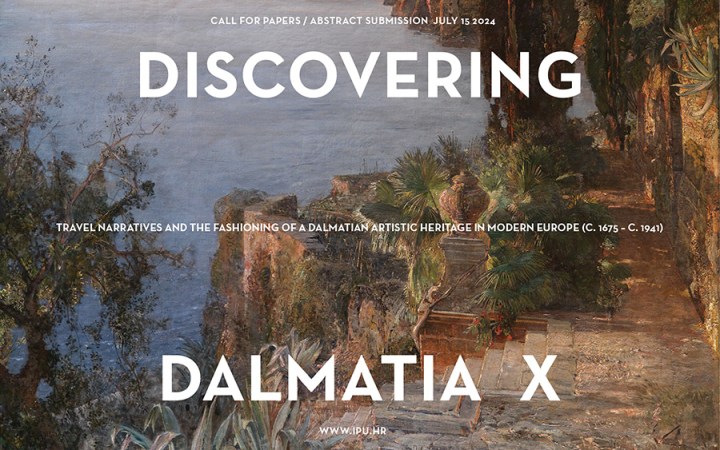
From the Institute of Art History – The Cvito Fisković Centre in Split:
Discovering Dalmatia X: Travel Narratives and the Fashioning of a Dalmatian Artistic Heritage in Modern Europe, c. 1675–1941
Online and in-person, Split City Museum – Old City Hall, 12–14 December 2024
Proposals due by 15 July 2024
Travel narratives encompass travel experiences presented in books, illustrated books, magazines, personal or official reports, diaries, letters, drawings, paintings, prints, and photographs. These are among the most frequently used sources in history, literature, art history, anthropology, and a range of other disciplines. But, due to their diversity and complexity as texts, travel narratives have tended to elude definition or easy categorisation across the spectrum of disciplines that draw on travel as valuable primary source materials.
Travelogues about Dalmatia, both visual and textual, have played a considerable role in the construction of its European identity, grounded in a curiosity about the region’s unique artistic heritage. The reasons for this lie with Dalmatia’s geographical position on the border between East and West, between the Christian and Islamic cultural worlds—the long history of which is richly recorded in the art and cultural expression of the region. The dichotomy of ‘East’ and ‘West’ in Dalmatia has meant a hybridisation of cultural, artistic, and geographical borders, all of which have made Dalmatia a particularly attractive destination for study trips from the early modern period.
The key period for the diffusion of travelogues about Dalmatia in Europe began in the late seventeenth century, and lasted until the mid-twentieth century. This era saw extraordinary popularisation and internationalisation of the travel genre in Europe, prior to the rise of organised tourism. This was likewise a crucial period for modern art history, during which processes of disciplinary transition and modernisation took place, both in Dalmatia and throughout the continent of Europe as a whole. Dalmatia was ‘exotic’ and yet simultaneously accessible to the classically-oriented Western European cultural imaginary.
With this conference, we aim to bring together historical and theoretical research on the travel genre as experiences transformed into textual and visual forms (irrespective of the geographical area), with a re-evaluation of the role of travel narratives in shaping the cultural identity of Dalmatia.
We, therefore, pose, two key questions:
• What does ‘travel narrative’ encompass?
• How did travelogues influence perceptions of Dalmatia’s artistic heritage in modern Europe?
Historians and theorists of art, architecture, urbanism, literature, anthropology, ethnology, and those engaged with travel narratives, are warmly invited to participate in scholarly presentations and discussion at the conference. We hope to contribute, on the one hand, to fostering an understanding of travel as an autonomous multidisciplinary and multimedia practice, and, on the other, to understanding the formation of perceptions of Dalmatia in the European imaginary. We are looking forward to considering a wide range of travel narratives for the conference—varying in genre characteristics, recording media, authors’ origins, and travel motives.
We welcome proposals for 20-minute papers. Proposals consisting of a 250-word abstract and a short CV in Croatian or English should be sent via email as a PDF attachment to discoveringdalmatia@gmail.com by 15 July 2024.
We plan to enable participation at the conference both in person in Split and via online platforms to facilitate international involvement. Registration will take place on the evening of the 11th of December, the closing address will take place on the 14th of December, and the hosts will organise coffee and refreshments for the conference participants during breaks. No participation fee will be charged for this conference. The organisers do not cover travel and accommodation costs. The organisers can help participants to find reasonably-priced accommodation in the historical city centre. Papers and discussion will be conducted in English. The duration of a spoken contribution should not exceed 20 minutes. Presentations will be followed by discussions. We propose to publish a collection of selected papers from the conference.
The conference is organized as part of the Croatian Science Foundation project Travelogues Dalmatia IP-2022-10-8676.
Scientific Committee
Basile Baudez (Princeton University, Department of Art and Archaeology)
Joško Belamarić (Institute of Art History – Cvito Fisković Centre Split)
Mateo Bratanić (University of Zadar, Department of History)
Iain Gordon Brown (Honorary Fellow, National Library of Scotland)
Hrvoje Gržina (Croatian State Archives)
Katrina O’Loughlin (Brunel University London)
Cvijeta Pavlović (University of Zagreb, Department of Comparative Literature)
Frances Sands (Sir John Soane’s Museum)
Marko Špikić (University of Zagreb, Department of Art History)
Ana Šverko (Institute of Art History – Cvito Fisković Centre Split)
Elke Katharina Wittich (Leibniz Universität Hannover)
Organizing Committee
Joško Belamarić (Institute of Art History – Cvito Fisković Centre Split)
Tomislav Bosnić (Institute of Art History – Cvito Fisković Centre Split)
Mateo Bratanić (University of Zadar, Department of History)
Ana Ćurić (Institute of Art History)
Matko Matija Marušić (Institute of Art History)
Katrina O’Loughlin (Brunel University London)
Cvijeta Pavlović (University of Zagreb, Department of Comparative Literature)
Ana Šverko (Institute of Art History – Cvito Fisković Centre Split)










 Enfilade
leave a comment