Call for Papers | Puritan Picture
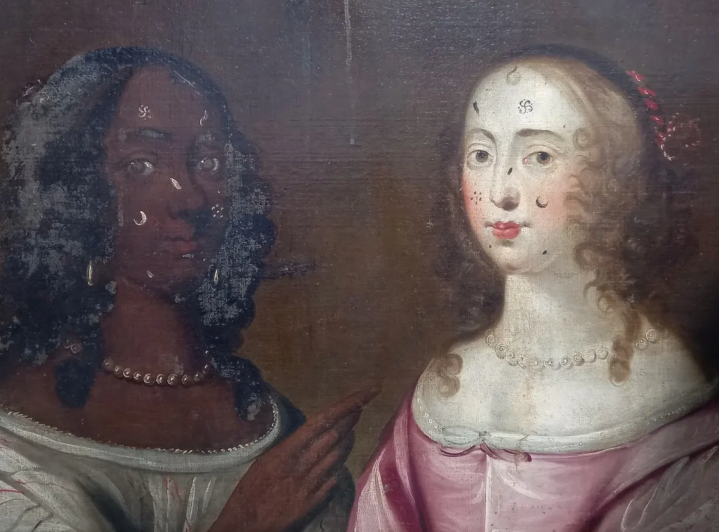
Unidentified painter (British School), Allegorical Painting of Two Ladies Wearing Beauty Patches, detail, ca. 1650s, oil on canvas, 64 × 75 cm. The painting sold at Trevanion, Fine Art and Antiques sale on 23 June 2021 (lot 564).
◊ ◊ ◊ ◊ ◊
This extraordinary painting predates even the long 18th century, but I imagine many Enfilade readers are as intrigued with it as I am. –CH. From ArtHist.net:
Puritan Picture: Vanity, Morality, and Race in Seventeenth-Century Britain
Yale University, New Haven, 27–28 September 2024
Proposals due by 17 June 2024
The middle decades of the seventeenth century in Britain were characterized by radical political, religious, and social change. In this period, an unknown artist created a remarkable painting that spoke to fears and anxieties crystallizing around a perceived increase in moral laxity, gender transgression, and the insidious influence of foreigners. The painting depicts two women side by side, each wearing a conspicuous array of beauty patches. The woman on the left reprimands her companion with the words “I black with white bespott: y[o]u white w[i]th blacke this Evill / proceeds from thy proud hart, then take her: Devill.” Text and image combine to inveigh against the sins of pride, vanity, and worldly excess. The painting reminds the viewer that sinful behavior leads to the devil and exhorts them to seek salvation.
Purchased by the Yale Center for British Art (YCBA) at auction in June 2021, the painting was recognized as a work of outstanding significance to the study of early modern race and gender. After an export stop, it was acquired by Compton Verney, an art gallery in Warwickshire that is housed in a Grade I–listed eighteenth-century manor surrounded by 120 acres of parkland, landscaped by Lancelot ‘Capability’ Brown. Compton Verney has loaned the painting to the YCBA for inclusion in the museum’s ongoing technical study of the theory and practice of painting skin tones. It will go on view at Compton Verney in November 2024. This enigmatic painting has never been subject to sustained research, and much about it remains uncertain. We do not know the identity of the artist or patron, or the original location of the painting, and it is not clear whether the two women are real or imagined figures.
The YCBA, in partnership with Compton Verney, will host a two-day symposium to increase understanding of this significant object in the history of British art and culture. We welcome proposals from established and emerging scholars and encourage participants to be imaginative in their approach. Themes for consideration include but are not limited to:
• artist circles and modes of production
• color symbolism and its connection to racial formation
• contemporary attitudes to piety and morality
• cosmetics, clothing, and accessories
• female sexuality and gender roles
• pigments and processes used by early modern artists for painting skin tones
• religious and ethnic minorities in early modern Britain
• the role of print culture and prescriptive literature
The symposium will be held at Hastings Hall, Yale School of Architecture on September 27 and 28, 2024. Please submit an abstract of no more than 250 words and a short biography to Sarah Leonard (sarah.leonard@yale.edu) by Monday, 17 June 2024. Final presentations should not exceed twenty minutes in length. The YCBA will provide travel and accommodations for successful applicants.
Call for Papers | Baroque Times: The Table’s Scenography
From ArtHist.net:
Baroque Times: The Table’s Scenography
Vila Nova de Foz Côa, Portugal, 14–16 November 2024
Proposals due by 15 July 2024
When discussing the table or the act of being at the table, our immediate thoughts go to the act of eating, the company present, and the food to be shared. However, the table transcends its practical function to become a richly layered symbol, both materially and conceptually, embodying sociability in myriad ways throughout history. During the modern era (17th–18th centuries), the table’s significance unfolded across diverse contexts and environments, from the opulent settings of palaces to the humble abodes of common citizens. Regardless of setting, the table served as a focal point, drawing together a spectrum of personalities and activities, thus assuming a central role in daily life. In palatial settings, the table symbolized power and sophistication, showcasing culinary refinement and adherence to social etiquette. The table epitomizes socialization, serving as a nexus for fundamental human experiences—the nourishment of the body and the establishment of communal identity within society. As such, it acts as a microcosm of cultural norms and interpersonal dynamics, revealing insights into societal values and individuals’ relationships with one another and with themselves.
Inspired by Christian traditions, the Western table echoes the teachings of Christ, who in the Gospels elevated the table to a sacred space for gatherings, sharing, inclusion and teaching. Depicted in various biblical scenes, such as the Wedding at Cana, the home of Martha, the Emmaus supper, and the Last Supper, the table emerges as a locus of truth and reverence, where communal sharing imbues food with deeper meaning.
At the table, physical proximity, and eye contact foster connections, yet may also give rise to discord. It is a space where alliances are forged, love and friendship blossom, and adversaries may surface. In its multifaceted nature, the table serves as a catalyst for a myriad of human activities, offering profound insights into the essence of human existence, whether amidst moments of serenity or the complexities of social interaction.
The following themes are proposed, although other related topics may also be accepted:
• The Table as Object: consideration of the table as a piece of furniture, in its various functions, such as dining, campaign, gaming.
• The Everyday Table: a space for daily gatherings, where routines and eating habits intertwine.
• Table and Power: dynamics of power and social hierarchy that manifest through table arrangement and associated rituals.
• Dressing the Table: the importance of porcelain, glassware, cutlery, textiles, and other elements in the aesthetic and functional composition of the table.
• Etiquette: the norms and social conventions that govern behavior at the table across different cultures and historical contexts.
• Food: the relationship between the table and the culinary space, including kitchens and food preparation areas.
• Celebration: how the table becomes the centrepiece of festive celebrations (attire, theatre, dance, fireworks, music, and ephemeral art in general).
• The Table in Literature: representations and symbolism associated with the table in literary works.
• Cross-Cultural Perspectives: Investigating intercultural practices related to the table and their mutual influences.
• Representations in the Visual Arts: how artists depict the table in painting, sculpture, tiles, textiles, and other decorative arts.
• Virtualizations of the Table: how the table is reinterpreted and recreated in virtual and digital environments.
• The Table in Cinema: representation and role of the table in neo-baroque movies of different genres.
• The Neo-Baroque Table: How the aesthetic and cultural principles of the Baroque continue to influence contemporary representations of the table.
To submit a proposal, send an abstract (a maximum of 300 words) addressing the objectives, methodology, and relevance of the work to the themes of the congress, along with a biographical note (maximum of 150 words) to temposdobarroco@gmail.com by 15 July 2024.
Scientific Committee
Carla Sofia Ferreira Queirós (ESEPP; CITCEM/FLUP)
Margarida Rebocho (ARS LUMINAE)
Maria João Pereira Coutinho (IHA – NOVA FCSH / IN2PAST)
Rui De Luna (Associação Cultural Castilho e Távora)
Sílvia Ferreira (IHA – NOVA FCSH / IN2PAST)
Scientific Committee
Ana Isabel Buescu (CHAM – NOVA FCSH)
Caroline Heering (Université catholique de Louvain)
Fátima Eusébio (Secretariado Nacional para os Bens Culturais da Igreja)
Fernando Quiles García (Universidad Pablo Olavide)
Gonçalo Vasconcelos e Sousa (Universidade Católica Portuguesa-Porto)
Inês de Ornelas e Castro (IELT – NOVA FCSH)
Isabel Drumond Braga (FLUL, CIDEHUS-UÉ; CH-UL)
Jaromir Olsovsky (University of Ostrava, Czech Republic)
Luis Javier Cuesta Hernández (Universidad Iberoamericana, Ciudad de México)
Ricardo Bernardes (Fundação Casa de Mateus)
Call for Articles | Anachronisms in Art History
From the Call for Papers / Appel à contributions:
Anachronisms in Art History / Anachronismes en histoire de l’art
Special issue of Perspective: Actualité en histoire de l’art
Edited by Thomas Golsenne, Hélène Leroy, and Hélène Valance
Proposals due by 17 June 2024, with finished articles due by 1 December 2024
Perspective will explore, in its 2025.2 issue—co-edited by Thomas Golsenne (INHA), Hélène Leroy (Musée d’Art Moderne de Paris), and Hélène Valance (université Bourgogne-Franche-Comté/InVisu)—the question of anachronisms in art history.
Since at least the 1960s, a number of critical approaches have emerged with regard to sweeping Western approaches that classified artworks and artists in successive stylistic periods, and even based the discipline on these temporal and formal categories. They made it possible to call into question the 19th-century ‘historism’ that confused the scholars’ temporal categories with the historical phenomena themselves, just as they have redefined periods as designations of time, objects of history. In practice, however, it is clear that the period remains more than ever the temporal unit within which we conceive art history and study it. Even if the subject of anachronism in art history emerged much earlier, for reasons that merit further consideration, it genuinely became worthy of interest for the epistemology of the historical sciences at the turn of the 21st century. What about art history?
To this end, three main topics emerge for proposed articles:
1 Disciplinary Anachronisms
2 Methodological Anachronisms
3 Historical Anachronisms
Additional information (including a bibliography) is available from the full Call for Papers»
Taking care to ground reflections in a historiographic, methodological, or epistemological perspective, please send your proposals (an abstract of 2,000 to 3,000 characters/350 to 500 words, a working title, a short bibliography on the subject, and a biography limited to a few lines) to the editorial email address (revue-perspective@inha.fr) no later than 17 June 2024.
Perspective handles translations; projects will be considered by the committee regardless of language. Authors whose proposals are accepted will be informed of the decision by the editorial committee in July 2024, while articles will be due on 1 December 2024. Submitted texts (between 25,000 and 45,000 characters/ 4,500 or 7,500 words, depending on the intended project) will be formally accepted following an anonymous peer review process.
Published by the Institut national d’histoire de l’art (INHA) since 2006, Perspective is a biannual journal which aims to bring out the diversity of current research in art history, highly situated and explicitly aware of its own historicity.
Conference | Textual Bibliography for Modern Foreign Languages

◊ ◊ ◊ ◊ ◊
Seminar on Textual Bibliography for Modern Foreign Languages
The British Library, London, 28 June 2024
p r o g r a m m e
11.00 Registration and coffee
11.30 Juan Gomis (Valencia) — Visual Recognition Tools for the Study of Spanish Chapbooks, 18th and 19th Centuries
12.25 Lunch break
1.30 Karima Gaci (Leeds) — French Grammar Textbooks Published in England, 18th and 19th Centuries
2.15 Yuri Cerqueira dos Anjos (Wellington) — French Writing Manuals in the 19th Century
3.00 Tea
3.30 Alexandra Wingate (Indiana) — Reviewing the Systems Approach: A General Model for Book and Information Circulation
4.15 Sarah Pipkin (London) — Two Works by Kepler in University College London, De stella nova (1606) and De cometis libri tres (1619), and Their Provenance
The seminar will end at 5.00pm. Attendance is free, but please pre-register by sending your full name to Barry Taylor at barry.taylor@bl.uk and Susan Reed at susan.reed@bl.uk.
Exhibition | The Craft of Tea, 1660–2024
Now on view at the The Goldsmiths’ Centre:
The Craft of Tea, 1660–2024
The Goldsmiths’ Centre, London, 1 May — 27 June 2024
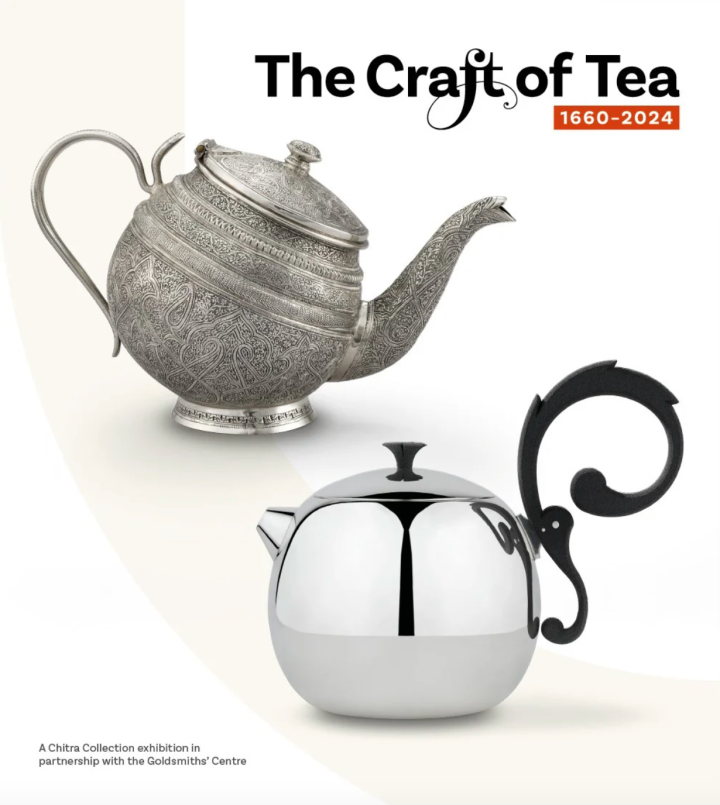 The Craft of Tea, 1660–2024 explores the material history of tea, stylistically and thematically, from 1660 to the present day. It presents remarkable silver objects from the Chitra Collection, an extraordinary private museum of historic teawares, alongside examples by modern and contemporary makers. Over forty notable pieces from the collection will be displayed, spanning the seventeenth to the twenty-first century. They will be exhibited together with loans from the Pearson Silver Collection, the Goldsmiths’ Company Collection, and individual makers. The Chitra Collection team has been a long-term contributor to the Goldsmiths’ Centre’s public and training programmes. The co-curated exhibition is a unique chance for members of the jewellery and silversmithing industry, Londoners and visitors to the Goldsmiths’ Centre to view examples from this incredible collection.
The exhibition is divided into eight themes that take you on a journey from the early beginnings of the tea trade in Europe, through tea taking as ritual, power, and rebellion, to the boundary-pushing teapots of the modern and contemporary period. The exhibits are global in scope, whilst also questioning the preoccupations of UK silversmiths today. Amongst the historical examples in each thematic display, you will find a contemporary counterpart that responds to or extends the ideas under consideration. Whatever your interest—visual, historical, or practical—we hope that you will enjoy this celebration of the craft of making tea.
The Chitra Collection is an unsurpassed private museum of historic teawares. With objects from Europe, Asia, and the Americas, the collection celebrates the global significance of tea and teaware design, from ancient China, through to the present day. In 2011 Nirmal Sethia, philanthropist and chairman of the luxury tea company Newby London, set himself the task of acquiring the world’s greatest collection of teawares to record and preserve tea cultures of the past. Today, the collection, named in honour of his late wife, Chitra, totals almost 3000 objects and is already the world’s finest and most comprehensive of its kind.
Charlotte Dew, Evelyn Earl, Grace Fannon, and Gregory Parsons, eds., The Craft of Tea, 1660–2024 (London: The Goldsmiths’ Centre, 2024), 70 pages, ISBN: 978-0907814450, $16.
Exhibition | Anxiety and Hope in Japanese Art
Now on view at The Met:
Anxiety and Hope in Japanese Art
The Metropolitan Museum of Art, New York, 8 April 2023 — 14 July 2024 (in four rotations)

Suzuki Harunobu, Young Woman Riding a Carp, 1760s, woodblock print (nishiki-e), ink and color on paper 26 × 20 cm (New York: The Metropolitan Museum of Art, JP1647). Here, the image of a young woman parodies the Daoist immortal Qin Gao, an auspicious figure who rides a carp. On display for rotation 4.
Drawn largely from The Met’s renowned collection of Japanese art, this exhibition explores the twin themes of anxiety and hope, with a focus on the human stories in and around art and art making. The exhibition begins with sacred images from early Japan that speak to concerns about death, dying, and the afterlife or that were created in response to other uncertainties, such as war and natural disaster. The presentation then proceeds chronologically, highlighting medieval Buddhist images of paradises and hells, Zen responses to life and death, depictions of war and pilgrimage, and the role of protective and hopeful images in everyday life. In the final galleries, the exhibition’s underlying themes are explored through a selection of modern woodblock prints, garments, and photographs.
Rotation 1 | 8 April — 13 August 2023
Rotation 2 | 26 August — 26 November 2023
Rotation 3 | 16 December 2023 — 14 April 2024
Rotation 4 | 27 April — 14 July 2024
The exhibition is made possible by The Miriam and Ira D. Wallach Foundation Fund.
Exhibition | Embracing Color: Enamel in Chinese Decorative Arts
Now on view at The Met:
Embracing Color: Enamel in Chinese Decorative Arts, 1300–1900
The Metropolitan Museum of Art, New York, 4 July 2022 — 4 January 2026

Snuff Bottle with Fish, late 18th–early 19th century, Qing dynasty (1644–1911), overlay glass with ivory-and-glass stopper, 6 cm high (New York: The Metropolitan Museum of Art, 21.175.280a, b).
Enamel decoration is a significant element of Chinese decorative arts that has long been overlooked. This exhibition reveals the aesthetic, technical, and cultural achievement of Chinese enamel wares by demonstrating the transformative role of enamel during the Ming (1368–1644) and Qing (1644–1911) dynasties. The first transformational moment occurred in the late 14th to 15th century, when the introduction of cloisonné enamel from the West, along with the development of porcelain with overglaze enamels, led to a shift away from a monochromatic palette to colorful works. The second transformation occurred in the late 17th to 18th century, when European enameling materials and techniques were brought to the Qing court and more subtle and varied color tones were developed on enamels applied over porcelain, metal, glass, and other mediums. In both moments, Chinese artists did not simply adopt or copy foreign techniques; they actively created new colors and styles that reflected their own taste. The more than 100 objects on view are drawn mainly from The Met collection.
Rotation 1 | 4 July 2022 — 30 April 2023
Rotation 2 | 20 May 2023 — 24 March 2024
Rotation 3 | 13 April 2024 — 16 February 2025
Rotation 4 | 1 March 2025 — 4 January 2026
This exhibition is made possible by the Florence and Herbert Irving Fund for Asian Art Exhibitions.
Exhibition | The Fuyun Xuan Collection of Chinese Snuff Bottles
Now on view at the Hong Kong Museum of Art:
Art of Gifting: The Fuyun Xuan Collection of Chinese Snuff Bottles
Hong Kong Museum of Art, from 12 April 2024

Double-gourd-shaped snuff bottle with floral design in painted enamals on yellow ground, glass, four-character mark of Qianlong and of the period, 1736–95, 6.1 cm high (Hong Kong Museum of Art).
In 2023, the Hong Kong Museum of Art received a generous donation from Mrs. Josephine Sin of 490 Chinese snuff bottles from the Fuyun Xuan Collection—the most extensive and comprehensive of its kind ever received by a museum in Hong Kong. Established by the late local collector Christopher Sin, the Fuyun Xuan Collection is recognised as one of the most important private collections of snuff bottles in the world. Featuring the gems of Mr. Sin’s lifelong collection, this donation represents a significant gift to Hong Kong from the donor couple. Epitomising the finest skills and artistry of Chinese artisans, the small and delicate snuff bottles became popular among nobles and high-ranking officials since emerging in the early Qing dynasty, and were often given as gifts in diplomatic, official, and social settings. Showcasing all of the 490 donated snuff bottles, the exhibition invites viewers to step into the kaleidoscopic world of these miniature, precious gifts.
The exhibition is one of the activities in the Chinese Culture Promotion Series. The LCSD has long been promoting Chinese history and culture through organising an array of programmes and activities to enable the public to learn more about the broad and profound Chinese culture.
Exhibition | Growing and Knowing in the Gardens of China
From the press release for the exhibition (7 March 2024) . . .
奪天工 Growing and Knowing in the Gardens of China
The Huntington Library, Art Museum, and Botanical Gardens, San Marino, 14 September 2024 — 6 January 2025
A new exhibition at The Huntington Library, Art Museum, and Botanical Gardens will explore the potential of gardens as spaces that not only delight the senses and nourish the body but also inspire the mind—both intellectually and spiritually. The literati during China’s Ming (1368–1644) and Qing (1644–1912) dynasties believed gardens resulted in more ethical connections to all living things. On view in the Chinese Garden’s Studio for Lodging the Mind from 14 September 2024 to 6 January 2025, 奪天工 Growing and Knowing in the Gardens of China will exhibit 24 objects, including hanging scrolls, hand scrolls, albums, and books from The Huntington’s collections and those throughout the United States. The exhibition will also feature a participatory artwork by contemporary Chinese artist Zheng Bo that was commissioned by The Huntington.
Growing and Knowing and the Huntington exhibition Storm Cloud: Picturing the Origins of Our Climate Crisis will run concurrently as part of PST ART: Art & Science Collide, a regional event presented by Getty featuring more than 60 exhibitions and programs that explore the intersections of art and science, both past and present.
Growing and Knowing will present three key themes: ‘Growing’, ‘Knowing’, and ‘Being’.
Growing
The introductory section to the exhibition, ‘Growing’, will focus on historical horticultural practices in China, many of which are still practiced today. Chinese scholars and gardeners experimented with domestication, grafting, and hybridization to create unusual cultivars (new varieties of plants developed through human intervention). Throughout the Ming and Qing dynasties, these techniques were well documented in horticultural manuals. Some of these books—such as The Secretly Transmitted Mirror of Flowers, completed by Chen Hao 陳淏 (1615–1703) in 1688—remained popular instructional guides in China into the 20th century. The well-known chrysanthemum flower exists as a result of hybridization experiments conducted by scholars and gardeners. Visitors will have the opportunity to view chrysanthemums in full bloom just outside of the exhibition walls in The Huntington’s Chinese Garden. Reproductions of gardening tools from the period will also be displayed.
Knowing
The second section, ‘Knowing’, will present a diverse selection of books and paintings from the Ming and Qing dynasties, showcasing the multiple ways that scholars thought about the plants they cultivated. “The works selected for ‘Knowing’ specifically highlight scholars’ understanding of plants as food, sources of emergency sustenance and pharmaceuticals, and keys to classical literature,” said exhibition curator Phillip E. Bloom, The Huntington’s June and Simon K.C. Li Curator of the Chinese Garden and Director of the Center for East Asian Garden Studies. A subtheme of the section will touch on the era’s hierarchies of knowledge—specifically how scholars’ intellectual knowledge of plants was valued over gardeners’ direct, physical knowledge. Gardeners’ bodily insights were largely ignored in historical texts, but they were revealed in visual sources. For example, the Ming dynasty painting Garden for Solitary Pleasure (17th century) shows a scholar lying deep in thought among bamboo and other trees, as nearby laborers bend over plants and carry tools to cultivate the scholar’s garden.
Being
Chinese scholars did not grow and learn about plants just for knowledge’s sake. Growing and knowing were means for them to better understand their place in the world and learn to interact more ethically with other creatures. The last section of the exhibition, ‘Being’, will explore these practices of self-cultivation. “In order to truly understand how nature works, scholars not only contemplated plants but also engaged with and learned from them,” Bloom said. “Caring for plants, observing their habits, taking pleasure in their forms, and ultimately recognizing their commonalities with humans were, in essence, practices whereby people may perfect themselves.” Pursuits of a Scholar, an 18th-century Qing dynasty painting album, dedicates several leaves to the different ways that scholars interacted with plants. One leaf shows a scholar writing observations of a bamboo plant in his study, while another depicts a scholar caring for chrysanthemums.
Ecosensibility Exercise: Fragrant Eight-Section Brocade 生態感悟練習: 聞香八段錦 by Zheng Bo
To invite visitors to develop their own meaningful relationships with their natural surroundings, The Huntington has commissioned the participatory artwork Ecosensibility Exercise: Fragrant Eight-Section Brocade by Hong Kong–based artist Zheng Bo. Fragrant Eight-Section Brocade is inspired by the traditional Chinese mind-body practice qigong 氣功. Building on exercises that date back nearly 900 years and remain widely practiced today, Zheng’s work includes eight exercises that combine simple full-body movements and deep breathing to activate the mind and body. Each exercise is performed with a fragrant plant, encouraging the participants to develop a human-plant connection. Visitors to the exhibition can perform the exercises on their own throughout The Huntington’s gardens at marked stops chosen by the artist. A film documenting the eight exercises will be shown in the gallery. The Huntington is also planning a series of public programs in which the artist will guide visitors through his reinterpreted movements.
Exhibition Catalog
The Huntington will publish an open-access digital catalog edited by Phillip E. Bloom, Nicholas K. Menzies (research fellow in The Huntington’s Center for East Asian Garden Studies), and Michelle Bailey (assistant curator for the Center for East Asian Garden Studies). The book will include seven essays, 16 catalog entries by various scholars, and a conversation with artist Zheng Bo. A paperback version of the catalog will be available at the Huntington Store.
This exhibition is made possible with support from Getty through its PST ART: Art & Science Collide initiative.
Call for Papers | A Legacy of Landscape Study
From ArtHist.net:
A Legacy of Landscape Study
Yale Center for British Art, New Haven, 5–6 December 2024
Proposals due by 1 July 2024
The Yale Center for British Art (YCBA) and Oak Spring Garden Foundation (OSGF) share a legacy of landscape study rooted in the collections of Paul and Rachel Lambert ‘Bunny’ Mellon. While the Mellons’ collecting practices differed, they both gathered significant materials in the history of British environments, horticulture, and landscapes. Notable examples include Paul Mellon’s paintings and prints by George Stubbs and J. M. W. Turner and Bunny Mellon’s garden treatises and Humphrey Repton Red Books. From these origins, the YCBA’s extensive collection of British art has encouraged generations of new scholarship on British landscape art, while OSGF has become a leading research institution for the global histories and futures of gardens, landscapes, and plants. Inspired by this legacy of collecting and scholarship, the YCBA and OSGF are hosting a symposium at Yale to bring together new interdisciplinary research on British landscape studies.
By commingling the diversity of approaches to the histories and depictions of landscapes and environments represented by the two institutions, this symposium aims to generate new scholarly conversation about the intersections of British culture, ecology, and land. We invite papers exploring new topics in the study of British landscapes, from art history to cultural geography to environmental studies, and we particularly welcome work exploring the relationship of cultural output to physical landscapes and ecologies. We encourage broad definitions of ‘landscape’ and ‘British’ to open the potential for discussions of the global context of Britain and its former empire, and to consider an international exchange of landscape art, design, and horticulture.
Proposed subjects might include, but are not limited to:
• Extractive, industrial, urban, and neglected landscapes
• Histories of collecting and display (whether art or plants)
• Interconnections of landscape and garden history and art history
• New critical approaches to environments, landscapes, and British identity
• Plant history and humanities broadly, including related subjects such as food history and agrarian history
Please submit an abstract of no more than 250 words and a short biography by 1 July 2024, 5pm (ET). The YCBA will provide travel and accommodations for successful applicants.










 Enfilade
leave a comment