Exhibition | Emulating Books
Now on view at The Met:
Emulating Books: Book Objects from the Lynn and Bruce Heckman Gift
The Metropolitan Museum of Art, New York, 18 April — 16 July 2024

Box with Tulip and Hearts Motif in Book Form, 1714, carved wood (possibly European walnut), 9 × 7 × 3 cm (NY: The Metropolitan Museum of Art, gift of Lynn and Bruce Heckman, N7433.3 .B69 1714).
Creating objects in book form has been an artistic practice for a millennium. These personal, inventive objects are ubiquitous in many cultures. They have been made for various purposes by people from all walks of life and skill levels. Whether precious or plain, useful or symbolic, they all benefit from their connection to the book. For example, the book-style relic of the ship Eurydice, which sank in 1878, killing over 300 sailors, was carved from a piece of the ship, and serves as an emblem documenting the history of the event, as well as a memorial book honoring the dead.
An object made in the form of a book translates the meaning of the type of book it emulates, therefore imbuing the object with the emotional, material, or spiritual values of the original or imagined book. These objects can express feelings of love, enlightenment, humor and faith, and sometimes the mere experience of holding a book object, as with a treasured tome, can comfort its owner, as in the case of the solid wood Holy Bible which will never open, but comforts just the same. As a result of the book’s power, traditions of making specific types of book objects, such as book safes and game boards, have evolved and flourished. Examples of these traditions, made during the eighteenth to twentieth centuries can be seen in this exhibition.
The Heckman collection is a gift to the Thomas J. Watson Library from Lynn Geringer Heckman, who began collecting objects in book form with her late husband Bruce Heckman in 1989, eventually amassing over 1,000 works. The Watson gift is a select group chosen from the larger collection. The objects on display will be available for consultation in our Reading Room at the conclusion of the exhibition.
Call for Papers | Discovering Dalmatia X
From the Institute of Art History – The Cvito Fisković Centre in Split:
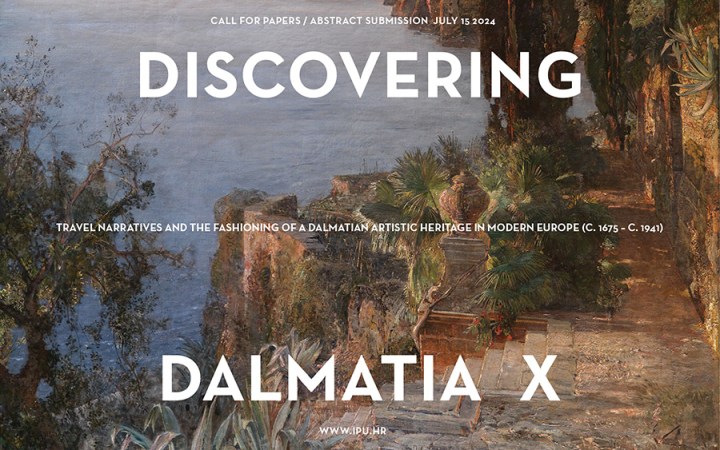
Discovering Dalmatia X: Travel Narratives and the Fashioning of a Dalmatian Artistic Heritage in Modern Europe, c. 1675–1941
Online and in-person, Split City Museum – Old City Hall, 12–14 December 2024
Proposals due by 15 July 2024
Travel narratives encompass travel experiences presented in books, illustrated books, magazines, personal or official reports, diaries, letters, drawings, paintings, prints, and photographs. These are among the most frequently used sources in history, literature, art history, anthropology, and a range of other disciplines. But, due to their diversity and complexity as texts, travel narratives have tended to elude definition or easy categorisation across the spectrum of disciplines that draw on travel as valuable primary source materials.
Travelogues about Dalmatia, both visual and textual, have played a considerable role in the construction of its European identity, grounded in a curiosity about the region’s unique artistic heritage. The reasons for this lie with Dalmatia’s geographical position on the border between East and West, between the Christian and Islamic cultural worlds—the long history of which is richly recorded in the art and cultural expression of the region. The dichotomy of ‘East’ and ‘West’ in Dalmatia has meant a hybridisation of cultural, artistic, and geographical borders, all of which have made Dalmatia a particularly attractive destination for study trips from the early modern period.
The key period for the diffusion of travelogues about Dalmatia in Europe began in the late seventeenth century, and lasted until the mid-twentieth century. This era saw extraordinary popularisation and internationalisation of the travel genre in Europe, prior to the rise of organised tourism. This was likewise a crucial period for modern art history, during which processes of disciplinary transition and modernisation took place, both in Dalmatia and throughout the continent of Europe as a whole. Dalmatia was ‘exotic’ and yet simultaneously accessible to the classically-oriented Western European cultural imaginary.
With this conference, we aim to bring together historical and theoretical research on the travel genre as experiences transformed into textual and visual forms (irrespective of the geographical area), with a re-evaluation of the role of travel narratives in shaping the cultural identity of Dalmatia.
We, therefore, pose, two key questions:
• What does ‘travel narrative’ encompass?
• How did travelogues influence perceptions of Dalmatia’s artistic heritage in modern Europe?
Historians and theorists of art, architecture, urbanism, literature, anthropology, ethnology, and those engaged with travel narratives, are warmly invited to participate in scholarly presentations and discussion at the conference. We hope to contribute, on the one hand, to fostering an understanding of travel as an autonomous multidisciplinary and multimedia practice, and, on the other, to understanding the formation of perceptions of Dalmatia in the European imaginary. We are looking forward to considering a wide range of travel narratives for the conference—varying in genre characteristics, recording media, authors’ origins, and travel motives.
We welcome proposals for 20-minute papers. Proposals consisting of a 250-word abstract and a short CV in Croatian or English should be sent via email as a PDF attachment to discoveringdalmatia@gmail.com by 15 July 2024.
We plan to enable participation at the conference both in person in Split and via online platforms to facilitate international involvement. Registration will take place on the evening of the 11th of December, the closing address will take place on the 14th of December, and the hosts will organise coffee and refreshments for the conference participants during breaks. No participation fee will be charged for this conference. The organisers do not cover travel and accommodation costs. The organisers can help participants to find reasonably-priced accommodation in the historical city centre. Papers and discussion will be conducted in English. The duration of a spoken contribution should not exceed 20 minutes. Presentations will be followed by discussions. We propose to publish a collection of selected papers from the conference.
The conference is organized as part of the Croatian Science Foundation project Travelogues Dalmatia IP-2022-10-8676.
Scientific Committee
Basile Baudez (Princeton University, Department of Art and Archaeology)
Joško Belamarić (Institute of Art History – Cvito Fisković Centre Split)
Mateo Bratanić (University of Zadar, Department of History)
Iain Gordon Brown (Honorary Fellow, National Library of Scotland)
Hrvoje Gržina (Croatian State Archives)
Katrina O’Loughlin (Brunel University London)
Cvijeta Pavlović (University of Zagreb, Department of Comparative Literature)
Frances Sands (Sir John Soane’s Museum)
Marko Špikić (University of Zagreb, Department of Art History)
Ana Šverko (Institute of Art History – Cvito Fisković Centre Split)
Elke Katharina Wittich (Leibniz Universität Hannover)
Organizing Committee
Joško Belamarić (Institute of Art History – Cvito Fisković Centre Split)
Tomislav Bosnić (Institute of Art History – Cvito Fisković Centre Split)
Mateo Bratanić (University of Zadar, Department of History)
Ana Ćurić (Institute of Art History)
Matko Matija Marušić (Institute of Art History)
Katrina O’Loughlin (Brunel University London)
Cvijeta Pavlović (University of Zagreb, Department of Comparative Literature)
Ana Šverko (Institute of Art History – Cvito Fisković Centre Split)
New Publication | Close Encounters: The Low Countries and Britain
As noted at Art History News, the following essays are all available for free through the RKD’s website:
Karen Hearn, Angela Jager, Sander Karst, Rieke van Leeuwen, David Taylor, and Joanna Woodall, eds., Close Encounters: Cross-Cultural Exchange between the Low Countries and Britain, 1600–1830 (The Hague, Gerson Digital X, 2024, produced by Rieke van Leeuwen). Proceedings of the International Conference Held at the RKD, The Hague, 22–23 September 2022

Samuel van Hoogstraten, Perspective Portrait of a Young Man Reading in the Courtyard of an Imaginary Building, 1662–67 (Dordrecht: Dordrechts Museum, inv./cat.nr. DM/023/1525).
1 Refugees and Fortune Seekers: Artists from the Low Countries in Britain, An Overview in Numbers — Rieke van Leeuwen
2 Nicholas Stone the Elder (c. 1587–1647) and his Circle — Adam White
3 Between Two Courts: Gerard van Honthorst and Stuart Patrons in London and The Hague — Michele Frederick
4 Fire and Plague: Samuel van Hoogstraten’s Career in England — John Loughman
5 The Van de Velde Studio at the Queen’s House — Allison Goudie and Imogen Tedbury
6 Dutch Terminology in Artists’ Workshops in London — Ulrike Kern
7 Leatherwork and Kwab Frames: 17th-Century Auricular Picture Frames and their Anglo-Dutch Context — Gerry Alabone
8 Copying the Cartouche: Anglo-Dutch Encounters in Cartography and Slavery — Eleanor Stephenson
9 John van Collema: A Dutch India Goods Merchant in London — Amy Lim
10 The Print Collection of William Cartwright (1606–1686): A Reconstruction — Ellinoor Bergvelt
11 Thomas Worlidge’s Claim to Fame: An Approach to Rembrandt’s Printed Tronies in 18th-Century England — Rebecca Welkens
12 The Griffier Family of Painters and the Young Thomas Gainsborough — Rica Jones
13 Willem van de Velde’s Fame in 18th-Century England — Remmelt Daalder
14 In the Wake of the Old Masters: Dutch Modern Artists in Britain, 1780–1830 — Quirine van der Meer Mohr
Funding News | Mellon Centre Publication and Digitisation Grants
The Mellon Centre recently announced changes to its publication grants and the introduction of digitization grants:
Paul Mellon Centre Funding: Publication and Digitisation Grants
Applications accepted 5 August — 30 September 2024
Ahead of the opening of the autumn 2024 round of funding opportunities we have made some alterations to simplify and improve our Publication Grants. Our Publication Grants continue to be one of our most heavily subscribed awards, and in 2023 received over ninety applications. Therefore we have decided to streamline the process; instead of having the single Publication Grant, for which authors and publishers could apply separately or together, from autumn 2024 there will be three distinct grant categories:
Author Grants (Large)
Awards of up to £6,000 which can only be applied for by authors, editors or individuals working on a long-form piece of written work (e.g. monograph, catalogue etc.). This award is designed to support costs incurred by the author relating to the publication, such as image purchasing and copyright, commissioning of new photography or graphics, marketing/publicity costs and supporting publisher subventions.
Author Grants (Small)
Awards of up to £1,000 which can only be applied for by individuals working on a short-form piece of written work (e.g. article, chapter etc.) for a scholarly journal or edited volume. This award is primarily designed to support costs incurred by the individual for images use associated with their piece of writing (e.g. copyright costs, image purchasing, commissioning of new photography or graphics).
Exhibition Publication Grants
Awards of up to £6,000 which can only be applied for by organisations, institutions or publishers working on a publication associated with an exhibition on British art or architectural history. The publication could be due to be published to coincide with the exhibition or as a direct result of an exhibition. This award is primarily designed to support the practical costs incurred by the organisation, institution or publisher when publishing the work (e.g. printing, binding, image rights, commissioning new photography or images, indexing, copy-editing, production costs, marketing and publicity etc.). If a publisher is interested in applying for a grant for a publication not relating to an exhibition we would encourage them to speak to the author or editor so they can apply for an Author Grant (Large).
Applications will open on 5 August and close 30 September. Please do contact the Grants & Fellowships Manager if you have any questions relating to these changes. Multiple applications across these schemes, for the same publication, will not be accepted. If an applicant is interested in digitising a publication then we would encourage them to look at our new Digitisation Grant which is due to be introduced in autumn 2024.
Supporting the field of British art history publishing has been an important strand of grantmaking for Paul Mellon Centre since its inception in 1970. These changes to the structure of the publications grants will not impact on the overall amount awarded to publication annually, and we will endeavour to support as many projects as possible.
◊ ◊ ◊ ◊ ◊
Digitisation Grants
The Mellon Centre is pleased to be able to introduce Digitisation Grants, a new funding opportunity that will be offered for the first time in our autumn 2024 round. Our Digital Project Grant was introduced in 2015 and since then has supported a variety of fascinating and innovative digital projects; however, since its inception we have noticed that many applicants are looking for funding to support more straightforward digitisation projects, and we hope this new grant will help.
The Digitisation Grant is an award of up to £5,000 and is specifically designed to help organisations make materials from their collections freely available for users online via digital methods. The grant may be used towards the practical costs of in-house digitisation (e.g. equipment and software), hiring an external digitisation service and personnel costs for cataloguing or research purposes.
Materials to be digitised could include:
• photographic collections
• archival collections of letters, index cards, notes etc.
• bound volumes (e.g. diaries, magazines, newspapers, albums, sketchbooks, published books etc.)
• objects, paintings or assets
• publications
Please note that organisations can only apply for this award to digitise items in their own collections.
We hope this grant will help to make materials concerning British art and architectural history available to a wider audience and continue Paul Mellon Centre’s mission to champion new ways of understanding British art history and culture.
Exhibition | Black Newporters, 17th–19th Centuries

Opening this month at the Newport Historical Society:
A Name, A Voice, A Life: The Black Newporters of the 17th–19th Centuries
Newport Historical Society, 29 May — 29 November 2024
Curated by Zoe Hume
Discover the rich narratives of five individuals of African descent who resided in Newport from its inception in 1639 to the abolition of slavery in Rhode Island’s constitution in 1842. Delve into their connections, commercial endeavors, religious affiliations, and more through an immersive exhibit at the Newport Historical Society Richard I. Burnham Resource Center. The exhibition also features interpretations by three Rhode Island artists, offering visual insights into the lives and experiences of these historical figures.
Online Talk | Peter Kenny on Cabinetmaker Charles-Honoré Lannuier

◊ ◊ ◊ ◊ ◊
An ADAF online presentation (as noted at Events in the Field, the ever-useful calendar maintained by The Decorative Arts Trust) . . .
Peter Kenny | Forging a New Vernacular: French Ébéniste in Federal New York
Online, American Decorative Arts Forum, 21 May 2024, 9pm (ET)
Charles-Honoré Lannuier (1779–1819) arrived in New York in the spring of 1803 a thoroughly-trained Parisian ébéniste who, according to his inaugural newspaper advertisement, had “worked at his trade with the most celebrated Cabinet Makers of Europe.”

Charles-Honoré Lannuier, Pier Table, 1815–19, mahogany, mahogany veneer, pine, tulip poplar, maple, marble, gilded brass, die-stamped brass, plate glass, 35 inches wide (New York: The Metropolitan Museum of Art, 2018.30a, b).
Well-versed in the elegant forms of the late Louis XVI period, which still held sway during the earliest period of his training in Paris, Lannuier’s design vocabulary at the time of his arrival also included the harder edged yet brilliant neoclassical style of post-Revolutionary France known as Directoire (1795–99), and the Consulat (1799–1804), a heavier more monumental style featuring the more archaeologically correct forms of le goût antique. This was Lannuier’s Parisian stylistic legacy. How he transformed this legacy, ultimately becoming one of the two principal leaders of the New York school of cabinetmaking alongside his greatest rival, Duncan Phyfe, is an inspiring and a uniquely American story.
After a thirty-year career at the Metropolitan Museum of Art, Peter M. Kenny retired in 2014 as the Ruth Bigelow Wriston Curator of American Decorative Arts and Administrator of the American Wing. From 2015 to 2020 he served as co-president of Classical American Homes Preservation Trust, where he was responsible for the overall management and curatorial vision of its seven historic houses in New York City, the Hudson River Valley, North and South Carolina, and the U. S. Virgin Islands. A nationally recognized expert on early American furniture, he has lectured extensively on the subject at American museums and universities. The catalogs to his major exhibitions on the renowned cabinetmakers Charles-Honoré Lannuier (1779–1819) and Duncan Phyfe (1770–1854) garnered the Robert C. Smith Award of the Decorative Arts Society, and the Henry Allan Moe Prize from the New York State Historical Association. He was the 2015 recipient of the Eric M. Wunsch Award for Excellence in the American Arts and the 2018 Antiques Dealers’ Association of America Award of Merit. Mr. Kenny serves on the boards of The Chipstone Foundation in Milwaukee, which publishes the journals, American Furniture and Ceramics in America, Boscobel Restoration, Inc. in Garrison, New York, and Hyde Hall in Cooperstown, NY. He also serves as a Scholarly Advisor for Historic Huguenot Street in New Paltz, NY. Mr. Kenny is a graduate of Montclair State University and received his MA from the Cooperstown Graduate Program (State University of New York College at Oneonta) in History Museum Studies.
The American Decorative Arts Forum (ADAF) encourages the study, understanding, enjoyment and preservation of American art and design from their earliest beginnings to the present. Founded in 1983 to promote the study and appreciation of decorative arts, the ADAF has broadened its scope to include many areas of American fine arts and design, including fashion and architecture. The Forum sponsors up to twelve lectures annually by nationally recognized experts which are held in-person at the Gunn Theater, Legion of Honor, San Francisco and/or via Zoom. Members also have access to special events, including curator-led tours of exhibitions, visits to private collections, and travel opportunities. Members also receive a newsletter and emails containing updates and schedules of lectures and events.
Mount Vernon Symposium 2024
From Mount Vernon:
On the Eve of Independence: Art and Architecture in the British Empire
Online and in-person, The Washington Presidential Library at Mount Vernon, 31 May — 2 June 2024
In 1774, on the eve of the American Revolution, George Washington began a major expansion of his home, a building whose foundations dated to the 1730s. It was a project that he maintained throughout the war and that he continued after his triumphant return to Mount Vernon. Inspired by the work that began 250 years ago, the 2024 Mount Vernon Symposium will explore the art and architecture of the British Atlantic in the long-eighteenth century, surveying the connections between and comparisons of British and American practices in the years preceding and surrounding the American Revolution.
Speaker biographies and abstracts are available here»
f r i d a y , 3 1 m a y
1.00 Welcome and Introductions
1.15 Afternoon Talks
• Cosmopolitan and Local in Colonial Boston: Copley’s House — Jeffrey Klee
• Britain Over the Blue Ridge: Architectural Impressions on Virginia’s Shenandoah Valley — A. Nicholas Powers
• Between a Handsome Finish and Sorrowful Discouragement: Black Craftsmen and the Making of American Architecture — Tiffany Momon
• Reimagining Hemsley’s Cloverfields — Willie Graham
• George Washington’s Mount Vernon: From Revolution to Revitalization — Susan Schoelwer and Thomas Reinhart
6.30 Reception, Mansion East Lawn / Mansion Open House
7.15 Dinner, Ford Orientation Center
s a t u r d a y , 1 j u n e
9.00 Welcome and Introductions
9.15 Morning Talks
• Free versus Will: Craftspeople in Early Maryland — Brittany Luberda
• Sleuthing Out a Portrait: From Mount Vernon to the British Island of Dominica — Dorinda Evans
• Drawing the Lines of Revolution: Pastel Portraits, Boycotts, and American Independence — Megan Baker
• Disasters in the Eighteenth-Century North Atlantic: Art, Gardens, and Novel — Joseph Litts
12.15 Lunch, Founders’ Terrace
1.45 Afternoon Talks
• The Endless Round: The London Town House, Politics and Society in the 1770s — Jeremy Musson
• Enlightened Eclecticism: The Grand Design of the 1st Duke and Duchess of Northumberland — Adriano Aymonino
• The Transatlantic Design Network: Thomas Jefferson, John Soane, and Agents of Architectural Exchange — Danielle Willkens
5.45 Reception, Mount Vernon Wharf
7.00 Dinner, Mount Vernon Wharf
s u n d a y , 2 j u n e
9.30 Morning Talks
• The Irish War of Independence and Burning the Big House, 1920–21 — Terence Dooley
• Tory, Whig, Empire: The Implications of Classical Style in the Early Modern British Empire — Sarah Hutcheson
• Public Architecture and Imperial Reform on the Eve of the Revolution: Governing the British Atlantic after the Treaty of Paris — Christian Koot
• Educating the Next Generation in Historic Trades and Preservation — Markus Damwerth, Christina Butler, Joseph Zemp, and Steve Fancsali
Exhibition | Maria Cosway (1760–1838)
Opening this month at the Pasquale Paoli Museum in Merusaglia:
Maria Cosway (1760–1838): A strada eccezziunale di un’artista
Museu Pasquale Paoli, Merusaglia (Corsica), 18 May — 30 October 2024
Curated by Amandine Rabier
 Maria Cosway (1760–1838): A Strada eccezziunale di un’artista (L’itinéraire singulier d’une artiste), présentée au Musée Maison natale de Pasquale Paoli raconte le cheminement d’une femme brillante que tout prédestinait à une grande carrière d’artiste dans la High Society anglaise et qui, contre toute attente, trouvera sa véritable émancipation en renonçant à sa première vocation pour se consacrer à l’éducation des jeunes filles. Ami fidèle, Pasquale Paoli (1725–1807) fut présent à chaque étape de cette vie singulière. Ses lettres à l’attention de Maria Cosway, tel un fil rouge, ponctuent les différentes sections de cette exposition. Fruit de deux années de travail en collaboration avec des institutions britanniques et italiennes reconnues, l’exposition s’accompagne d’un catalogue édité en français et en anglais, richement illustré et documenté par des historiens d’art réputés, spécialistes du XVIIIe siècle, sous la direction d’Amandine Rabier, commissaire de l’exposition. Cette exposition est aussi pour le musée de Merusaglia, l’occasion de s’extraire de son enracinement local pour rayonner sur la scène internationale, conformément à son Projet Scientifique et Culturel.
Introduction
• L’apprentissage en Italie
• Maria Hadfield devient Maria Cosway
Salle 1 | Maria Cosway dans la société anglaise
• La reine de Pall Mall
• À propos des femmes artistes
• Pasquale Paoli et Maria Cosway
Salle 2 | Maria Cosway peintre
• L’influence du cercle romain
• L’amitié avec David
• Exposer à la Royal Academy
Salle 3 | Rupture
Salle 4 | Émancipation: Maria Cosway pédagogue
Amandine Rabier, ed., Maria Cosway (Ghent: Snoeck Publishers, 2024), ISBN: 978-9461619051, €30.
Exhibition | Splendour in Venice: Canaletto and Guardi

Francesco Guardi, The Feast of the Ascension in the Piazza San Marco, detail, ca. 1775, oil on canvas
(Lisbon: Calouste Gulbenkian Museum)
◊ ◊ ◊ ◊ ◊
Opening this fall at Lisbon’s Calouste Gulbenkian Museum:
Splendor in Venice: Canaletto and Guardi in 18th-Century Painting
Veneza em Festa: Canaletto e Guardi na Pintura do Século XVIII
Calouste Gulbenkian Museum, Lisbon, 24 October 2024 — 13 January 2025
Museo Thyssen-Bornemisza, Madrid, 3 February — 12 May 2025
In 2024, the Calouste Gulbenkian Museum welcomes the masters of 18th-century Venetian painting in an exhibition organised in collaboration with the Museo Thyssen-Bornemisza. After working together on a 2009 exhibition devoted to the French painter Henri Fantin-Latour, the Calouste Gulbenkian Museum and the Museo Thyssen-Bornemisza are joining forces once again to promote an encounter between the works of their respective collections, based on their characteristic affinities. This new project, which starts in Lisbon in autumn 2024 and continues in Madrid in early 2025, takes as its theme 18th-century Venetian painting, with each museum contributing works that echo and complement one another. Canaletto, Guardi, Bellotto, and Tiepolo—creators of some of the most brilliant compositions of their time—will be brought together with other artists for the exhibition. The display will focus on the feste (the celebrations held in La Serenissima), vedute (panoramic views of a specific location), and capricci (fantastical architectures dreamt up by local artists), all of which are naturally festive motifs.
◊ ◊ ◊ ◊ ◊
Note (added 16 August 2025) — The posting was updated to include the dates in Madrid. Also, note that the catalogue is distributed by ACC Art Books and Simon & Schuster.
Lecture | Basile Baudez on Fabrics in 18th-C Venice
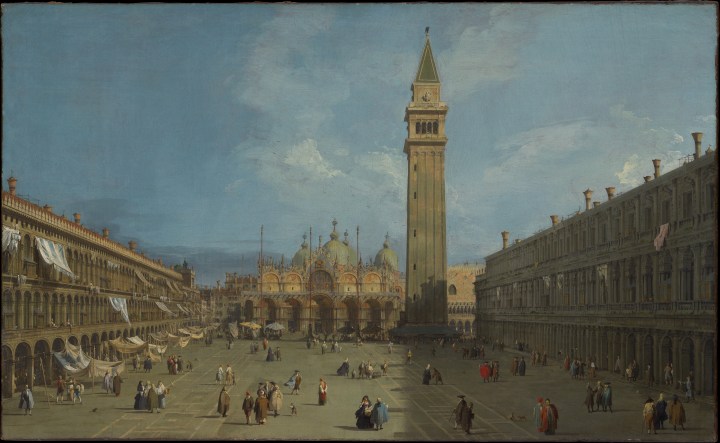
Canaletto, Piazza San Marco, ca. 1723, oil on canvas, 68 × 112 cm
(New York, The Metropolitan Museum of Art, Purchase, Mrs. Charles Wrightsman Gift, 1988.162)
◊ ◊ ◊ ◊ ◊
From the Bibliotheca Hertziana:
Basile Baudez | Fabricating the City: Canaletto and 18th Century-Venice
Online and in-person, Bibliotheca Hertziana – Max Planck Institute for Art History, Rome, 4 June 2024, 11am
Textiles are everywhere in the modern city. Flags flutter atop buildings. Awnings stretch over sidewalks. Laundry dangles between houses. Yet the crucial role these fabrics play in urban life has not been properly understood. This research seminar looks to eighteenth-century Venice to uncover the ways in which textiles shaped politics, society, and law in the early-modern metropolis.
One of the most famous cities in Europe and a gateway to the East, visited by merchants and tourists from around the world, Venice was adorned with textiles of all types: Turkish carpets, military standards, baldachins, and clothing, among them. Focusing on the celebrated vedute of Canaletto, this seminar will discuss how textiles mediated tensions between public authorities and private citizens in the control of common spaces such as streets and squares just as distinct public and private spheres were emerging in Europe and the question of who controlled them became increasingly contentious. Eighteenth-century Venice emerges here as a vivid case study for the progressive transformation of streets and squares from sites of living to sites of regulated circulation and temporary occupation, a marker of modern cities as we know them. By exploring the rich and varied textiles that adorned one of the most beautiful cities in Europe, this research seminar will not only shed light on a key moment in Venice’s political and artistic history, it will provide valuable historical grounding for future discussions about the role of physical fabrics in the social and political fabric of our cities.
This research looks at eighteenth-century Venice to establish a model applicable to any urban context. Under the pressure of the contemporary explosion of the tourist market in the eighteenth century, Venice became the most reproduced and recognizable cityscape in the world, far more so than urban centers like Paris and London. Images of the city and its inhabitants are found in painting, print, drawing, porcelain, and furniture while being endlessly described in travel books, guides, letters, novels, and plays. An entire school of city view painters celebrated its contemporary life in contrast to the ruins of Rome, its main rival. Having lost its economic and political standing on the world stage, the Venetian Republic positioned itself as a unique space of political stability, freedom, and pleasure while celebrating its cosmopolitanism. Indeed, Venice kept its unique status as the main trade partner of the Ottoman Empire, and its tourists sought to get a glance at its exotic visitors and their luxurious fabrics. Recent historiography on Venice has challenged the traditional view of the eighteenth century as a time of decadence and backwardness; in fact, it enjoyed an era of financial prosperity (derived largely from the textile industry), intellectual, musical, and artistic renaissance that posits the city, with its unique republican government, as a perfect case study to tell a story about modernity.
St Mark’s Square, the center of Venetian political, religious, and social life, was the most tightly controlled space in the Republic and probably in the whole of Europe. It is the heart of this study and is often compared to the stage of a theater, to which seeing and being seen are integral. On the Venetian stage, the Republic’s Senate took painstaking care to regulate the usage of and access to its every part, from the porticoes under the Procuratie to the interstitial space between the two Piazzetta granite columns: beggars and prostitutes were forbidden, itinerant vendors had to be authorized, garments were carefully controlled. But the Square was also the main locus of distraction, encounters, gossip, the location of the most popular cafés like Florian and luxury shops. On St Mark’s Square the Senate organized the main religious and civic festivities from the annual, tented Corpus Domini procession to the vast ephemeral luxury market erected the week of the Ascension—and, of course, the most famous Carnival of the continent, where clothes and masks helped to disguise each participant. By focusing on images, testimonies, and laws governing St Mark’s Square, this research covers the entirety of urban life in its spatial and temporal complexity through the textile medium.
This event with be available through the Bibliotheca Hertziana’s Vimeo Channel. The link will be soon published here.
Basile Baudez is Associate Professor of Architectural History in the Art & Archaeology department at Princeton University after having taught at the Sorbonne in Paris. His first book, Architecture et Tradition Académique au Siècle des Lumières (Presses Universitaires de Rennes, 2013) questions the role of architects in early modern European academies. He co-edited several volumes on the history of architecture such as A Civic Utopia: Architecture and the City in France, 1765–1837 (Drawing Matters, 2016), Chalgrin et son Temps: Architectes et architecture entre l’Ancien Régime et l’Empire (Blake and Co, 2016), and most recently Textile in Architecture from the Middle Ages to Modernism (Routledge, 2023). He curated several shows devoted to architectural drawings, at the Ecole des Beaux-Arts and at the Musée des Arts Décoratifs in Paris, and at the Courtauld Institute in London. His latest monograph, Inessential Colors: Architecture on Paper in Early Modern Europe (Princeton University Press, 2021) was the 2022 winner of the Alice Davis Hitchcock Medallion awarded by the Society of Architectural Historians of Great Britain. He is currently completing a book project entitled Textiles in the City: Fabricating Eighteenth-Century-Venice on the role of textiles in urban settings.










 Enfilade
leave a comment