Call for Papers | SEASECS 2025, Savannah
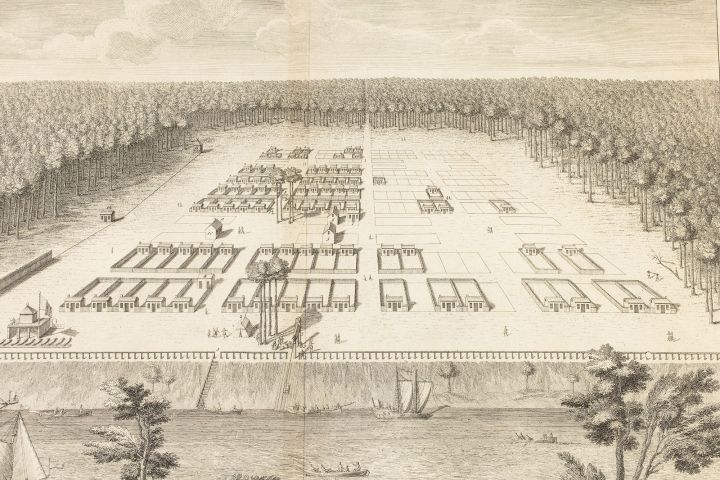
Paul Fourdrinier, after George Jones, A View of Savannah as it stood the 29th of March 1734, detail, ca. 1734, engraving, 20 × 26 inches.
◊ ◊ ◊ ◊ ◊
From SEASECS, with a selection of panels of particular interest for art historians:
51st Annual Meeting of the Southeastern American Society for Eighteenth-Century Studies
The Past is Still Present: Reclaiming the Eighteenth Century
The DeSoto, Savannah, Georgia, 6–8 February 2025
Proposals due by 16 September 2024
Conference Highlights
• Plenaries by Kurt Knoerl (underwater archaeologist and historian) and Celeste Guichard (architectural historian)
• Walking tour of historic Savannah led by Christopher Hendricks
• Reacting to the Past pedagogical workshop led by David Eick
• Writing (and submitting!) a pedagogy article led by Martha Bowden
Three ways to submit proposals
1. For any of the 23 outstanding Panels Seeking Participants, send your paper proposal (230–300 words) directly to the panel organizer by Monday, September 16. Include your full name, your institutional affiliation, and your email address (if possible, your ‘official’ institutional/professional email address).
2. For all other individual paper submissions on any topic related to the long 18th century, send your proposal to Elizabeth Kuipers by Monday, September 16, Elizabeth.Kuipers@asurams.edu. Include your full name, your institutional affiliation and your email address.
3. Send information on fully formed panels (including but not limited to undergraduate research panels) to Elizabeth Kuipers by Monday, September 16. Organizers, please send the title of your panel, your name, your institutional affiliation, and your email address along with the names of each of your participants, the titles of their papers, their institutional affiliations, and their email addresses.
Notifications of acceptances will be sent the first week of October.
Graduate students: We will have extra graduate student travel stipends this year to defray costs, thanks to the generosity of SEASECS members! Application details will be available in the fall.
◊ ◊ ◊ ◊ ◊
Illustrating the Past: The Long 18th Century in Graphic Novels, Comic Books, and Comic Strips
Joe Johnson, joejohnson@clayton.edu
This panel seeks presentations on graphic novels, comic books, and comic strips produced during or after, set in, and/or responding to the long 18th century. These comics can be adaptations of period works (such as renderings of Gulliver’s Travels, Robinson Crusoe, Tristram Shandy, and Frankenstein) or original stories depicting the era, its events, and people, such as Isaac Newton, the noted artist Jacques-Louis David, Napoleon, France’s loss of Canada in 1759, or its Revolution thirty years later.
◊ ◊ ◊ ◊ ◊
Art & Nature: Landscape in the Long 18th Century
Kasie Alt, kalt@georgiasouthern.edu
Ars et natura, art/skill and nature, form a foundational pairing, or tension depending on the source, in Enlightenment thinking. At the intersection of art and nature the concept of ‘landscape’ pervades the 18th century. Beneath what was, in European artistic hierarchies, a relatively lowly genre lies a complex matrix of identities and questions about the nature of the world and one’s place in it. Throughout the 18th century, art, literature, and philosophy, on a global scale, grappled with ideological, aesthetic, and cultural approaches to land in a manner that blurs, tests, and renegotiates the very identity of humans vis à vis nature and each other. Landscape was often used to locate oneself—to develop, negotiate, or reappraise one’s identity, place, and/or relationship to the world in which we live. Leveraging the interdisciplinary nature of the concept, this panel invites presentations examining landscape, broadly defined, in any discipline including visual and material cultures, architecture and design, literature, history, and philosophy, in any geographic area during the long 18th century. Given the theme of this year’s conference, presentations that discuss the lasting presence, effects, or ideological implications of 18th century landscape in today’s world are particularly welcome.
◊ ◊ ◊ ◊ ◊
Teaching Symposium
Martha F. Bowden, mbowden@kennesaw.edu
The teaching symposium invites teachers of the 18th century in all disciplines to contribute their particular strategies for introducing their 21st-century students to the world of the long 18th century. The 18th century offers challenges to our students: it is so near and yet so far, its developing consciousness of race, ethnicity, and gender like ours in its struggles but often so foreign in its approaches and conclusions. You may want to describe a syllabus for a class specifically about the 18th century, or a unit in a survey or freshman seminar that includes the 18th century but is not confined to it. Teachers at all levels, from AP and honors high school courses through graduate courses, are invited to submit proposals.
As time goes on, the challenges to our teaching change; how did the disruptions of the Covid pandemic change the needs of your students? Do you have strategies for dealing with AI, including teaching your students to use AI-powered tools? How has the increased availability of Digital Humanities resources affected your teaching strategies? The symposium takes the form of short, focused presentations about specific strategies, ideally accompanied by handouts that the audience can take home. While the presenters are usually the instructors, we have also had professor/student dialogues; I encourage participants to consider this dialogic approach to the pedagogy of the 18th century. Historically, the sessions have been very well attended, and the audiences not only ask really significant questions but also contribute wisdom of their own. I think of it as a conversation as much as a traditional panel. Send your proposal as a Word attachment containing the description of your teaching strategy.
◊ ◊ ◊ ◊ ◊
From Textile to Fashion and Beyond
Arlene Leis, Aleis914@gmail.com
What histories might emerge when we explore simultaneously textile and fashion practices and examine the possibilities between and beyond the two? Over the past fifty years research into the synergies between textile and dress histories continue to gain momentum. Ground breaking research by Lou Taylor, Evelyn Welch, Peter McNeil, Luca Molà, Rebecca Arnold, and John Styles have studied how dress and textiles were sources of innovation and economic and cross-cultural influences. More recently, Christopher Breward, Beverly Lemire, and Giorgio Riello’s substantial The Cambridge Global History of Fashion presents broader contextualization and investigates a range of key topics pertaining to fashion practice across time and space, including synergies between dress and textile, while also providing sharp analysis of wider visual and material cultures. There is also a continuing interest in how science and technology as seen in photography, conservation, reconstruction, and digitization help us better understand complex textiles and garment histories.
Our panel focuses on the interdisciplinarity between two seemingly separate histories: textile and fashion. Examining closely the relationship between the two, including across diverse media and genres, our goal is to utilize this panel as a way to explore, encourage, and foreground a range of interactions, and it attempts to further grasp and understand, at historical, practical, and theoretical levels, the possible links between these practices. The papers explore the cultural and social histories of apparel and textiles as well as their preservation, with the aim of presenting and making way for new and emerging research on textiles, fashion, and beyond.
◊ ◊ ◊ ◊ ◊
Artist’s Signatures
Sarah Sylvester Williams, willisj@millsaps.edu
During the 18th century, artists did not always sign their artworks. Scholar Charlotte Guichard has written about artists who did, such as Chardin, François Boucher, Hubert Robert, and Jacques-Louis David. These signatures were evidence of the changing status of the artist and art market, as well as political developments. But what about other artists who did not regularly sign their work? This panel seeks papers that deal with rare or infrequent artistic signatures. What do the odd occasions when the artist included their signature tell us about the artist, the artwork, or the circumstances of its commissioning or reception?
◊ ◊ ◊ ◊ ◊
Material Culture of Gender
Lauren DiSalvo, Laurendisalvo4@vt.edu
This is an open session exploring the relationships between material culture and gender in the long 18th century. Of interest are papers that use material culture to explore how social behavior relating to gender might be communicated or reinforced through material objects. For example, Ryan Whyte writes about miniature women’s almanacs as a subversive mode of women’s participation in Enlightenment knowledge. The miniaturizing of paintings in the almanacs’ pages and their decorative covers presented a feminized knowledge, yet the same material object allowed women to participate in the discourse of history painting. Especially welcome are papers that use material culture to challenge or complicate 18th-century understandings of gender. Participants may choose to focus discussions on gendering in relationship to individual objects or their materiality.
◊ ◊ ◊ ◊ ◊
Representations of Indigenous Perspectives
Patty Hamilton, phamilto@uu.edu
To follow up on LeAnne Howe’s plenary presentation at our 2024 conference at Furman, “The Art and Craft of Image Production in Fiction: Depictions of Native Americans in Historical Fiction,” I propose to broaden the conversation from ‘depictions’ (which may or may not be historically accurate depending on who is doing the depicting, as Prof. Howe illustrated) to ‘representations of indigenous perspectives’ in the long 18th century. Spanning genres, these representations may be literary, historical, or artistic, but they should share in common an attempt to accurately represent the perspective (beliefs, values, social fabric, experience) of indigenous peoples (as Olaudah Equiano does in the opening chapter of his autobiography). What insights or re-visioning can such representations yield? For the purposes of the panel, ‘indigenous’ may be broadly construed as the native peoples of North, Central, and South America and the Caribbean as well as West Africa, India, or other sites of European empire in the 18th century. Orientations may be critical or pedagogical.










 Enfilade
leave a comment