Call for Papers | Skillful Hands: Apprentices and Networks of Learning
From the Call for Papers:
Skillful Hands: Apprentices and Networks of Learning, 1650–1950
Rienzi’s Biennial Symposium
Museum of Fine Arts, Houston, 9 November 2024
Proposals due by 15 August 2024
Rienzi, the house museum for European decorative arts of the Museum of Fine Arts, Houston, presents the symposium Skillful Hands: Apprentices and Networks of Learning 1650–1950.

William Hogarth, Industry and Idleness, Plate I: The Fellow ‘Prentices at Their Looms, October 1747, etching and engraving (Houston: Sarah Campbell Blaffer Foundation, BF.1983.5.45).
Until the late 19th century, apprenticeship was the primary way people were trained in craft trades in Europe and the Americas. Formal education was mainly out of reach for many children from middle-class and low-income families. Apprenticeship training, a legal contract between a student and a master craftsperson, became an advantageous alternative to traditional education. Apprenticeships were regulated and monitored by European craft guilds established during the medieval period to control craft production. Their influence extended beyond the training period, and apprentices were generally closely linked to master craftspeople through cultural and social ties, including intermarriage. Within the traditional guild system, females, immigrants, Indigenous and enslaved peoples, and children from low-income families were often excluded.
With the onset of the Industrial Revolution, informal apprenticeships were introduced to adapt to innovations and technologies. Colonial expansion provided a range of new raw materials and new demands for skilled labor. Outside traditional European apprenticeship models, skills were acquired through forced migration, local environments, and informal training in various colonial regions. These varied experiences resulted in a diverse network of skilled craftspeople, both anonymous and renowned. The symposium critically considers the networks of learning available—and unavailable—to diverse groups of people and how access to training and materials through apprenticeships helped to shape craft traditions. Who had access, and who did not? How did skills and ideas travel? How did apprenticeship systems affect the material, form, and quality of crafted objects? How did political, social, and cultural conditions in colonies such as British and French North America, New Spain, and the Caribbean influence trade training modes?
Graduate students and entry-level and mid-career professionals are invited to submit a 400-word abstract outlining a 20-minute presentation, along with a CV, by Thursday, 15 August 2024, to rienzisymposium@mfah.org. Selected participants will be notified by Friday, 30 August 2024, and offered a $600 honorarium for travel and lodging. All presentations are given Saturday, 9 November 2024, at the Museum of Fine Arts, Houston.
Possible themes for investigation may include, but are not limited to:
• Transatlantic trade
• Workshop traditions
• Empire and colonialism
• Technology
• Gender
• Race
• Economics
• Labor
• Class
• Education
• Childhood
Symposium | A la Ronde: Female Expression through Craft and Design
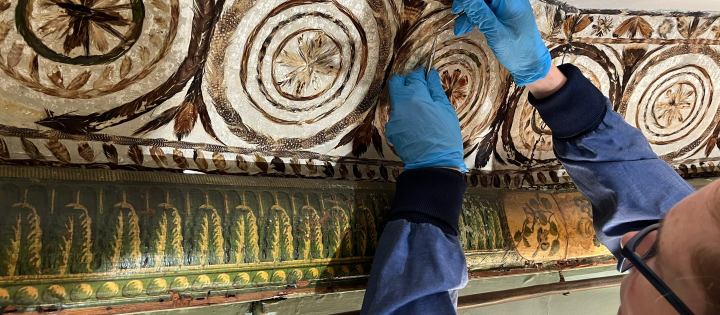
Conservation of the feather frieze in the Drawing Room at A la Ronde in Devon
◊ ◊ ◊ ◊ ◊
From the National Trust:
Female Expression through Craft and Design in the 18th and Early 19th Centuries
Online and in-person, Reed Hall, University of Exeter, 11 July 2024
The National Trust is delighted to announce this hybrid conference inspired by the conservation, outreach, and interpretation project A la Ronde: Conserving the Past, Creating the Future. Intended to forge new bonds with researchers and academic professionals, find synergies with similar projects and properties, and to share stories and discoveries from our recent conservation work in a broader context, the symposium will be offered in hybrid form, with presentations both in-person and online. Booking is available here»
About A la Ronde — A small estate in Lympstone, Devon, this 16-sided house and chapel were built, and perhaps designed, by Jane Parminter and her young cousin and ward, Mary, around 1796, following their return from several Grand Tours of Europe. The house is now owned by the National Trust and contains the extraordinary decorative interiors designed by the Parminters. These include over 27 metres of friezes formed from feathers in the drawing room, patterned wall painting in the central Octagon room, and a Shell Gallery sitting at the top of the house encrusted with over 26,000 individual components, accessed by a narrow Grotto Staircase from below. The wider estate also contained a chapel, alms houses, and school room for local unmarried women and girls, a manse, vegetable gardens, and small picturesque landscape in the context of a ferme ornée. Mary’s will records that the grounds originally contained decorative features including a shellery, fountain, obelisks, and seating. The Shell Gallery, Grotto Staircase, Drawing Room feather frieze, and Octagon have been recently conserved as part of a two-year multi-strand project, A la Ronde: Conserving the Past, Creating the Future, which culminates in 2024.
p r o g r a m m e
9.30 Welcome and Opening Remarks
• Jonathan Fisher (General Manager South East Devon Portfolio, National Trust)
• Emma Mee (Project Lead, National Trust)
9.45 Keynote Presentation
• Daniel Maudlin (University of Plymouth), Making Cottages: Rural Retreat and the Appropriation of the Vernacular in the 18th Century
10.10 Panel 1 | Female-Designed and Commissioned Domestic Spaces
• Rosemary Baird Andrae FSA, The Architectural Patronage of Mrs Montagu, Queen of the Bluestockings
• Tom Coombe (Collections and House Manager, National Trust), The Ornamental Dairy at Croome: Ceramics, Crafting, and Performance
• Jyoti Pandey Sharma (School of Planning and Architecture, New Delhi), Transculturalism in 19th-Century Mofussil India: Begam Samru and Her Architecturally Hybrid Sardhana Palace
• Saniya Siddiqui (School of Planning and Architecture, New Delhi), Taj Mahal Palace: A Royal Residence Commissioned by Nawab Shah Jahan Begum (r.1868–1901), Ruler of Bhopal Princely State in the British-ruled Indian Subcontinent
11.30 Coffee Break
11:45 Panel 2 | A la Ronde and National Trust Conservation Work
Convenor: Nigel Blades (Head of Conservation, National Trust)
• Daniel Cull (Conservator, National Trust), Conserving the Past, Creating the Future: A Summary of the Conservation Project at A la Ronde
• Nicola Shreeve (Remedial Conservator, National Trust), The Technical Investigation and Conservation of the Octagonal Chairs from A la Ronde
• Nicola Walker (Senior National Conservator, Paper and Photography, National Trust), Shells, Curtains, and a Doll’s House: Conservation and Collaboration
1.00 Lunch
1.45 Panel 3 | Decorative Historic Interiors and Material Histories
• Lucy Powell (Leverhulme Early Career Research Fellow, University of Oxford), ‘The Feather’d Fair’: Women, Femininity, and Feathers in the 1790s
• Clare Taylor (The Open University), ‘Our New Paper Hangings’: Women and Wallpaper in 18th-Century Britain
• Libby Horsfield (PhD student, Birkbeck University), The Centre of Attention: Women’s Crafted Fire Screens and the Country House Interior in the 19th Century
• Emily Deal (Digital Curator, National Trust), The Material Biography of Molly Lepell: Material Culture and Collection as a Form of Life Writing in the 18th Century
3.00 Coffee Break
3.10 Panel 4 | Georgian Period Embellished Decorative Interiors Using Natural Materials
Convenor: Rachel Conroy (Senior National Curator, Decorative Arts, National Trust)
• Wenyu Dong (MA student, Central Academy of Fine Arts), From Chinese Chambre to Feather Room: Elizabeth Montagu’s Interiors in the 1760s and 1780s London
• Kyriaki Hadjiafxendi (Senior Lecturer, Victorian Literature and Culture, Bath Spa University), The Eventfulness of Nature: Women and the Seashore in the Long 19th Century
• Beth Howell (Business Services Coordinator, National Trust), ‘Call Us Not Weeds!’: Examining the Aesthetics of Upcycling and Anonymity in Victorian Depictions of Seaweed
• Laura Keim (Stenton Curator), Kaila Temple (Stenton Curatorial Assistant), and Lara Kaplan (Objects Conservator Winterthur Museum), ‘Place to Cultivate Her Mind in by Musing’: Anne Reckless Emlen’s 1757 Shellwork Grotto
4.50 Closing Remarks
• Sarah Lloyd (Research Fellow, Institute of Historical Research, University of London)
Essay | Caroline Gonda on Anne Seymour Damer
Caroline Gonda recently published this essay on The British Museum’s Blog, with lots of images and links for relevant items, including the drawing reproduced here.
Caroline Gonda, “Anne Seymour Damer: Public Life, Private Love,” The British Museum Blog (27 June 2024). Gossip about Anne Seymour Damer’s sexuality nearly wrecked her relationships and reputation, but in this queer love story, love beats scandal.

John Downman, Study for a Portrait of Anne Damer, charcoal, touched with red chalk, 1788 (London: The British Museum, 1967,1014.181.141).
‘Social media’ ruined lives in the 18th century, just as it does today. Anne Seymour Damer (1748/9–1828) was a sculptor (a highly unusual career for a woman artist at the time) and an aristocrat, which made her a part of celebrity culture and particularly exposed to gossip. Damer was also the subject of scandal because of her intimate relationships with other women. One of her contemporaries, the writer and literary hostess Hester Piozzi, described her as ‘a lady much suspected for liking her own sex in a criminal way’. Damer was repeatedly labelled as a Sapphist. The term was an allusion to the ancient Greek poet Sappho; famous for her love poems, many of them addressed to other women, Sappho was beginning to be seen in this period as the original lesbian (a term drawn from her birthplace of Lesbos). The gossip put Damer’s reputation at risk, but also sabotaged her chances of finding—and keeping—love. . .
The full essay is available here»
Caroline Gonda is College Associate Professor and Glen Cavaliero Fellow in English at St Catharine’s College, Cambridge.
Call for Papers | Women as Collectors
From the Call for Papers:
Collecting Past and Present: Women as Collectors
The Wallace Collection, London, 1 November 2024
Proposals due by 2 August 2024
In 2024, the Wallace Collection launched Collecting Past and Present. This new research series takes the format of biannual, themed study days, which include fascinating talks from specialists, exploring collecting through the ages to the modern day. Exclusive interviews with contemporary collectors also feature, revealing tantalising glimpses of extraordinary objects and how they are brought together. These are followed by drinks receptions that act as unique forums for discussion. For those further afield or unable to make it to the museum, the talks can be watched online.
We are now inviting abstracts for our November study day that explore women as collectors and patrons of all art forms. Talks should be 45-minutes long and illustrated by a presentation. They will be held in the Wallace Collection Theatre on Friday, 1 November 2024, between 10.15 and 17.30 GMT. We would like to encourage all those with a specialist interest to share a short text (500 words) and CV with Collecting.PastandPresent@wallacecollection.org by Friday, 2 August 2024. If your submission is accepted, we will require your talk’s title (maximum seven words), an abstract (60 words), and a bio (60 words). We can contribute up to the following amounts towards speakers’ travel expenses on submission of receipts:
• Speakers within the UK – £100
• Speakers from Continental Europe – £180
• Speakers from outside Europe – £300










 Enfilade
leave a comment