New Book | The Memory of ’76
From Yale UP:
Michael Hattem, The Memory of ’76: The Revolution in American History (New Haven: Yale University Press, 2024), 360 pages, ISBN: 978-0300270877, $35.
The surprising history of how Americans have fought over the meaning and legacy of the Revolution for nearly two and a half centuries
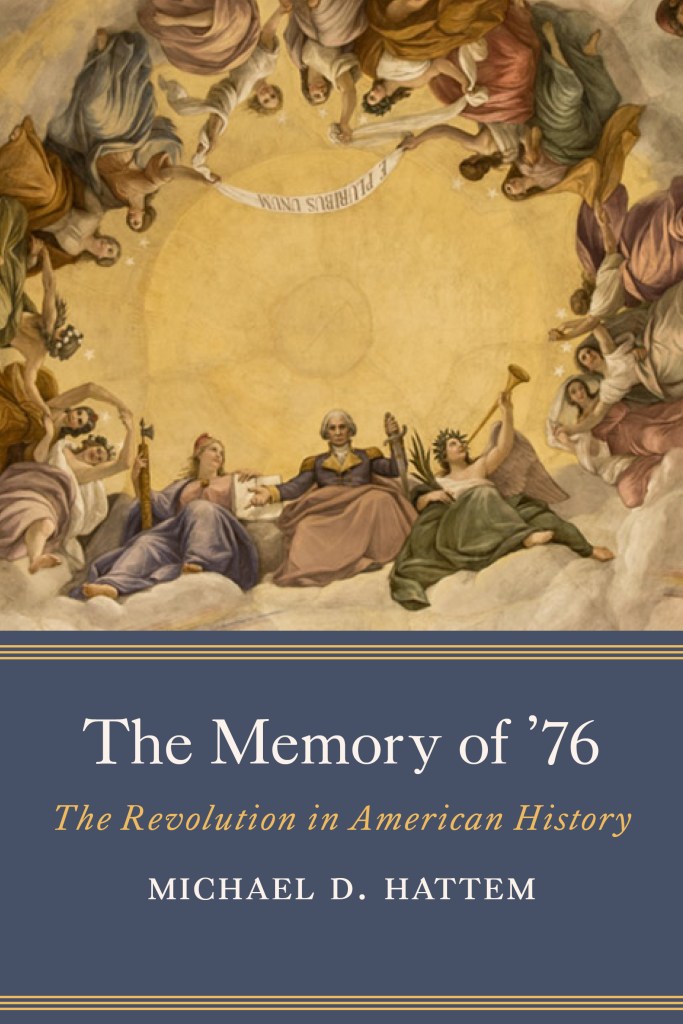 Americans agree that their nation’s origins lie in the Revolution, but they have never agreed on what the Revolution meant. For nearly two hundred and fifty years, politicians, political parties, social movements, and a diverse array of ordinary Americans have constantly reimagined the Revolution to fit the times and suit their own agendas. In this sweeping take on American history, Michael D. Hattem reveals how conflicts over the meaning and legacy of the Revolution—including the Declaration of Independence and the Constitution—have influenced the most important events and tumultuous periods in the nation’s history; how African Americans, women, and other oppressed groups have shaped the popular memory of the Revolution; and how much of our contemporary memory of the Revolution is a product of the Cold War. By exploring the Revolution’s unique role in American history as a national origin myth, Hattem shows how the meaning of the Revolution has never been fixed, how remembering the nation’s founding has often done far more to divide Americans than to unite them, and how revising the past is an important and long‑standing American political tradition.
Michael D. Hattem is a historian of early America and author of Past and Prologue: Politics and Memory in the American Revolution. He is the associate director of the Yale–New Haven Teachers Institute and lives in New Haven, Connecticut.
New Book | Glorious Lessons: John Trumbull
From Yale UP:
Richard Brookhiser, Glorious Lessons: John Trumbull, Painter of the American Revolution (New Haven: Yale University Press, 2024), 276 pages, ISBN: 978-0300259704, $30.
 The complicated life and legacy of John Trumbull, whose paintings portrayed both the struggle and the principles that distinguished America’s founding moment
John Trumbull (1756–1843) experienced the American Revolution firsthand—he served as aid to George Washington and Horatio Gates, was shot at, and was jailed as a spy. He made it his mission to record the war, giving visual form to what most citizens of the new United States thought: that they had brought into the world a great and unprecedented political experiment. His purpose, he wrote, was “to preserve and diffuse the memory of the noblest series of actions which have ever presented themselves in the history of man.” Although Trumbull’s contemporaries viewed him as a painter, Trumbull thought of himself as a historian. Richard Brookhiser tells Trumbull’s story of acclaim and recognition, a story complicated by provincialism, war, a messy personal life, and, ultimately, changing fashion. He shows how the artist’s fifty-year project embodied the meaning of American exceptionalism and played a key role in defining the values of the new country. Trumbull depicted the story of self-rule in the modern world—a story as important and as contested today as it was 250 years ago.
Richard Brookhiser is a senior editor of National Review and a fellow of the National Review Institute. His books include Founding Father: Rediscovering George Washington and Founders’ Son: A Life of Abraham Lincoln. He lives in New York City.
New Book | Edward Duffield: Philadelphia Clockmaker
Coming in August from the APS Press, with distribution by the University of Pennsylvania Press:
Bob Frishman, Edward Duffield: Philadelphia Clockmaker, Citizen, Gentleman, 1730–1803 (Philadelphia: The American Philosophical Society Press, 2024), 256 pages, ISBN: 978-1606180099, $60.
 Edward Duffield (1730–1803) was a colonial Philadelphia clockmaker, whose elegant brass, mahogany, and walnut timekeepers stand proudly in major American museums and collections. Duffield, unlike other leather-apron ‘mechanics,’ was born rich and owned a country estate, Benfield, and many more properties. He was deeply involved in civic and church affairs during crucial years in American history—his lifelong close friend, Benjamin Franklin, was staying at Duffield’s Benfield estate when Franklin, Thomas Jefferson, and John Adams first discussed the Declaration of Independence. Sally, Franklin’s daughter, brought her family there for extended periods during the Revolution and Franklin’s wife, Deborah, was best friends for fifty years with Duffield’s mother-in-law. Duffield was even one of three executors of Franklin’s will.
In this lavishly illustrated book, Bob Frishman catalogs and describes seventy-one known Duffield clocks and instruments and reveals how, during the mid-eighteenth century, they largely were not fabricated from scratch by isolated individuals. He contends that Duffield and his fellow clockmakers were not furniture-makers; they were mechanical artisans whose complex metal machines rang the hours and steadily ticked inside wooden cases made by others. Existing books on Philadelphia clocks have focused on these artifacts as furniture, including their woodwork, cabinetmakers, and decorative aspects. However, Frishman, a professional horologist for nearly four decades, brings his vast expertise to bear on this first comprehensive study of Duffield’s life and work.
Far more than a treatise on pre-industrial horological timekeeping, this book tells the compelling stories of a man, a city, and an era, while deepening our appreciation for Duffield’s stately sentinels—often a colonial American family’s most valuable possession—and the times and places in which their makers lived.
Bob Frishman was introduced to horology―the science of timekeeping―on Thanksgiving Day, 1980, when he was invited into the overflowing cellar of a collector and dealer of antique clocks, watches, tools, and machinery. Had Bob stayed home that day, or not left the holiday dining table and gone down those basement stairs, this book would not have been written. Nor would Bob’s other horological efforts during the past four decades ever have happened: eight thousand mechanical clocks repaired; two thousand antique clocks and watches restored and sold; hundred-plus articles and reviews published; hundred-plus in-person and virtual lectures delivered to horological and general audiences here and abroad; annual NAWCC symposia organized at the Winterthur Museum, the Museum of Fine Arts, Boston, the Henry Ford Museum, and the Museum of the American Revolution; and exhibits created and mounted by him at venues including the Horological Society of New York and the Willard House & Clock Museum.
Bob is a Silver Star Fellow of the National Association of Watch and Clock Collectors, and a Liveryman of the Worshipful Company of Clockmakers in London. As a dedicated supporter of other venerable cultural institutions, he is a Proprietor of the Boston Athenaeum, holder of Share Number 8 of the Library Company of Philadelphia, a member of the Grolier Club, the American Antiquarian Society, and the Ross Society of the Museum of Fine Arts, Boston. He continues to operate Bell-Time Clocks in Andover, Massachusetts, where he lives with his wife, author Jeanne Schinto.










 Enfilade
leave a comment