Andalusia Acquires Portrait of Adèle Sigoigne by Bass Otis
From the press release from Andalusia Historic House, Gardens & Arboretum:
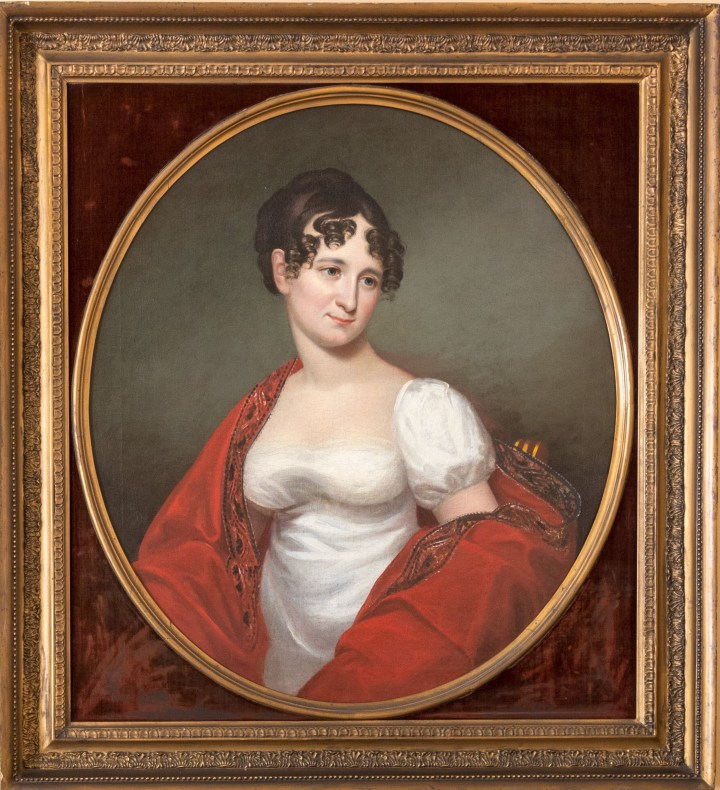
Bass Otis, Portrait of Miss Adèle Sigoine, 1815, oil on canvas (Bensalem, Pennsylvania: The Andalusia Foundation).
An oil painting by Philadelphia artist Bass Otis (1784–1861), Portrait of Miss Adèle Sigoigne (1815)—which has been on view at Andalusia Historic House, Gardens & Arboretum (Andalusia) in Bensalem, Pennsylvania since 2014 as a long-term loan from the Independence Seaport Museum (ISM) in Philadelphia—now joins Andalusia’s permanent collection in an act of collegial partnership. Adèle Sigoigne was a good friend of Jane Craig Biddle (1793–1856) who lived at Andalusia with her husband, Nicholas Biddle (1786–1844). ISM has deaccessioned the painting and transferred its ownership to Andalusia.
“We are overjoyed to have Adèle’s portrait now part of our permanent collection,” said Andalusia’s executive director John Vick. “Every piece of art in the historic house has a unique story to tell about the property and the people who lived here or visited. Adèle was practically family to the Biddles, making this a fitting home for her portrait. We are grateful to our partners at Independence Seaport Museum for recognizing what the painting means to Andalusia and for making this momentous transfer possible.”
“Our staff and Board were unanimous in wanting to transfer this painting permanently to Andalusia,” said Peter Seibert, ISM’s president and chief executive officer. “Its history and associations with the Biddle family are significant, and thus the painting is imminently relevant to their mission. For us, the transfer is a visible reminder of how two museums can come together to ensure that the history and heritage of our community is preserved in public trust for future generations.”
Although it is unclear how or when Jane and Adèle met, their lasting friendship is certain. Close in age and of similar social standing, the two women came from very different backgrounds, however. Jane was a Philadelphian by birth, the only daughter of John and Margaret Craig, the couple who first established Andalusia as a country estate in 1795. Adèle, by contrast, was French-born and had lived in Haiti. After the Haitian Revolution began in 1791, she moved to Philadelphia with her mother, Aimée Sigoigne, who started a school for young women at 128 Pine Street. Adele was one of a few guests who attended Jane’s wedding to Nicholas Biddle, held at Andalusia on 3 October 1811. The Biddles’ three daughters would later attend Madame Sigoigne’s school, including Adèle who was named for her mother’s dear friend. (The name Adèle remained popular for several generations of Biddle descendants.)
Although the portrait is unsigned, its attribution is firm; it is nearly certain that the Biddles commissioned Bass Otis to paint Adèle’s portrait as he also painted Jane’s portrait around 1815. (This painting is in the collection of the Second Bank of the United States Portrait Gallery in Philadelphia.) Both women are shown in fashionable, Empire-style dresses with luxurious fabrics draped over their shoulders: Jane’s is white and sheer while Adèle’s is a vibrant red. Their hair is also similarly styled in an updo with ringlets framing their faces. Nicholas Biddle conveyed his appreciation of Adèle’s portrait to Otis in a letter, which remains with and will be transferred with the painting from ISM.
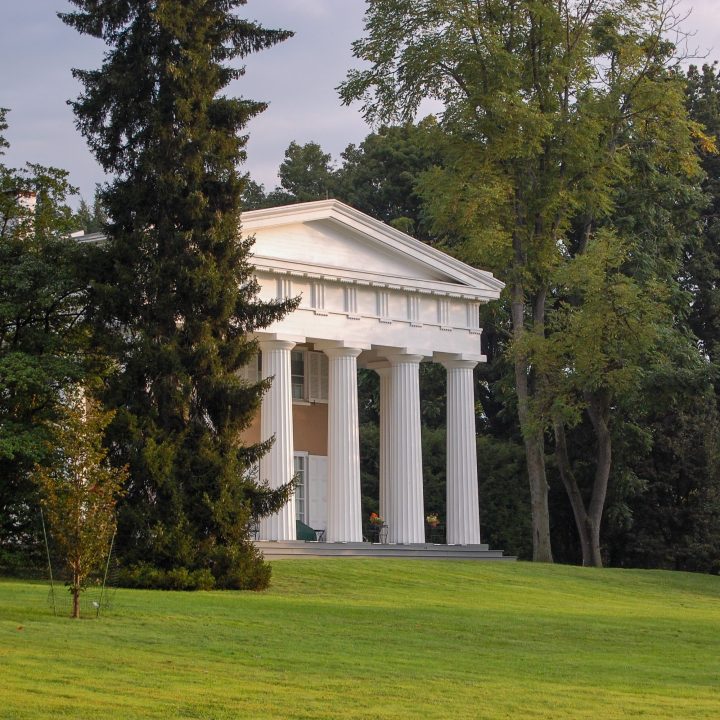
With its oldest portions dating to the 1790s, the house at Andalusia was expanded by Benjamin Latrobe in 1806 and then again in the 1830s, when an addition with a Doric columned porch was constructed according to designs by Thomas Ustick Walter (Walter had trained under William Strickland).
Since the portrait of Sigoigne has been on loan at Andalusia, it has been on view in the historic house’s library, which was part of the 1830s addition designed by architect Thomas Walter. Now in Andalusia’s permanent collection, it will be moved to what is known as the Painted Floor Bedroom. This room is part of the original 1797 construction and could have been where Adèle stayed when she visited Jane around the time that the portrait was made.
The Biddles’ patronage of Bass Otis continued for many years. In 1827, Nicholas Biddle commissioned the artist to paint a copy of Jacques-Louis David’s famous scene Napolean Crossing the Alps (1801). The oil on canvas copy, also on view at Andalusia, was owned by Napoleon’s brother Joseph Bonaparte, who knew the Biddles, lived near them in Philadelphia, and owned a country estate (Point Breeze) near Andalusia. By the 1820s, however, the Biddles began to favor another Philadelphia artist, Thomas Sully, who painted the couple’s portraits in 1826, both of which are on view at Andalusia. In 1829 the Biddles commissioned him to paint another portrait of Adèle Sigoigne, which is in the collection of The Huntington Library, Art Museum and Botanical Gardens in San Marino, California.
◊ ◊ ◊ ◊ ◊
Andalusia Historic House, Gardens & Arboretum is a non-profit organization and a scenic 50-acre property overlooking the Delaware River in Bensalem, Pennsylvania. Established more than 225 years ago, the site is a natural paradise of preserved native woodlands and spectacular gardens, as well as museum with an exceptional collection of paintings, sculptures, decorative art, and rare books and manuscripts.
The Kimbell Acquires Stubbs’s Mares and Foals
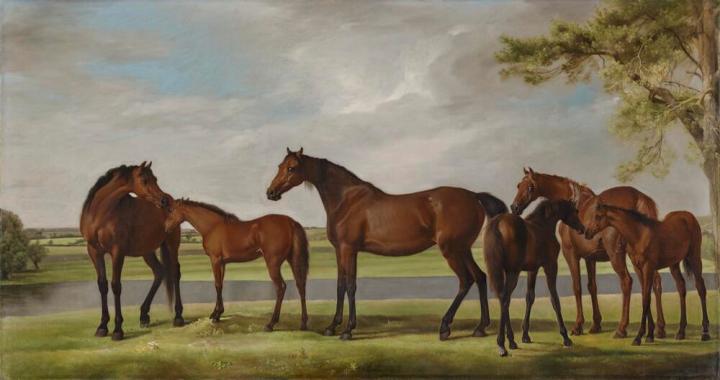
George Stubbs, Mares and Foals Belonging to the 2nd Viscount Bolingbroke, ca. 1761–62, oil on canvas, 99 × 187 cm
(Fort Worth: Kimbell Art Museum, acquired in memory of Ben J. Fortson)
◊ ◊ ◊ ◊ ◊
From the press release (28 June 2024), as noted at Art History News:
The Kimbell Art Museum today announced the acquisition of George Stubbs’s Mares and Foals Belonging to the 2nd Viscount Bolingbroke, painted between about 1761 and 1762. Widely regarded as the finest painter of animals in the history of European art, Stubbs is best known for his paintings of horses, which transcend historical genres to achieve rare pictorial refinement and emotional resonance. The painting entering the Kimbell’s collection is one of the principal, and likely earliest, in a celebrated, innovative series that has been called the artist’s crowning achievement: paintings depicting friezes of brood mares and their offspring. The acquisition, along with that of Thomas Gainsborough’s painting Going to Market, Early Morning (ca. 1773), purchased by the Kimbell in 2023, significantly elevates the Kimbell’s holdings of eighteenth-century British paintings, which Velma and Kay Kimbell favored when initially building their collection. The painting will be on view in the Kimbell’s Louis I. Kahn Building beginning 28 June 2024.
“With a mandate to collect only works of major historical and aesthetic importance, the Kimbell is the natural home for this masterpiece,” said Eric Lee, director of the Kimbell Art Museum. “I am sure that it will become an audience favorite. Visitors to the museum will relish the multidimensional depiction of mares and foals—alive with subtle drama, imbued with tenderness, and fascinating in its expression of the individual personalities of each horse.”
In this picture, which is slightly more than six feet long by three feet tall, a mature bay mare commands the center of a group of two other mares and three foals, who nuzzle close to their mothers. The composition is set within a springtime landscape at what is probably the viscount’s family estate of Lydiard Tregoze, Wiltshire, now Borough of Swindon, with verdant green parkland, cloudy sky, and a broad, dark gray stretch of water providing spatial interest beyond the long, slender legs of the horses. Highly naturalistic, the horses are lifelike in their anatomical forms and poses. While the overall mood is tranquil and domestic as the horses gently commune with each other, the cloudy sky and the wide, sparkling eyes of the mares add an element of drama and nobility to the composition.
The titular 2nd Viscount Bolingbroke, Frederick St. John (1732–1787), was one of Stubbs’s most important early patrons. The Kimbell painting seems to be the earliest commission of this virtually unprecedented subject; it is probably the work that Stubbs exhibited at the Society of Artists in 1762. Soon, other members of Bolingbroke’s circle of aristocratic horse enthusiasts and fellow statesmen of the Whig political party commissioned similar compositions on the theme of brood mares and their offspring, many doubtless depicting the patrons’ own horses. Stubbs’s equestrian paintings—along with his portrayals of rural life and of other animals—were an especially delightful and sophisticated expression of the pastimes of the British nobility and landed gentry. Patrons could hang such works alongside fashionable portraits and Old Master paintings in their town or country houses, where vast fields, parklands, stables, and studs reflected their love of hunting and sporting life.
Stubbs was then, and is today, recognized for his unrivaled understanding of equine anatomy and unsurpassed ability to record not only the appearance of individual animals but also their temperaments. His genius in understanding the horse arose from anatomical study and from his apparent empathy for the character of each horse and his ability to express its exquisite beauty. His skill extended to landscapes that enhanced the mood, composition, and legibility of the animal subjects.
Mares and Foals Belonging to the 2nd Viscount Bolingbroke remained in the family collection at Lydiard Tregoze until it was sold at auction in 1943 and shortly thereafter entered the collection of Mrs. John Arthur Dewar, of the whisky distillery family, who also owned Henry Raeburn’s Allen Brothers (Portrait of James and John Lee Allen), which entered the Kimbell collection in 2002. The Kimbell acquired Mares and Foals Belonging to the 2nd Viscount Bolingbroke from a private collection through London-based art dealers Simon C. Dickinson Ltd. At the museum, the painting joins Stubbs’s Lord Grosvenor’s Arabian Stallion with a Groom, a work acquired by the Kimbell in 1981. Mares and Foals Belonging to the 2nd Viscount Bolingbroke was previously on view at the Kimbell in 2004–05, when it was on loan to the exhibition Stubbs and the Horse.
The Kimbell Art Foundation acquired Mares and Foals Belonging to the 2nd Viscount Bolingbroke in memory of Ben J. Fortson (1932–2024), who passed away in May and whose leadership was instrumental in the Kimbell’s growth. Mr. Fortson served on the Board of Directors of the Kimbell Art Foundation from 1964 until his death and was the Foundation’s longtime Executive Vice President and Chief Financial Officer. He will be forever remembered for stewarding the Kimbell’s investments and finances and for being the driving force behind the building of the museum’s Renzo Piano Pavilion, which opened in 2013 and houses the museum’s temporary exhibitions and permanent collections of Asian, African, and ancient American art.










 Enfilade
leave a comment