Exhibition | Guillaume Lethière
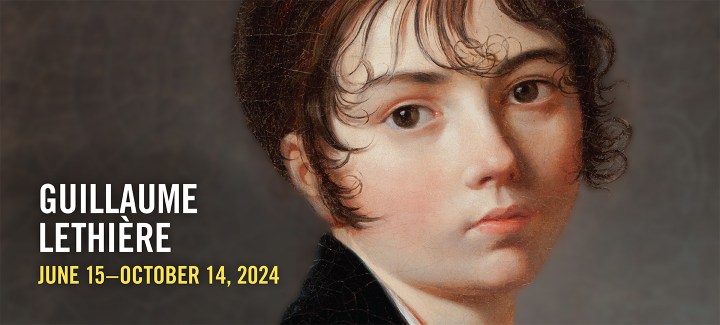
Guillaume Lethière, Woman Leaning on a Portfolio, detail, ca. 1799, oil on canvas
(Worcester Art Museum, Massachusetts, 1954.21)
◊ ◊ ◊ ◊ ◊
Now on view at The Clark:
Guillaume Lethière
The Clark Art Institute, Williamstown, Massachusetts, 15 June — 14 October 2024
Musée du Louvre, Paris, 13 November 2024 — 17 February 2024
Curated by Esther Bell, Olivier Meslay, Sophie Kerwin, and Marie-Pierre Salé
The first monographic exhibition ever presented on the artist
 Born in Sainte-Anne, Guadeloupe, Guillaume Lethière (1760–1832) was a key figure in French painting during the late eighteenth and early nineteenth centuries. The son of a white plantation owner and an enslaved woman of mixed race, Lethière moved to France with his father at age fourteen. He trained as an artist and successfully navigated the tumult of the French Revolution and its aftermath to achieve the highest levels of recognition in his time.
A favorite artist of Napoleon’s brother Lucien Bonaparte, Lethière served as director of the Académie de France in Rome, as a member of the Institut de France, and as a professor at the École des Beaux-Arts. A well-respected teacher, he operated a robust studio that rivaled those of his most successful contemporaries. Despite his remarkable accomplishments and considerable body of work, Lethiere is not well known today. The exhibition, organized in partnership with the Musée du Louvre and featuring some one hundred paintings, prints, and drawings, celebrates Lethière’s extraordinary career and sheds new light on the presence and reception of Caribbean artists in France during his lifetime.
Guillaume Lethière is co-organized by the Clark Art Institute, Williamstown, Massachusetts, and the Musée du Louvre, Paris, and curated by Esther Bell, deputy director and Robert and Martha Berman Lipp Chief Curator; and Olivier Meslay, Hardymon Director; with the assistance of Sophie Kerwin, curatorial assistant, at the Clark; and by Marie-Pierre Salé, chief curator in the Department of Drawings at the Louvre.
For more information, see the exhibition press release»
Esther Bell and Olivier Meslay, eds., Guillaume Lethière (New Haven: Yale University Press, 2024), 432 pages, ISBN: 978-0300275780, $65. With contributions by Alain Chevalier, Natasha Coleman, Darcy Grimaldo Grigsby, Frederic Lacaille, Anne Lafont, Christelle Lozere, Sophie Kerwin, Mehdi Korchane, C.C. McKee, Marie-Isabelle Pinet, Frederic Regent, Marie-Pierre Sale, Aaron Wile, and Richard Wrigley.
New Book | Everyday Politics and Culture in Revolutionary France
From the Oxford University Studies in the Enlightenment series, published by Liverpool UP:
Suzanne Desan, Bryant Ragan, and Victoria Thompson, eds., Everyday Politics and Culture in Revolutionary France: Essays in Honor of Lynn Hunt (Liverpool: Liverpool University Press, 2024), 320 pages, ISBN: 978-1802073812, $99. Also available as a PDF and epublication.
 The French revolutionary era produced surprises. Why did the French revolutionaries decriminalize sodomy? How did the Revolution alter fundamental attitudes toward time and progress? How did it change people’s interactions with outdoor spaces and with material objects, from playing cards to holy cards? How did it leave a lasting footprint on personal identity, family relationships, and religious belief? Addressing diverse topics like these, the essays in this volume showcase exciting new research about the revolutionary era. Written to honor the historian Lynn Hunt, the essays rethink our understanding of the French Revolution by exploring three central themes: the multifaceted nature of grassroots politics; the pervasive and personal impact of the Revolution on daily life; and its long-term influence on memory, identity, and sense of self. From the October Days to dechristianization and beyond, the authors probe the precarious invention of democracy, analyze how intimately and intently the French Revolution influenced people’s lives, and examine how it shaped nineteenth-century memory, female religiosity, and political culture. Embracing contingency, diversity of experience and perspective, and the multifarious nature of change, the essays document the power and complexity of the revolutionary era as a lived experience.
Suzanne Desan is Vilas Distinguished Achievement Professor of History Emerita, University of Wisconsin-Madison. She is the author of The Family on Trial in Revolutionary France and co-editor of The French Revolution in Global Perspective. She is currently writing a book on the October Days in the early French Revolution.
Bryant T. Ragan teaches early modern European history and the history of sexuality at The Colorado College. He presently participates on a research team that is developing an interactive website and relational database that focuses on the policing of male sodomy in eighteenth-century Paris.
Victoria E. Thompson is Chair of the School of History and Sociology at the Georgia Institute of Technology. She is completing a book entitled King and Public in the Parisian Royal Square, 1748–89 that examines the relationship between the design, representation, and use of urban space and socio-political transformation.
c o n t e n t s
Introduction: Suzanne Desan and Victoria Thompson
1 Victoria Thompson — A Perpetually Agitated Place: Politics in the Tuileries Garden, 1789–1792
2 Suzanne Desan — Military Men, Violence, and Gender in the October Days of 1789
3 Jeff Horn — Dechristianization and Terror in Champagne
4 Bryant Ragan — Same-sex Sexual Relations and the French Revolution: The Decriminalization of Sodomy in 1789
5 William Max Nelson — Leaping into the Future: Enlightenment Ideas of Progress and French Revolutionary Time
6 Jeff Ravel — ’Plus de rois, de dames, de valets’: Playing Cards during the French Revolution
7 Denise Z. Davidson — ‘Notes et souvenirs … sur la vie politique de mon père’: Memory, Mourning, and Politics in the Revolutionary Era
8 Jennifer Popiel — Martyred Virgins, Embattled Women, and Mass Culture: Sentiment and Authority in Nineteenth-Century Religious Images, 1830–60
Epilogue: Lynn Hunt — Why the French Revolution Continues to Matter
Bibliography










 Enfilade
leave a comment