The Descendants Project Purchases Woodland Plantation House
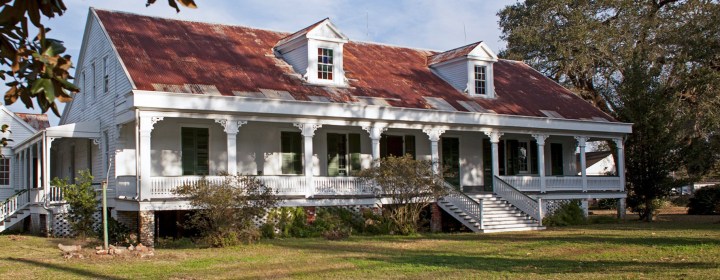
Woodland Plantation House, LaPlace, Louisiana, the oldest portions of which date to 1793. The Descendants Project purchased the house and four acres of land in January 2024 for $750,000. More information is available here»
◊ ◊ ◊ ◊ ◊
From National Public Radio:
Debbie Elliott, “Louisiana Plantation Where Historic Slave Revolt Started Now under Black Ownership,” NPR Morning Edition (9 July 2024).
Jo Banner is excited to show the newly acquired Woodland Plantation House near the banks of the Mississippi River.
“We have still a lot of work to do, but I think for the home to be from 1793, it looks rather good,” she beams.
The raised creole-style building has a rusty tin roof and a wide front porch. Forest green wooden shutters cover the windows and doors. The site is historically significant because this is where one of the largest slave revolts in U.S. history began. It’s also known as the German Coast Uprising because this region was settled by German immigrants.
“The start of the 1811 revolt happened here, on this porch,” Banner says.
Banner and her twin sister Joy are co-founders of the Descendants Project, a non-profit in Louisiana’s heavily industrialized river parishes—just west of New Orleans. Early this year, the group bought the Woodland Plantation Home, putting it in Black ownership for the first time [in its over 200-year history] . . .
“Our mission is to eradicate the legacies of slavery so for us, it’s the intersection of historic preservation, the preservation of our communities, which are also historic, and our fight for environmental justice,” says Joy Banner.
The full report is available here»
More information on the house is available at the Society of Architectural Historians’ Archipedia site»
◊ ◊ ◊ ◊ ◊
About The Descendants Project:
The Descendants Project is an emerging organization committed to the intergenerational healing and flourishing of the Black descendant community in the Louisiana river parishes. The lands of the river parishes hold the intersecting histories of enslavement, settler colonialism, and environmental degradation.
We are descended from the enslaved men, women, and children who were forced to labor at one or more of the hundreds of plantations that line the Mississippi River from New Orleans to Baton Rouge. Starting in the 1970s, large industrial petrochemical plants began purchasing the land of these plantations still surrounded by vulnerable Black descendant communities. The region is now known as ‘Cancer Alley’ for the extreme risks of cancer and death due to pollution. The community faces many other problems such as food insecurity, high unemployment, high poverty, land dispossession, and health issues that stem from a culture of disregard for Black communities and their quality of life.
Through programming, education, advocacy, and outreach, The Descendants Project is committed to reversing the vagrancies of slavery through healing and restorative work. We aim to eliminate the narrative violence of plantation tourism and champion the voice of the Black descendant community while demanding action that supports the total well-being of Black descendants.
New Book | The Unnatural Trade
Forthcoming from Yale UP:
Brycchan Carey, The Unnatural Trade: Slavery, Abolition, and Environmental Writing, 1650–1807 (New Haven: Yale University Press, 2024), 280 pages, ISBN: 978-0300224412, $65.
 A look at the origins of British abolitionism as a problem of eighteenth-century science, as well as one of economics and humanitarian sensibilities
How did late eighteenth-century British abolitionists come to view the slave trade and British colonial slavery as unnatural, a ‘dread perversion’ of nature? Focusing on slavery in the Americas, and the Caribbean in particular, alongside travelers’ accounts of West Africa, Brycchan Carey shows that before the mid-eighteenth century, natural histories were a primary source of information about slavery for British and colonial readers. These natural histories were often ambivalent toward slavery, but they increasingly adopted a proslavery stance to accommodate the needs of planters by representing slavery as a ‘natural’ phenomenon. From the mid-eighteenth century, abolitionists adapted the natural history form to their own writings, and many naturalists became associated with the antislavery movement. Carey draws on descriptions of slavery and the slave trade created by naturalists and other travelers with an interest in natural history, including Richard Ligon, Hans Sloane, Griffith Hughes, Samuel Martin, and James Grainger. These environmental writings were used by abolitionists such as Anthony Benezet, James Ramsay, Thomas Clarkson, and Olaudah Equiano to build a compelling case that slavery was unnatural, a case that was popularized by abolitionist poets such as Thomas Day, Edward Rushton, Hannah More, and William Cowper.
Brycchan Carey is professor of literature, culture, and history at Northumbria University in Newcastle upon Tyne. He has published numerous books and articles on the cultural history of slavery and abolition.










 Enfilade
leave a comment