Oxford Art Journal, March 2024
In the latest issue of the Oxford Art Journal:
Oxford Art Journal 47.1 (March 2024), published June 2024.
a r t i c l e s
 • Matthew C. Hunter and Avigail Moss, “Art and the Actuarial Imagination: Propositions,” pp. 1–12.
Noting insurance’s importance will hardly come as a surprise to curators, artists, conservators, and others concerned with current practices of exhibiting art. “Art insurance,” as one commentator observes, “is huge business and not least now that artworks move around the world in far greater volume and frequency than ever before.”6 Similarly, insurance and its extensive profiteering—from the trade in enslaved peoples to its biopolitical work in capitalist modernity—have been powerfully thematised by Cameron Rowland, Rana Hamadeh, and numerous other contemporary artists (Fig. 1).7 Yet, academic art history has been conspicuously slow to reckon with insurance’s force, functions, and fictions. This special issue is meant less as a reprimand for that blind spot than as a prompt to disciplined conversation. Drawing primarily upon the archive of European and North American art practices from the eighteenth century to the present, we mean to agitate for greater attention to how, when, where, and why insurance has come to penetrate art’s making, moving, showing, selling, storing, and being.
• Nina Dubin, “‘Infidelity, Imposture, and Bad Faith’: Reproducing an Insurance Bubble,” pp. 13–37.
When Grayson Perry commemorated the 2008 financial crisis with an etching titled Animal Spirit, he participated in a longstanding tradition of deploying printed images to satirize and demystify a boom-and-bust economy. More specifically, his print recalls a wave of caricatures that circulated in 1720 amidst a pan-European crash: one precipitated by a bubble in hypothetical commodities, foremost among them shares in joint-stock insurance companies. Produced by a group of Amsterdam-based artists including Bernard Picart, such engravings catered to a public that, already in 1720, viewed the business of insurance as occupying the vanguard of an inscrutable financial culture. Not only do these works exemplify early modern artistic efforts to translate into visual form the abstractions of an increasingly financialized economy. They also critically engage with the insurance operations of print, at a time when engraved reproductions presented themselves as policies that safeguarded works of art from the risks of accident and loss.
• Matthew C. Hunter, “The Sun Is God: Turner, Angerstein, and Insurance,” pp. 39–65.
J. M. W. Turner’s Slavers Throwing Overboard the Dead and Dying—Typhon Coming On (also known as The Slave Ship) is probably the iconic visualization of insurance logic in Western art. Exhibited in 1840, the painting has come to be taken as a meditation on the jettison of one hundred thirty three captives from the slave ship Zong off Jamaica in late 1781, murders notoriously claimed as insurable losses from the ship’s underwriters. Less noted is the pervasive presence of insurance within Turner’s practice and milieu. This article follows the tandem of Turner and John Julius Angerstein (1735–1823), a leading underwriter at Lloyd’s of London and an early patron. It places them within a world of artists’ organizations being remade as political instruments by embracing life insurers’ actuarial tables. It traces the pair into the National Gallery (originally housed in Angerstein’s home) as Turner willed his art to the institution, contingent on the purchase of fire insurance. Revisiting The Slave Ship through this skein of underwriting activity, the article posits the Turner/Angerstein coupling as an instructive moment in insurance’s penetration through the thick of artistic practice.
• Richard Taws, “Charles Meryon’s Graphic Risks,” pp. 67–94.
This article considers the place of risk and fictitious value in the work of French printmaker Charles Meryon. Meryon is best-known for the Eaux-fortes sur Paris, the vertiginous etchings of the city he made between 1850 and 1854. Yet despite his close association with the metropolis, Meryon’s visual world was not limited to the French capital. Previously a sailor, he had travelled widely, notably to the South Pacific, to protect speculative whaling interests in New Zealand. At the peak of his career, in 1855, Meryon designed share certificates for an unrealised Franco-Californian property development company, whose owners commissioned from Meryon a panorama of San Francisco. Meryon’s certificate prints have not been discussed at length in the literature on the artist. In the years following the 1848 Revolution, thousands of French workers emigrated to California, and Meryon’s famous etchings of Paris were made against the backdrop of contemporary enthusiasm for the California Gold Rush; these phenomena should, I suggest, be understood together. Focusing on Meryon’s connections to construction and extraction schemes, lotteries, mass emigration, and insurance, this paper reorients analysis of Meryon’s work away from Paris towards more transnational, transatlantic networks of people and things. Reviewing Meryon’s practice in the light of these works, I argue that they illuminate an actuarial imagination at work.
• Ross Barrett, “Sculpting the ‘Idea of Insurance’: John Quincy Adams Ward’s Protection Group and the Rise of the American Life Sector,” pp. 95–115.
This essay examines John Quincy Adams Ward’s Protection Group (1871), a now-lost sculpture that ornamented the original New York headquarters of the Equitable Life Assurance Society, as a complex cultural response to the array of public relations problems that its patron and the broader life insurance sector faced in the decades after the Civil War. Adopted as a company logo at the very moment that the Equitable took steps to expand its insurance portfolio and extend the geographic range of its operations, the Protection Group outlined an imaginative allegory of indemnification that explained the benefits of the company’s policies, popularized actuarial conceptions of status, risk, and uncertainty, and set the terms for a wave of cultural promotions and rebranding efforts that would be undertaken by American life companies in the decades that followed. Tracing the work that the Protection Group did to smooth the way for the Equitable’s development into a multinational insurer and inure turn-of-the century consumers to the financial products and risk sensibilities of the life sector, this essay sheds new light on the pivotal contributions that academic sculptors made to the development of the modern US life insurance industry.
• Avigail Moss, “Ars Longa,Vita Brevis: The Fine Art & General Insurance Company, Ltd,” pp. 117–40.
In late-nineteenth-century Britain, artworks circulated widely between exhibitions, institutions, and marketplaces, increasing the risks of destruction and loss. Administrators, artists, and collectors offset these risks by turning to a key incidental service in capitalism: insurance. But how did artworks and artifacts test insurance underwriters’ capacities? And how did the insurance world impact the art world? This article introduces the Fine Art & General Insurance Company, Ltd, a firm established in London in 1890. As a unique collaboration between art workers and powerful City merchants and underwriters, the company operated for nearly a century, insuring works that travelled to international and domestic expositions, and underwriting collections like the National Gallery’s Chantrey Bequest. With branches and agents stationed in global metropoles, and with ties to the broader British imperium, the company was a key, if inconspicuous, power broker and proxy on the global cultural stage. As an economic and aesthetic gatekeeper, the company also adjudicated on the artworks it perceived to be acceptable risks, and I argue that by analysing its early activities we gain insight into the ways that art insurance—an inherently collective and even speculative activity—was already affecting art’s ecosystems before the twentieth century.
• Sophie Cras, “Art and Insurance after the Era of Statistics,” pp. 141–57.
This article focuses on two artworks made in 2010 by two French artists of different generations: Christian Boltanski’s The Life of C.B. and Julien Prévieux’s Les connus connus, les inconnus connus et les inconnus inconnus. Both resulted from the collaboration between the artist and an actuary-mathematician, at a time when the theoretical, technical and professional assumptions about statistics-based insurance were deeply shaken by the emergence of so-called ‘big data’ and ‘global catastrophic risks’. This vacillation is perceptible in the artists’ choices to represent—and make use of—quantitative, actuarial knowledge. Boltanksi’s video work stages the transformations of life insurance under the data deluge produced by connected technologies of ‘quantified self’. Prévieux’s sound installation displays the techniques of prospective actuarial imagination, when experts mix fact and fiction so as to quantify global catastrophic risks that exceed our capacities to foresight. Therefore, instead of showcasing the implacable efficiency of data-driven technologies, both artists humorously emphasize their inadequacy in the chain of knowledge, prediction, and action.
b o o k r e v i e w s
• Arie Hartog, “Viewing Broken Things: Review of Stacy Boldrick, Iconoclasm and the Museum (Routledge, 2020),” pp. 159–62.
• Ty Vanover — The Spectacle of Crime: Review of Frederic Schwartz, The Culture of the Case: Madness, Crime, and Justice in Modern German Art (The MIT Press, 2023),” pp. 162–66.
• Jennifer Sichel — A Feminist Queering: Review of Julia Bryan-Wilson, Louise Nevelson’s Sculpture: Drag, Color, Join, Face (Yale University Press, 2023),” pp. 166–68.
Abstracts
Notes on Contributors
Lecture Series | Bénédicte Savoy on Returning Looted Heritage, 1815
This fall at the Prado (as noted by Nina Siegal in The New York Times) . . .
Bénédicte Savoy | Returning Looted Heritage: 1815, The Dismantling of the Louvre and the Rebirth of Museums in Europe
La recuperación del patrimonio saqueado: 1815, el desmantelamiento del Louvre y el renacimiento de los museos en Europa
Online and in-person, Museo Nacional del Prado, Madrid, 7, 14, 21, and 28 November 2024

Bénédicte Savoy (Photograph by Maurice Weiss).
Between 1794 and 1811, successive French governments seized “works of art and science” from different states of Europe. This policy of appropriation, made legitimate by the belief that works of art, the natural by-product of freedom, should be returned to the land of liberty (i.e., France), gave rise to a major flow of cultural objects (paintings, sculptures, manuscripts, exquisite incunabula, etc.) from the countries involved towards France.
The vast majority of these objects, grouped together in the Louvre and the Bibliothèque nationale in Paris, were claimed by and returned to their rightful owners after the fall of the Empire (1814–1815). The restitution of 1815, a major historical and cultural event in Europe, mobilized the European intelligentsia and had a major impact on the cultural geography of the continent. The passions unleashed at the time fueled the European historiography of disentailment and confiscations during the 19th century. Most of the arguments exchanged then continue even now to structure the contemporary debate on restitutions. The lectures seek to identify the transnational concerns and consequences of this important event. Lectures will be given in French with simultaneous Spanish translation.
7 November — Reclaiming Cultural Heritage
The first lecture delves into the concept of restitution, especially from the point of view of those persons who traveled to Paris in 1815 with the intention of demanding the return of the plundered treasures. We shall study the relationship between post-conflict gestures of restitution and processes of reclaiming the objects of value. Among the key ideas to be discussed are the following: What steps are taken to actually reclaim the works of art? Who takes the initiative? In what circumstances? What resistance strategies are carried out by the possessing institutions?
14 November — The Interplay of Law and Morality
This lecture examines the complex relationship between legal principles and moral considerations as evidenced in the 1815 restitution debates. These discussions have profoundly influenced contemporary perspectives on repatriating looted assets. We contrast the legalists, who argue from a legal standpoint against the repossession of goods by Napoleon’s adversaries, with the moralists, who champion the rights of nations to their heritage and advocate for cultural justice. The enduring tension and the relevance of these two-century-old arguments will be critically analysed.
21 November — The Dilemma of Universality
In 1814 and 1815 European intellectuals praised the Louvre’s model for its intellectual, emotional, and historical significance while acknowledging the ethical dilemma it posed: the presence of these treasures in the museums in Paris was possible only because of their absence from other cities. This session explores the paradox of the universal museum concept and the ensuing debate over whether cultural assets should be centralized or dispersed to foster cultural development. The dismantling of the Louvre and the debates it sparked offer insights into museum discourse that echo through subsequent decades.
28 November — Paths to Reconnection
Following the upheaval of 1815, within a drastically transformed geopolitical landscape, there ensued diverse approaches to cultural reappropriation. They varied from nation to nation, community to community, spilling over even to academies and universities. The return of artworks to their places of origin opened up then, as it continues to do now, the possibility of finding a multitude of destinations beyond that of museums, including their reinstatement in original locations such as churches. This lecture will address how societies navigate the post-conflict recovery of their heritage and the time it takes to determine the rightful place for these works of art.
Devoted to the study of the processes of restitution of cultural property to countries looted by France during the Napoleonic period, the 12th Cátedra del Prado is led by Bénédicte Savoy, professor for Modern Art History at the Technische Universität Berlin. Between 2016 and 2021 Savoy also held a professorship at the Collège de France in Paris, where she taught the cultural history of artistic heritage in Europe from the 18th century to the 20th century. Her research focuses on museum history, Franco-German cultural transfer, Nazi looted art, and research on postcolonial provenance. In 2018 Professor Savoy wrote the report On the Restitution of African Cultural Heritage together with Senegalese scholar Felwine Sarr. This report was commissioned by Emmanuel Macron, President of France. She has received numerous awards for her research, academic activities, and teaching, including the 2016 Gottfried Wilhelm Leibniz Prize of the German Research Foundation and, most recently, the Berlin Science Prize. She is a member of the Berlin-Brandenburg Academy of Sciences and Humanities, a Knight of the French Legion of Honor and a member of various other institutions, advisory boards, and committees. Her most recent publications include the book Africa’s Struggle for Its Art: History of a Postcolonial Defeat, which has been translated into several languages, and the joint publication Atlas der Abwesenheit: Kameruns Kulturerbe in Deutschland (Atlas of Absence: Cameroon’s Cultural Heritage in Germany).
Exhibition | Guillaume Lethière
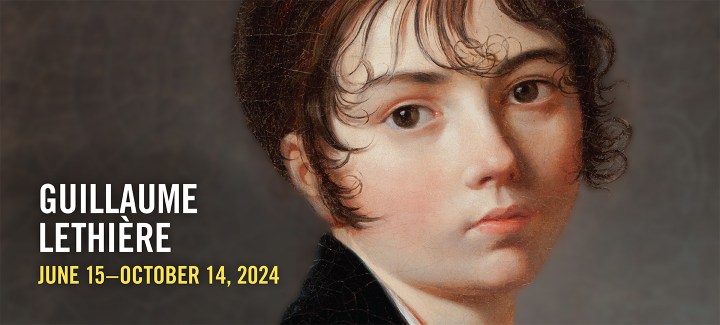
Guillaume Lethière, Woman Leaning on a Portfolio, detail, ca. 1799, oil on canvas
(Worcester Art Museum, Massachusetts, 1954.21)
◊ ◊ ◊ ◊ ◊
Now on view at The Clark:
Guillaume Lethière
The Clark Art Institute, Williamstown, Massachusetts, 15 June — 14 October 2024
Musée du Louvre, Paris, 13 November 2024 — 17 February 2024
Curated by Esther Bell, Olivier Meslay, Sophie Kerwin, and Marie-Pierre Salé
The first monographic exhibition ever presented on the artist
 Born in Sainte-Anne, Guadeloupe, Guillaume Lethière (1760–1832) was a key figure in French painting during the late eighteenth and early nineteenth centuries. The son of a white plantation owner and an enslaved woman of mixed race, Lethière moved to France with his father at age fourteen. He trained as an artist and successfully navigated the tumult of the French Revolution and its aftermath to achieve the highest levels of recognition in his time.
A favorite artist of Napoleon’s brother Lucien Bonaparte, Lethière served as director of the Académie de France in Rome, as a member of the Institut de France, and as a professor at the École des Beaux-Arts. A well-respected teacher, he operated a robust studio that rivaled those of his most successful contemporaries. Despite his remarkable accomplishments and considerable body of work, Lethiere is not well known today. The exhibition, organized in partnership with the Musée du Louvre and featuring some one hundred paintings, prints, and drawings, celebrates Lethière’s extraordinary career and sheds new light on the presence and reception of Caribbean artists in France during his lifetime.
Guillaume Lethière is co-organized by the Clark Art Institute, Williamstown, Massachusetts, and the Musée du Louvre, Paris, and curated by Esther Bell, deputy director and Robert and Martha Berman Lipp Chief Curator; and Olivier Meslay, Hardymon Director; with the assistance of Sophie Kerwin, curatorial assistant, at the Clark; and by Marie-Pierre Salé, chief curator in the Department of Drawings at the Louvre.
For more information, see the exhibition press release»
Esther Bell and Olivier Meslay, eds., Guillaume Lethière (New Haven: Yale University Press, 2024), 432 pages, ISBN: 978-0300275780, $65. With contributions by Alain Chevalier, Natasha Coleman, Darcy Grimaldo Grigsby, Frederic Lacaille, Anne Lafont, Christelle Lozere, Sophie Kerwin, Mehdi Korchane, C.C. McKee, Marie-Isabelle Pinet, Frederic Regent, Marie-Pierre Sale, Aaron Wile, and Richard Wrigley.
New Book | Everyday Politics and Culture in Revolutionary France
From the Oxford University Studies in the Enlightenment series, published by Liverpool UP:
Suzanne Desan, Bryant Ragan, and Victoria Thompson, eds., Everyday Politics and Culture in Revolutionary France: Essays in Honor of Lynn Hunt (Liverpool: Liverpool University Press, 2024), 320 pages, ISBN: 978-1802073812, $99. Also available as a PDF and epublication.
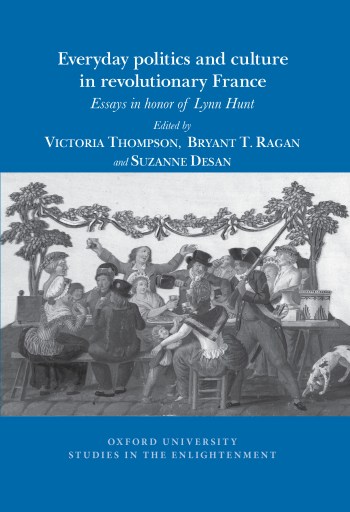 The French revolutionary era produced surprises. Why did the French revolutionaries decriminalize sodomy? How did the Revolution alter fundamental attitudes toward time and progress? How did it change people’s interactions with outdoor spaces and with material objects, from playing cards to holy cards? How did it leave a lasting footprint on personal identity, family relationships, and religious belief? Addressing diverse topics like these, the essays in this volume showcase exciting new research about the revolutionary era. Written to honor the historian Lynn Hunt, the essays rethink our understanding of the French Revolution by exploring three central themes: the multifaceted nature of grassroots politics; the pervasive and personal impact of the Revolution on daily life; and its long-term influence on memory, identity, and sense of self. From the October Days to dechristianization and beyond, the authors probe the precarious invention of democracy, analyze how intimately and intently the French Revolution influenced people’s lives, and examine how it shaped nineteenth-century memory, female religiosity, and political culture. Embracing contingency, diversity of experience and perspective, and the multifarious nature of change, the essays document the power and complexity of the revolutionary era as a lived experience.
Suzanne Desan is Vilas Distinguished Achievement Professor of History Emerita, University of Wisconsin-Madison. She is the author of The Family on Trial in Revolutionary France and co-editor of The French Revolution in Global Perspective. She is currently writing a book on the October Days in the early French Revolution.
Bryant T. Ragan teaches early modern European history and the history of sexuality at The Colorado College. He presently participates on a research team that is developing an interactive website and relational database that focuses on the policing of male sodomy in eighteenth-century Paris.
Victoria E. Thompson is Chair of the School of History and Sociology at the Georgia Institute of Technology. She is completing a book entitled King and Public in the Parisian Royal Square, 1748–89 that examines the relationship between the design, representation, and use of urban space and socio-political transformation.
c o n t e n t s
Introduction: Suzanne Desan and Victoria Thompson
1 Victoria Thompson — A Perpetually Agitated Place: Politics in the Tuileries Garden, 1789–1792
2 Suzanne Desan — Military Men, Violence, and Gender in the October Days of 1789
3 Jeff Horn — Dechristianization and Terror in Champagne
4 Bryant Ragan — Same-sex Sexual Relations and the French Revolution: The Decriminalization of Sodomy in 1789
5 William Max Nelson — Leaping into the Future: Enlightenment Ideas of Progress and French Revolutionary Time
6 Jeff Ravel — ’Plus de rois, de dames, de valets’: Playing Cards during the French Revolution
7 Denise Z. Davidson — ‘Notes et souvenirs … sur la vie politique de mon père’: Memory, Mourning, and Politics in the Revolutionary Era
8 Jennifer Popiel — Martyred Virgins, Embattled Women, and Mass Culture: Sentiment and Authority in Nineteenth-Century Religious Images, 1830–60
Epilogue: Lynn Hunt — Why the French Revolution Continues to Matter
Bibliography
Exhibition | Comment m’habillerai-je?
Now on view at the Museum of the French Revolution (near Grenoble):
Comment m’habillerai-je? Se vêtir sous la Révolution française, 1789–1804
Musée de la Révolution française, Vizille, 28 June — 10 November 2024
 Découvrez une mode en pleine (r)évolution!
Dans la société française de la fin du XVIIIe siècle, marquée par la culture des apparences, dans quelle mesure la rupture que constitue la Révolution française se reflète-t-elle dans la manière de se vêtir ?
L’exposition se propose de répondre à cette question. Véritable marqueur social sous l’Ancien Régime, le vêtement se transforme sous la Révolution française pour devenir le symbole d’une prise de position politique. Face au nouveau contexte politique et social et au nouvel élan de liberté, il devient par la suite un véritable objet de luxe et de mode. L’exposition présentera ces transformations à l’aide de textes, d’objets, d’iconographie et surtout d’estampes, medium de diffusion par excellence des modes, des symboles politiques et des idées.
Dans le cadre de la saison culturelle Des habits et nous, portée par le Département de l’Isère. Une exposition conçue et organisée par le Musée de la Révolution française et la Bibliothèque nationale de France.
Comment m’habillerai-je ? Se vêtir sous la Révolution française, 1789–1804 (Gent: Snoeck Publishers, 2024), 160 pages, ISBN: 978-9461619136, €30.
Exhibition | Point of View
The exhibition developed from the Women of the Rijksmuseum research project:
Point of View: The Collection Seen from a Gender Perspective
Rijksmuseum, Amsterdam, 5 July — 1 September 2024
Did all 17th-century children wear dresses? Why did women have to fight so hard to wear trousers? And what does the size of your desk say about your gender? Point of View explores how ideas around gender have been visualised through the ages and shows they are constantly changing.
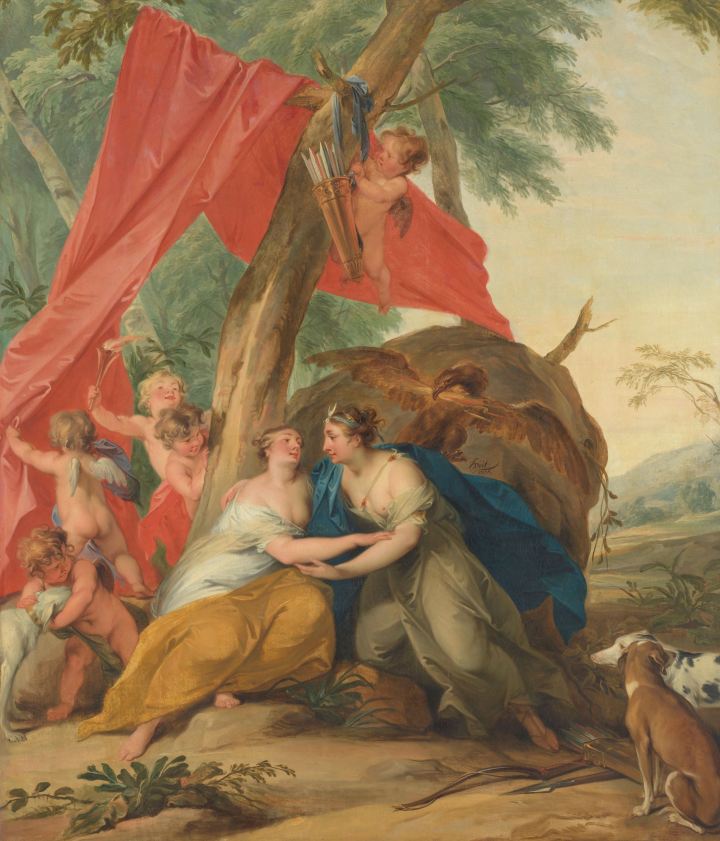
Jacob de Wit, Jupiter, Disguised as Diana, Seducing the Nymph Callisto, 1727, 240 × 205 cm (Amsterdam: Rijksmuseum, SK-A-3885).
These 150 paintings, prints, drawings, costumes, accessories, sculptures, photographs, and furniture items from the Rijksmuseum collection show that gender is everywhere. See the 17th-century portraits in which all the children are wearing dresses. Discover how, in the 18th century, anybody who could afford it was wearing pink—as well as glitter, frills, and floral patterns. Displayed together, these objects show that our ideas about masculinity, femininity, and gender in its broadest sense are defined by their time and place. The exhibition includes artworks by Gesina ter Borch, Marlene Dumas, Bartholomeus van der Helst, Kinke Kooi, Robert Mapplethorpe, Erwin Olaf, Maria Roosen, Charley Toorop, and Sara Troost.
Point of View shows there have always been people whose identity, experiences, and mode of expression didn’t fit the conventions around masculinity and femininity. One example from history is Christina, Queen of Sweden (1626–1689), who had herself portrayed in both female and male form. The exhibition also features portraits of more recent gender-fluid icons including Robert Mapplethorpe and Grace Jones. The exhibition ends with a contemporary perspective on gender; photographer Bete van Meeuwen worked with a group of 10 college students whose photographs show what gender means to them.
New Book | Louis Galloche (1670–1761)
From Silvana Editoriale:
François Marandet, Louis Galloche (1670–1761): Un peintre de poesie au XVIIIe siècle (Milan: Silvana Editoriale, 2023), 112 pages, ISBN: 978-8836656165, €28.
 Oublié par l’histoire de l’art, Louis Galloche (Paris, 1670–1761) fut pourtant l’une des figures majeures de la peinture française au cours de la première moitié du XVIIIe siècle. Il décora des résidences aussi importantes que les châteaux royaux de Versailles, de Fontainebleau et du Trianon. Couronné par le titre de chancelier de l’Académie royale de peinture et sculpture, Louis Galloche eut des élèves voués à devenir célèbres tels François Lemoyne et Charles-Joseph Natoire. Ayant conçu des poesie semblables à celles du Titien, Louis Galloche avait surtout un sens de la beauté particulièrement prononcé. Les tableaux, dessins, et multiples documents d’archives qui ont été retrouvés par François Marandet font ainsi redécouvrir, à travers cette toute première monographie consacrée à Louis Galloche, l’œuvre et l’itinéraire d’un des meilleurs artistes français de sa génération.
c o n t e n t s
Préface
Introduction
Chronologie
Un Élève de Louis de Boullogne, 1690–1711
• Premières études
• Grandes peintures à petits prix
• Un retour du pays des morts
Le Temps des Poesie, 1712–1731
• À la manière du Titien
• Nouvelles études
• Un concours truqué
Le Doyen de l’Académie Royale, 1732–1761
• Des tableaux pour la reine
• Les Salons de la concurrence royale
• Un concours sans vainqueur
• Louis Galloche: stéréotypes et réalité
Bibliographie
Exhibition | Sèvres Extraordinaire! Sculpture from 1740 until Today

From the press release for the upcoming BGC exhibition (note the new dates) . . .
Sèvres Extraordinaire! Sculpture from 1740 until Today
Bard Graduate Center, New York, 10 September — 16 November 2025
Curated by Tamara Préaud, Soazig Guilmin, Charlotte Vignon, and Susan Weber
Sèvres Extraordinaire! Sculpture from 1740 until Today presents the history of the Sèvres Manufactory and its production of extraordinary sculptural objects in various ceramic pastes. Organized by Sèvres, Manufacture et Musée nationaux, and Bard Graduate Center (BGC), the exhibition is the first outside of France to highlight the production of sculpture made at the famed porcelain manufactory.

Etienne-Maurice Falconet, L’Amour menaçant (Threatening Love), 1758/61, Manufacture de Sèvres, soft-paste porcelain biscuit (Manufacture et Musée nationaux, Sèvres, MNC 27724.1).
From extravagant Rococo to restrained Neoclassical, from romantic, neo-Gothic inventions to the elegant curves of the Art Nouveau or the geometries of the Art Deco, and in partnership with artists associated with Surrealism, Abstract Expressionism, and Pop art, Sèvres has continually pushed the boundaries of ceramic production, creating objects that are neither functional nor decorative but rather art that it simply calls ‘sculpture’. One of the main characteristics of the manufactory, from its origins in the disused premises of the Château de Vincennes until the present day, is the unsurpassed variety of its production. The exhibition considers the term ‘sculpture’ in its broadest sense and features three-dimensional vases, centerpieces for a dining table, clocks, inkstands, and rare cups and saucers alongside more expected objects such as busts, figures, and medallions. This approach presents the history of the Sèvres Manufactory through a lesser-known part of its production while highlighting the significant roles of artists, designers, and architects, whose designs represent a microcosm of larger developments in art and culture.
The exhibition reveals the roles of chemical and technological advances as well as artistic innovations in the manufactory’s success, and it presents approximately two hundred works from the collection of Sèvres, Manufacture et Musée nationaux, in ceramic, soft- and hard-paste porcelain, faïence, and stoneware. Other objects highlight the long process of making a sculpture at Sèvres, from initial design to its final painted decoration. These items—sketched, drawn, or engraved sources as well as terra-cotta models and plaster molds—represent the institution’s rich, diverse, and mostly unknown archives.
Situating sculpture produced at the Sèvres Manufactory in the larger context of French history from 1740 through the twenty-first century, the exhibition tells the story of Sèvres’s relationship to French political power. As a royal, imperial, and then a national manufactory, Sèvres was regularly called upon to produce elaborate porcelain dinner, tea, and coffee services, as well as vases and other objects to be used as diplomatic gifts or to adorn the residences of the French elite.
The exhibition is organized chronologically and occupies all four floors of the Bard Graduate Center Gallery. It reflects the manufactory’s history of collaborations with innovative artists and architects to create new forms and designs aligned with the fashions of their time. Featured works from eighteenth-century artists and designers include those of Jean-Claude Duplessis and Louis-Simon Boizot, among others. Alexandre-Évariste Fragonard, Jean-Baptiste Carpeaux, Albert-Ernest Carrier-Belleuse, and Auguste Rodin represent important collaborations of the nineteenth century. Jean Arp, Louise Bourgeois, and Ettore Sottsass are among the artists whose work demonstrates the manufactory’s artistic output in the twentieth century; and creations by Yayoi Kusama, Johan Creten, Jim Dine, Kristin McKirdy, and Betty Woodman reflect Sèvres’s ongoing commitment to working with the most important living artists of the day.
Bard Graduate Center will schedule a number of public events associated with the exhibition. A symposium for scholars and curators is expected to feature Judith Cernogora and Viviane Mesqui, Conservatrices de musée, Sèvres; Tamara Préaud, former archivist of the Sèvres Manufactory; and Linda Roth, Charles C. and Eleanor Lamont Cunningham Curator of European Decorative Arts at the Wadsworth Atheneum Museum of Art.
◊ ◊ ◊ ◊ ◊
Three Centuries of Innovation at Sèvres: A Research Symposium
Friday, 20 September 2024, 1:30–5:30pm
1.00 Introduction by exhibition curator Charlotte Vignon
2.00 Session A
• Tamara Préaud (Manufacture nationale de Sèvres) — Dynasties of Sculptors at Sèvres
• Viviane Mesqui (Manufacture nationale de Sèvres) — Re-editions Serving Heritage at the Sèvres Manufactory: Sèvres Beehive Vases from 1769 to 2024
3.15 Coffee break
3.45 Session B
• Linda Roth (Wadsworth Atheneum Museum) — Taxile Doat: Sculptor, Decorator, and Studio Potter at Sèvres
• Soazig Guilmin (Manufacture nationale de Sèvres) — The Art of Light and Sculpture: A Legacy of the Sèvres Manufactory
• Judith Cernogora (Manufacture nationale de Sèvres) — Luxury and Extravagance: Contemporary Furniture in Sèvres Porcelain
5.15 Concluding remarks
Registration information is available here»
◊ ◊ ◊ ◊ ◊
Tamara Préaud, Sevres Extraordinaire! Sculpture from 1740 Until Today (New Haven: Yale University Press, 2024), 600 pages, ISBN: 978-0300278750, $85.
 The accompanying catalogue is the first large-scale, English-language publication to explore the production of sculpture created by the famed French manufactory from its eighteenth-century origins to the present. Published by Bard Graduate Center and distributed by Yale University Press, this richly illustrated volume is primarily written by Tamara Préaud, who held the position of archivist at the Sèvres Manufactory for more than forty years and today is considered one of the most important historians of the manufactory. Additional texts were written by Guilhem Scherf, curator of sculpture at the Louvre Museum; Soazig Guilmin, head of the registrar’s department and art historian at the Sèvres Museum; Judith Cernogora, curator of contemporary art at the Sèvres Museum; and Florence Rionnet, curator at the Musée des Beaux-Arts in Quimper, Brittany. The volume is edited by Susan Weber and Charlotte Vignon.
c o n t e n t s
Unless otherwise noted, all text by Tamara Préaud
Introduction
• French Sculpture in the Eighteenth and Nineteenth Centuries: Historical Context and Stylistic References — Guilhem Scherf
• Sculpture in France from the Belle Époque to Pop Art — Florence Rionnet
Part I | General Considerations
1 Materials and Production — Tamara Preaud with Soazig Guilmin
2 Salaries and Prices
3 Imitations, Copies, Overmoldings, and Marks
Part II | History
4 The Eighteenth Century
5 The Directorship of Alexandre Brongniart
6 The Second Half of the Nineteenth Century, 1848–91
7 The Twentieth Century
8 Two Decades of Contemporary Art at Sèvres, 2000–20 — Judith Cernogora
9 Sales and Deliveries after 1941 — Soazig Guilmin
◊ ◊ ◊ ◊ ◊
Note (added 9 September 2024) — The posting was updated to include information on the symposium.
Note (added 6 September 2025) — The posting was updated with the exhibition’s new dates. It was originally slated to be on view from 21 September 2024 to 5 January 2025 but closed early due to building maintenance issues.
Call for Papers | Sculpture between Britain and Italy, 1742–1854
From the Call for Papers:
Sculptural Models, Themes, and Genres between Britain and Italy, ca. 1742–1854
Victoria and Albert Museum, London, 16–17 May 2025
Organized by Adriano Aymonino, Albertina Ciani, and Kira d’Alburquerque
Proposals due by 30 September 2024
The University of Buckingham and the Victoria and Albert Museum are organising a two-day interdisciplinary conference on the role played by British-Italian artistic exchanges in shaping sculptural models, themes, and genres in the eighteenth and nineteenth centuries.
The conference adopts a longue durée approach, focusing on the century when these exchanges were most intense: from 1742, when Prince Hoare of Bath the Elder arrived in Rome—the first documented English sculptor to spend a period of study in the city—to the opening of the Crystal Palace in Sydenham in 1854, whose sculptural decoration was directed by the Milanese Raffaele Monti. Throughout this period, the two traditions became interdependent, developing an artistic dialogue that influenced sculptural models and themes not only in Italy and Britain but also across Europe and the territories of the expanding British Empire, from the Indian subcontinent to the Americas.
This conference adopts a typological approach, investigating how academic frameworks and patronage networks influenced the diffusion of sculptural models, themes, and genres, and how market dynamics—along with the industrial production of new materials—either reinforced or challenged these aspects. We are interested in exploring the evolution of established genres such as busts, ideal sculptures, funerary and public monuments, copies, and adaptations after the Antique, as well as the diffusion of models and themes in decorative figurative sculpture, including reliefs, medallions, chimneypieces, and in smaller artworks such as gems, cameos, impressions, ivories, or in objects produced in porcelain, earthenware, and various new artificial ‘stones’. While concentrating on sculpture, the conference embraces an interdisciplinary approach to evaluate how the development of new models, themes, and genres reflected or shaped cultural and national identities, social values, evolving canons, and shifting audiences in the different contexts of Italy and the Anglophone world.
Recent years have witnessed a surge in monographic publications and PhD dissertations by art historians, social historians, and scholars focused on material culture, examining individual artists and themes connected to this trans-national movement. This two-day conference aims to assess the current state of research and explore future directions in the discipline.
We invite proposals for twenty-minute papers on topics that could include, but are not limited to:
• The impact of the academy and academic aesthetic and pedagogical frameworks in shaping sculptural models, themes, and genres, and their diverse manifestations.
• The influence of patronage and collecting in shaping sculptural models, themes, and genres, and their diverse manifestations.
• Industry and the market’s role in the production and dissemination of ‘high art’ models, themes, and genres, as well as commercial, religious, garden, and decorative sculpture.
• The impact of casts, copies, and adaptations on reinforcing or challenging academic canons and establishing new models, themes, and genres.
• The role played by new materials (such as porcelain, biscuit, Wedgwood ‘basalt’ and Jasperware, Coade stone, Parian ware, electrotyping, etc.) in the diffusion and transformation of models, themes, and genres.
• The impact and adaptation of classical or early modern Italian models and themes in the Anglophone world and vice versa.
• The tension/dialogue between themes after the Antique and medieval or early modern themes from literature or history.
• The tension/dialogue between classical and Christian themes.
• The relationship between European and non-European models, themes, and genres.
• The relationship between painting and sculpture, and the links between making and viewing.
• The relationship between sculpture and prints in the diffusion and transformation of models, themes, and genres.
• The changing audiences of sculpture between the eighteenth and nineteenth centuries and the progressive ‘commercialisation’ of models, themes, and genres, exemplified by events such as the 1854 opening of the Crystal Palace (Sydenham).
Please submit a title and abstract of no more than 200 words, along with a short biography (about 100 words – please do not send CVs) to Albertina Ciani (2127054@buckingham.ac.uk) by noon (BST), 30 September 2024. The abstract and biography should be combined in a single Word document and submitted as an email attachment. Incomplete or late submissions will not be considered. Notification of the outcome will be communicated via email by 31 October 2024.
The conference is part of a series of events organised to celebrate the launch of a new edition of Francis Haskell and Nicholas Penny’s Taste and the Antique in October 2024.
Fellowship | PhD Position in Architectural History, Trinity College Dublin
From the Call for Applicants, with apologies for the short notice. –CH
PhD Position in Architectural History: Stone in 18th-Century Architecture
Department of the History of Art and Architecture, Trinity College Dublin, starting September 2024
Applications due by 17 July 2024
Applicants are sought for a funded four-year PhD at Trinity College Dublin, commencing in September 2024, on a topic relating to the ERC advanced grant research project STONE-WORK, led by Professor Christine Casey in the Department of History of Art and Architecture. The successful applicant will be based in the School of Histories and Humanities and enrolled in the Structured PhD Programme. The award comprises the student’s PhD tuition fees and an annual stipend of €25,000.
STONE-WORK challenges the perception of architecture as a primarily conceptual activity by shifting focus from individual to collective achievement. Despite the emphatic materiality of architecture, its history remains dominated by a sequential model which privileges the agency of individuals and ideas. STONE-WORK’s fundamental premise is that architecture results from a cumulative sequence of actions involving an array of actors, great and small. Revealing stone’s hidden trajectory from quarry to wall, floor, column, and chimneypiece will probe the nexus of skills, techniques, and support mechanisms developed by communities in its sourcing, supplying, and fashioning, and the impact of these processes upon building activity. This cross-disciplinary research, combining the history of architecture and craft with geology aims to produce a holistic analysis of architecture and stone production.
The project pursues four main objectives:
• Transform knowledge of interdependence in architectural production.
• Develop a cross-disciplinary interface between geology, craft, and architectural history for the analysis of building stone.
• Reconstruct the trade and labour networks of Anglo-Irish stone production to determine how quarrying and stone-working affected the use of stone in eighteenth-century architecture.
• Discover the qualitative standards in materials and techniques which underpinned the handling of stone in eighteenth-century architectural production.
The PhD dissertation will explore the agency of the consumer and maker in the eighteenth-century stone industry by focusing on the chimney-piece industry in Britain and Ireland. This is an under-studied topic rich in surviving data both material and archival.
We are seeking applicants with the following qualifications:
Essential
• A first-class (or equivalent) undergraduate degree or a master’s degree with distinction in the History of Art or History of Architecture
• Excellent communicative competence in English
• Excellent research and organisational skills
• Knowledge of classical architecture in eighteenth-century Britain and Ireland
Desirable
• Demonstrable experience of using archives and working knowledge of eighteenth-century architecture
• Willingness to contribute to the activities of the STONE-WORK research project
Applications for the award must include
• A personal statement (max. 2 pages), including your motivation for applying for this PhD student position
• A curriculum vitae with educational history, including two academic references
• Transcripts of degree results
Prospective students should send these documents to Melanie Hayes at pghishum@tcd.ie by the deadline on the 17th July 2024. The successful candidate will then make a formal application to TCD via the my.tcd.ie portal and be issued with a formal offer in the same manner as other incoming PhD students. Applications will not be considered complete without academic references. Applicants will be notified of the outcome of their application by early August. If the successful candidate does not have English as a first language, s/he will also be required to submit evidence of English language competence at this stage.
Trinity College Dublin is committed to policies, procedures, and practices which do not discriminate on grounds such as gender, civil status, family status, age, disability, race, religious belief, sexual orientation, or membership of the travelling community. On that basis we encourage and welcome talented people from all backgrounds to join our staff and student body. Trinity’s Diversity Statement can be viewed in full here.
Dr Melanie Hayes, Trinity College Dublin, Department of the History of Art and Architecture, College Green, Dublin 2, Ireland, HAYESM7@tcd.ie.










 Enfilade
leave a comment