New Book | Glorious Lessons: John Trumbull
From Yale UP:
Richard Brookhiser, Glorious Lessons: John Trumbull, Painter of the American Revolution (New Haven: Yale University Press, 2024), 276 pages, ISBN: 978-0300259704, $30.
 The complicated life and legacy of John Trumbull, whose paintings portrayed both the struggle and the principles that distinguished America’s founding moment
John Trumbull (1756–1843) experienced the American Revolution firsthand—he served as aid to George Washington and Horatio Gates, was shot at, and was jailed as a spy. He made it his mission to record the war, giving visual form to what most citizens of the new United States thought: that they had brought into the world a great and unprecedented political experiment. His purpose, he wrote, was “to preserve and diffuse the memory of the noblest series of actions which have ever presented themselves in the history of man.” Although Trumbull’s contemporaries viewed him as a painter, Trumbull thought of himself as a historian. Richard Brookhiser tells Trumbull’s story of acclaim and recognition, a story complicated by provincialism, war, a messy personal life, and, ultimately, changing fashion. He shows how the artist’s fifty-year project embodied the meaning of American exceptionalism and played a key role in defining the values of the new country. Trumbull depicted the story of self-rule in the modern world—a story as important and as contested today as it was 250 years ago.
Richard Brookhiser is a senior editor of National Review and a fellow of the National Review Institute. His books include Founding Father: Rediscovering George Washington and Founders’ Son: A Life of Abraham Lincoln. He lives in New York City.
New Book | Edward Duffield: Philadelphia Clockmaker
Coming in August from the APS Press, with distribution by the University of Pennsylvania Press:
Bob Frishman, Edward Duffield: Philadelphia Clockmaker, Citizen, Gentleman, 1730–1803 (Philadelphia: The American Philosophical Society Press, 2024), 256 pages, ISBN: 978-1606180099, $60.
 Edward Duffield (1730–1803) was a colonial Philadelphia clockmaker, whose elegant brass, mahogany, and walnut timekeepers stand proudly in major American museums and collections. Duffield, unlike other leather-apron ‘mechanics,’ was born rich and owned a country estate, Benfield, and many more properties. He was deeply involved in civic and church affairs during crucial years in American history—his lifelong close friend, Benjamin Franklin, was staying at Duffield’s Benfield estate when Franklin, Thomas Jefferson, and John Adams first discussed the Declaration of Independence. Sally, Franklin’s daughter, brought her family there for extended periods during the Revolution and Franklin’s wife, Deborah, was best friends for fifty years with Duffield’s mother-in-law. Duffield was even one of three executors of Franklin’s will.
In this lavishly illustrated book, Bob Frishman catalogs and describes seventy-one known Duffield clocks and instruments and reveals how, during the mid-eighteenth century, they largely were not fabricated from scratch by isolated individuals. He contends that Duffield and his fellow clockmakers were not furniture-makers; they were mechanical artisans whose complex metal machines rang the hours and steadily ticked inside wooden cases made by others. Existing books on Philadelphia clocks have focused on these artifacts as furniture, including their woodwork, cabinetmakers, and decorative aspects. However, Frishman, a professional horologist for nearly four decades, brings his vast expertise to bear on this first comprehensive study of Duffield’s life and work.
Far more than a treatise on pre-industrial horological timekeeping, this book tells the compelling stories of a man, a city, and an era, while deepening our appreciation for Duffield’s stately sentinels—often a colonial American family’s most valuable possession—and the times and places in which their makers lived.
Bob Frishman was introduced to horology―the science of timekeeping―on Thanksgiving Day, 1980, when he was invited into the overflowing cellar of a collector and dealer of antique clocks, watches, tools, and machinery. Had Bob stayed home that day, or not left the holiday dining table and gone down those basement stairs, this book would not have been written. Nor would Bob’s other horological efforts during the past four decades ever have happened: eight thousand mechanical clocks repaired; two thousand antique clocks and watches restored and sold; hundred-plus articles and reviews published; hundred-plus in-person and virtual lectures delivered to horological and general audiences here and abroad; annual NAWCC symposia organized at the Winterthur Museum, the Museum of Fine Arts, Boston, the Henry Ford Museum, and the Museum of the American Revolution; and exhibits created and mounted by him at venues including the Horological Society of New York and the Willard House & Clock Museum.
Bob is a Silver Star Fellow of the National Association of Watch and Clock Collectors, and a Liveryman of the Worshipful Company of Clockmakers in London. As a dedicated supporter of other venerable cultural institutions, he is a Proprietor of the Boston Athenaeum, holder of Share Number 8 of the Library Company of Philadelphia, a member of the Grolier Club, the American Antiquarian Society, and the Ross Society of the Museum of Fine Arts, Boston. He continues to operate Bell-Time Clocks in Andover, Massachusetts, where he lives with his wife, author Jeanne Schinto.
Call for Papers | Skillful Hands: Apprentices and Networks of Learning
From the Call for Papers:
Skillful Hands: Apprentices and Networks of Learning, 1650–1950
Rienzi’s Biennial Symposium
Museum of Fine Arts, Houston, 9 November 2024
Proposals due by 15 August 2024
Rienzi, the house museum for European decorative arts of the Museum of Fine Arts, Houston, presents the symposium Skillful Hands: Apprentices and Networks of Learning 1650–1950.

William Hogarth, Industry and Idleness, Plate I: The Fellow ‘Prentices at Their Looms, October 1747, etching and engraving (Houston: Sarah Campbell Blaffer Foundation, BF.1983.5.45).
Until the late 19th century, apprenticeship was the primary way people were trained in craft trades in Europe and the Americas. Formal education was mainly out of reach for many children from middle-class and low-income families. Apprenticeship training, a legal contract between a student and a master craftsperson, became an advantageous alternative to traditional education. Apprenticeships were regulated and monitored by European craft guilds established during the medieval period to control craft production. Their influence extended beyond the training period, and apprentices were generally closely linked to master craftspeople through cultural and social ties, including intermarriage. Within the traditional guild system, females, immigrants, Indigenous and enslaved peoples, and children from low-income families were often excluded.
With the onset of the Industrial Revolution, informal apprenticeships were introduced to adapt to innovations and technologies. Colonial expansion provided a range of new raw materials and new demands for skilled labor. Outside traditional European apprenticeship models, skills were acquired through forced migration, local environments, and informal training in various colonial regions. These varied experiences resulted in a diverse network of skilled craftspeople, both anonymous and renowned. The symposium critically considers the networks of learning available—and unavailable—to diverse groups of people and how access to training and materials through apprenticeships helped to shape craft traditions. Who had access, and who did not? How did skills and ideas travel? How did apprenticeship systems affect the material, form, and quality of crafted objects? How did political, social, and cultural conditions in colonies such as British and French North America, New Spain, and the Caribbean influence trade training modes?
Graduate students and entry-level and mid-career professionals are invited to submit a 400-word abstract outlining a 20-minute presentation, along with a CV, by Thursday, 15 August 2024, to rienzisymposium@mfah.org. Selected participants will be notified by Friday, 30 August 2024, and offered a $600 honorarium for travel and lodging. All presentations are given Saturday, 9 November 2024, at the Museum of Fine Arts, Houston.
Possible themes for investigation may include, but are not limited to:
• Transatlantic trade
• Workshop traditions
• Empire and colonialism
• Technology
• Gender
• Race
• Economics
• Labor
• Class
• Education
• Childhood
Symposium | A la Ronde: Female Expression through Craft and Design
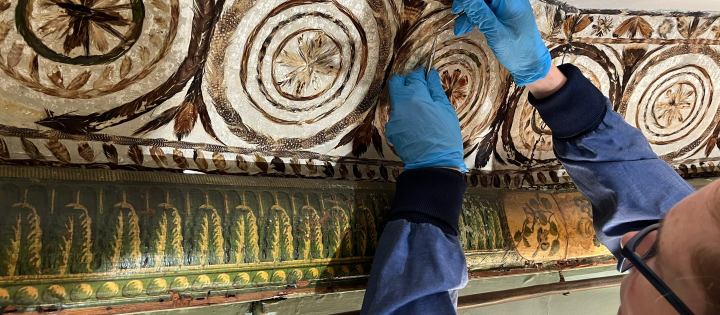
Conservation of the feather frieze in the Drawing Room at A la Ronde in Devon
◊ ◊ ◊ ◊ ◊
From the National Trust:
Female Expression through Craft and Design in the 18th and Early 19th Centuries
Online and in-person, Reed Hall, University of Exeter, 11 July 2024
The National Trust is delighted to announce this hybrid conference inspired by the conservation, outreach, and interpretation project A la Ronde: Conserving the Past, Creating the Future. Intended to forge new bonds with researchers and academic professionals, find synergies with similar projects and properties, and to share stories and discoveries from our recent conservation work in a broader context, the symposium will be offered in hybrid form, with presentations both in-person and online. Booking is available here»
About A la Ronde — A small estate in Lympstone, Devon, this 16-sided house and chapel were built, and perhaps designed, by Jane Parminter and her young cousin and ward, Mary, around 1796, following their return from several Grand Tours of Europe. The house is now owned by the National Trust and contains the extraordinary decorative interiors designed by the Parminters. These include over 27 metres of friezes formed from feathers in the drawing room, patterned wall painting in the central Octagon room, and a Shell Gallery sitting at the top of the house encrusted with over 26,000 individual components, accessed by a narrow Grotto Staircase from below. The wider estate also contained a chapel, alms houses, and school room for local unmarried women and girls, a manse, vegetable gardens, and small picturesque landscape in the context of a ferme ornée. Mary’s will records that the grounds originally contained decorative features including a shellery, fountain, obelisks, and seating. The Shell Gallery, Grotto Staircase, Drawing Room feather frieze, and Octagon have been recently conserved as part of a two-year multi-strand project, A la Ronde: Conserving the Past, Creating the Future, which culminates in 2024.
p r o g r a m m e
9.30 Welcome and Opening Remarks
• Jonathan Fisher (General Manager South East Devon Portfolio, National Trust)
• Emma Mee (Project Lead, National Trust)
9.45 Keynote Presentation
• Daniel Maudlin (University of Plymouth), Making Cottages: Rural Retreat and the Appropriation of the Vernacular in the 18th Century
10.10 Panel 1 | Female-Designed and Commissioned Domestic Spaces
• Rosemary Baird Andrae FSA, The Architectural Patronage of Mrs Montagu, Queen of the Bluestockings
• Tom Coombe (Collections and House Manager, National Trust), The Ornamental Dairy at Croome: Ceramics, Crafting, and Performance
• Jyoti Pandey Sharma (School of Planning and Architecture, New Delhi), Transculturalism in 19th-Century Mofussil India: Begam Samru and Her Architecturally Hybrid Sardhana Palace
• Saniya Siddiqui (School of Planning and Architecture, New Delhi), Taj Mahal Palace: A Royal Residence Commissioned by Nawab Shah Jahan Begum (r.1868–1901), Ruler of Bhopal Princely State in the British-ruled Indian Subcontinent
11.30 Coffee Break
11:45 Panel 2 | A la Ronde and National Trust Conservation Work
Convenor: Nigel Blades (Head of Conservation, National Trust)
• Daniel Cull (Conservator, National Trust), Conserving the Past, Creating the Future: A Summary of the Conservation Project at A la Ronde
• Nicola Shreeve (Remedial Conservator, National Trust), The Technical Investigation and Conservation of the Octagonal Chairs from A la Ronde
• Nicola Walker (Senior National Conservator, Paper and Photography, National Trust), Shells, Curtains, and a Doll’s House: Conservation and Collaboration
1.00 Lunch
1.45 Panel 3 | Decorative Historic Interiors and Material Histories
• Lucy Powell (Leverhulme Early Career Research Fellow, University of Oxford), ‘The Feather’d Fair’: Women, Femininity, and Feathers in the 1790s
• Clare Taylor (The Open University), ‘Our New Paper Hangings’: Women and Wallpaper in 18th-Century Britain
• Libby Horsfield (PhD student, Birkbeck University), The Centre of Attention: Women’s Crafted Fire Screens and the Country House Interior in the 19th Century
• Emily Deal (Digital Curator, National Trust), The Material Biography of Molly Lepell: Material Culture and Collection as a Form of Life Writing in the 18th Century
3.00 Coffee Break
3.10 Panel 4 | Georgian Period Embellished Decorative Interiors Using Natural Materials
Convenor: Rachel Conroy (Senior National Curator, Decorative Arts, National Trust)
• Wenyu Dong (MA student, Central Academy of Fine Arts), From Chinese Chambre to Feather Room: Elizabeth Montagu’s Interiors in the 1760s and 1780s London
• Kyriaki Hadjiafxendi (Senior Lecturer, Victorian Literature and Culture, Bath Spa University), The Eventfulness of Nature: Women and the Seashore in the Long 19th Century
• Beth Howell (Business Services Coordinator, National Trust), ‘Call Us Not Weeds!’: Examining the Aesthetics of Upcycling and Anonymity in Victorian Depictions of Seaweed
• Laura Keim (Stenton Curator), Kaila Temple (Stenton Curatorial Assistant), and Lara Kaplan (Objects Conservator Winterthur Museum), ‘Place to Cultivate Her Mind in by Musing’: Anne Reckless Emlen’s 1757 Shellwork Grotto
4.50 Closing Remarks
• Sarah Lloyd (Research Fellow, Institute of Historical Research, University of London)
Essay | Caroline Gonda on Anne Seymour Damer
Caroline Gonda recently published this essay on The British Museum’s Blog, with lots of images and links for relevant items, including the drawing reproduced here.
Caroline Gonda, “Anne Seymour Damer: Public Life, Private Love,” The British Museum Blog (27 June 2024). Gossip about Anne Seymour Damer’s sexuality nearly wrecked her relationships and reputation, but in this queer love story, love beats scandal.

John Downman, Study for a Portrait of Anne Damer, charcoal, touched with red chalk, 1788 (London: The British Museum, 1967,1014.181.141).
‘Social media’ ruined lives in the 18th century, just as it does today. Anne Seymour Damer (1748/9–1828) was a sculptor (a highly unusual career for a woman artist at the time) and an aristocrat, which made her a part of celebrity culture and particularly exposed to gossip. Damer was also the subject of scandal because of her intimate relationships with other women. One of her contemporaries, the writer and literary hostess Hester Piozzi, described her as ‘a lady much suspected for liking her own sex in a criminal way’. Damer was repeatedly labelled as a Sapphist. The term was an allusion to the ancient Greek poet Sappho; famous for her love poems, many of them addressed to other women, Sappho was beginning to be seen in this period as the original lesbian (a term drawn from her birthplace of Lesbos). The gossip put Damer’s reputation at risk, but also sabotaged her chances of finding—and keeping—love. . .
The full essay is available here»
Caroline Gonda is College Associate Professor and Glen Cavaliero Fellow in English at St Catharine’s College, Cambridge.
Call for Papers | Women as Collectors
From the Call for Papers:
Collecting Past and Present: Women as Collectors
The Wallace Collection, London, 1 November 2024
Proposals due by 2 August 2024
In 2024, the Wallace Collection launched Collecting Past and Present. This new research series takes the format of biannual, themed study days, which include fascinating talks from specialists, exploring collecting through the ages to the modern day. Exclusive interviews with contemporary collectors also feature, revealing tantalising glimpses of extraordinary objects and how they are brought together. These are followed by drinks receptions that act as unique forums for discussion. For those further afield or unable to make it to the museum, the talks can be watched online.
We are now inviting abstracts for our November study day that explore women as collectors and patrons of all art forms. Talks should be 45-minutes long and illustrated by a presentation. They will be held in the Wallace Collection Theatre on Friday, 1 November 2024, between 10.15 and 17.30 GMT. We would like to encourage all those with a specialist interest to share a short text (500 words) and CV with Collecting.PastandPresent@wallacecollection.org by Friday, 2 August 2024. If your submission is accepted, we will require your talk’s title (maximum seven words), an abstract (60 words), and a bio (60 words). We can contribute up to the following amounts towards speakers’ travel expenses on submission of receipts:
• Speakers within the UK – £100
• Speakers from Continental Europe – £180
• Speakers from outside Europe – £300
Exhibition | Flora Yukhnovich and François Boucher
Melissa Hyde contributed to the booklet that accompanies the exhibition; for more information, see Jan Dalley’s review for the Financial Times (14 June 2024).
Flora Yukhnovich and François Boucher: The Language of the Rococo
The Wallace Collection, London, 5 June — 3 November 2024
 This summer discover new works by British artist Flora Yukhnovich (b. 1990) in this free display.
Yukhnovich, celebrated for her large-scale, semi-abstract oil paintings, has given the language of the Rococo new life. Two new paintings by the artist, made in response to two exceptional paintings by the celebrated 18th-century French painter François Boucher (1703–1770), occupy gilt frames at the top of our grand staircase. Boucher’s paintings will be displayed in the Housekeeper’s Room out of their frames, on white walls, like contemporary works of art. Theatrical and tongue-in-cheek, they are prime examples of the Rococo, a decorative and exuberant style favoured across the arts by royal and aristocratic patrons in France and elsewhere from the 1730s. Flora Yukhnovich and François Boucher: The Language of the Rococo prompts visitors to reconsider preconceptions, explore how we can connect with the Rococo today, and examine the impact of display on art interpretation and historical re-evaluation.
Image: Two versions of the exhibition poster are available from The Wallace’s shop; the one pictured here reproduces a detail of Yukhnovich’s 2024 painting Folies Bergère.
Board Game | La Fleur: Extravagant Gardens in Rococo France
Recently funded on Kickstarter, with late pledges still available for a scheduled release of March 2025:
La Fleur: Extravagant Gardens in Rococo France
Created by Dux Somnium Games
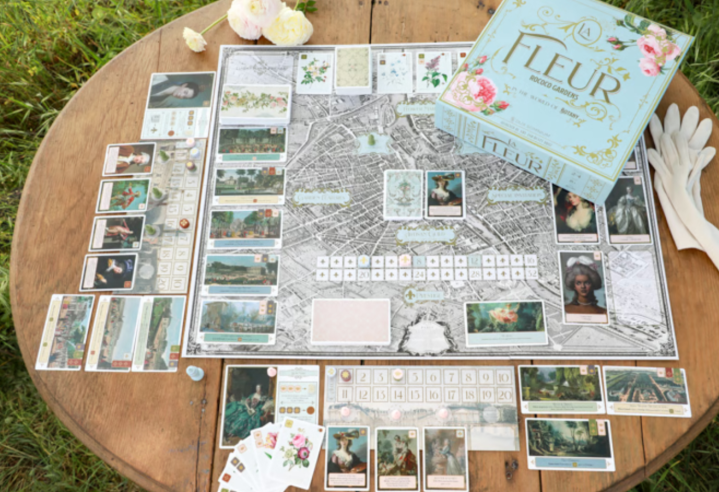 Host the fanciest French Rococo parties in the ultimate garden-building, flower-collecting, and guest-stealing game for 1 to 4 players (ages 8+).
Opulence, love, and flowers! La Fleur is a strategy board game where you take on the role of a French Rococo garden enthusiast as you build your château, host garden parties, and gain enough prestige to hold the greatest of all garden gatherings, the Grande Soirée. Each round you will send your artisans to different parts of Paris to acquire floral beauties, hire additional help, earn coins, and commission new garden features for your château. But be quick! Resources each round are limited, and the first artisan to each location gets their pick of the crème de la crème. Available in English and French.
Call for Papers | Practices of Female Botanists
From the Call for Papers:
Book of Nature, Nature of Books: Practices of Female Botanists
Livre de la nature, nature du livre: Pratiques des femmes botanistes
Dijon, 19–20 June 2025
Proposals due by 31 October 2024
The research centres TIL (Université de Bourgogne) and EMMA (Université Paul-Valéry Montpellier 3) are organizing a bilingual (French-English) international interdisciplinary conference on the role of women in the development of botany as part of visual, manuscript and print cultures, from the Middle Ages to the contemporary period. We propose to foster discussions at the intersections of the history of natural sciences, print culture, book history, illustration studies, gender studies, plant studies, and ecocriticism. Papers may focus on a wide variety of case studies pertaining to any geographical area, from herbals to non-fiction writing, from publishers’ and libraries’ archives to museum collections, or from the garden to the diary and to the printed book. They will address the role of women as amateur or professional botanists, gardeners, members of clubs, illustrators, diarists, writers, publishers, and in any other capacity where their individual practices bear on forms of manuscript and print artefacts.
Historically, a putative association between women and plants shaped the views on both (Greene; Taiz and Taiz). Even after the discovery of sexuality in plants in the late seventeenth century, the idea remained so prevalent that Hegel wrote in his Philosophy of Right (1821) that men were “like animals, active and combative,” and women “like plants, essentially placid” (Schiebinger 2). It was probably for this reason that Jean-Jacques Rousseau, among many others, recommended botany to ladies. By the early nineteenth century, botany was viewed as a feminine science, and a distinction was emerging between scientific botany, for men, and popular, literary botany, for women (Shteir). The conference aims to explore the way the spaces and boundaries of women’s contributions to botany were redefined in the face of institutional and societal conventions and restrictions. Along with histories of suppression, we will also examine the way women gained prominence in certain fields, such as illustration and shaped aspects of manuscript and print cultures. Specific case studies as well as papers looking at long-term processes will shed light on past and contemporary trends so as to assess legacies and propose revaluations.
We invite academics and young scholars, librarians, visual artists, and publishers to contribute papers exploring the following themes:
• The Book of Nature and its legacy — We would welcome papers on the legacy of the medieval trope of nature legible as a book, materialized from the 12th century by such productions as herbals. This theme could include issues around the vexed notion of ‘nature’ when it collides with ‘the feminine’ and if/how practices can be seen as gendered in the domain of botany.
• Itineraries of women and plants — Papers may include biographical accounts that trace the itineraries of female botanists in relation to the type of plants that they study. It may be fruitful to underline the implicit or explicit hierarchies that underscore gender divisions: is there a link between unobtrusive species such as moss, fungus and ferns, and their being studied by women? We will also examine the usual association between women and care, as for instance in relation to medicinal plants.
• Records, archives, and exchanges — We would like to hear about the way researchers can gain access to the role of female botanists. How much of their work has been recorded, compared to their male counterparts, and how are such records organized and archived? We also welcome contributions that explore institutional funding of research and travel, as well as traces of transnational networks and discussions with domestic and foreign correspondents. Can we imagine unknown treasures still waiting to be discovered?
• Circulation of manuscript and print artefacts — Papers may examine the specific ways women circulated their findings. This may bear on the history of publishing: how have publishers approached the female botanist? What is the role of women working as publishers themselves, or as popularizers of botany and educationalists in print? The connection between print and manuscripts may also lead us to address the interplay between restriction, emancipation and creativity, in such instances as the diary, the private circulation of manuscripts and private archives.
• Spaces of practice and display — Attention will also be paid to the spatial and medial dimension of the circulation of manuscript and print artefacts, from the page of the book, periodical and diary to museums, drawing rooms, gardens, lecture theatres, gendered spaces, all the way to the internet today. This provides an opportunity to assess the alternative function of certain spaces such asthe garden and domestic spaces when they are redefined as botanical laboratories. Space may also provide clues to how women have been confined by their social backgrounds or have moved across social boundaries.
• Botany, illustration, and nature writing — Working as illustrators often allowed women artists to engage in scientific pursuits whilst being deprived of institutional support.This limitation may have nevertheless been a way of consolidating iconic and textual models and modes of inquiry that found their way in the illustrated book, in nature writing, and in theoretical and popular views of plants’ lives. Therefore, we also invite papers that explore how the material conditions of textual and visual practices, as well as attitudes to plants have been tropedinto a “botanical poetics” (Rosenberg 10–14). We would also like to know how contemporary illustrators, botanists, and nature writers come to terms with such legacies.
• Amateur and professional science — The papers may focus on the way fully recognized or overlooked women negotiated the boundary between private and public spheres, how they construed the porosity between certain fields, and which educational spaces they had access to. This could lead to investigations of women’s contribution to the development of botany as an individual and/or institutional pursuit, as an intimate source of personal development as opposed to a professional career, and of course to assessments of overlooked contributions to the history of science.
• Female crafting and the intermedial circulation of models — We welcome contributions that highlight the material, technical, and intermedial aspects of women’s practices. Are there specific experimental productions such as Mary Delany’s paper mosaics and Anna Atkins’s cyanotypes that lend themselves to a critical analysis of their marginal status and alternative visualizations of nature? Certain types of material objects have been associated to botanical practices and the intermedial dissemination of models, as, for instance, the models of flowers made by the Brendel firm in Germany, still preserved in European universities such as Dijon. What was the role of women in the manufacturing of these models? What was their impact on the careers and aesthetics of female botanists?
Please send a 300-word abstract and a biobibliography (in English or French) before 31 October 2024 to bookofnature2025@gmail.com. Notification will be given by 15 December 2024, and the program will be finalized in January 2025. After the conference, the deadline for the submission of papers for publication will be 30 September 2025.
Keynote Speakers
Anne Hodge (curator of drawings and prints, National Gallery of Ireland)
Valérie Chansigaud (historian of science, independent scholar and author)
Scientific Committee
Marie-Charlotte Anstett (CNRS, Université de Bourgogne), Anna Cabanel (KU Leuven), Kathleen Davidson (University of Sydney), Rodolphe Leroy (Université de Bourgogne), Katherine Manthorne (City University of New York), Clélia Nau (University Paris-Cité), and Ann Shteir (York University, Canada)
Organizing Committee
Sophie Aymes, Marie-Odile Bernez, Ali Hatapçı, Candice Lemaire (Université de Bourgogne), Valérie Morisson (Université Paul-Valéry Montpellier 3)
b i b l i o g r a p h i e i n d i c a t i v e
Bending, Stephen. Green Retreats: Women, Gardens, and Eighteenth-Century Culture. Cambridge: Cambridge UP, 2013.
Chansigaud, Valérie. Histoire de l’illustration naturaliste. Paris: Delachaux et Niestlé, 2009.
Chansigaud, Valérie. Une histoire des fleurs: entre nature et culture. Paris: Delachaux et Niestlé, 2014.
Davis, Rebecca. “The Book of Nature.” Nature and Literary Studies. Ed. Peter Remien and Scott Slovic. Cambridge: Cambridge UP, 2022. 31–48.
George, Sam. Botany, Sexuality, and Women’s Writing, 1760–1830: From Modest Shoot to Forward Plant. Manchester: Manchester UP, 2007.
Greene, Edward Lee. Landmarks of Botanical History. Part 2. Ed. Frank Egerton. Stanford UP, 1983.
Johnson, Nuala. Empire, Gender, and Bio-Geography: Charlotte Wheeler-Cuffe and Colonial Burma. New York: Routledge, 2023.
LaBouff, Nicole. “Public Science in the Private Garden: Noblewomen Horticulturalists and the Making of British Botany c. 1785–1810.” History of Science 59.3 (2021): 223–55.
Laroche, Rebecca. Medical Authority and Englishwomen’s Herbal Texts, 1550–1650. London: Routledge, 2016.
Libster, Martha. Herbal Diplomats: The Contribution of Early American Nurses (1830–1860) to Nineteenth-Century Health Care Reform and the Botanical Medical Movement. Golden Apple Publications, 2004.
Lightman, Bernard, ed. A Companion to the History of Science. Malden: John Wiley & Sons, 2016.
Manthorne, Katherine. Fidelia Bridges: Nature into Art. Lund Humphries, 2023.
Page, Judith and Elise Lawton Smith. Women, Literature, and the Domesticated Landscape: England’s Disciples of Flora, 1780–1870. Cambridge: Cambridge UP, 2011.
Rosenberg, Jessica. Botanical Poetics: Early Modern Plant Books and the Husbandry of Print. Philadelphia: U of Pennsylvania P, 2022.
Rudolph, Emanuel. “Women in Nineteenth-Century American Botany: A Generally Unrecognized Constituency.” American Journal of Botany 69.8 (1982): 1346–55.
Sagal, Anna. Botanical Entanglements: Women, Natural Science, and the Arts in Eighteenth-Century England. Charlottesville: U of Virginia P, 2022.
Schiebinger, Londa. Nature’s Body: Gender in the Making of Modern Science. Rutgers: Rutgers UP, 2004.
Shteir, Ann. Cultivating Women, Cultivating Science: Flora’s Daughters and Botany in England, 1760 to 1860. Baltimore: Johns Hopkins UP, 1996.
Strocchia, Sharon. Forgotten Healers: Women and the Pursuit of Health in Late Renaissance Italy. Cambridge: Harvard UP, 2019.
Taiz, Lincoln and Lee Taiz. Flora Unveiled: The Discovery and Denial of Sex in Plants. Oxford: Oxford UP, 2017.










 Enfilade
leave a comment