Colonial Williamsburg Acquires Rare Charleston ‘Free’ Badge
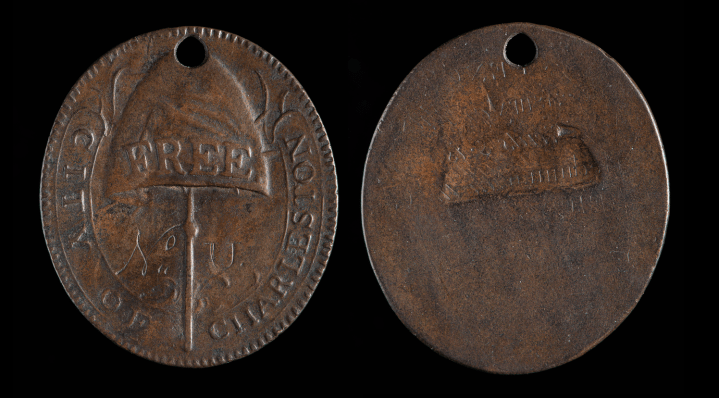
City of Charleston ‘Free’ Badge with Phrygian Cap and Pole, marked ‘No. U’, engraved by Thomas Albernethie, ca. 1787–89, copper
(Colonial Williamsburg: Museum Purchase, The Friends of Colonial Williamsburg Collections Fund and Partial Gift of John Kraljevich, 2024-171).
◊ ◊ ◊ ◊ ◊
From the press release (30 July 2024). . .
Colonial Williamsburg Acquires Rare Charleston ‘Free’ Badge
New research shows the previously unknown numismatic origins of ‘U’ and ‘X’ badges.
Weeks after the Revolutionary War ended by the terms of the Treaty of Paris in 1783, the newly incorporated city of Charleston, South Carolina began to pass laws. The population of the city was overwhelmingly African American with more than 8,000 people in the community, and the vast majority of them were enslaved; only about 600 were living there as free citizens. Ever fearful of insurrection, the city’s administration continued to implement policies designed to constrain the lives of all of its African American residents. An ordinance from 22 November 1783 regulated the employment or ‘hiring out’ of skilled and unskilled enslaved workers in which an individual went to work for an entity other than their enslaver, who was paid a fee for the service provided. An annual fee of five to forty shillings was to be paid to the city by the enslaver for the right of an enslaved person to be hired out, and a badge or ticket was required to be worn by the laborer. [The law also required free African American residents to wear badges.]
While no examples of ‘slave’ badges dating to 1783 are known to exist today, 10 ‘free’ badges from later in the 1780s have been identified in museums and private collections. The Colonial Williamsburg Foundation has recently acquired one of these ‘free’ badges, and it is now on view in the Lowcountry section of the exhibition A Rich and Varied Culture in the Nancy N. and Colin G. Campbell Gallery of the DeWitt Wallace Decorative Arts Museum, one of the Art Museums of Colonial Williamsburg.
“It’s an important piece—and an emotional one,” said J. Grahame Long, The Colonial Williamsburg Foundation’s executive director of collections and deputy chief curator. “Obviously, it’s a terrific addition to Colonial Williamsburg’s permanent collection, but it goes much further than that. It’s a critical component in telling America’s whole story.”
The Charleston ‘hiring out’ law pertained not only to enslaved workers. It went further to affect the free African American population as well, stating that
“…every free negro, mulatto or [mestizo] living or residing within this City, shall be obliged … to register him, her or themselves, in the office of the City Clerk, with the number of their respective families and places of residence … every free negro, mulatto, or mestizo, above the age of fifteen years, shall be obliged to obtain a badge from the Corporation of the City, for which badge every such person shall pay into the City Treasury the sum of Five Shillings, and shall wear it suspended by a string or ribband, and exposed to view on his breast.”
Through these dehumanizing requirements, the city of Charleston levied a fee on the right of free people of color to live and work there—a stinging irony given the root causes of the American Revolution. The penalties for breaking this law were harsh: failure to comply could cause a free person to be fined £3, which if not paid within 10 days could force the person to the workhouse (jail) and work for up to 30 days. Enslaved individuals caught wearing a ‘free’ badge were subject to whipping, by up to 39 lashes, followed by an hour in the stocks.
“I can’t help but see the parallels between these 18th-century ‘free’ badges and the yellow stars worn by Jews during the Holocaust,” said Erik Goldstein, Colonial Williamsburg’s senior curator of mechanical arts, metals, and numismatics. “Both survive as reminders of horrific ideologies, and how humanity must do better going forward.”

City of Charleston ‘Free’ Badge with Phrygian Cap and Pole, marked ‘No. X’, copper (Winston-Salem: Museum of Early Southern Decorative Arts; acquired in 2024, photo by Lea Lane).
Of the 10 known ‘free’ badges, with one exception, all are made of copper. Their iconography is misleadingly uplifting: they featured the ‘Phrygian’ cap and pole, symbolizing the lofty ideals of liberty since ancient times and were rendered in high relief and emblazoned ‘FREE’. Each of these badges carries a unique sequential designator as they were intended to be instruments of tracking, control, and a revenue source. The badge acquired by Colonial Williamsburg is engraved ‘No. U’ and is part of a succession, possibly limited to 26 or fewer badges with letters instead of numbers. To date, the only other badge inscribed with a letter is ‘No. X’, and the other eight examples are numbered between 14 and 341.
Research conducted by Goldstein at Colonial Williamsburg reveals new insights into how these badges were made. What further unites badges ‘U’ and ‘X’ are the copper pieces, or planchets, that they were struck on. Both exhibit portions of text engraved in retrograde or ‘mirror image’ on their backs, showing that they had previously been part of a printing plate relating to money. Once reversed, the readable portions contain words like ‘PENCE’, ‘TREASURY’, ‘DEPOSIT’, and ‘RENTS’. This detail offers a surprising clue to their numismatic origin; the only paper currency circulating in South Carolina in the 1780s that carried these specific terms were the City of Charleston’s emissions of 12 July and 20 October 1786, only current until 21 July 1788. It can therefore be said with certainty that the badges ‘U’ and ‘X’ were made of copper recycled from the out-of-date printing plates for these two issues. As of mid-2024, unique examples of only the ‘Two Pence’ and the ‘Five Shillings & Three Pence’ bills from the 1786 issues of Charleston’s paper money have been recorded. Given that the text engraved on the reverses of badges ‘U’ and ‘X’ match neither, they were for the printing of bills of unknown denominations that are not known to survive.
“The fact that two of the ‘free’ badges were made from re-used copper printing plates is an exciting discovery, since few printing plates from 18th-century American currency issues survive, in any form. But it also makes sense, using governmentally owned material for an official purpose,” said Goldstein.
A law passed on 16 June 1789, eliminated both of Charleston’s badge programs for African Americans. When the city reimplemented a significantly enlarged system of regulation in 1800, it required the purchase and wearing of badges for enslaved people only. Between then and the end of the Civil War in 1865, more than 187,000 ‘slave badges’ were made, sold, and worn by Charleston’s ‘hired out’ enslaved workers. Though ‘free’ badges were never again mandated by the city, the poor condition of some of the surviving examples suggests they may have been worn well past their obsolescence. It is speculated that their owners sought to display their status as dignified, free individuals in an open and proud manner for all to see.
◊ ◊ ◊ ◊ ◊
As reported by Michaela Ratliff for WGHP Fox News 8 (27 July 2024), the Museum of Early Southern Decorative Arts in Winston-Salem, North Carolina, also recently acquired a Charleston ‘free’ badge (as pictured above); theirs is marked ‘No. X’. More information is available at MESDA’s Facebook page.
Exhibition | Worlds Collide: Archaeology and Global Trade
From the press release for the exhibition:
Worlds Collide: Archaeology and Global Trade in Williamsburg
DeWitt Wallace Decorative Arts Museum, Colonial Williamsburg, 7 September 2024 — 2 January 2027

Madeira Decanter, England, ca. 1750, colorless leaded glass, excavated at Wetherburn’s Tavern (Colonial Williamsburg).
We live in an international world where people, commerce, ideas, and traditions cross borders on a daily basis, and this concept is hardly new. As a new exhibition will show at the DeWitt Wallace Decorative Arts Museum, one of the Art Museums of Colonial Williamsburg, these aspects of life were just as evident in the 18th century. Worlds Collide: Archaeology and Global Trade in Williamsburg will reveal the colonial capitol of Virginia to have been a thriving, urban center coursing with people and goods from all over the world as evidenced through approximately 225 archaeological artifacts curated by Colonial Williamsburg’s renowned team of archaeologists. From Spanish coins to Chinese porcelain, punch bowls with political slogans to printer’s type and a dog’s tag, botanicals and glass, the objects vary widely and represent a mere fraction of the over 60 million objects in the collection. Through the opportunity to recover and understand these artifacts, which are the material remains of daily lives of residents from Virginia and abroad, the evidence shows the collision of worlds that defined the town.
“Written documents, works of art, and other sources of information about the past invariably carry the biases of their creators,” said Ron Hurst, the Foundation’s chief mission officer, “but archaeological deposits offer a largely unbiased view of past civilizations. This exhibition illustrates clearly that worldwide commerce is nothing new and touched most parts of the north Atlantic world in the 18th century, even in a place as small as Williamsburg, Virginia.”
Cities such as Williamsburg were hubs where the numerous customs, styles, and tastes of its inhabitants clashed, melded, and evolved through daily interactions. Eighteenth-century Williamsburg was home to people representing a broad mix of economic status, genders, and ages. In addition to Indigenous people and those of European descent, more than half of the town’s population was African or African American, the majority of which was enslaved. The objects seen in Worlds Collide reflect just as much the daily lives of these men, women and children as they do the individuals who enslaved them. To illuminate the diversity of these facets of everyday life, the exhibition is organized around five main themes: material goods, food, ideas, landscapes, and people. When visitors walk through the galleries, they may be surprised to recognize themselves in aspects of the colonial capitol.
“Archaeology provides a tangible connection to the past through the materials we find,” said Jack Gary, Colonial Williamsburg’s executive director of archaeology. “These aren’t abstract ideas but materials that we can all look at together and that can spark discussions about our shared past. Guests will likely see themselves and the modern world in many of these themes.”

Wetherburn’s Tavern in Colonial Williamsburg was especially successful in the 1750s. The exhibition will include cowrie shells and a leaded glass Madeira decanter excavated at the site.
Among the highlighted objects are cowrie shells recovered from Wetherburn’s Tavern. Cowries are the small shells of marine gastropods that make their homes in shallow reef lagoons within the Indian and Pacific Oceans. Harvested in these regions, the shells of these creatures were used as currency throughout the Indo- Pacific and portions of sub-Saharan Africa for centuries, traveling from as far east as the Maldives to the Bight of Benin in western Africa. The value of these shells as money, however, led to their exploitation in the transatlantic slave trade. Purchased and processed in the Pacific, these shells were imported to West Africa by European traders extensively as goods of exchange to fund the forced migration of millions of Africans to the Americas. While these objects played a role in this story of human bondage and suffering, they may also speak to the power of memory and the resilient identity of those who were enslaved. Often recovered from archaeological sites once occupied by enslaved men, women, and children, these shells were also used as items of adornment or keepsakes. This kind of usage may speak to individuals’ attempts to draw on transatlantic memories and traditions to reclaim their identity in the face of the dehumanizing system of enslavement in the 18th century in places such as Williamsburg.
“Whether in the 18th century or today, the objects we use in our daily lives make statements about who we are, what we value, and the connections between ourselves and others in the world. It is exciting to bring so many artifacts that represent a truly diverse set of 18th-century Williamsburg’s population into the public eye,” said Sean Devlin, senior curator of archaeological collections at Colonial Williamsburg.
Another highlighted object to be seen in the exhibition is a fragment of a Chinese export porcelain platter owned by John Murry, Earl of Dunmore, who was the last royal governor of Virginia. It is especially unique as it may have traveled the farthest among the objects included in Worlds Collide. Adorned with the armorial decoration of a Scottish noble, this object was found among the late 18th-century refuse in Williamsburg on the site of Prentis Store. Most likely its story began as part of a written order for a large dinner service of tableware, perhaps accompanied by a drawing of the decoration, issued to a European merchant by Lord Dunmore. The order would have traveled to the Chinese port of Guangzhou where workshops specialized in applying the fine overglaze decoration that was requested. The porcelain pieces themselves, however, had previously been shipped to Guangzhou from the city of Jingdezhen (located 400 miles inland), which was an early factory city that produced nearly all porcelain for both domestic and export markets. Finally translated from text to physical object, this service was packed into the hold of a returning merchant ship before being delivered to Dunmore in Scotland. It then continued its global trek when Dunmore was appointed to governing positions first in New York and then Virginia. On the eve of the Revolution in 1775, Dunmore was forced to flee Williamsburg and left most of the family’s household possessions in the Governor’s Palace. From there, portions of this dinner service, which had literally sailed across most of the globe, ended their journey dispersed about the town.
Excavation at Wetherburn’s Tavern also produced a glass decanter for Madeira wine. In the 18th century, Virginians preferred to drink European wines at home and in taverns, and wines from Spain and Portugal were more prevalent than those from France. Among the favorites of Colonials was Madeira, a sweet, fortified wine produced on the Atlantic Island of the same name that was controlled by Portugal. Most of these wines were shipped in barrels or storage jars, and often needed to be decanted into individual bottles or vessels for serving. In this instance, not only did the contents of the decanter cross the world’s oceans but so did the vessel. Made of leaded glass, the decanter almost certainly was imported to Williamsburg upon a merchant ship from Britain and was of a very fashionable type in the mid-1700s. The body is engraved with a chain on which hangs a label bearing the engraved word ‘MADEIRA’ and surrounded by appropriate decoration, such as grapes, grape leaves, tendrils, and possibly grape flowers.
A broad hoe found at Carters Grove Plantation is an example of the agricultural products that flowed back and forth from the Virginia colony and Britain. Tobacco was the first crop to overtake the countryside in the areas around Williamsburg in the late 17th and early 18th centuries, and the tendrils of this crop reached into every facet of daily life there. The tobacco hoe was a uniquely colonial tool that evolved over the 18th century as did the cultivation of the crop itself; the shape and construction of hoes changed in response to the needs of the agricultural enterprise. By early in the century, hoes were being produced in the tens of thousands in Britain for export to the colonies in North America and the Caribbean. This hoe is stamped with a repeated ‘AD’ mark that likely denoted the shop or individual who made the tool, even though their name is lost to time.
Further exemplifying how the 18th-century economy was truly global is a Tuscan oil jar found at the Anthony Hay House and Cabinet Shop site. Massive jars such as this were produced in northern Italy, particularly in the upper reaches of the Arno River Valley. The jars were brought down river and used to store and ship edible oils from ports such as Livorno. Among the largest buyers of these oils were British merchants and the
British navy. These pots traveled from Italian ports to docksides in London and around the globe in the holds of these ships, being found in such diverse settings as Jamaica, Patagonia, and coastal Australia, as well as Williamsburg.
For anyone fascinated by archaeology, globalization or material culture, Worlds Collide: Archaeology and Global Trade in Williamsburg is certain to fascinate, delight, and educate. It also will serve as an important orientation to Colonial Williamsburg’s Historic Area, as it will expand the visitor’s imagination to the daily lives of all those who lived there in the 18th century.
The exhibition is generously funded by Jacomien Mars.
Information on additional objects can be found here»










 Enfilade
leave a comment