Colonial Williamsburg Acquires Rare Charleston ‘Free’ Badge
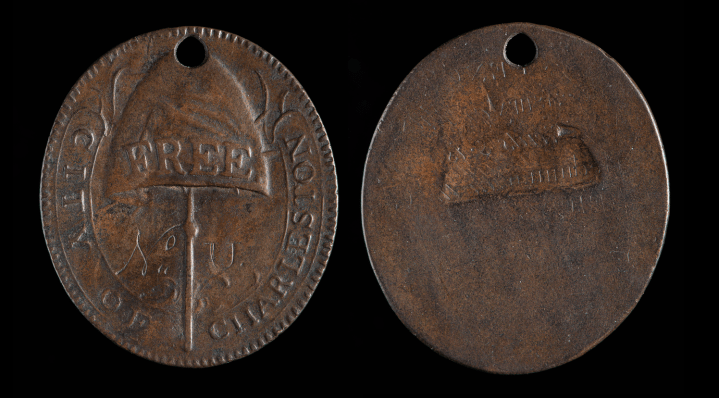
City of Charleston ‘Free’ Badge with Phrygian Cap and Pole, marked ‘No. U’, engraved by Thomas Albernethie, ca. 1787–89, copper
(Colonial Williamsburg: Museum Purchase, The Friends of Colonial Williamsburg Collections Fund and Partial Gift of John Kraljevich, 2024-171).
◊ ◊ ◊ ◊ ◊
From the press release (30 July 2024). . .
Colonial Williamsburg Acquires Rare Charleston ‘Free’ Badge
New research shows the previously unknown numismatic origins of ‘U’ and ‘X’ badges.
Weeks after the Revolutionary War ended by the terms of the Treaty of Paris in 1783, the newly incorporated city of Charleston, South Carolina began to pass laws. The population of the city was overwhelmingly African American with more than 8,000 people in the community, and the vast majority of them were enslaved; only about 600 were living there as free citizens. Ever fearful of insurrection, the city’s administration continued to implement policies designed to constrain the lives of all of its African American residents. An ordinance from 22 November 1783 regulated the employment or ‘hiring out’ of skilled and unskilled enslaved workers in which an individual went to work for an entity other than their enslaver, who was paid a fee for the service provided. An annual fee of five to forty shillings was to be paid to the city by the enslaver for the right of an enslaved person to be hired out, and a badge or ticket was required to be worn by the laborer. [The law also required free African American residents to wear badges.]
While no examples of ‘slave’ badges dating to 1783 are known to exist today, 10 ‘free’ badges from later in the 1780s have been identified in museums and private collections. The Colonial Williamsburg Foundation has recently acquired one of these ‘free’ badges, and it is now on view in the Lowcountry section of the exhibition A Rich and Varied Culture in the Nancy N. and Colin G. Campbell Gallery of the DeWitt Wallace Decorative Arts Museum, one of the Art Museums of Colonial Williamsburg.
“It’s an important piece—and an emotional one,” said J. Grahame Long, The Colonial Williamsburg Foundation’s executive director of collections and deputy chief curator. “Obviously, it’s a terrific addition to Colonial Williamsburg’s permanent collection, but it goes much further than that. It’s a critical component in telling America’s whole story.”
The Charleston ‘hiring out’ law pertained not only to enslaved workers. It went further to affect the free African American population as well, stating that
“…every free negro, mulatto or [mestizo] living or residing within this City, shall be obliged … to register him, her or themselves, in the office of the City Clerk, with the number of their respective families and places of residence … every free negro, mulatto, or mestizo, above the age of fifteen years, shall be obliged to obtain a badge from the Corporation of the City, for which badge every such person shall pay into the City Treasury the sum of Five Shillings, and shall wear it suspended by a string or ribband, and exposed to view on his breast.”
Through these dehumanizing requirements, the city of Charleston levied a fee on the right of free people of color to live and work there—a stinging irony given the root causes of the American Revolution. The penalties for breaking this law were harsh: failure to comply could cause a free person to be fined £3, which if not paid within 10 days could force the person to the workhouse (jail) and work for up to 30 days. Enslaved individuals caught wearing a ‘free’ badge were subject to whipping, by up to 39 lashes, followed by an hour in the stocks.
“I can’t help but see the parallels between these 18th-century ‘free’ badges and the yellow stars worn by Jews during the Holocaust,” said Erik Goldstein, Colonial Williamsburg’s senior curator of mechanical arts, metals, and numismatics. “Both survive as reminders of horrific ideologies, and how humanity must do better going forward.”

City of Charleston ‘Free’ Badge with Phrygian Cap and Pole, marked ‘No. X’, copper (Winston-Salem: Museum of Early Southern Decorative Arts; acquired in 2024, photo by Lea Lane).
Of the 10 known ‘free’ badges, with one exception, all are made of copper. Their iconography is misleadingly uplifting: they featured the ‘Phrygian’ cap and pole, symbolizing the lofty ideals of liberty since ancient times and were rendered in high relief and emblazoned ‘FREE’. Each of these badges carries a unique sequential designator as they were intended to be instruments of tracking, control, and a revenue source. The badge acquired by Colonial Williamsburg is engraved ‘No. U’ and is part of a succession, possibly limited to 26 or fewer badges with letters instead of numbers. To date, the only other badge inscribed with a letter is ‘No. X’, and the other eight examples are numbered between 14 and 341.
Research conducted by Goldstein at Colonial Williamsburg reveals new insights into how these badges were made. What further unites badges ‘U’ and ‘X’ are the copper pieces, or planchets, that they were struck on. Both exhibit portions of text engraved in retrograde or ‘mirror image’ on their backs, showing that they had previously been part of a printing plate relating to money. Once reversed, the readable portions contain words like ‘PENCE’, ‘TREASURY’, ‘DEPOSIT’, and ‘RENTS’. This detail offers a surprising clue to their numismatic origin; the only paper currency circulating in South Carolina in the 1780s that carried these specific terms were the City of Charleston’s emissions of 12 July and 20 October 1786, only current until 21 July 1788. It can therefore be said with certainty that the badges ‘U’ and ‘X’ were made of copper recycled from the out-of-date printing plates for these two issues. As of mid-2024, unique examples of only the ‘Two Pence’ and the ‘Five Shillings & Three Pence’ bills from the 1786 issues of Charleston’s paper money have been recorded. Given that the text engraved on the reverses of badges ‘U’ and ‘X’ match neither, they were for the printing of bills of unknown denominations that are not known to survive.
“The fact that two of the ‘free’ badges were made from re-used copper printing plates is an exciting discovery, since few printing plates from 18th-century American currency issues survive, in any form. But it also makes sense, using governmentally owned material for an official purpose,” said Goldstein.
A law passed on 16 June 1789, eliminated both of Charleston’s badge programs for African Americans. When the city reimplemented a significantly enlarged system of regulation in 1800, it required the purchase and wearing of badges for enslaved people only. Between then and the end of the Civil War in 1865, more than 187,000 ‘slave badges’ were made, sold, and worn by Charleston’s ‘hired out’ enslaved workers. Though ‘free’ badges were never again mandated by the city, the poor condition of some of the surviving examples suggests they may have been worn well past their obsolescence. It is speculated that their owners sought to display their status as dignified, free individuals in an open and proud manner for all to see.
◊ ◊ ◊ ◊ ◊
As reported by Michaela Ratliff for WGHP Fox News 8 (27 July 2024), the Museum of Early Southern Decorative Arts in Winston-Salem, North Carolina, also recently acquired a Charleston ‘free’ badge (as pictured above); theirs is marked ‘No. X’. More information is available at MESDA’s Facebook page.










 Enfilade
leave a comment