Roundtable | The Study of Collecting: Past, Present, and Future

Frans Francken the Younger, The Cabinet of a Collector with Paintings, Shells, Coins, Fossils, and Flowers, 1619, oil on panel, 56 × 85 cm
(Royal Museum of Fine Arts Antwerp)
◊ ◊ ◊ ◊ ◊
From the programme flyer:
Roundtable Discussion | The Study of Collecting: Past, Present, and Future
Institute of Advanced Studies Forum, University College London, 10 September 2024, 14.00–16.00
Begun in 1989, the Journal of the History of Collections has played a pivotal role in the development of the study of collecting. A multidisciplinary field by nature, the study of collecting began, arguably, with research into the early modern period and such cabinets of curiosities as those belonging to Hans Sloane and Ulisse Aldrovandi. With 35 complete volumes of the Journal now having been published, the time is ripe for a look at the past, present, and future of the field. This will also be an occasion to mark the appointment of Christina M. Anderson as Editor in Chief and the recent retirement of the Journal’s Founding Editor, Arthur MacGregor.
The UCL Centre for Early Modern Exchanges, together with the Journal of the History of Collections, is hosting a roundtable discussion to explore themes that have developed in the field over the past 35 years and to identify new ones that are emerging. In doing so, the event aims to consider not only traditional methodologies but also new approaches that have been developed in the humanities, social sciences, museum studies, heritage, art market, etc., in recent years. It also seeks to address the ways in which early modern cabinets of curiosities have inspired contemporary museums, magazines, and bloggers.
Short presentations (5–10 minutes) will be given by members of a panel, to include Paula Findlen (Stanford University), Anne Gerritsen (University of Warwick), Anna Garnett (Petrie Museum), Mark Carine (Natural History Museum), and Hélia Marçal (UCL History of Art), among others. These overviews will be followed by a moderated panel discussion and questions from the audience. Refreshments will be provided. For catering purposes, rsvp to editorjhc@gmail.com. We look forward to seeing you there!
New Book | Comfortable Everyday Life at Näs Manor
From Amsterdam UP:
Carolina Brown, Comfortable Everyday Life at the Swedish Eighteenth-Century Näs Manor (Amsterdam: Amsterdam University Press, 2024), 320 pagers, ISBN: 978-9048562374, €136.
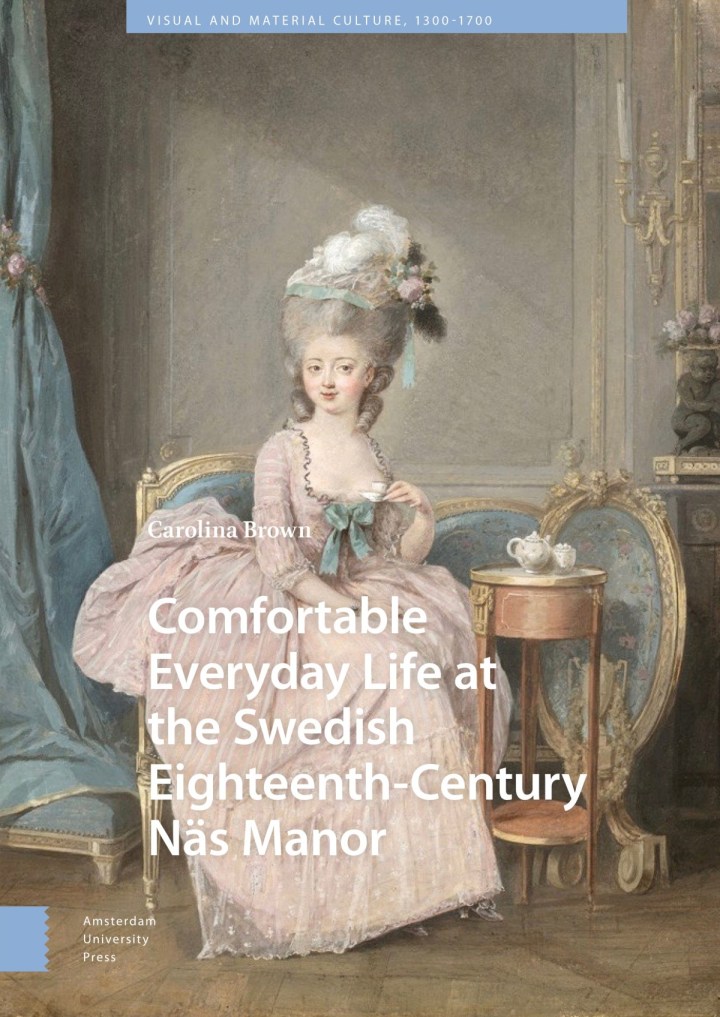 During the eighteenth century, comfortable everyday life becomes a new ideal. The good life was no longer about grand representation or the manifestation of material opulence. The new luxury was instead the comfortably arranged life at home. This book is about the traces of this change, its approach and consequences, and its anchoring in the material and social life of the Swedish manor. The comfort revolution of the eighteenth century was clearly associated with both new types of furniture and new ways of furnishing. An important aspect of the development of comfort was the new mobility and flexibility in form and function that the home and its interior now showed. Through the home of the Wadenstierna family on the country estate of Näs, north of Stockholm, the comfortable everyday life is set by their various tables—at writing desks, sewing tables, dressing tables, coffee tables, and games tables.
Carolina Brown is associate professor and senior lecturer in art history at Uppsala University. For over three decades in her teaching and research, she has addressed the arts and culture of the early modern period—focusing on portraiture, interior design, and fashion.
c o n t e n t s
Introduction
1 Carl Eric Wadenstierna and Nas Manor
2 At the Sewing Table
3 At the Writing Table
4 At the Dressing Table
5 At the Games Tables
6 At the Coffee Table
Concluding Words
Bibliography and Sources
Index










 Enfilade
leave a comment