Uffizi Acquires Subleyras’s Mystical Marriage of St. Catherine de’ Ricci
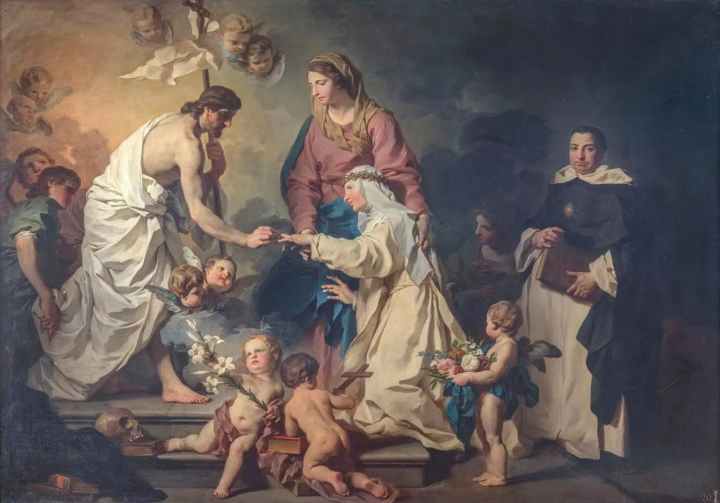
Pierre Subleyras, The Mystical Marriage of St Catherine de’ Ricci, 1746, oil on canvas, 75 × 250 cm
(Florence: Uffizi)
◊ ◊ ◊ ◊ ◊
From the recent press release (as noted at Art History News) . . .
A majestic masterpiece of 18th-century French art is set to become a highlight in the Uffizi collection: the large canvas The Mystical Marriage of Saint Catherine de’ Ricci, signed by the renowned Occitan painter Pierre Hubert Subleyras (1675–1758) and dated 1746. Historians attribute significant importance to this painting for its quality, prestigious commission, and collection history. It was acquired by the museum director, Simone Verde, at the international TEFAF fair in Maastricht in February 2024. Upon its arrival in Florence, it will be restored and prominently displayed in the gallery spaces dedicated to 18th-century painting.
In 1763, the canvas—created for the canonization of Saint Catherine de’ Ricci—was part of Girolamo Colonna di Sciarra’s collection, then Lorenzo Onofrio Colonna’s, followed by Filippo III Colonna’s. Between 1812 and 1935, it was housed in the Barberini collection in the namesake Roman palace. That same year, it was auctioned and bought by the Marquis Sacchetti, from whom it was inherited by the current owners.
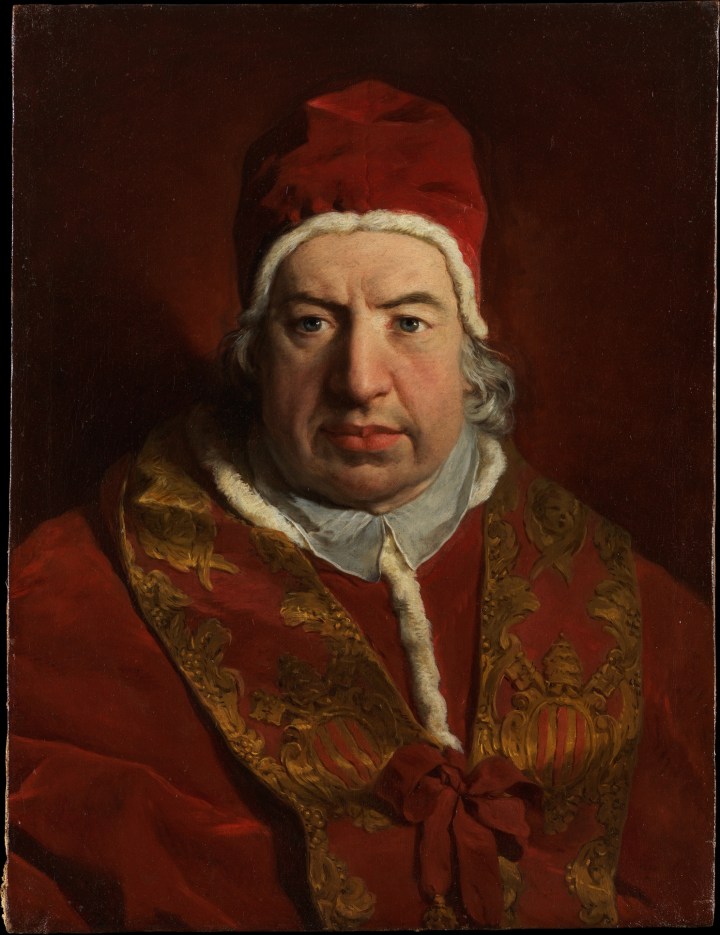
Pierre Subleyras, Portrait of Pope Benedict XIV (Prospero Lambertini, 1675–1758), 1746, oil on canvas, 64 × 49 cm (New York: The Metropolitan Museum of Art, 2009.145).
As was customary, religious orders presented the Pope with artworks celebrating the figures about to be canonized, but the choice of subject and artist was reserved for the Pope. In this case, Pope Benedict XIV Lambertini chose Subleyras, a painter gaining great success in Rome. The Bolognese Pope had entrusted him with his portrait in 1746, now housed in the Metropolitan Museum of New York.
Subleyras’ purism, the monumental quality of figures with marble-like white complexions still retaining a rocaille style, is already moving towards Neoclassicism, aligning with modernity. The solemn yet composed sacred scene in The Mystical Marriage owes much to the classicism of Poussin and his interpretation of Roman Baroque models. The reference to 17th-century classicist masters is enriched by the airy colors typical of the 18th century. The movement around the mystical marriage scene is conveyed through a multitude of putti and cherubic heads, where the artist showcases his virtuosity with still life elements such as the white lily branch or the floral arrangement held by the winged putto depicted in profile.
Subleyras distinguished himself as a painter of histories and portraits, but among his greatest masterpieces is one of the most beautiful nudes in art history, the Female Nude kept in the Barberini Gallery in Rome (ca. 1740). The French painter, who later died in Rome, was trained by his father (also a painter) and went to Paris in 1726, where he won the prestigious Prix de Rome scholarship in 1728 as a resident of the French Academy in Rome. In 1736, he married Maria Felice Tibaldi, a miniaturist who often reproduced her husband’s works in miniature. In 1748, Cardinal Silvio Valenti Gonzaga introduced the artist to Pope Benedict XIV, for whom he painted not only his portrait but also the Mass of Saint Basil for St. Peter’s Basilica (now in Santa Maria degli Angeli). During the same period, he painted the Miracle of Saint Benedict for the Olivetani church in Perugia (Rome, Santa Francesca Romana) and Saint Ambrose and Theodosius (Perugia, National Gallery of Umbria).

Pierre Subleyras, Female Nude Seen from the Back, ca. 1732, oil on canvas, 74 × 136 cm (Rome: Palazzo Barberini).
The Director of the Uffizi Galleries, Simone Verde, stated: “The Mystical Marriage is a work of primary importance for 18th-century art and will be a prominent new addition to the museum’s 18th-century rooms. Besides its refined aesthetics and compositional elegance, it significantly reflects the taste of the circle of nobles and intellectuals around the Roman Curia in the mid-18th century. It is a true masterpiece, rare to find on the market, that will enrich the Uffizi’s 18th-century collections, filling a significant gap and representing another step towards completing the pictorial history of Italy pursued by Luigi Lanzi, a mission that remains central to the museum today due to its national and international collection significance.”
Call for Submissions | Metropolitan Museum Journal
Metropolitan Museum Journal 60 (2025)
Submissions due by 15 September 2024
The Editorial Board of the peer-reviewed Metropolitan Museum Journal invites submissions of original research on works of art in the Museum’s collection. The Journal publishes Articles and Research Notes. Works of art from The Met collection should be central to the discussion. Articles contribute extensive and thoroughly argued scholarship—art historical, technical, and scientific—whereas Research Notes are narrower in scope, focusing on a specific aspect of new research or presenting a significant finding from technical analysis, for example. Articles and Research Notes in the Journal appear in print and online, and are accessible in JStor on the University of Chicago Press website. The maximum length for articles is 8,000 words (including endnotes) and 10–12 images, and for research notes 4,000 words (including endnotes) and 4–6 images.
The process of peer review is double-anonymous. Manuscripts are reviewed by the Journal Editorial Board, composed of members of the curatorial, conservation, and scientific departments, as well as scholars from the broader academic community. Submission guidelines are available here. Please send materials to journalsubmissions@metmuseum.org. The deadline for submissions for volume 60 (2025) is 15 September 2024.










 Enfilade
leave a comment