Conference | Placing China at the Courts of Europe, 1700–1800
From the conference programme:
Placing China at the Courts of Europe, 1700–1800
Historischer Gasthof ‘Zum Eichenkranz’, Oranienbaum-Wörlitz, 5–6 September 2024
Organized by Lukas Nickel and Anette Froesch
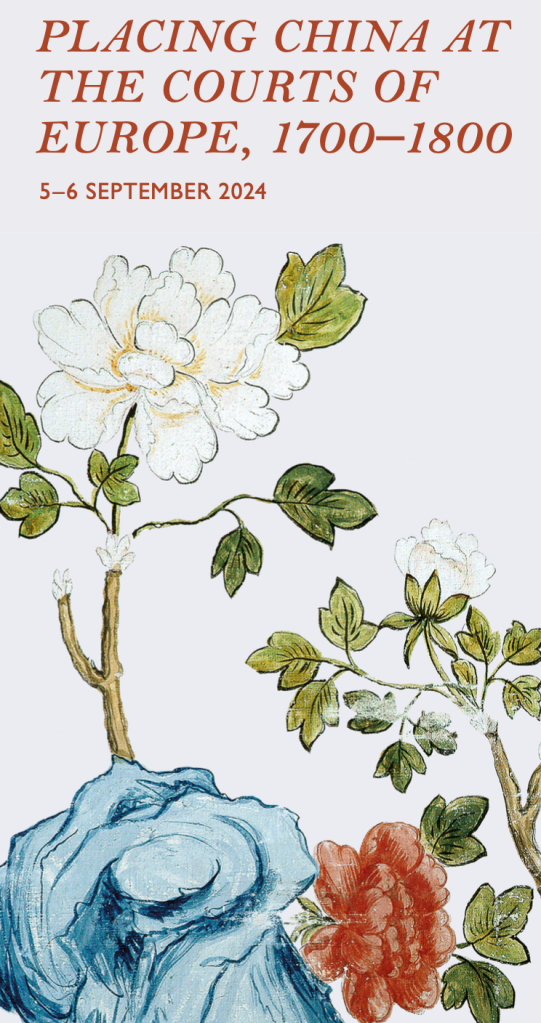 When Leopold III Frederick Franz, Duke of Anhalt-Dessau (1740–1817), added Chinese-inspired state rooms, a pagoda, a tea house, and bridges to his sprawling garden realm, he followed a practise widely employed at courts of the German states, Austria, and across Europe. Chinoiserie was of such importance that it was used by his political allies as well as rivals, by conservative and progressive rulers, and in both Protestant and Catholic settings. While the centrality of China to elite representation of the time has been noted often, so-far its significance remains opaque. The conference, a collaboration between the Kulturstiftung Dessau-Wörlitz and the Institute of Art History, University of Vienna, aims at investigating the intentions and rationales behind the inclusion of Chinese-inspired spaces, structures, and designs into programs of representation at European courts during the 18th century.
Open to the public, the conference will be conducted in English. The fee (including catering and excursions) is €35. Registration should be sent to julia.cahnbley@gartenreich.de by 25 August 2024. Organizers plan to publish the proceedings in 2025.
t h u r s d a y , 5 s e p t e m b e r
9.30 Welcome — Harald Meller (Kulturstiftung Dessau-Wörlitz)
9.45 Greetings — Lukas Nickel (Universität Wien) and Anette Froesch (Kulturstiftung Dessau-Wörlitz)
10.15 Opening Lecture | Lukas Nickel — The Many Chinas in 18th-Century Europe
11.00 Coffee break
11.30 Stéphane Castelluccio (Centre André-Chastel) — France and China: Between Fascination and Reserve
12.00 Emile de Bruijn (National Trust) — Placing China in England: Chinese-Style Interiors and Furnishings in 18th-Century English Country Houses
12.30 Discussion
13.00 Lunch break
14.00 Anette Froesch — ‘As if he had been in Beijing all his life’: The Chinese-Style Interiors and Gardens of Prince Leopold III Friedrich Franz von Anhalt-Dessau
14.30 Cordula Bischoff (Technische Universität Dresden) — Think Big: Augustus the Strong and His Collections of Asiatica
15.00 Coffee break
15.30 Constantijn Johannes Leliveld (Berlin) — Prussian Pioneers: Shaping European Perceptions of China in the 18th Century
16.00 Maria Cinta Krahe Noblett (Universidad Autónoma de Madrid) — Placing Chinese Art during the Reign of Queen Elisabeth Farnese of Spain (r. 1714–1746)
16.30 Discussion
17.00 Excursion to Schloss Wörlitz
f r i d a y , 6 s e p t e m b e r
8.30 Excursion to Schloss and Park Oranienbaum
10.30 Coffee break
11.00 Elfriede Iby (Schloss Schönbrunn) — Chinoiserie in Schönbrunn Palace
11.30 Gyorgyi Fajcsák (Ferenc Hopp Museum of Asiatic Arts, Hungary) — Gardens in the Esterházy Palace: Chinoiserie Murals at Eszterháza/Fertöd
12.00 Filip Suchomel (Univerzita Karlova) — Oriental Interiors in Czech Aristocratic, Ecclesiastical, and Bourgeois Residences in the 18th and 19th Centuries
12.30 Discussion
13.00 Lunch break
14.00 Luca Malvicino (Castello Reale di Govone) — Chinese Wallpapers: A New Decorative Fashion and a Representation of Status in the Kingdom of Sardinia
14.30 Denise Gubitosi (Universität Wien) — Nel Gusto Cinese: The Wallpapers in the Chinese Rooms of the Castello di Racconigi
15.00 Kristel Smentek (Massachusetts Institute of Technology) — Mixed Messages: Images of China and Court Politics in Late 18th-Century France
15.30 Discussion
16.00 Concluding Remarks — Lukas Nickel










 Enfilade
leave a comment