Exhibition | Wonders of Creation: Art and Science in the Islamic World
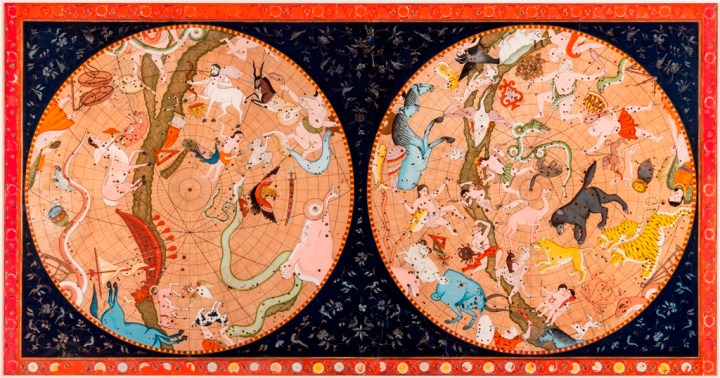
Star map depicting the Northern and Southern celestial hemispheres (with constellations inscribed in Devanagari), India, Jaipur, ca. 1780, ink, opaque watercolor, and gold on paper (Chicago: Pritzker Collection; photo by Michael Tropea).
◊ ◊ ◊ ◊ ◊
From the press release (11 July) for the exhibition:
Wonders of Creation: Art, Science, and Innovation in the Islamic World
The San Diego Museum of Art, 7 September 2024 — 5 January 2025
McMullen Museum of Art, Boston College, 2025
Curated by Ladan Akbarnia
The San Diego Museum of Art (SDMA) invites visitors to explore sources of wonder in the exhibition, Wonders of Creation: Art, Science, and Innovation in the Islamic World. The exhibition explores intersections of science and craft in Islamic material culture and contemporary art through the framework of a 13th-century text by Zakariyya ibn Muhammad al-Qazwini describing the wonders of the universe.
This trailblazing exhibition, organized by Ladan Akbarnia, Curator of South Asian and Islamic Art at The San Diego Museum of Art, showcases over 200 extraordinary works of art and objects from the eighth century to today. Using wonder as the vehicle to introduce and explore Islamic culture, Wonders of Creation illuminates the global impact of science and artistic production from the Islamic world while introducing new audiences to its diverse geographies and multifaceted visual cultures. With treasures including lavishly illuminated and illustrated manuscripts, fine textiles, luster-painted glass and ceramic wares, astrolabes and star maps, talismans, inscribed precious stones, and architectural marvels, visitors will gain a deeper appreciation of ingenuity and craftsmanship spanning 13 centuries across the Islamic world.
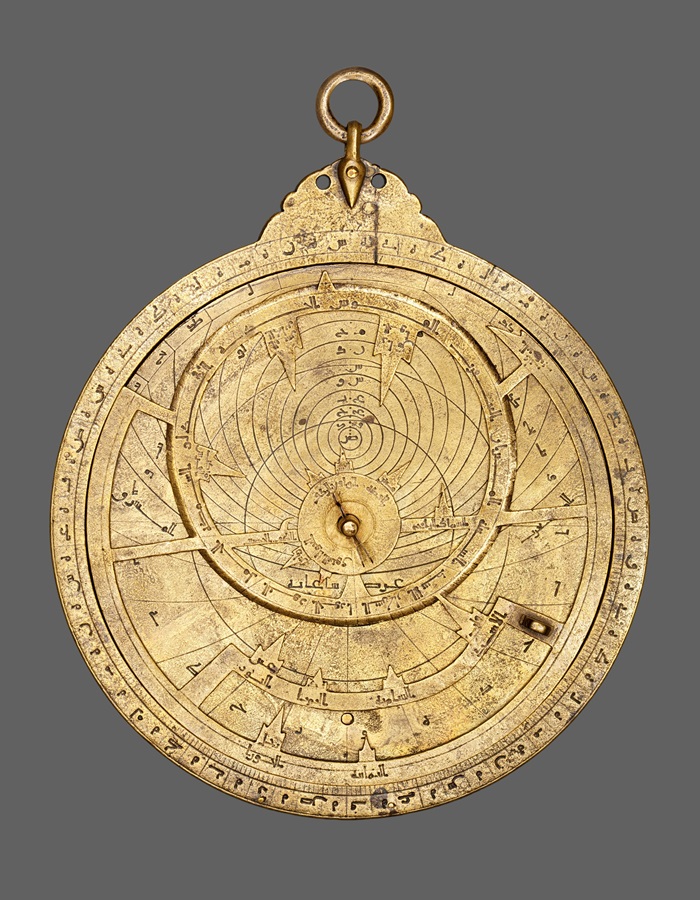
Nastulus, Astrolabe, 101 AH (ca. 720), 18 × 22 cm (Kuwait: al-Sabah Collection). The note at the Google Arts & Culture page describes this as “the earliest dated Islamic astrolabe.”
The exhibition presents works from more than 30 lenders, including major loans from The al-Sabah Collection, Dar Al-Athar al-Islamiyyah, Kuwait; and the Islamic Arts Museum Malaysia (IAMM). Works from the IAMM are on loan to the US for the first time. In addition to selections from these prestigious collections, visitors will also see contemporary commissions specifically for the exhibition by artists Ala Ebtekar and Hayv Kahraman, along with works by other prominent contemporary artists. The Museum has also commissioned Mamluk joinery samples made by master craftsman Hassan Abou Zeid of the Egyptian Heritage Rescue Foundation to introduce a hands-on opportunity for guests and commissioned two contemporary replicas of a 17th-century Persian astrolabe by Taha Yasin Arslan to further evoke a sense of awe throughout the exhibition. Wonders of Creation is designed to invite visitors to explore the marvels of the heavens and the earth and admire the crafts and customs of humanity.
“We are thrilled to present this groundbreaking exhibition to our visitors with support from the Getty through its PST Art: Art & Science Collide initiative,” says Roxana Velásquez, Maruja Baldwin Executive Director and CEO at The San Diego Museum of Art. “This exhibition celebrates the rich cultural heritage and enduring legacy of Islamic civilization, inviting audiences of all backgrounds to discover and appreciate its profound and diverse contributions.”
Qazwini’s text, The Wonders of Creation and the Rarities of Existence, is a revolutionary cosmography that meticulously details the universe, blending scientific knowledge with fantastical anecdotes, portraying all phenomena as signs of divine creation. The author, an Islamic judge and professor, emphasized wonder as a path to knowledge, urging readers to contemplate natural marvels to deepen their understanding of God and the cosmos. Today, his work remains influential, offering insights into Islamic culture and inspiring curiosity about natural phenomena. The exhibition invites visitors to explore some of the world’s wonders in the spirit of Qazwini’s call to wonder.
Wonders of Creation is part of Getty PST Art, an arts initiative that brings together more than 70 exhibitions from organizations across the Southern California region, all exploring intersections of art and science. Funding for this exhibition is made possible with support from Getty through its PST ART: Art & Science Collide initiative and the National Endowment for the Humanities. Wonders of Creation is also supported in part by the National Endowment for the Arts, and additional support is provided by Bank of America, Lani and Joe Curtis, Tatiana and Robert Dotson, Diana and Fred Elghanayan, Drs. Nasrin Owsia and Behrooz Akbarnia, The Nissan Foundation, and A.O. Reed. Institutional support is provided by the City of San Diego Commission for Arts and Culture and the members of The San Diego Museum of Art.
Wonders of Creation will be on view at The San Diego Museum of Art from 7 September 2024 until 5 January 2025. It will then travel to the McMullen Museum of Art, Boston College. The exhibition is complemented by a full-color catalogue with original research and contributions from leading international scholars, a scholarly symposium, artists in conversation, family-oriented art-making workshops, performances, and other programming for the community.
◊ ◊ ◊ ◊ ◊
Also worth noting is this recent study of al-Qazvini’s The Wonders of Creation from Edinburgh UP:
Stefano Carboni, The Wonders of Creation and the Singularities of Painting: A Study of the Ilkhanid London Qazvīnī (Edinburgh: Edinburgh University Press, 2020), 456 pages, ISBN: 978-1474461399, $65.
A beautifully illustrated study of the so-called London Qazvini, an early fourteenth-century illustrated Arabic copy of al-Qazvini’s The Wonders of Creation and the Oddities of Existing Things. One of a handful of extant illustrated codices produced under the Mongols of Iran, this unique manuscript gathers earlier Mesopotamian painting traditions, North Jaziran-Seljuq elements, Anatolian inspiration, the latest changes brought about after the advent of Mongols and a large number of illustrations of extraordinary subjects which escape proper classification. In this lavishly illustrated volume Stefano Carboni offers a stylistic analysis and discussion of the manuscript’s miniatures, a presentation and description of the 368 extant paintings that illustrate the codex, and a partial critical translation of the related Arabic text. This is the first time that sections throughout the whole text are available in English.
Stefano Carboni is the director and CEO of the Art Gallery of Western Australia and adjunct professor at the University of Western Australia. He is author and editor of several books including Glass from Islamic Lands: The Al-Sabah Collection (2001) and Venice and the Islamic World 828–1797 (2007).










 Enfilade
leave a comment