Exhibition | Sonya Clark: The Descendants of Monticello

Blinking eyes appear in the windows of Declaration House as part of Sonya Clark’s installation The Descendants of Monticello. Thomas Jefferson resided at the site while writing the Declaration of Independence, together with his enslaved valet Robert Hemmings. The original house was razed in 1883; it was reconstructed in 1975. (Photo by Steve Weinik/Monument Lab).
◊ ◊ ◊ ◊ ◊
From Philadelphia’s Monument Lab:
Declaration House | Sonya Clark’s The Descendants of Monticello
Independence National Historical Park, Philadelphia, 24 June — 1 December 2024
Declaration House is a public art and history exhibition presented by Monument Lab at Independence National Historical Park that explores the site where Thomas Jefferson and Robert Hemmings spent several months in Philadelphia during the drafting of the Declaration of Independence in 1776. The project poses a central question: What does the Declaration of Independence mean to us today? By moving Hemmings to the center of this moment in history, the project seeks to illuminate the entangled legacies of freedom and enslavement at the core of our nation’s founding.
Declaration House presents the exclusive premiere of Sonya Clark’s The Descendants of Monticello, a public artwork that brings the historic house to life through a monumental montage featuring the blinking eyes of Robert Hemmings’ collateral descendants and others who are related to the over 400 people enslaved at Monticello, including descendants biologically related to Jefferson. Declaration House also includes public programs with creative residents Jeannine A. Cook and Ty ‘Dancing Wolf’ Ellis, and a Welcome Station during summer weekend hours at the historic house where visitors are invited to respond to the project’s central question with hand-drawn responses that will be collected by Monument Lab and shared with Independence National Historical Park to inform future programming and reflection ahead of America’s Semiquincentennial in 2026.
◊ ◊ ◊ ◊ ◊
Philip Kennicott wrote about the installation for The Washington Post (12 August 2024). More information, including additional press coverage, is available at Monument Lab.
Exhibition | Wonders of Creation: Art and Science in the Islamic World
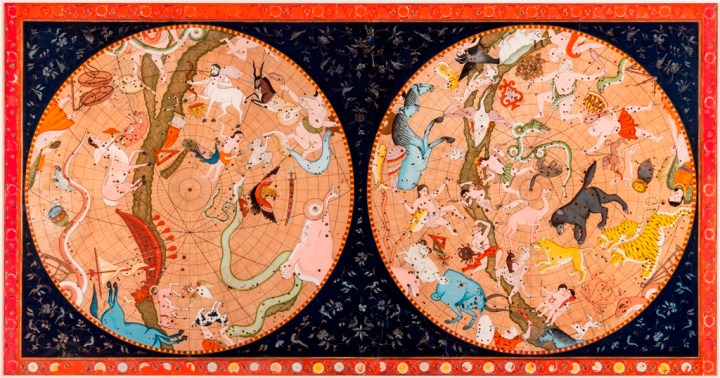
Star map depicting the Northern and Southern celestial hemispheres (with constellations inscribed in Devanagari), India, Jaipur, ca. 1780, ink, opaque watercolor, and gold on paper (Chicago: Pritzker Collection; photo by Michael Tropea).
◊ ◊ ◊ ◊ ◊
From the press release (11 July) for the exhibition:
Wonders of Creation: Art, Science, and Innovation in the Islamic World
The San Diego Museum of Art, 7 September 2024 — 5 January 2025
McMullen Museum of Art, Boston College, 2025
Curated by Ladan Akbarnia
The San Diego Museum of Art (SDMA) invites visitors to explore sources of wonder in the exhibition, Wonders of Creation: Art, Science, and Innovation in the Islamic World. The exhibition explores intersections of science and craft in Islamic material culture and contemporary art through the framework of a 13th-century text by Zakariyya ibn Muhammad al-Qazwini describing the wonders of the universe.
This trailblazing exhibition, organized by Ladan Akbarnia, Curator of South Asian and Islamic Art at The San Diego Museum of Art, showcases over 200 extraordinary works of art and objects from the eighth century to today. Using wonder as the vehicle to introduce and explore Islamic culture, Wonders of Creation illuminates the global impact of science and artistic production from the Islamic world while introducing new audiences to its diverse geographies and multifaceted visual cultures. With treasures including lavishly illuminated and illustrated manuscripts, fine textiles, luster-painted glass and ceramic wares, astrolabes and star maps, talismans, inscribed precious stones, and architectural marvels, visitors will gain a deeper appreciation of ingenuity and craftsmanship spanning 13 centuries across the Islamic world.
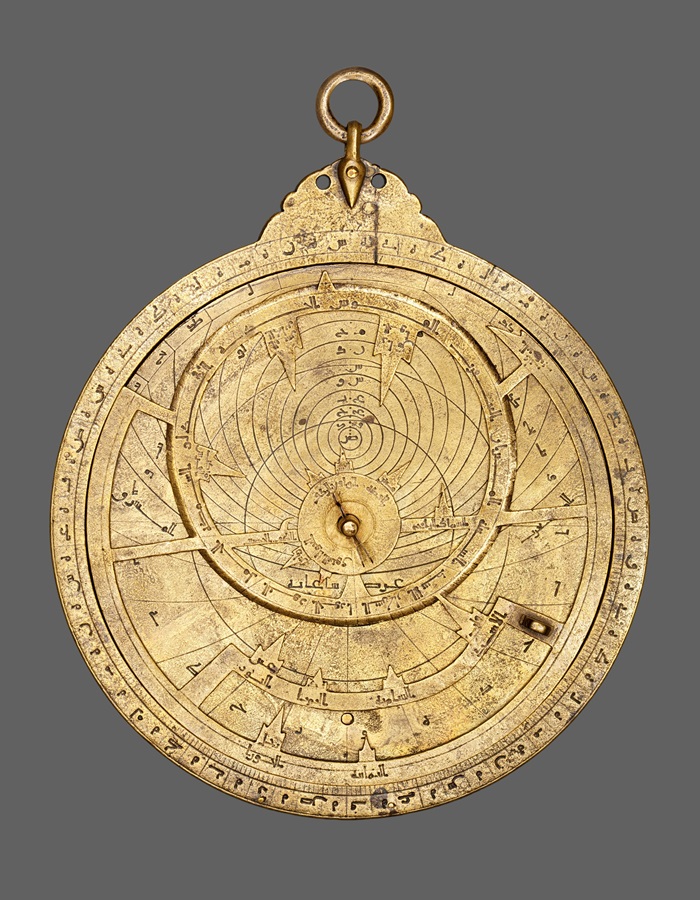
Nastulus, Astrolabe, 101 AH (ca. 720), 18 × 22 cm (Kuwait: al-Sabah Collection). The note at the Google Arts & Culture page describes this as “the earliest dated Islamic astrolabe.”
The exhibition presents works from more than 30 lenders, including major loans from The al-Sabah Collection, Dar Al-Athar al-Islamiyyah, Kuwait; and the Islamic Arts Museum Malaysia (IAMM). Works from the IAMM are on loan to the US for the first time. In addition to selections from these prestigious collections, visitors will also see contemporary commissions specifically for the exhibition by artists Ala Ebtekar and Hayv Kahraman, along with works by other prominent contemporary artists. The Museum has also commissioned Mamluk joinery samples made by master craftsman Hassan Abou Zeid of the Egyptian Heritage Rescue Foundation to introduce a hands-on opportunity for guests and commissioned two contemporary replicas of a 17th-century Persian astrolabe by Taha Yasin Arslan to further evoke a sense of awe throughout the exhibition. Wonders of Creation is designed to invite visitors to explore the marvels of the heavens and the earth and admire the crafts and customs of humanity.
“We are thrilled to present this groundbreaking exhibition to our visitors with support from the Getty through its PST Art: Art & Science Collide initiative,” says Roxana Velásquez, Maruja Baldwin Executive Director and CEO at The San Diego Museum of Art. “This exhibition celebrates the rich cultural heritage and enduring legacy of Islamic civilization, inviting audiences of all backgrounds to discover and appreciate its profound and diverse contributions.”
Qazwini’s text, The Wonders of Creation and the Rarities of Existence, is a revolutionary cosmography that meticulously details the universe, blending scientific knowledge with fantastical anecdotes, portraying all phenomena as signs of divine creation. The author, an Islamic judge and professor, emphasized wonder as a path to knowledge, urging readers to contemplate natural marvels to deepen their understanding of God and the cosmos. Today, his work remains influential, offering insights into Islamic culture and inspiring curiosity about natural phenomena. The exhibition invites visitors to explore some of the world’s wonders in the spirit of Qazwini’s call to wonder.
Wonders of Creation is part of Getty PST Art, an arts initiative that brings together more than 70 exhibitions from organizations across the Southern California region, all exploring intersections of art and science. Funding for this exhibition is made possible with support from Getty through its PST ART: Art & Science Collide initiative and the National Endowment for the Humanities. Wonders of Creation is also supported in part by the National Endowment for the Arts, and additional support is provided by Bank of America, Lani and Joe Curtis, Tatiana and Robert Dotson, Diana and Fred Elghanayan, Drs. Nasrin Owsia and Behrooz Akbarnia, The Nissan Foundation, and A.O. Reed. Institutional support is provided by the City of San Diego Commission for Arts and Culture and the members of The San Diego Museum of Art.
Wonders of Creation will be on view at The San Diego Museum of Art from 7 September 2024 until 5 January 2025. It will then travel to the McMullen Museum of Art, Boston College. The exhibition is complemented by a full-color catalogue with original research and contributions from leading international scholars, a scholarly symposium, artists in conversation, family-oriented art-making workshops, performances, and other programming for the community.
◊ ◊ ◊ ◊ ◊
Also worth noting is this recent study of al-Qazvini’s The Wonders of Creation from Edinburgh UP:
Stefano Carboni, The Wonders of Creation and the Singularities of Painting: A Study of the Ilkhanid London Qazvīnī (Edinburgh: Edinburgh University Press, 2020), 456 pages, ISBN: 978-1474461399, $65.
A beautifully illustrated study of the so-called London Qazvini, an early fourteenth-century illustrated Arabic copy of al-Qazvini’s The Wonders of Creation and the Oddities of Existing Things. One of a handful of extant illustrated codices produced under the Mongols of Iran, this unique manuscript gathers earlier Mesopotamian painting traditions, North Jaziran-Seljuq elements, Anatolian inspiration, the latest changes brought about after the advent of Mongols and a large number of illustrations of extraordinary subjects which escape proper classification. In this lavishly illustrated volume Stefano Carboni offers a stylistic analysis and discussion of the manuscript’s miniatures, a presentation and description of the 368 extant paintings that illustrate the codex, and a partial critical translation of the related Arabic text. This is the first time that sections throughout the whole text are available in English.
Stefano Carboni is the director and CEO of the Art Gallery of Western Australia and adjunct professor at the University of Western Australia. He is author and editor of several books including Glass from Islamic Lands: The Al-Sabah Collection (2001) and Venice and the Islamic World 828–1797 (2007).
Exhibition | Magnified Wonders: An 18th-Century Microscope
From the press release (17 July) for the exhibition:
Magnified Wonders: An 18th-Century Microscope
J. Paul Getty Museum, Los Angeles, 10 September 2024 — 2 February 2025
Curated by Miriam Schefzyk and Arlen Heginbotham
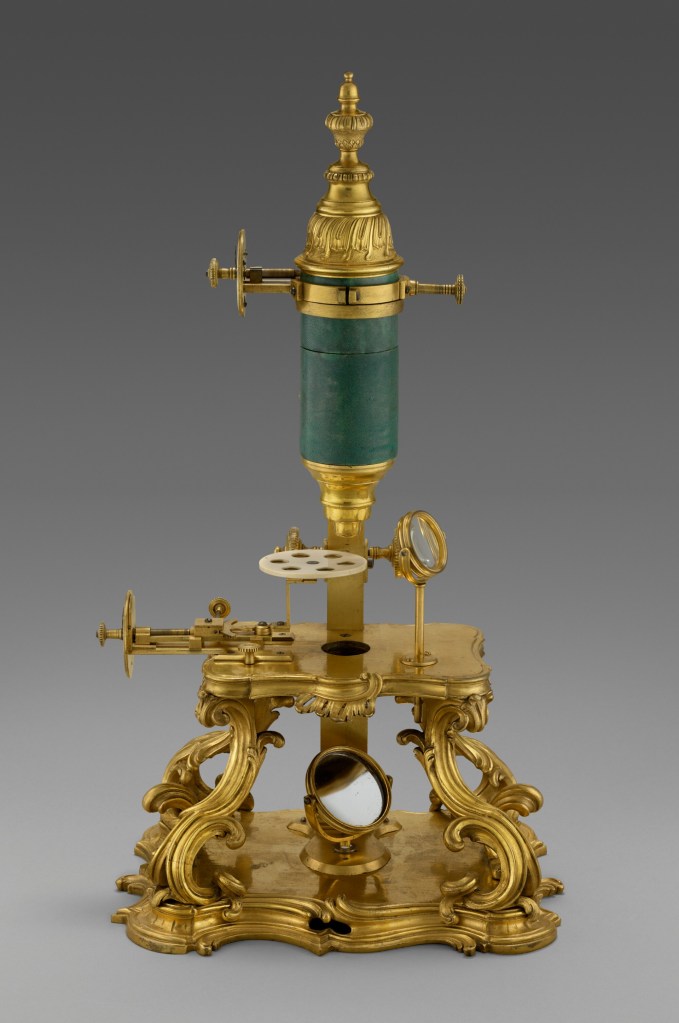
Compound Microscope with a Micrometric Stage, early 1750s, gilt bronze, iron, enamel, shagreen (sharkskin), and glass (Getty Museum, 86.DH.694.1).
The J. Paul Getty Museum presents Magnified Wonders: An 18th-Century Microscope, an exhibition showcasing a French microscope from Getty’s collection as both a scientific instrument and Rococo work of art during the Age of Enlightenment. On view at the Getty Center from 10 September 2024 until 2 February 2025, the exhibition highlights this object’s cultural and historical context and reveals its technical complexity. It is one of only ten existing microscopes of this type in the world, and Getty is the only museum in the United States with one in its collection.
Made in Paris around 1751, the microscope features advanced micrometers for precision measurement, and specialized accessories for viewing many types of specimens. It is nearly identical to the one used by the French king Louis XV. Aristocrats and amateur scientists used this microscope to explore the mysteries of the natural world, illustrating the social élite’s interest in scientific inquiry.
“It is remarkable that this microscope is still in perfect working order,” says Arlen Heginbotham, conservator of decorative arts conservation at the Getty Museum. “The quality of the optics is truly impressive, and the gears and dials still function smoothly and precisely.”
The Getty microscope will be on display alongside its lavish leather case containing lenses, tools, and specimen slides of natural curiosities. The exhibition highlights the scientific and social context of this instrument through a selection of illustrated scientific publications from the period, drawn from the collections of the Getty Research Institute. Robert Hooke’s famous Micrographia will be on view, a publication that features illustrations of specimens that he explored with the compound microscope. Video and digital presentations will demonstrate the fully functional microscope’s uses and capabilities and allow visitors to view period illustrations of microscopic specimens.
“It is incredible to think about how this microscope opened up a whole new cosmos heretofore invisible to the naked eye,” says Miriam Schefzyk, associate curator of sculpture and decorative arts at the Getty Museum.
While the microscope is a complex scientific instrument, it is also a unique work of art in the Rococo style. A dominant style in France from the 1730s through the 1750s, it was applied to all artworks, including decorative arts, gardens, interiors, and even scientific instruments. Inspired by nature, its major characteristics are C and S curves, asymmetrical composition, and dynamic movement. The exhibition will also feature several prints with designs that include these distinct Rococo motifs, as well as a wall clock made by Jacques Caffieri, highlighting the similarity of its elaborate design in gilt bronze.
Magnified Wonders: An 18th-Century Microscope is co-curated by Miriam Schefzyk, associate curator of sculpture and decorative arts at the Getty Museum, and Arlen Heginbotham, conservator of decorative arts conservation at the Getty Museum.
This exhibition is part of PST ART, a Getty initiative presenting over 70 exhibitions at institutions across Southern California tied to the theme Art & Science Collide.
Exhibition | Paper and Light
Opening in October at The Getty:
Paper and Light
J. Paul Getty Museum, Los Angeles, 15 October 2024 — 19 January 2025
 Artists have for centuries explored the interaction of paper and light. This exhibition of drawings charts some of the innovative ways in which the two media were creatively used together. Works include the Museum’s extraordinary 12-foot-long transparency by Carmontelle—essentially an 18th-century motion picture—which will be shown lit from behind as originally intended. Drawings by more contemporary artists including Vija Celmins will join sheets by Tiepolo, Delacroix, Seurat, and Manet to portray the themes of translucency and the representation of light.
Julian Brooks and Michelle Sullivan, Paper and Light: Luminous Drawings (Los Angeles: J. Paul Getty Museum, 2024), 112 pages, ISBN 978-1606069301, $25.
The treatment of light and shadow is one of the building blocks of drawing. From techniques such as highlights and reserves, to material selection and the creation of translucent tracing paper, to the use of light as a medium for viewing artworks, artists for hundreds of years have found innovative and dazzling ways to create light on a sheet of paper. This publication examines the central relationship between paper and light in the world of drawings in western European art from the Renaissance to the twentieth century. Focusing on drawings from the collection of the J. Paul Getty Museum, as well as works from the British Museum, Musée du Louvre, and others, and featuring masterful works by such artists as Parmigianino, Leonardo da Vinci, Nicolas Poussin, Odilon Redon, Edgar Degas, and Georges Seurat, Paper and Light will entice readers to look longer and more closely at drawings, deriving an even deeper appreciation for the skill and labor that went into them.
Julian Brooks is senior curator and head of the Department of Drawings at the J. Paul Getty Museum. Michelle Sullivan is associate conservator of drawings at the J. Paul Getty Museum.
New Book | The Mobile Image from Watteau to Boucher
From Getty Publications:
David Pullins, The Mobile Image from Watteau to Boucher (Los Angeles: Getty Research Institute, 2024), 208 pages, ISBN: 978-1606068885, $60.
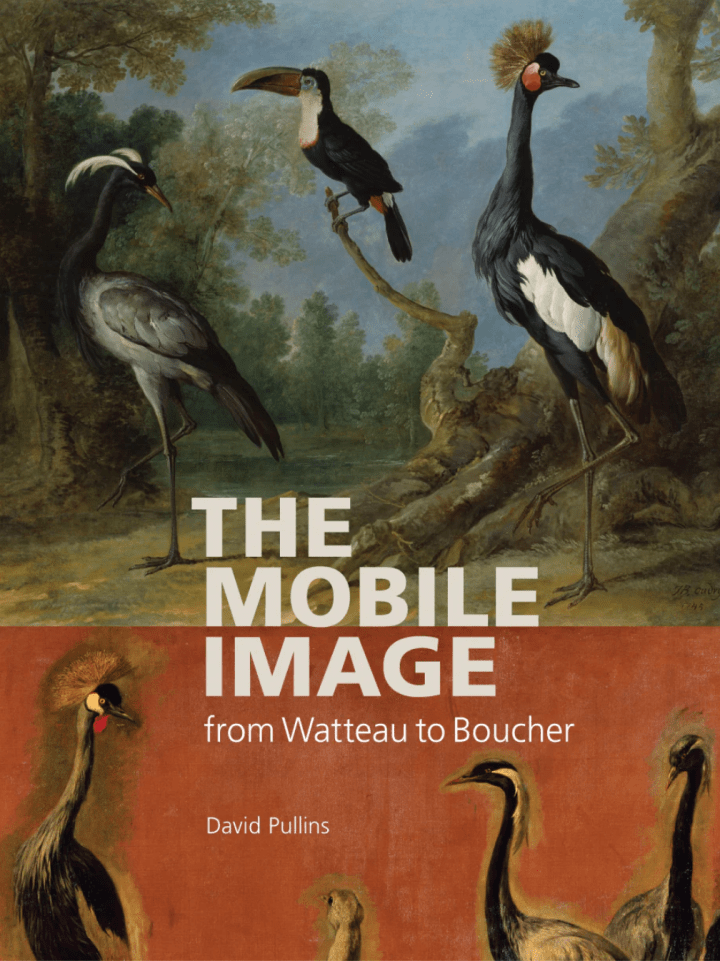 Reframing long-held assumptions about what distinguishes fine from decorative art, this innovative study explores a mode of making, seeing, and thinking that slices across eighteenth-century visual culture.
This book provides a new way of thinking about eighteenth-century French art and visual culture by prioritizing production over reception. Abandoning the ideologically driven discourse that distinguished fine from decorative art between the 1690s and 1770s, The Mobile Image reveals how the two have been inextricably bound from the earliest stages of artistic instruction through the daily life of painters’ workshops. In this study, author David Pullins defines artisanal and artistic means of learning, seeing, and making through a system of ‘mobile images’: motifs that were effectively engineered for mobility and designed never to be definitive, always awaiting replication and circulation. He examines the careers of Antoine Watteau, Jean-Baptiste Oudry, and François Boucher, situating them against a much broader cast of actors—such as printmakers, publishers, anonymous studio assistants, and architects, among others—to place eighteenth-century painting within a wider context of media and making.
David Pullins is Jayne Wrightsman Curator at the Metropolitan Museum of Art, where he is responsible for seventeenth-and eighteenth-century French, Italian, and Spanish painting.
New Book | Claude III Audran, Arbiter of the French Arabesque
From Amsterdam UP:
Barbara Laux, Claude III Audran, Arbiter of the French Arabesque (Amsterdam: Amsterdam University Press, 2024), 252 pages, ISBN: 978-9463729284, €129 / $147.
 Claude III Audran, Arbiter of the French Arabesque is the first substantial biographical study of Claude III Audran, a late 17th- and early 18th-century master of ornament and a proponent of cutting-edge design who took inspiration from contemporary sources. This work investigates Audran’s accomplishments and the factors that impacted the longevity and arc of his successful career, taking into consideration the contextual variables that influenced and shaped his work. Audran’s achievements bridge an important period with the eclipse of the Guild Maîtrise and the rise of the Académie royale. Audran subcontracted young artists, such as Watteau, Lancret, and Desportes, in order to circumvent restrictions on guild practice enacted by the crown. Looking at his commissions not only reveals the elite taste of his patrons, including Louis XIV, but also Audran’s ability to use elements from popular culture to animate his arabesques, which created hallmarks of rococo interior design.
Barbara Laux is an independent researcher and is currently Senior Curatorial Assistant at the Yale Center for British Art. She earned an MA in the History of Decorative Arts and in Art History prior to her PhD at the Graduate Center, City University of New York.
c o n t e n t s
Acknowledgments
Introduction
1 Biography of Claude III Audran (1658–1734)
2 The French Arabesque as an Art Form, Audran as Master Ornamentalist and His Initial Commissioned Works
3 Claude III Audran and Jean de La Fontaine’s Fables: Maintaining the Social Hierarchy
4 Attracting New Patrons in the Eighteenth Century
5 Claude III Audran’s Competitors and His Legacies
Illustrations
Appendix
Bibliography
Index
Conference | Placing China at the Courts of Europe, 1700–1800
From the conference programme:
Placing China at the Courts of Europe, 1700–1800
Historischer Gasthof ‘Zum Eichenkranz’, Oranienbaum-Wörlitz, 5–6 September 2024
Organized by Lukas Nickel and Anette Froesch
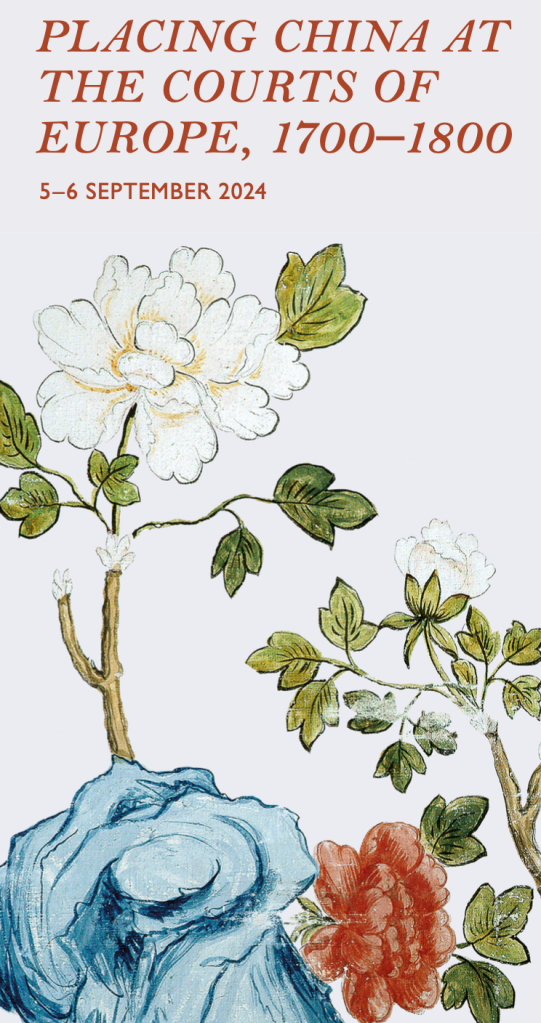 When Leopold III Frederick Franz, Duke of Anhalt-Dessau (1740–1817), added Chinese-inspired state rooms, a pagoda, a tea house, and bridges to his sprawling garden realm, he followed a practise widely employed at courts of the German states, Austria, and across Europe. Chinoiserie was of such importance that it was used by his political allies as well as rivals, by conservative and progressive rulers, and in both Protestant and Catholic settings. While the centrality of China to elite representation of the time has been noted often, so-far its significance remains opaque. The conference, a collaboration between the Kulturstiftung Dessau-Wörlitz and the Institute of Art History, University of Vienna, aims at investigating the intentions and rationales behind the inclusion of Chinese-inspired spaces, structures, and designs into programs of representation at European courts during the 18th century.
Open to the public, the conference will be conducted in English. The fee (including catering and excursions) is €35. Registration should be sent to julia.cahnbley@gartenreich.de by 25 August 2024. Organizers plan to publish the proceedings in 2025.
t h u r s d a y , 5 s e p t e m b e r
9.30 Welcome — Harald Meller (Kulturstiftung Dessau-Wörlitz)
9.45 Greetings — Lukas Nickel (Universität Wien) and Anette Froesch (Kulturstiftung Dessau-Wörlitz)
10.15 Opening Lecture | Lukas Nickel — The Many Chinas in 18th-Century Europe
11.00 Coffee break
11.30 Stéphane Castelluccio (Centre André-Chastel) — France and China: Between Fascination and Reserve
12.00 Emile de Bruijn (National Trust) — Placing China in England: Chinese-Style Interiors and Furnishings in 18th-Century English Country Houses
12.30 Discussion
13.00 Lunch break
14.00 Anette Froesch — ‘As if he had been in Beijing all his life’: The Chinese-Style Interiors and Gardens of Prince Leopold III Friedrich Franz von Anhalt-Dessau
14.30 Cordula Bischoff (Technische Universität Dresden) — Think Big: Augustus the Strong and His Collections of Asiatica
15.00 Coffee break
15.30 Constantijn Johannes Leliveld (Berlin) — Prussian Pioneers: Shaping European Perceptions of China in the 18th Century
16.00 Maria Cinta Krahe Noblett (Universidad Autónoma de Madrid) — Placing Chinese Art during the Reign of Queen Elisabeth Farnese of Spain (r. 1714–1746)
16.30 Discussion
17.00 Excursion to Schloss Wörlitz
f r i d a y , 6 s e p t e m b e r
8.30 Excursion to Schloss and Park Oranienbaum
10.30 Coffee break
11.00 Elfriede Iby (Schloss Schönbrunn) — Chinoiserie in Schönbrunn Palace
11.30 Gyorgyi Fajcsák (Ferenc Hopp Museum of Asiatic Arts, Hungary) — Gardens in the Esterházy Palace: Chinoiserie Murals at Eszterháza/Fertöd
12.00 Filip Suchomel (Univerzita Karlova) — Oriental Interiors in Czech Aristocratic, Ecclesiastical, and Bourgeois Residences in the 18th and 19th Centuries
12.30 Discussion
13.00 Lunch break
14.00 Luca Malvicino (Castello Reale di Govone) — Chinese Wallpapers: A New Decorative Fashion and a Representation of Status in the Kingdom of Sardinia
14.30 Denise Gubitosi (Universität Wien) — Nel Gusto Cinese: The Wallpapers in the Chinese Rooms of the Castello di Racconigi
15.00 Kristel Smentek (Massachusetts Institute of Technology) — Mixed Messages: Images of China and Court Politics in Late 18th-Century France
15.30 Discussion
16.00 Concluding Remarks — Lukas Nickel
Exhibition | The Paradox of Pearls
Opening next month at The Walpole Library:
The Paradox of Pearls: Accessorizing Identities in the Eighteenth Century
The Lewis Walpole Library, Farmington, CT, 27 September 2024 — 31 January 2025
Curated by Laura Engel
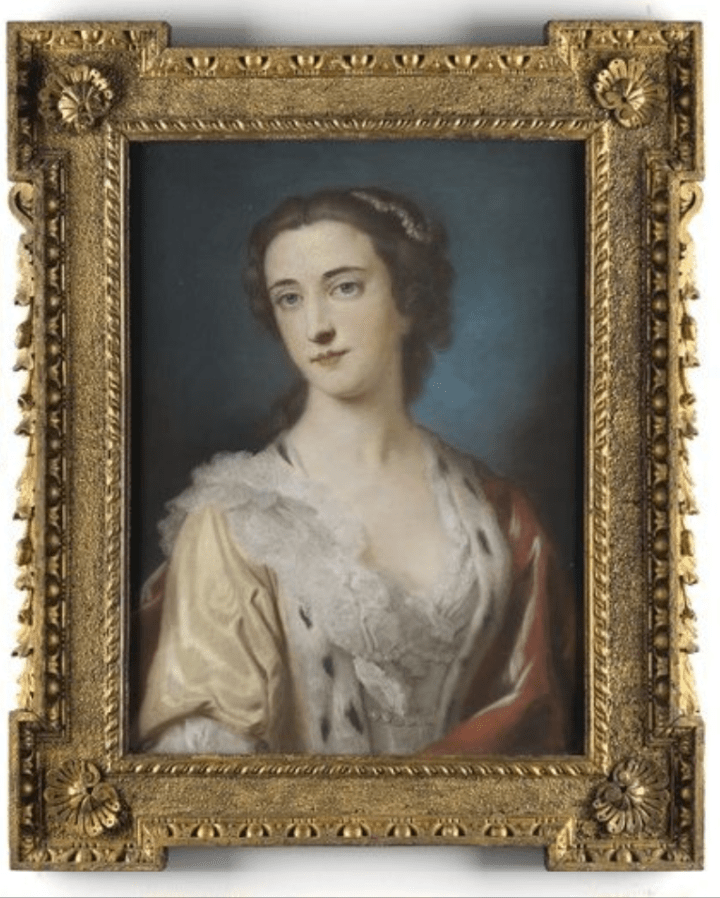
William Hoare, Portrait of Maria Walpole, ca. 1742, pastel on paper (The Lewis Walpole Library, Yale University, LWL Ptg. 152).
Pearls figure prominently in pictures of celebrated and imagined figures across the eighteenth century. Adorning royalty, celebrities, servants, and in fashion plates, the mysterious, opaque, and gleaming white accessory aligns with the mutable, seductive, and threatening emergence of new forms of identity. Worn as jewelry, as embellishments to the body and dress, or embedded in the settings of precious objects—pearls accessorize, highlight, colonize, and perform. As one of the most sought-after commodities of the early modern colonial enterprise, a precious jewel tied to bondage and violence, pearls have a baroque and complex history. Drawing from materials in the Lewis Walpole Library this exhibition will explore the ‘paradox of pearls’ by considering how the varied and often contradictory meanings of this jewel appear in period images and the ways in which practices from the past connect us to the powerful presence of pearls today. The exhibition is curated by Professor Laura Engel of Duquesne University.
◊ ◊ ◊ ◊ ◊
Curator Talk with Laura Engel
The Lewis Walpole Library, 16 November 2024, 2pm
From Queen Elizabeth I to Harry Styles, the legacy of pearls is a story about self-fashioning. Pearls feature prominently in many pictures of celebrated figures from the past. Worn as jewelry—as embellishments of the body and apparel, or embedded in the settings of precious objects—pearls illuminate ideas about beauty, power, and style. Drawing upon materials in the Lewis Walpole Library, this talk considers how the varied and often contradictory meanings of this jewel were represented in period images and the ways in which practices from the past connect us to the enduring presence of pearls today. Space is limited, and advance registration through the Farmington Libraries site is required. Registration link forthcoming.
New Book | Pearls for the Crown
From Penn State UP:
Mónica Domínguez Torres, Pearls for the Crown: Art, Nature, and Race in the Age of Spanish Expansion (University Park: The Pennsylvania State University Press, 2024), 218 pages, ISBN: 978-0271096810, $100. Also available as an ebook.

In the age of European expansion, pearls became potent symbols of imperial supremacy. Pearls for the Crown demonstrates how European art legitimated racialized hierarchies and inequitable notions about humanity and nature that still hold sway today.
When Christopher Columbus encountered pristine pearl beds in southern Caribbean waters in 1498, he procured the first source of New World wealth for the Spanish Crown, but he also established an alternative path to an industry that had remained outside European control for centuries. Centering her study on a selection of key artworks tied to the pearl industry, Monica Dominguez Torres examines the interplay of materiality, labor, race, and power that drove artistic production in the early modern period. Spanish colonizers exploited the expertise and forced labor of Native American and African workers to establish pearling centers along the coasts of South and Central America, disrupting the environmental and demographic dynamics of their overseas territories. Drawing from postcolonial theory, material culture studies, and ecocriticism, Domínguez Torres demonstrates how, through use of the pearl, European courtly art articulated ideas about imperial expansion, European superiority, and control over nature, all of which played key roles in the political circles surrounding the Spanish Crown. This highly anticipated interdisciplinary study will be welcomed by scholars of art history, the history of colonial Latin America, and ecocriticism in the context of the Spanish colonies.
Mónica Domínguez Torres is Professor of Art History with a joint appointment in Latin American and Iberian Studies at the University of Delaware.
New Book | The Muse of History: The Ancient Greeks
From Penguin Books and Harvard UP’s Belknap Press:
Oswyn Murray, The Muse of History: The Ancient Greeks from the Enlightenment to the Present (Cambridge: Belknap Press, 2024), 528 pages, ISBN: 978-0674297456, £30 / $38.
 The study of ancient Greece has been central to Western conceptions of history since the Renaissance. The Muse of History traces the shifting patterns of this preoccupation in the last three centuries, in which successive generations have reinterpreted the Greeks in the light of their contemporary worlds. Thus, in the eighteenth century, the conflict between Athens and Sparta became a touchstone in the development of republicanism, and in the nineteenth, Athens came to represent the democratic ideal. Amid the ideological conflicts of the twentieth century, the Greeks were imagined in an age of suffering, inspiring defenses against nationalism, Nazism, communism, and capitalism.
Oswyn Murray is an emeritus Fellow of Balliol College, University of Oxford, and a leading scholar of the ancient world. He has written widely translated books including Early Greece and The Symposion: Drinking Greek Style and is the coeditor of The Oxford History of the Classical World.
c o n t e n t s
Part One | The Muse of History
Introduction: Past and Present
The Republic of Letters
1 The Western Traditions of Ancient History
2 Enlightenment Greece: Sparta versus Athens
3 Ireland Invents Greek History: The Lost Historian John Gast
4 The Philhellenes and Marathon
Radical History
5 The Contested Reign of Mitford
6 Romantic History in Britain and Europe
7 Utilitarian History: Mill and Grote
The Triumph of Germany
8 Hegel, Niebuhr, and Critical History
9 Burckhardt and Cultural History
10 The Archaic Age
11 The Problem of Socrates
12 In Search of the Key to All Mythologies
Part Two | The Angel of History
The Crisis of the Republic of Letters
13 The Repentance of Gilbert Murray
14 Saving Civilization: The Warburg Institute and the SPSL
15 Momigliano on Peace and Liberty
16 Momigliano in England
The School of Paris
17 Fernand Braudel and the Mediterranean
18 The ‘École de Paris’
Unfnished Business
19 Dark Times: The Cold War and the Triumph of Capitalism 391
20 The Crisis of Theory in History
Acknowledgements
Notes
List of Illustrations
Index










 Enfilade
leave a comment