Exhibition | Olympus on the Lake: Canova, Thorvaldsen, Hayez
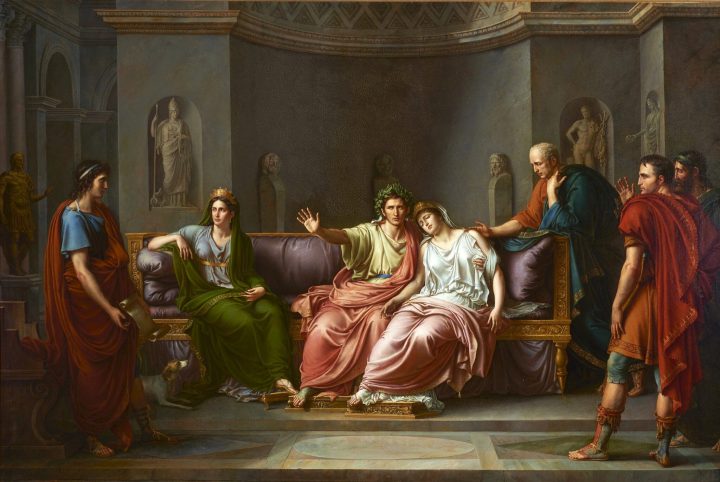
Jean-Baptiste Joseph Wicar, Virgil Reading the Sixth Canto of the Aeneid, 1818–21, oil on canvas
(Tremezzo: Museo di Villa Carlotta)
◊ ◊ ◊ ◊ ◊
Now on view at Villa Carlotta (with an English description available here) . . .
Olympus on the Lake: Canova, Thorvaldsen, Hayez, and the Treasures of the Sommariva Collection
Villa Carlotta, Tremezzo (on Lake Como), 22 June – 30 September 2024
Abile politico e potente braccio destro di Napoleone a Milano, Giovanni Battista Sommariva (1762–1826) è stato uno dei maggiori e più celebri collezionisti tra l’Impero e la Restaurazione. Approfittando di quei tempi di rapidi e radicali cambiamenti, nel 1802—quando si interruppe la sua breve ma fulminante carriera—era ormai riuscito a costruirsi una immensa fortuna.
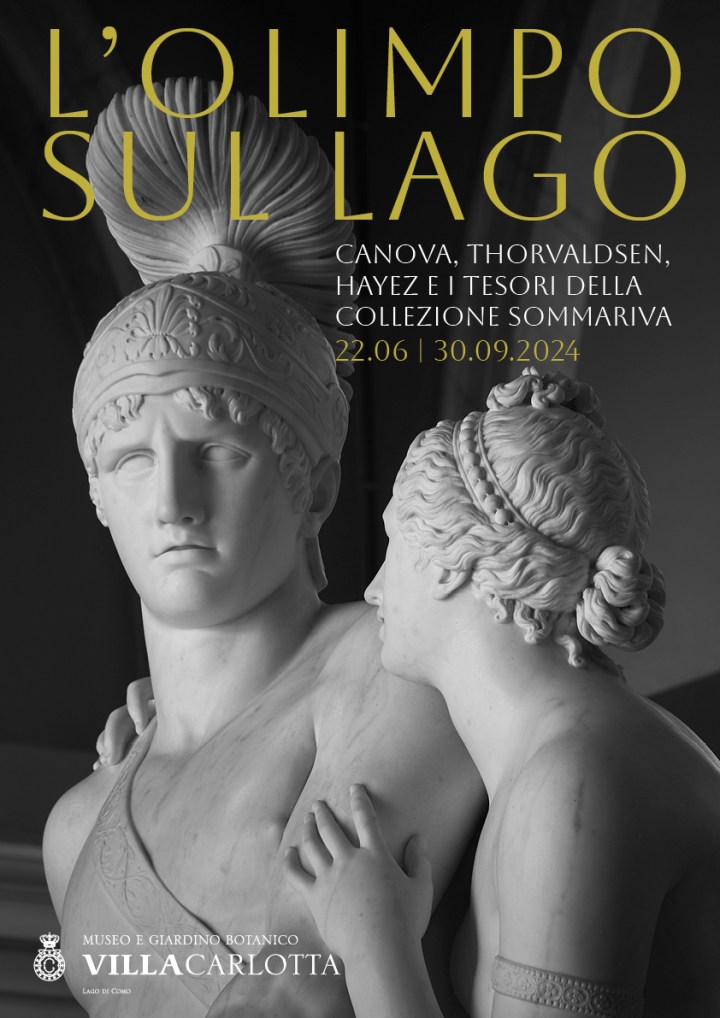 La sua leggendaria raccolta era una delle più importanti dell’epoca, insieme a quelle dei familiari di Napoleone, in particolare dell’imperatrice Josephine. Divisa tra il suo palazzo a Parigi, in uno dei quartieri più alla moda della città, e la villa di Tremezzo sul Lago di Como (oggi Villa Carlotta), vantava dipinti antichi e capolavori dei maggiori artisti dell’epoca—David, Prud’hon, Girodet, Wicar, Appiani, Bossi, Hayez—oltre a una infinità di preziosi oggetti d’arte. Soprattutto per la presenza a Villa Sommariva delle opere di Canova e degli splendidi marmi di Thorvaldsen, accorrevano viaggiatori da tutto il mondo, tra cui personaggi illustri come Stendhal, Lady Morgan, Flaubert. Attraverso una selezione delle opere più famose di quella straordinaria collezione—sculture, dipinti, stampe, gioielli e miniature—Villa Carlotta celebra un magnifico protagonista della propria storia e un grande mecenate di statura europea.
Per tutta la durata della mostra L’Olimpo sul lago, è possibile visitare presso il Museo del Paesaggio del Lago di Como (Tremezzina) l’esposizione Paesaggio sublime: Il Lago di Como all’epoca di Giovanni Battista Sommariva (1801–1826) che esporrà incisioni, tempere e acquerelli della prima a metà del XIX secolo con il proposito di evocare l’aspetto del lago e dei suoi borghi al tempo di Giovanni Battista Sommariva.
Fernando Mazzocca, Maria Angela Previtera, and Elena Lissoni, eds., L’Olimpo sul lago: Canova, Thorvaldsen, Hayez e i tesori della Collezione Sommariva (Milan: Silvana Editoriale, 2024), 352 pages, ISBN 978-8836658336, €35.
Exhibition | Belle da Costa Greene: A Librarian’s Legacy
Opening in October at The Morgan:
Belle da Costa Greene: A Librarian’s Legacy
The Morgan Library & Museum, New York, 25 October 2024 — 4 May 2025
Organized by Philip Palmer and Erica Ciallela
 The incredible story of the first director of the Morgan Library: a visionary Black woman who walked confidently in an early 20th-century man’s world of wealth and privilege
To mark the 2024 centenary of its life as a public institution, the Morgan Library & Museum will present a major exhibition devoted to the life and career of its inaugural director, Belle da Costa Greene (1879–1950). Widely recognized as an authority on illuminated manuscripts and deeply respected as a cultural heritage executive, Greene was one of the most prominent librarians in American history.
She was the daughter of Genevieve Ida Fleet Greener (1849–1941) and Richard T. Greener (1844–1922), the first Black graduate of Harvard College, and was at birth known by a different name: Belle Marion Greener. After her parents separated in the 1890s, her mother changed the family surname to Greene, Belle and her brother adopted variations of the middle name da Costa, and the family began to pass as White in a racist and segregated America.
Greene is well known for the instrumental role she played in building the exceptional collection of rare books and manuscripts formed by American financier J. Pierpont Morgan, who hired her as his personal librarian in 1905. After Morgan’s death in 1913, Greene continued as the librarian of his son and heir, J.P. Morgan Jr., who would transform his father’s Library into a public institution in 1924. But her career as director of what was then known as the Pierpont Morgan Library―a leadership role she held for twenty-four years―is less well understood, as are aspects of her education, private collecting, and dense social and professional networks.
The exhibition will trace Greene’s storied life, from her roots in a predominantly Black community in Washington, D.C., to her distinguished career at the helm of one of the world’s great research libraries. Through extraordinary objects―from medieval manuscripts and rare printed books to archival records and portraits―the exhibition will demonstrate the confidence and savvy Greene brought to her roles as librarian, scholar, curator, and cultural executive, and honor her enduring legacy.
This exhibition is organized by Philip Palmer, Robert H. Taylor Curator and Department Head of Literary and Historical Manuscripts, and Erica Ciallela, Exhibition Project Curator.
Erica Ciallela and Philip Palmer, eds., Belle da Costa Greene: A Librarian’s Legacy (New York: DelMonico Books, 2024), 304 pages, ISBN: 978-1636811352, $50. With a foreword by Colin Bailey, an afterword by Tamar Evangelestia-Dougherty, and contributions by Araceli Bremauntz-Enriquez, Julia Charles-Linen, Erica Ciallela, Rhonda Evans, Anne-Marie Eze, Daria Rose Foner, Jiemi Gao, Juliana Amorim Goskes, Gail Levin, Philip Palmer, Deborah Parker, and Deborah Willis.
New Book | J. Pierpont Morgan’s Library
From Scala:
Colin Bailey, Barry Bergdoll, Andrew Dolkart, Daria Rose Foner, Christine Nelson, and Brian Regan, J. Pierpont Morgan’s Library: Building the Bookman’s Paradise (London: Scala Arts Publishers, 2023), 256 pages, ISBN: 978-1785513992, £35 / $50.
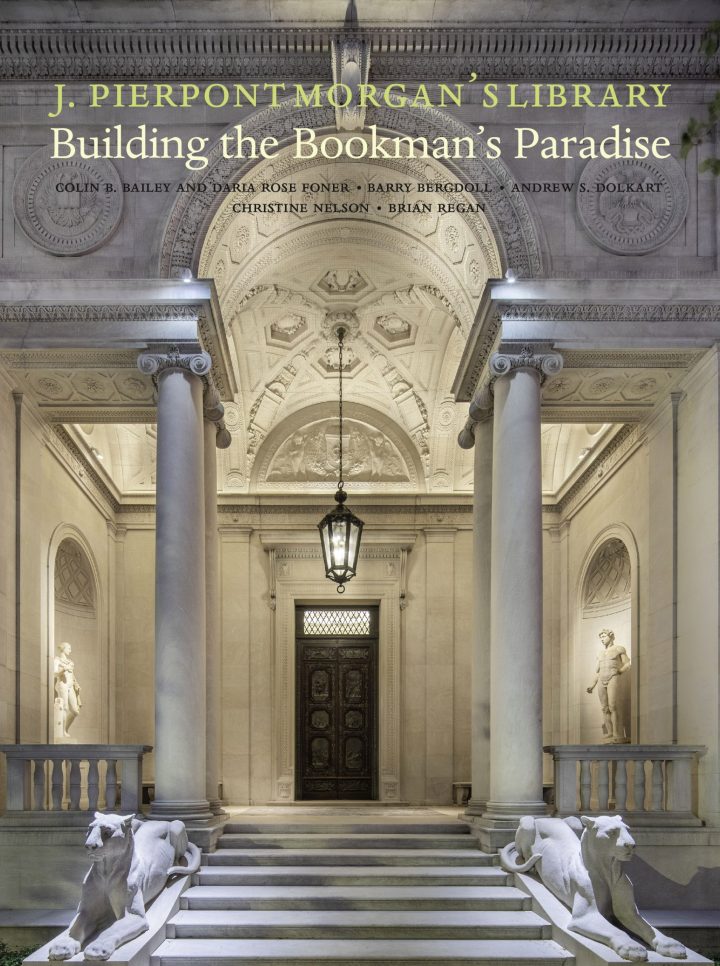 This beautifully illustrated book celebrates the first-ever restoration of the exterior of J. Pierpont Morgan’s Library—the historic heart of the Morgan Library & Museum.
Morgan’s Library has stood as a significant cultural landmark ever since it was commissioned by J. Pierpont Morgan for personal use at the start of the twentieth century. Its transition to a public institution in the twenties has lent to an even greater flood of admiration and patronage, by both local and international audiences. The elegant design by Charles Follen McKim stands as one of the finest examples of neoclassical architecture in the United States, significant for its distinctive Italian Renaissance style and its opulent interior period rooms. The site has been designated both a National Historic Landmark and a New York City landmark, and it is listed on the National Register of Historic Places. The book, following on the heels of the completed restoration, will punctuate this latest milestone in the building’s storied history.
Colin B. Bailey, Director of the Morgan Library & Museum, is a specialist in eighteenth-century French art.
Barry Bergdoll is the Meyer Schapiro Professor of Art History at Columbia University and the former chief curator in the Department of Architecture and Design at the Museum of Modern Art, New York.
Andrew Dolkart is a professor of historic preservation at the Columbia University Graduate School of Architecture, Planning and Preservation.
Daria Rose Foner is the former Research Associate to the Director of the Morgan Library & Museum and is now with the Old Masters Department at Sotheby’s, New York.
Christine Nelson is the former Drue Heinz Curator of Literary and Historical Manuscripts, The Morgan Library & Museum, now Fellowships Manager, the Library Company of Philadelphia.
Brian Regan is the architectural advisor to the Morgan Library & Museum.
New Book | Morgan―The Collector
From Arnoldsche Art Publishers:
Vanessa Sigalas and Jennifer Tonkovich, eds., Morgan―The Collector: Essays in Honor of Linda Roth’s 40th Anniversary at the Wadsworth Atheneum Museum of Art (Stuttgart: Arnoldsche Verlagsanstalt, 2023), 288 pages, ISBN: 978-3897906792, $65.
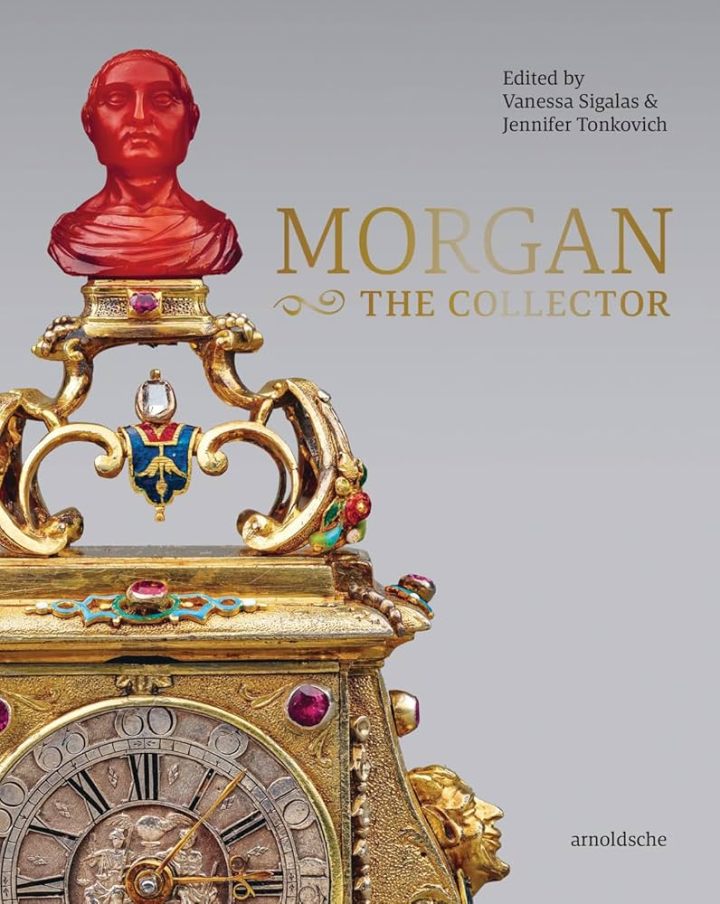 The essays in this lavishly illustrated volume offer a multi-faceted portrait of American financier J. Pierpont Morgan (1837–1913) as a collector of art.
A riveting exploration of Morgan’s acquisitions from antiquities to medieval manuscripts, to Old Master paintings, and European decorative arts, Morgan―The Collector introduces the reader to how and why he amassed his vast collection. The book also serve as a tribute to Linda Roth, curator at Wadsworth Atheneum Museum of Art, Hartford, Connecticut, who dedicated much of her forty-year career to researching Morgan and the over 1,500 works from his collection now in the museum. This volume is directed at both a scholarly audience and general readers interested in the history of collecting, European art, and America during the Gilded Age.
New Book | The Radical Print
Distributed by Yale University Press:
Esther Chadwick, The Radical Print: Art and Politics in Late Eighteenth-Century Britain (London: Paul Mellon Centre for Studies in British Art, 2024), 248 pages, 9781913107437, $60.
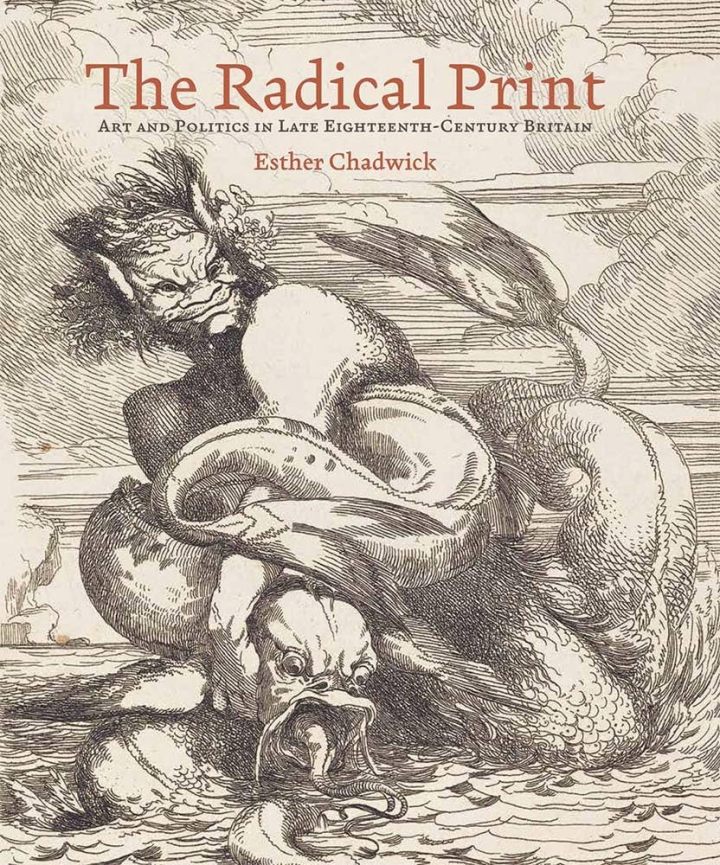 The Radical Print argues for printmaking in Britain as the most exciting, innovative, and critically engaged field of artistic production in the late eighteenth century. Moving the print from the margins to the centre of the study of art history, this new critical study demonstrates how print responded to the acceleration of historical events, the polarisation of public discourse, and the sense of a world turned upside down in ways that traditional artistic media could not. Across five chapters, this book brings printmakers James Barry, John Hamilton Mortimer, James Gillray, Thomas Bewick, and William Blake together as artists of the ‘Paper Age’ for the first time. From Barry’s experiments in aquatint at the time of the American Revolution to Blake’s visionary engravings of the post-Napoleonic period, Esther Chadwick shows how the print medium provided artists with special purchase on the major political issues of their age. The Radical Print assembles a rich array of material, from the period’s best-known prints to unpublished ephemera, revealing print’s dynamic role in one of the most turbulent periods of British history.
Esther Chadwick is Lecturer in Art History at the Courtauld Institute of Art.
Lecture | Cynthia Chin on Recreating a Martha Washington Gown

Gainsborough Silk Weaving Company, detail of the reproduced silk used in Cynthia Chin’s replica of a gown owned by Martha Washington
(Image courtesy of Cynthia Chin)
◊ ◊ ◊ ◊ ◊
Upcoming at the Wadsworth Atheneum:
Cynthia Chin | Off the Dressmaker’s Needle: Recreating Martha Washington’s Purple Silk Gown and Recovering the Lives Within
Wadsworth Atheneum, Hartford, CT, 15 September 2024, 2pm

Cynthia Chin, Gown and petticoat, 2024, Silk, linen, and wool. The gown is a reproduction of a garment owned by Martha Custis Washington. The original was made in the the early 1760s when Washington was in her thirties, remade around the time of the American Revolution (1775–1783), and possibly worn during her tenure as First Lady (1789–1797). The original gown is now in the collection of the New Hampshire Historical Society.
The recent work of art and material culture historian Cynthia Chin involves an in-depth study of a purple silk gown owned by Martha Custis Washington (1731–1802). Chin reveals how her research and recreation of the textile and garment illuminate the stories of the people who made, wore, and cared for it. Join us before the lecture to view Chin’s colorful replica of Washington’s gown, on view in New Nation, Many Hands. Free with reservations encouraged.
As Dr. Chin notes in her Maker-Scholar Statement: “Recreating this garment as it may have appeared when new, unworn, and unaltered honors the forced labor of the enslaved seamstresses who tended the original object, including Caroline Branham (1764–1843), Charlotte, and Ona ‘Oney’ Judge (1773–1838). I commissioned the textile specifically for this project. It was reproduced by the Gainsborough Silk Weaving Company in Suffolk, UK. This gown and its replication methodology reveal new evidence of how the original dress changed over its lifespan, and how Martha Washington may have appeared when she was young. It remembers all unseen and forced labor—the ‘many hands’ that created our new American democracy.”
Cynthia E. Chin is an art and material culture historian of Vast Early America and Britain in the eighteenth century, specializing in dress, textiles, identity, and collecting. As a researcher at the University of Glasgow, Cynthia examines collections of dress, textiles, and art from around 1600 to 1830 in order to understand how private collections, individual collectors, and museum acquisitions strategies shaped notions of ‘early America’.
Presented with support from the Joseph and Robert Cornell Memorial Foundation Fund at the Wadsworth Atheneum.
Lecture | Ned Lazaro on the Mourning Embroidery of Elizabeth Bennett
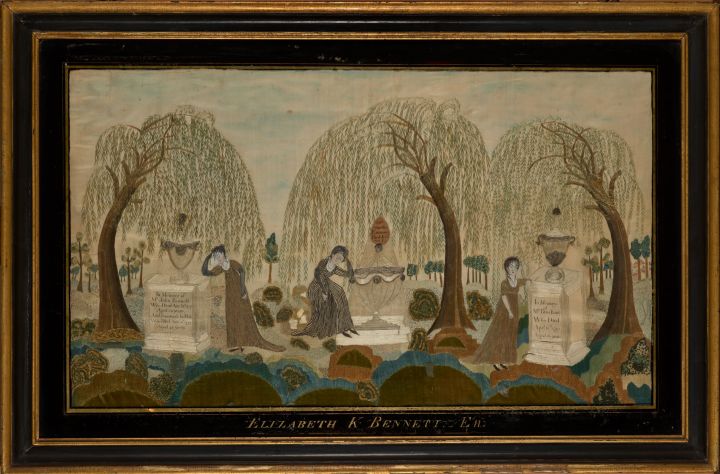
Elizabeth K. Bennett, Mourning Picture, 1801–07, polychrome silk embroidery, metallic threads, gouache and watercolor paints, plain-weave silk ground (Hartford: Wadsworth Atheneum, gift of Miss Jane W. Stone, 1938.236).
◊ ◊ ◊ ◊ ◊
Upcoming at the Wadsworth Atheneum:
Ned Lazaro | The Mourning Embroidery of Elizabeth K. Bennett
Wadsworth Atheneum, Hartford, CT, 8 September 2024, 1pm
Needlework was an important part of a young girl’s education in eighteenth- and nineteenth-century America. Mourning embroideries often depicted figures overcome with sadness and weeping willow trees. Ned Lazaro, Associate Curator of Costume and Textiles, discusses the ongoing significance of a particular example. Free with museum admission.
Uffizi Acquires Subleyras’s Mystical Marriage of St. Catherine de’ Ricci
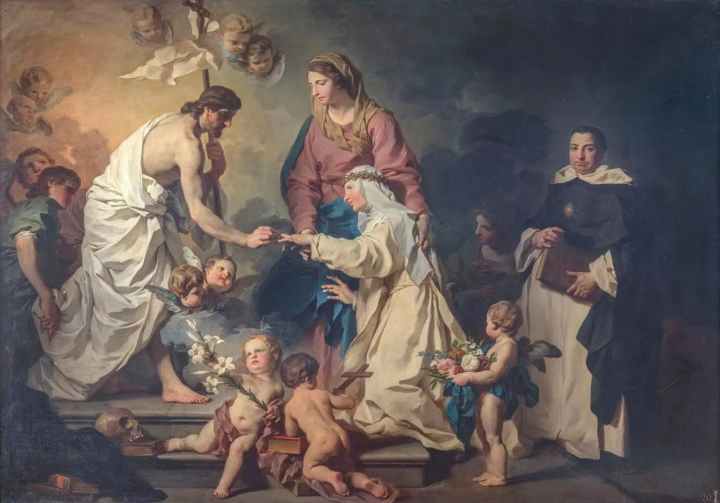
Pierre Subleyras, The Mystical Marriage of St Catherine de’ Ricci, 1746, oil on canvas, 75 × 250 cm
(Florence: Uffizi)
◊ ◊ ◊ ◊ ◊
From the recent press release (as noted at Art History News) . . .
A majestic masterpiece of 18th-century French art is set to become a highlight in the Uffizi collection: the large canvas The Mystical Marriage of Saint Catherine de’ Ricci, signed by the renowned Occitan painter Pierre Hubert Subleyras (1675–1758) and dated 1746. Historians attribute significant importance to this painting for its quality, prestigious commission, and collection history. It was acquired by the museum director, Simone Verde, at the international TEFAF fair in Maastricht in February 2024. Upon its arrival in Florence, it will be restored and prominently displayed in the gallery spaces dedicated to 18th-century painting.
In 1763, the canvas—created for the canonization of Saint Catherine de’ Ricci—was part of Girolamo Colonna di Sciarra’s collection, then Lorenzo Onofrio Colonna’s, followed by Filippo III Colonna’s. Between 1812 and 1935, it was housed in the Barberini collection in the namesake Roman palace. That same year, it was auctioned and bought by the Marquis Sacchetti, from whom it was inherited by the current owners.
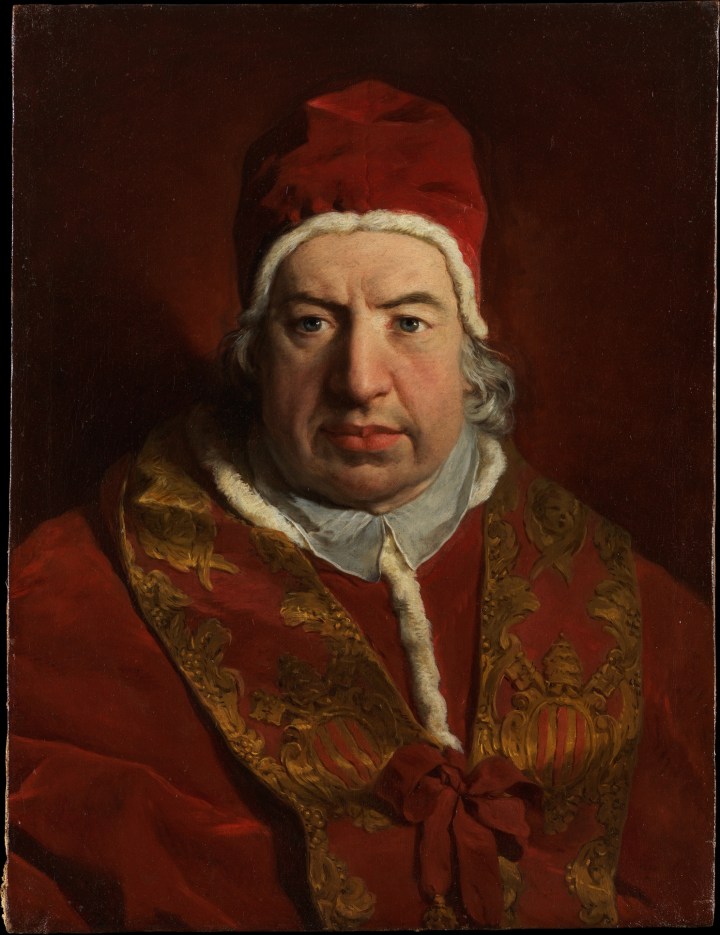
Pierre Subleyras, Portrait of Pope Benedict XIV (Prospero Lambertini, 1675–1758), 1746, oil on canvas, 64 × 49 cm (New York: The Metropolitan Museum of Art, 2009.145).
As was customary, religious orders presented the Pope with artworks celebrating the figures about to be canonized, but the choice of subject and artist was reserved for the Pope. In this case, Pope Benedict XIV Lambertini chose Subleyras, a painter gaining great success in Rome. The Bolognese Pope had entrusted him with his portrait in 1746, now housed in the Metropolitan Museum of New York.
Subleyras’ purism, the monumental quality of figures with marble-like white complexions still retaining a rocaille style, is already moving towards Neoclassicism, aligning with modernity. The solemn yet composed sacred scene in The Mystical Marriage owes much to the classicism of Poussin and his interpretation of Roman Baroque models. The reference to 17th-century classicist masters is enriched by the airy colors typical of the 18th century. The movement around the mystical marriage scene is conveyed through a multitude of putti and cherubic heads, where the artist showcases his virtuosity with still life elements such as the white lily branch or the floral arrangement held by the winged putto depicted in profile.
Subleyras distinguished himself as a painter of histories and portraits, but among his greatest masterpieces is one of the most beautiful nudes in art history, the Female Nude kept in the Barberini Gallery in Rome (ca. 1740). The French painter, who later died in Rome, was trained by his father (also a painter) and went to Paris in 1726, where he won the prestigious Prix de Rome scholarship in 1728 as a resident of the French Academy in Rome. In 1736, he married Maria Felice Tibaldi, a miniaturist who often reproduced her husband’s works in miniature. In 1748, Cardinal Silvio Valenti Gonzaga introduced the artist to Pope Benedict XIV, for whom he painted not only his portrait but also the Mass of Saint Basil for St. Peter’s Basilica (now in Santa Maria degli Angeli). During the same period, he painted the Miracle of Saint Benedict for the Olivetani church in Perugia (Rome, Santa Francesca Romana) and Saint Ambrose and Theodosius (Perugia, National Gallery of Umbria).

Pierre Subleyras, Female Nude Seen from the Back, ca. 1732, oil on canvas, 74 × 136 cm (Rome: Palazzo Barberini).
The Director of the Uffizi Galleries, Simone Verde, stated: “The Mystical Marriage is a work of primary importance for 18th-century art and will be a prominent new addition to the museum’s 18th-century rooms. Besides its refined aesthetics and compositional elegance, it significantly reflects the taste of the circle of nobles and intellectuals around the Roman Curia in the mid-18th century. It is a true masterpiece, rare to find on the market, that will enrich the Uffizi’s 18th-century collections, filling a significant gap and representing another step towards completing the pictorial history of Italy pursued by Luigi Lanzi, a mission that remains central to the museum today due to its national and international collection significance.”
Call for Submissions | Metropolitan Museum Journal
Metropolitan Museum Journal 60 (2025)
Submissions due by 15 September 2024
The Editorial Board of the peer-reviewed Metropolitan Museum Journal invites submissions of original research on works of art in the Museum’s collection. The Journal publishes Articles and Research Notes. Works of art from The Met collection should be central to the discussion. Articles contribute extensive and thoroughly argued scholarship—art historical, technical, and scientific—whereas Research Notes are narrower in scope, focusing on a specific aspect of new research or presenting a significant finding from technical analysis, for example. Articles and Research Notes in the Journal appear in print and online, and are accessible in JStor on the University of Chicago Press website. The maximum length for articles is 8,000 words (including endnotes) and 10–12 images, and for research notes 4,000 words (including endnotes) and 4–6 images.
The process of peer review is double-anonymous. Manuscripts are reviewed by the Journal Editorial Board, composed of members of the curatorial, conservation, and scientific departments, as well as scholars from the broader academic community. Submission guidelines are available here. Please send materials to journalsubmissions@metmuseum.org. The deadline for submissions for volume 60 (2025) is 15 September 2024.
Roundtable | The Study of Collecting: Past, Present, and Future

Frans Francken the Younger, The Cabinet of a Collector with Paintings, Shells, Coins, Fossils, and Flowers, 1619, oil on panel, 56 × 85 cm
(Royal Museum of Fine Arts Antwerp)
◊ ◊ ◊ ◊ ◊
From the programme flyer:
Roundtable Discussion | The Study of Collecting: Past, Present, and Future
Institute of Advanced Studies Forum, University College London, 10 September 2024, 14.00–16.00
Begun in 1989, the Journal of the History of Collections has played a pivotal role in the development of the study of collecting. A multidisciplinary field by nature, the study of collecting began, arguably, with research into the early modern period and such cabinets of curiosities as those belonging to Hans Sloane and Ulisse Aldrovandi. With 35 complete volumes of the Journal now having been published, the time is ripe for a look at the past, present, and future of the field. This will also be an occasion to mark the appointment of Christina M. Anderson as Editor in Chief and the recent retirement of the Journal’s Founding Editor, Arthur MacGregor.
The UCL Centre for Early Modern Exchanges, together with the Journal of the History of Collections, is hosting a roundtable discussion to explore themes that have developed in the field over the past 35 years and to identify new ones that are emerging. In doing so, the event aims to consider not only traditional methodologies but also new approaches that have been developed in the humanities, social sciences, museum studies, heritage, art market, etc., in recent years. It also seeks to address the ways in which early modern cabinets of curiosities have inspired contemporary museums, magazines, and bloggers.
Short presentations (5–10 minutes) will be given by members of a panel, to include Paula Findlen (Stanford University), Anne Gerritsen (University of Warwick), Anna Garnett (Petrie Museum), Mark Carine (Natural History Museum), and Hélia Marçal (UCL History of Art), among others. These overviews will be followed by a moderated panel discussion and questions from the audience. Refreshments will be provided. For catering purposes, rsvp to editorjhc@gmail.com. We look forward to seeing you there!










 Enfilade
leave a comment