Call for Papers | ASECS 2025, Online
From the Call for Papers for round 3 (abstracts due by Friday) . . . and please be sure to consult the full list of panel offerings:
2025 American Society for Eighteenth-Century Studies Conference
Online, 55th Annual Meeting, 28–29 March and 4–5 April 2025
Proposals due by 20 September 2024
The American Society for Eighteenth-Century Studies (ASECS) is pleased to announce our Call for Papers for the 55th Annual Meeting, to be held virtually over two weekends in 2025: March 28–29 and April 4–5. The Society, established in 1969, is the foremost learned society in the United States for the study of all aspects of the period from the later seventeenth through the early nineteenth century. Round 3 (Submissions to Sessions) is open for submissions to panels, roundtables, and special sessions.
More information is available here»
◊ ◊ ◊ ◊ ◊
Africans and Africa in Italy (Italian Studies Caucus)
Chair: Wendy Wassyng Roworth (University of Rhode Island), wroworth@gmail.com [ID 51 / March 28–29]
Given the interest generated by the “Africans and Africa in Italy” panel at the 2024 ASECS meeting, the Italian caucus proposes another panel on the same topic for the 2025 online meeting. This session is dedicated to the realities and representations of African peoples and their homelands in the various Italian States, be they economic, political, religious, artistic, social, educational, etc. Papers may examine the lived experiences of Africans in rural and city environments, among nobility and other classes, and in relation to a variety of public entities. Portrayals of Africa and Africans may come from literary, theatrical, figurative, ceremonial, academic, etc. sources. Examples include but are not limited to: Africans featured in portrait and other figurative arts genres, treatment of/reference to Africans in historical, scientific, medical, ethnographic, encyclopedic and travel narratives; Africa as protagonist and/or setting in fictional, scientific, poetic, or dramatic literature. Papers may also interpret “Africans in Italy” in an indirect sense, i.e., to include the heated debates taking place in Italy (in person and in print) on the experiences of Africans outside of Italy. Chief among those discussion topics would be Africans’ experience of the transatlantic slave trade and subsequent enslavement in the Americas.
◊ ◊ ◊ ◊ ◊
Anne Schroder New Scholars Session (Historians of Eighteenth-Century Art and Architecture)
Chair: Laurel Peterson (Yale Center for British Art), laurel.peterson@yale.edu [ID 53 / April 4-5]
The Anne Schroder New Scholars Panel, sponsored by HECAA, seeks to promote scholarship that represents the future of eighteenth-century art and architectural studies. We invite proposals from advanced graduate students and early-career scholars working in the academy or museums. We welcome submissions that explore topics across the cultures, spaces, and materials that are related to art and architectural history globally over the long eighteenth century. We seek papers that reflect new approaches to both long-standing and under-studied issues and methods in eighteenth-century studies broadly, including but not limited to: critical race art history; Disability studies; ecocriticism and environmental studies; empire, colonization, and decolonial theory; gender and queer theory; global diasporic histories; Indigeneity; and material culture studies. Papers can be based on dissertations, book or article manuscripts in progress, Digital Humanities collaborations, or curatorial projects. We encourage scholars from underrepresented communities, contingent or independent scholars, and those working outside of North America to apply.
◊ ◊ ◊ ◊ ◊
‘Bad’ Art of the Long Eighteenth Century
Chair: Katherine Iselin (Emporia State University), kiselin@emporia.edu [ID 109 / April 4–5]
What constitutes ‘bad’ art? In art history, we often focus on surviving works that are unique or masterful in some way; works that epitomize the major interests of the period or works that exemplify the skill of the maker. But many other examples of art survive that do not qualify for any of these descriptions, or are perhaps even as far from them as possible. This panel looks to highlight these oft-forgotten pieces that occasionally sit in museum storage or private collections, hidden away from public eyes because they are considered unworthy of display. Yet we can learn much from such works: they can tell us a great deal of the levels of artistic production and appreciation, the accessibility of art to the non-elite, or artistic tastes outside the well-renowned. This panel seeks papers that examine works of art that might be construed as ‘bad’ in some way, exploring their place within the history of art in the long eighteenth century. Papers might also consider the role of accessibility for the artist, patron, or owner, as well as how works may have been displayed or viewed during their initial creation and by later collectors or owners.
◊ ◊ ◊ ◊ ◊
Bodies of Thought: Re-conceptualizations of the Body in Eighteenth-Century Art and Culture
Chair: Dorothy Johnson (University of Iowa), dorothy-johnson@uiowa.edu [ID 130 / April 4–5]
The Enlightenment in Europe witnessed radical shifts in the representation of the human figure in art and visual culture from the Rococo period to Neoclassicism and Romanticism. Transformations in the typology of the body in art can be best understood in the context of changing aesthetic, social, cultural, and political ideas and ideals that inflected the eighteenth century. The rise in prominence and prestige of the natural sciences during this period, which interrogated human origins and evolution, corporeal structures, biological, physiological, social and cultural identity and behavior, were ineluctably intertwined with artistic transformations in style and meaning. This panel invites papers that investigate the new meanings that accrued to the body as sign and signifier of cultural evolutions and revolutions.
◊ ◊ ◊ ◊ ◊
Eighteenth-Century Cats! (ASECS Graduate and Early Career Caucus)
Chair: Taylin Nelson (Rice University), tpn2@rice.edu [ID 68 / March 28–29]
What is an internet-based conference without addressing the internet’s favorite topic: cats!? This panel seeks papers interested in exploring eighteenth-century cats in their many facets and figurations. Cats abound during this period: from big cats in the natural histories, moralizing cats in fables and children’s stories, mysterious and symbolic cats in the art of Fragonard or Chardin, to real-life cats in the lives of Samuel Johnson or Horace Walpole.
Cats posed a challenge to Enlightenment thinking and represented diverse modes of existence during the period. It was Rousseau who claimed “the cat, enemy of all constraint, [a]s useful for characterising liberty.” From cultural perspectives, cats could represent a variety of topics, such as: domesticated pets, objects of torture, experimentation, and amusement, materially useful mousers, symbolic free agents, as street food, muses of philosophy and poetry, or dangerous predators from the ‘New World’.
This open-ended panel challenges panelists to tackle topics such as, but not limited to:
• Cats and Gender (associations with women and children, old maid tropes, sexuality and fertility, female subjectivity/objectivity)
• Cats and revolution (liberty, slavery, obedience, domestication, freedom versus torture)
• Cats and labor (skills, jobs, use-value, luxury versus labor, class)
• Cats and Science (vivisection and other experiments such as Lunardi’s balloon flight)
• Cats and the Atlantic World (predators, mousers on ships, posing threats/aids to colonists)
• Cats as vermin (massacres or street clearings)
• Thomas Gray’s “On the Death of a Favourite Cat” and any other artistic iterations of the poem
• Cats in fables (morality, education, kindness, pain, religion, transmutation)
• Author cats (Walpole, Johnson, Christopher Smart, and so on)
◊ ◊ ◊ ◊ ◊
Gifts from Flowers: Pollen, Fruit, Honey, Vegetables, Bouquets, Ceremonies, and More (South-Central Society for Eighteenth-Century Studies)
Chair: Kevin Cope (Louisiana State University), encope@lsu.edu [ID 83 / April 4–5]
Floral elements abound in long eighteenth-century culture. Still life paintings include or feature flowers; speculators plunge into the tulip market; posies and bouquets ornament every ceremony. Scientific concern for flowers reached a high pitch, whether in Thomas Jefferson’s pea-breeding program or among the growing ranks of botanical illustrators. Poets from John Philips to William Cowper celebrated all the members of the blooming tribe; travelers, fiction writers, and even musicians encounter or deploy the denizens of the vase. This panel is open to papers on all aspects of flower culture and activity, whether flowers themselves in art, literature, science, or philosophy or whether flowers as producers or sources of other cherished materials, whether the fruits and vegetables that swell from the bloom or the sweetening honey that competed with new-world sugar or even the icons that adorn heraldic devices. Papers from all disciplines, whether art history or botany or literature, are welcome.
◊ ◊ ◊ ◊ ◊
Hygge: The Visual and Material Culture of Coziness and Comfort
Chair: Kaitlin Grimes (Flagler College), KGrimes@flagler.edu [ID 150 / April 4–5]
Hygge, a Dano-Norwegian word, evokes the notions of comfortability and coziness that comes from the creation of a relaxing environment with specific creature comforts. Think of thick socks, a warm and fluffy blanket, a soft fire, a lovely cup filled with tea, and a good book all of which illustrate the simple and quiet pleasures of life away from the outside world. As we conference remotely, let us think about how those in the eighteenth century brought themselves comfort, both in childhood and adulthood. How did they create a cozy environment at home after a long day? What material objects did they turn to during the cold winters or the hot summers? And how was this idea depicted in eighteenth-century visual culture? Potential topics for this panel could include: blankets/textiles, fireplaces, tea and or coffee sets/services, beds/furniture, books (as a physical object), clothing, foodstuffs, children’s toy, interior decoration, family traditions, etc. This panel invites papers from all disciplines and as well as papers outside the potential topics listed above.
◊ ◊ ◊ ◊ ◊
‘Local’ Culture and Resistance
Chair: Harvey Shepherd (The Courtauld Institute of Art), hshepherd@courtauld.ac.uk [ID 123 / April 4–5]
This panel invites proposals from scholars studying ‘local’ culture as both a site and a tool of active resistance to conquest and cultural assimilation during the long-eighteenth century. The period of 1660 to 1830 is characterised by the emergence of national identities both in Europe and beyond, and the increase of colonial activity around the globe. These macrohistorical trends resulted in part from many understudied instances of interaction and erasure occurring at a regional level, often in border territories, coastlines, and newly-conquered areas. This discussion aims to complicate the distinction between the ‘micro’ and ‘macro’ histories of the eighteenth century by considering ‘the local’ as a sphere of resistance to the emergent globalisation of the early modern period. Panellists will consider the ways in which markers of ‘local’ cultural distinction—present in material and visual cultures, linguistics, writing, religious beliefs, or other expressions of identity—were mobilised as active tools of resistance to colonisation or the formation of modern nation states. In addition to considering the stakes involved in utilising ‘local’ identity as a form of resistance, the question of what constitutes our understanding of the term ‘local’ in the eighteenth century is itself a subject which presenters may choose to focus on. The panel welcomes submissions from scholars working in all areas of the humanities, and aims to stimulate conversation across disciplinary distinctions. Similarly, the discussion is not limited to any one geographical space, and papers are invited which examine any aspect of ‘local’ cultural resistance occurring across the eighteenth-century world.
◊ ◊ ◊ ◊ ◊
Sending a Woman to Do What an Army Could Not: Women in Asia
Chair: Samara Cahill (University of North Texas), samara.cahill@unt.edu [ID 46 / March 28–29]
Inspired by the multi-layered relationships among women portrayed in Hiroyuki Sanada et al’s 2024 adaptation of Shogun, James Clavell’s 1975 novel of early modern Japan, this panel invites papers on any aspect of women’s representation, experience, and relationships in long eighteenth-century Asia. Gender is both a mechanism of power and a method of symbolizing power dynamics that greatly influences the production of social institutions, privileges, and expectations. The issue of gender attained unprecedented prominence in early modern Asia, as the regulation and depreciation of women, which had long been shared and practiced, was fundamentally shaken by substantial social, political, and cultural transformations of the period. This panel asks literary scholars, historians, and art historians to investigate how social perceptions of gender were shaped and reshaped in diverse Asian cultures during the long eighteenth century.
◊ ◊ ◊ ◊ ◊
The Aesthetics of Chance, Risk, and Contingency
Chairs: Joseph Litts (Princeton University), jlitts@princeton.edu; and Erin Hein (University of Delaware), erinhein@udel.edu [ID 119 / March 28–29]
Being an artist is—and has been—risky business. Increased attention to and anxiety about uncertainty coincides with a period of increased transit, globalization, and industrialization from around 1650 to 1850. Fires and shipwrecks upended workshops and destroyed finished artworks, while open art markets led to financial instability. New and old media behaved unpredictably: marble cracked, oil paints did not cure, printmaking inks and acids went rogue, early photography capriciously captured and lost images. How did artists negotiate the unexpected? Amidst growing global trade, makers struggled to understand and manipulate new materials and subject matter. Printing errors paradoxically increased the value of impressions in Paris art markets. British and Dutch painters depicted maritime disasters for merchants whose treacherous voyages put lives and their own profits at stake. Artists from Giovanni Battista Piranesi to Alexander Cozens encouraged looking to random blots, tangled lines, and stains for inspiration. How did artists, collectors, and artworks convert chance, failures, mistakes, and risk into profits of all kinds?
Modern insurance, the stock market, and art itself converted loss into reward. For example, even the catastrophic financial losses of the South Sea Bubble became profitable for satirical artists who capitalized on the sudden inversion of fortune. Building on recent scholarship by Nina Dubin, Meredith Martin, and Madeleine Viljoen, as well as Charlotte Guichard and Matthew Hunter, how were artists visualizing and participating in systems of uncertainty? And how were art objects entangled in these networks? Attention to chance, risk, loss, and profit unsettles the fixedness of eighteenth century history and aesthetics. While this panel takes the Atlantic as its point of departure, we encourage contributions on a broad geographic range of materials and makers. We welcome submissions from scholars at all stages.
◊ ◊ ◊ ◊ ◊
The Art of Balance: Concepts of Equality and Democracy in Art and Visual Culture (Deutsche Gesellschaft für die Erforschung des 18. Jahrhunderts)
Chairs: Iris Brahms (Universität Tübingen), iris.brahms@fu-berlin.de; and Elisabeth Fritz (Freie Universität Berlin), elisabeth.fritz@fu-berlin.de [ID 78 / March 28–29]
In Western politics and philosophy of the eighteenth century, concepts of balance, equality, and democracy experienced a groundbreaking contouring that continues to have an impact until today (see McMahon 2023). These issues were negotiated not least in the arts. Our thesis is that the parallelism and simultaneity of opposing views and ideologies led to a striving for equilibrium and harmony, and was articulated, for example, within the ideas of social justice and political equality, or the goal of levelling extreme economic and financial differences, an idealistic balance that ultimately paved the way for new concepts of societal order, respectively democracy.
There is no glossing over the fact that a certain degree of difference and hierarchy to guarantee the aesthetically ‘harmonic’ order and balance was a persistent and prevailing ideal of the eighteenth century. Just as much, while aspiring for a newly balanced order within society, the dynamics of the socio-cultural developments of this period kept contributing to ongoing social injustices such as slavery or gender inequality. We decisively want include and discuss problematic strategies of appropriation and hegemonic agency and their paradoxical agenda in the names of equalization, modulation, normality, or assimilation, as well as non-Western concepts of equilibrium and collectivity. Our goal is to enter a fruitful debate and to develop a critical methodological approach, when we ask in which ways and to which ends the visual arts and their discourses helped to shape and spread the understanding of balance, equality, and democracy in the long eighteenth century.
◊ ◊ ◊ ◊ ◊
The Art of the Table: Dining and Desire in the Early Modern Period
Chair: Esther Gabel (Washington University in Saint Louis), esther.gabel@wustl.edu [ID 138 / March 28–29]
The early modern period saw a substantial shift in the preparation and presentation of food. Focus shifted from spice to ingredient, from captured to cultivated. New culinary techniques required new implements, and new methods of serving led to innovative porcelain and silver designs. Dining became more intimate, yet more elegant. Colonial drinks were the height of fashion. This panel seeks to bring together interdisciplinary perspectives to examine the complexities of ‘setting the table’ in the early modern period. Potential topics include (but are not limited to): print, cooks and cookbooks; porcelain and the art of presentation; the garnish; gardening; indulgence and intimacy in the dining room; food in art, or food as art; butter and sugar; and food or fiction (or melons made of sausage).
◊ ◊ ◊ ◊ ◊
The Historical Geographies of the Churrigueresque in the Iberian World
Chairs: Luis Gordo Peláez (California State University, Fresno), luisgordopelaez@csufresno.edu; and Cody Barteet (UWO), cbarteet@uwo.ca [ID 145 / April 4–5]
Spanish art historiography of the late 1700s (Llaguno and Ceán Bermúdez), favored Juan de Herrera’s sixteenth-century classical architecture and Bourbon-era architects Ventura Rodríguez and Juan de Villanueva. The latter architects were credited with restoring canonical models and shaping a national artistic identity by some historical and modern writers. This narrative castigates other ornamental architectural styles that developed after the mid-1600s, that were described as decorative fantasies and their designers, like Hurtado, Churriguera, and Ribera, labeled as ‘heretics’. In juxtaposition, the early 1900s American architects viewed Spanish architecture linearly, recognizing that Herrera’s work was in response to existing ornamental styles (like the Plateresque), and his ‘pure Classicism’ gave way to Churriguera’s ornamental creations. While vilified in Spain, Churriguera was celebrated in America, and Herrera criticized for adopting an ‘unrooted’ style deemed ‘out of key with the Spanish character’, unlike the ornamental styles that preceded or post-dated including the Churrigueresque. Few modern scholars have reconsidered this historiography by analyzing the exuberant aesthetic dominating Hispanic architecture in the late 17th and 18th centuries. The Churrigueresque and its transoceanic interpretations remain understudied in English scholarship. This panel aims to further examine the Churrigueresque through textual analyses and studies of its relationship to the Hispanic world’s built environment, including architectural, sculptural, and ephemeral elements. Proposals may address various aspects:
• Churrigueresque historiography and taxonomy, including the influence of other ‘decorative fantasies’ or styles
• Influence of other cultures and their technologies
• Intersection of race and built environment, sensorial studies, and digital humanities
• Center and Periphery Methodologies concerning the Churrigueresque in the broader Iberian world
◊ ◊ ◊ ◊ ◊
Women Artists: Emulation, Collaboration, Innovation
Chair: Christina Lindeman (University of South Alabama), clindeman@southalabama.edu [ID 99 / April 4–5]
In recent years, scholars have focused increased attention on women artists in the long eighteenth century. From watershed exhibitions including Making Her Mark in North America and Geniale Frauen in Europe, to publications on women artists by Spies-Gans (2022), Strobel (2023), and Quinn (2024). Taking advantage of this new research and artworks emerging on the market opens more opportunities to study women artists in various geographical areas and working in multifarious mediums. This panel seeks papers proposing new perspectives on women artists engaged in emulation, collaboration, and innovation from diverse regions and cultural settings.
Emulation was understood as a virtuous practice that led to innovation. However, as Laura Auricchio noted in her research on Adélaïde Labille-Guiard, that emulation was “necessary for female artists’ careers but dangerous for their reputations.” Emulating artworks deemed inappropriate could potentially damage a woman’s social standing even being judged unnatural. Moreover, a woman could be deemed a ‘copyist’ and lacking the intellectual breadth for history painting. How did women artists engage with artworks from the historical past or their contemporaries?
Taking collaboration as a focus, this panel invites new pathways to analyze the dynamic and gendered relationships in the studio. Papers that address how women collaborated with other artists, whether family members or contemporaries, are welcomed. How did women assert themselves in collaborative professional relationships? In what instances did collaborative working relationships run counter to established gender roles? How was the division of labor and responsibilities divided?
Finally, where can we see women innovating? Which women artists invented new methods of making art? How did they engage the materiality of their art by, for example, creating new formulas in pigments, brushes, pastels, or paper? How did women artists engage with natural philosophy and/or laboratory practices in the studio?
◊ ◊ ◊ ◊ ◊
Roundtable | Material Methods
Chair: Sal Nicolazzo (UC Davis), snicolazzo@ucdavis.edu [ID 118 / March 28–29]
We have long known that the eighteenth century was profoundly shaped by both materials and theories of materiality itself. From metallurgy to textiles, from ceramics to foods, scholars of eighteenth-century literature, the arts, history, economy, and governance have contributed to a rich and multifaceted understanding of how specific materials both acquired profound socio-cultural meaning and shaped human and ecological relations through their material properties.
This roundtable seeks to convene an interdisciplinary discussion of material methods for understanding the eighteenth century in the present. What kind of knowledge-production is entailed in cooking, fermenting, sewing, sculpting, binding, printing, growing, harvesting, or amalgamating the materials either represented or elided in the primary sources more traditionally employed in our disciplines for historical inquiry? How might we engage methodologically with contemporary artists like Candice Lin, Kara Walker, and Joscelyn Gardner, who devise artistic methods for reanimating eighteenth-century materials and histories? How might material methods transform, rather than simply re-enact, the material histories that shaped the eighteenth century, or push us to find terms other than ‘the eighteenth century’ for understanding the temporalities of our research or teaching? What material methods are necessary for engaging transformatively with the planetary material “duress” (Ann Stoler) of eighteenth-century capitalism and empire in which we all live? A wide array of formats, genres, and creative interpretations of the topic are welcomed, as is creative engagement with the unique affordances of the virtual format.
◊ ◊ ◊ ◊ ◊
Roundtable | The Legacies of Morris Eaves
Chairs: Wayne Ripley (Winona State University), wripley@winona.edu; and Tom Hothem (University of California, Merced), thothem@ucmerced.edu [ID 116 / March 28–29]
This panel invites participants to reflect on the life and work of the William Blake and Romanticism scholar Morris Eaves, who passed away in the spring of 2024. Eaves was the co-editor of Blake: An Illustrated Quarterly and a co-founder of the William Blake Archive as well as the author of books and articles on Blake, art history, technologies of visual reproduction, digital humanities, and editorial theory.
Eaves opened new interdisciplinary vistas of scholarly inquiry that were attuned to the relationship of print production, visual culture, and changing modes of technology. His book The Counter-Arts Conspiracy: Art and Industry in the Age of Blake (1992) positioned Blake in a variety of interrelated contexts—aesthetic, chalcographic, technological, religious, economic, and political—to show that Blake was engaged with debates that were both central to the eighteenth century and, as it happens, newly pertinent to the late twentieth and early twenty-first centuries. Eaves similarly understood how changes in technology demanded, in his phrase, a new “editorial settlement.” By helping to create and maintain the Blake Archive, which celebrates its 30th anniversary in 2025, Eaves posited a new model of the scholarly edition for the digital age and helped to advance the idea of the digital humanities.
Contributors to this panel are welcome to explore any aspect of Eaves’s thought in relation to the eighteenth century, and/or to offer personal reflections. We appeal especially to Eaves’s students, colleagues, and readers in asking participants to examine our field’s current interdisciplinary trajectory in relief of given work(s) from the Age of Blake. Participants should engage cultural production as rigorously and specifically as possible, certainly in the spirit with which Eaves approached such work.
Symposium | A Puritan Picture
From the Yale Center for British Art:
A Puritan Picture: Vanity, Morality, and Race in Seventeenth-Century Britain
In-person and online, Hastings Hall, Yale School of Architecture, New Haven, 27 September 2024
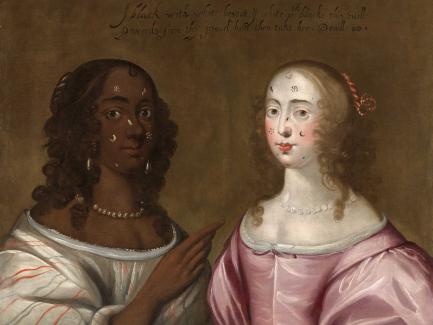
Unknown artist, Two Women Wearing Cosmetic Patches, ca. 1655, oil on canvas (Compton Verney Art Gallery and Park, Warwickshire, UK).
The YCBA, in partnership with Compton Verney, will host a symposium to increase understanding of the painting Two Women Wearing Cosmetic Patches. Topics include the painting’s provenance, attribution, and future display; the cloth trade in seventeenth-century England, Africa, and India; and evolving perceptions of beauty standards, including a keynote conversation focusing on cosmetic patches.
The middle decades of the seventeenth century in Britain were characterized by radical political, religious, and social change. In this period, an unknown artist created a remarkable painting that spoke to fears and anxieties crystallizing around a perceived increase in moral laxity, gender transgression, and the insidious influence of foreigners. The painting depicts two women side by side, each wearing a conspicuous array of beauty patches. The woman on the left reprimands her companion with the words “I black with white bespott: y[o]u white w[i]th blacke this Evill / proceeds from thy proud hart, then take her: Devill.” Text and image combine to inveigh against the sins of pride, vanity, and worldly excess. The painting reminds viewers that sinful behavior leads to the devil and exhorts them to seek salvation.
Compton Verney Art Gallery and Park in Warwickshire, England, has loaned the painting to the YCBA for conservation treatment and inclusion in the museum’s ongoing technical study of the theory and practice of painting skin tones. It will be on view at the Yale University Art Gallery from 20 August until 30 September 2024, before returning to Compton Verney. Registration for online and in-person attendance is recommended. For more information, please email jemma.field@yale.edu.
s c h e d u l e
9.20 Welcome by Jemma Field (Associate Director of Research, YCBA) and Oli McCall (Senior Curator, Compton Verney Art Gallery and Park)
9.30 Opening Talk
• A Painter for a Puritan Picture? — Edward Town (Assistant Curator of Paintings and Sculpture, YCBA)
This opening talk will provide an account of the recent history of the painting Two Women Wearing Cosmetic Patches and the research partnership between the YCBA and Compton Verney. It will present new findings about the painting’s early history and its attribution, set within the context of artistic production during the Interregnum.
9:50 Panel I | Women, Dress, and Morality
Chair: Elizabeth Cleland (Curator of European Paintings and Sculpture, Metropolitan Museum of Art)
This session will consider visual and textual ideals of female beauty and behavior in seventeenth-century England. Topics of discussion include the construction of ‘otherness’, the political and gendered value of clothing, and contemporary desires to increase control over women’s bodies and lives.
• Ad-dressing Conventions: Clothing, Gender, and Race in Two Women Wearing Cosmetic Patches — Jennifer Wu (Adjunct Professorial Lecturer, American University)
• Striped Cloth: Morality, Politics, and Gender in Interregnum England — Jemma Field (Associate Director of Research, YCBA)
• Beauty beyond Borders? English Perceptions of ‘Barbarous’ Beauty in the Seventeenth Century — Haijiao Wang (PhD student, University of Warwick)
11.05 Panel II | Bodies and Voices
Chair: Patricia Fumerton (Distinguished Professor, University of California, Santa Barbara)
This session interrogates female beauty standards, gender roles, and the concept of ‘otherness’. Drawing on an array of contemporary evidence—including emblems, anti-cosmetic polemics, travel narratives, pamphlets, and sermons—the speakers will look to further our understanding of the categories of desire, the racialization of beauty, and the development of national identities.
• ‘All your most excellent thoughts can desire’: The Transformation and Consumption of Bodies in Early Modern England — Todd Simmons (PhD student, Lehigh University)
• Body Language: Reading Text and Image in Two Women Wearing Cosmetic Patches — Jane Partner (Fellow and College Associate Professor, Trinity Hall, University of Cambridge)
• Patches, Paint, and Proto-Dermatology: The Moral Medicalization of Cosmetics in John Bulwer’s Anthropometamorphosis (1653) and John Gauden’s A Discourse of Auxiliary Beauty (1656) — Katherine Aske (Lecturer, Edinburgh Napier University)
12.20 Lunch break
2.00 Keynote Session | Cosmetics and Cultures of Beauty
Chair: Erin Griffey (Associate Professor, University of Auckland)
This keynote brings together experts on seventeenth-century beauty cultures to discuss the complexities of patching. The discussants will consider the performative aspects of the painting, including the dialogue between the subjects and the imagined viewer, as well as the overall image of adornment. Patching is then discussed from a variety of angles that include its material properties, cost, patterns of usage, and place in moral and social commentaries, to consider contemporary beauty ideals, how early moderns understood the skin, how they treated skin conditions, and how they read appearances as an index of character, physical health, and spiritual virtue.
• Jill Burke (Chair of Renaissance Visual and Material Cultures, University of Edinburgh)
• Evelyn Welch (Vice-Chancellor and President, University of Bristol)
3.30 Break
3.45 Closing Discussion | Exhibiting the Painting
Chair: Edward Town (Assistant Curator of Paintings and Sculpture, YCBA)
• Oli McCall (Senior Curator, Compton Verney Art Gallery and Park)
• Jane Simpkiss (Curator, Compton Verney Art Gallery and Park)
◊ ◊ ◊ ◊ ◊
Note (added 28 December 2024) — A recent press release notes the newly identified artist responsible for the painting: “Extensive research, including x-ray analysis,has concluded that the artist behind the painting is likely to be Father Jerome Hesketh (active 1647–1666). More than a dozen works by Hesketh feature in UK public collections today, such as Lyme Park, Sizergh Castle, and Moseley Old Hall. Comparisons between these and Two Women Wearing Cosmetic Patches offer compelling evidence they are by the same hand. . . .”










 Enfilade
leave a comment