Symposium | A Puritan Picture
From the Yale Center for British Art:
A Puritan Picture: Vanity, Morality, and Race in Seventeenth-Century Britain
In-person and online, Hastings Hall, Yale School of Architecture, New Haven, 27 September 2024
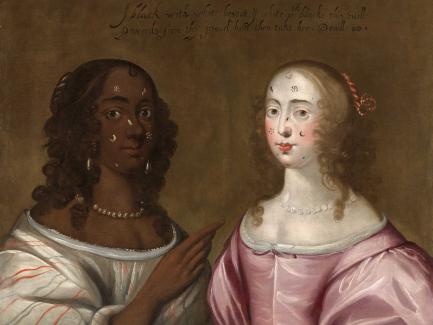
Unknown artist, Two Women Wearing Cosmetic Patches, ca. 1655, oil on canvas (Compton Verney Art Gallery and Park, Warwickshire, UK).
The YCBA, in partnership with Compton Verney, will host a symposium to increase understanding of the painting Two Women Wearing Cosmetic Patches. Topics include the painting’s provenance, attribution, and future display; the cloth trade in seventeenth-century England, Africa, and India; and evolving perceptions of beauty standards, including a keynote conversation focusing on cosmetic patches.
The middle decades of the seventeenth century in Britain were characterized by radical political, religious, and social change. In this period, an unknown artist created a remarkable painting that spoke to fears and anxieties crystallizing around a perceived increase in moral laxity, gender transgression, and the insidious influence of foreigners. The painting depicts two women side by side, each wearing a conspicuous array of beauty patches. The woman on the left reprimands her companion with the words “I black with white bespott: y[o]u white w[i]th blacke this Evill / proceeds from thy proud hart, then take her: Devill.” Text and image combine to inveigh against the sins of pride, vanity, and worldly excess. The painting reminds viewers that sinful behavior leads to the devil and exhorts them to seek salvation.
Compton Verney Art Gallery and Park in Warwickshire, England, has loaned the painting to the YCBA for conservation treatment and inclusion in the museum’s ongoing technical study of the theory and practice of painting skin tones. It will be on view at the Yale University Art Gallery from 20 August until 30 September 2024, before returning to Compton Verney. Registration for online and in-person attendance is recommended. For more information, please email jemma.field@yale.edu.
s c h e d u l e
9.20 Welcome by Jemma Field (Associate Director of Research, YCBA) and Oli McCall (Senior Curator, Compton Verney Art Gallery and Park)
9.30 Opening Talk
• A Painter for a Puritan Picture? — Edward Town (Assistant Curator of Paintings and Sculpture, YCBA)
This opening talk will provide an account of the recent history of the painting Two Women Wearing Cosmetic Patches and the research partnership between the YCBA and Compton Verney. It will present new findings about the painting’s early history and its attribution, set within the context of artistic production during the Interregnum.
9:50 Panel I | Women, Dress, and Morality
Chair: Elizabeth Cleland (Curator of European Paintings and Sculpture, Metropolitan Museum of Art)
This session will consider visual and textual ideals of female beauty and behavior in seventeenth-century England. Topics of discussion include the construction of ‘otherness’, the political and gendered value of clothing, and contemporary desires to increase control over women’s bodies and lives.
• Ad-dressing Conventions: Clothing, Gender, and Race in Two Women Wearing Cosmetic Patches — Jennifer Wu (Adjunct Professorial Lecturer, American University)
• Striped Cloth: Morality, Politics, and Gender in Interregnum England — Jemma Field (Associate Director of Research, YCBA)
• Beauty beyond Borders? English Perceptions of ‘Barbarous’ Beauty in the Seventeenth Century — Haijiao Wang (PhD student, University of Warwick)
11.05 Panel II | Bodies and Voices
Chair: Patricia Fumerton (Distinguished Professor, University of California, Santa Barbara)
This session interrogates female beauty standards, gender roles, and the concept of ‘otherness’. Drawing on an array of contemporary evidence—including emblems, anti-cosmetic polemics, travel narratives, pamphlets, and sermons—the speakers will look to further our understanding of the categories of desire, the racialization of beauty, and the development of national identities.
• ‘All your most excellent thoughts can desire’: The Transformation and Consumption of Bodies in Early Modern England — Todd Simmons (PhD student, Lehigh University)
• Body Language: Reading Text and Image in Two Women Wearing Cosmetic Patches — Jane Partner (Fellow and College Associate Professor, Trinity Hall, University of Cambridge)
• Patches, Paint, and Proto-Dermatology: The Moral Medicalization of Cosmetics in John Bulwer’s Anthropometamorphosis (1653) and John Gauden’s A Discourse of Auxiliary Beauty (1656) — Katherine Aske (Lecturer, Edinburgh Napier University)
12.20 Lunch break
2.00 Keynote Session | Cosmetics and Cultures of Beauty
Chair: Erin Griffey (Associate Professor, University of Auckland)
This keynote brings together experts on seventeenth-century beauty cultures to discuss the complexities of patching. The discussants will consider the performative aspects of the painting, including the dialogue between the subjects and the imagined viewer, as well as the overall image of adornment. Patching is then discussed from a variety of angles that include its material properties, cost, patterns of usage, and place in moral and social commentaries, to consider contemporary beauty ideals, how early moderns understood the skin, how they treated skin conditions, and how they read appearances as an index of character, physical health, and spiritual virtue.
• Jill Burke (Chair of Renaissance Visual and Material Cultures, University of Edinburgh)
• Evelyn Welch (Vice-Chancellor and President, University of Bristol)
3.30 Break
3.45 Closing Discussion | Exhibiting the Painting
Chair: Edward Town (Assistant Curator of Paintings and Sculpture, YCBA)
• Oli McCall (Senior Curator, Compton Verney Art Gallery and Park)
• Jane Simpkiss (Curator, Compton Verney Art Gallery and Park)
◊ ◊ ◊ ◊ ◊
Note (added 28 December 2024) — A recent press release notes the newly identified artist responsible for the painting: “Extensive research, including x-ray analysis,has concluded that the artist behind the painting is likely to be Father Jerome Hesketh (active 1647–1666). More than a dozen works by Hesketh feature in UK public collections today, such as Lyme Park, Sizergh Castle, and Moseley Old Hall. Comparisons between these and Two Women Wearing Cosmetic Patches offer compelling evidence they are by the same hand. . . .”










 Enfilade
leave a comment