Conference | Gothic (Revival) Spaces, 1750–1900

From John Britton, Graphical and Literary Illustration of Fonthill Abbey Wiltshire, with Heraldical and Genealogical Notices of the Beckford Family (1823).
◊ ◊ ◊ ◊ ◊
From ArtHist.net:
Gothic (Revival) Spaces: Concepts and Reinterpretation of British and Continental Domestic Architecture, 1750–1900
Würzburg, 14–16 November 2024
Organized by Daniela Roberts and Christina Clausen
Critical engagements with so-called Gothic spaces in fiction is arguably one of many intellectual explorations in the field of Gothic literature. These literary representations of space may emphasise the semiotic structure of fictional spaces in terms of plot, atmosphere and mood but they also reflect on characteristics and behavioural patterns of the narrative’s protagonists.
Until recently, however, less sustained scholarly attention has been paid to the relationship between Gothic architecture and Gothic literature and the architectural style of the Middle Ages as prototype of the Gothic Revival space. In the discipline of art history, on the other hand, a critical focus on Neo-Gothic architecture that highlights design, styles and architectural precursors inhabits a much more prominent role. And yet one could argue that scholarly enquiries into the complexity of spatial structures and effects including the re-contextualised Gothic forms and features as well as the social and performative functions of spaces, especially Gothic Revival interiors and furniture, are yet to emerge. With the conference Gothic (Revival) Spaces, we critically engage with the imaginary spaces in literature and the actually built or designed architectural spaces, since there’s little doubt that the evolution of the fictional and the tangible, material Gothic space is closely intertwined.
Organisation
• Daniela Roberts (daniela.roberts@uni-wuerzburg.de), Institut für Kunstgeschichte, Julius-Maximilians-Universität Würzburg
• Christina Clausen (clausen@kunst.tu-darmstadt.de), Fachgebiet Architektur- und Kunstgeschichte, Universität Darmstadt
t h u r s d a y , 1 4 n o v e m b e r
13.00 Arrival
13.30 Welcome and Introduction — Daniela Roberts (Julius-Maximilians-Universität Würzburg) and Christina Clausen (Technische Universität Darmstadt)
14.00 Opening Lecture
• Dale Townshend (Manchester Centre for Gothic Studies / Manchester Metropolitan University) — Towards a Poetics of Gothic Space
14.45 Break
15.15 Section 1 | Literary and Visual Fiction of Gothic Space
Chair: Daniela Roberts
• Antje Fehrmann (Freie Universität Berlin) — Fragmented Gaze versus Spatial Narrative: Horace Walpole and his Appropriation of Medieval Architecture
• Nicolas Marine (Universidad Politécnica de Madrid) — A Broad Mass of Existence: The House of the Seven Gables and the view from the Gothic House
• Maria Duran Marques (Universidade de Lisboa) — Gothic Fictions – Walpole’s Influences on Ferdinand II of Portugal and his Gothic Revival Projects in the Domestic Sphere
• Christina Clausen (Technische Universität Darmstadt) — Interactions between Pictorial Spaces in Painting and Neo-Gothic Interior Designs
f r i d a y , 1 5 n o v e m b e r
9.30 Section 2 | Constitution and Perception of Gothic Space
Chair: Antje Fehrmann
• Ute Engel (Martin-Luther-Universität Halle-Wittenberg) — The Chapel in the Woods and The Vyne: The Ambiguity of Gothic (Revival) Spaces
• Michal Lynn Shumate (Scuola IMT Alti Studi, Lucca) — Pointed Arches and Atmosphere: Cataloguing Roman Gothic
• Margarida Elias (Universidade Nova de Lisboa) — The Gothic Revival in Lisbon during the 19th Century
12.00 Lunch
14.00 Section 3 | Concepts of Historicisation and Authenticity as a Construction of Political Identity
Chair: Christina Clausen
• Meinrad von Engelberg (Technische Universität Darmstadt) — Von Laxenburg nach Stolzenfels: Die politische Bedeutung der deutschen Neugotik
• Mélina Collin (Université Paul-Valéry Montpellier 3) — American Gothic: Andrew Jackson Downing and the Democratisation of the Gothic Revival Style in the United States
• Dominik Müller (ETH Zürich) — Pyramids, Hexagons, and Pinnacles: Batalha’s Influence
• Madalena Costa Lima (Universidade de Lisboa) — Concepts of Gothic: Judgements and Sensibilities towards a Not Yet Defined Style in the Long 18th Century
17.30 Break
18.00 Keynote Lecture
• Peter Lindfield (Welsh School of Architecture, Cardiff University) — Creating Multi-layered Gothic (Revival) Spaces in 18th- and 19th-Century Britain: The Fashionable and Eccentric
s a t u r d a y , 1 6 n o v e m b e r
9.30 Section 4 | Neo-Gothic Interior in the Context of Stylistic Pluralism
Chair: Michal Lynn Shumate
• Matthew Winterbottom (Ashmolean Museum, Oxford) — Furnishing Gothic Revival Space
• Tommaso Zerbi (Deutsches Historisches Institut in Rom) — Tracing Empire and Domestic Gothic in the Eternal City (online)
• Katrin Kaufmann (Vitrocentre Romont) — Light and Colour in the Gothic Revival: Stained Glass as a Constitutive Element of Neo-Gothic Interior Design
• Ole W. Fischer (Staatliche Akademie der Bildenden Künste, Stuttgart) — Learning from Morris? From Red House to Bloemenwerf: Henry van de Velde and the Invention of L’Art Nouveau from the Spirit of Gothic
13.00 Closing Discussion
Call for Papers | Sex and Art
From ArtHist.net:
What Is Sex? Special Issue of Frame[less] Magazin
Proposals due by 8 December 2024
In der Kunstgeschichte ist Sexualität seit jeher ein facettenreiches und kontroverses Thema, das sich sowohl in subtilen Andeutungen als auch in expliziten Darstellungen widerspiegelt und eine breite Spannweite an Imagination und Interpretation bietet.
Klassische Darstellungen wie Tizians Zeus und Danae oder Berninis Apoll und Daphne zeigen, wie sexuelle Themen in mythologischen Kontexten verarbeitet wurden und bieten, wie die Erzählung der unbefleckten Empfängnis, die ikonografisch besonders in religiösen Darstellungen verankert ist, reiches Material für eine kritische Auseinandersetzung.
Auch Stillleben beinhalten oft subtile Anspielungen auf Erotik und Sexualität, erzählen von verborgenen Begehren und reflektieren das Verhältnis von künstlerischer Darstellung und gesellschaftlichen Normen, das sich weniger offensichtlich auch in den Werken Fragonards widerspiegelt.
Wie haben sich diese Erzählungen über die Jahrhunderte verändert und welche Bedeutung haben sie noch heute?
Die Enttabuisierung sexueller Themen in der Kunst, insbesondere seit den 1960er Jahren, bietet Ansatzpunkte für die Betrachtung, wie Künstler*innen den Diskurs über Sexualität und Feminismus revolutioniert haben und welche Tabus heute noch herausgefordert werden.
Gender, Diversität und LGBTQ+-Themen sind von zentraler Bedeutung, wenn es um die Frage geht, wie Kunst die Komplexität sexueller Identitäten und Vielfalt sichtbar macht und reflektiert.
Künstlerinnen wie Sarah Lucas und Nan Goldin setzen sich in ihren Arbeiten explizit mit der Darstellung von Geschlechtsteilen und sexuellen Handlungen auseinander. Auch im Performativen findet sich diese Auseinandersetzung mit Sexualität—wie zuletzt in Florentina Holzingers Opernperformance Sancta, die weltweit Schlagzeilen machte. Direkte Konfrontation—erotische Fotografie—künstlerisch inspirierte Form der Pornografie: Welche Grenzen werden zwischen Kunst und Konsum gezogen und wie fungiert der Körper dabei als Medium?
Im digitalen Zeitalter erweitert sich dieser Diskurs um neue Dimensionen: Cybererotik und die Erforschung von Körperlichkeit im Virtuellen schaffen innovative Formen der Sexualität, die physische Grenzen verschwimmen lassen und den erotischen Ausdruck in bisher unerforschte digitale Räume verlagern. So entstehen neuartige Verbindungen zwischen Körper, Sexualität und Technologie, die den Umgang mit Intimität auf radikal neue Weise gestalten.
Nach Foucault ist Sex Macht und das Bild Verhandlungsebene zwischen Gesagtem und Gesehenen. Doch welche Rolle spielt Kunst in der Auseinandersetzung mit problematischen Machtverhältnissen, mit Missbrauch und Übergriffen? Kann Kunst wirklich aufklären und ist Sex in all seinen Facetten und sozialen Implikationen überhaupt darstellbar?
frame[less]—das digitale Magazin für Kunst in Theorie und Praxis ist auf der Suche nach euren Beiträgen. Für das Issue #8 schreiben wir den Open Call zum Thema SEX aus. Die Form wird den Beitragenden freigestellt. Wir freuen uns über vielfältige Formate wie theoretische, kritische und wissenschaftliche Annäherungen an das Thema, genauso wie praktische, projektbezogene Beiträge. Ebenso heißen wir interdisziplinäre und hybride Formen willkommen. Es gibt keine formalen und personenbezogenen Kriterien für die Auswahl der Beiträge. Einzig die Qualität der Abstracts und Proposals entscheidet.
Wir ermöglichen einen interdisziplinären Diskurs im Bereich Kunst, wobei wir einen offenen Kunstbegriff propagieren, der unter anderem Disziplinen wie Architektur und Design mit einbezieht. Besonders Menschen, die sich als FLINTA definieren und beziehungsweise oder BIPoC möchten wir ermutigen, sich zu bewerben.
Sende uns dein Abstract oder Projektvorhaben (maximal eine Seite) zu, in dem du kurz deine Idee beschreibst. Bis zum 08.12.2024 hast du Zeit, dich unter redaktion@framelessmagazin.de zu bewerben. Wir geben dir dann schnellstmöglich eine Rückmeldung (ca. eine Woche) und informieren dich über alle weiteren Vorgänge.
frame[less] ist ein digitales Magazin für Kunst in Theorie und Praxis. frame[less] ist ein unabhängiges und nicht kommerzielles Online- Magazin, das Studierenden, Wissenschaftler:innen sowie Künstler:innen eine Plattform bietet, wissenschaftliche Beiträge, Essays, Kritiken, Kommentare, künstlerische Arbeiten und weitere Formen zu veröffentlichen.
New Book | Fierce Desires
From Norton:
Rebecca Davis, Fierce Desires: A New History of Sex and Sexuality in America (New York: W. W. Norton & Company, 2024), 480 pages, ISBN: 978-1631496578, $35.

From an esteemed scholar, a richly textured, authoritative history of sex and sexuality in America—the first major account in three decades.
Our era is one of sexual upheaval. Roe v. Wade was overturned in the summer of 2022, school systems across the country are banning books with LGBTQ+ themes, and the notion of a ‘tradwife’ is gaining adherents on the right while polyamory wins converts on the left. It may seem as though debates over sex are more intense than ever, but as acclaimed historian Rebecca L. Davis demonstrates in Fierce Desires, we should not be too surprised, because Americans have been arguing over which kinds of sex are ‘acceptable’—and which are not—since before the founding itself.
From the public floggings of fornicators in early New England to passionate same-sex love affairs in the 1800s and the crackdown on abortion providers in the 1870s, and from the movements for sexual liberation to the recent restrictions on access to gender affirming care, Davis presents a sweeping, engrossing, illuminating four-hundred-year account of this nation’s sexual past. Drawing on a wealth of sources, including legal records, erotica, and eighteenth-century romance novels, she recasts important episodes—Anthony Comstock’s crusade against smut among them—and, at the same time, unearths stories of little-remembered pioneers and iconoclasts, such as an indentured servant in colonial Virginia named Thomas/Thomasine Hall, Gay Liberation Front cofounder Kiyoshi Kuromiya, and postwar female pleasure activist Betty Dodson.
At the heart of the book is Davis’s argument that the concept of sexual identity is relatively novel, first appearing in the nineteenth century. Over the centuries, Americans have shifted from understanding sexual behaviors as reflections of personal preferences or values, such as those rooted in faith or culture, to defining sexuality as an essential part of what makes a person who they are. And at every step, legislators, police, activists, and bureaucrats attempted to regulate new sexual behaviors, transforming government in the process. The most comprehensive account of America’s sexual past since John D’Emilio and Estelle Freedman’s 1988 classic, Intimate Matters, Davis’s magisterial work seeks to help us understand the turmoil of the present. It demonstrates how fiercely we have always valued our desires, and how far we are willing to go to defend them.
Rebecca L. Davis is professor of history at the University of Delaware and author of Public Confessions: The Religious Conversions That Changed American Politics and More Perfect Unions: The American Search for Marital Bliss. She lives in Swarthmore, Pennsylvania.
New Book | Lower than the Angels
From Penguin Random House in the UK, with publication forthcoming (2025) in the US:
Diarmaid MacCulloch, Lower than the Angels: A History of Sex and Christianity (London: Allen Lane, 2024), 688 pages, ISBN: 978-0241400937, £35 / $40.
 The Bible observes that God made humanity “for a while a little lower than the angels.” If humans are that close to angels, does the difference lie in human sexuality and what we do with it? Much of the political contention and division in societies across the world centres on sexual topics, and one-third of the global population is Christian in background or outlook. In a single lifetime, Christianity or historically Christian societies have witnessed one of the most extraordinary about-turns in attitudes to sex and gender in human history. There have followed revolutions in the place of women in society, a new place for same-sex love amid the spectrum of human emotions and a public exploration of gender and trans identity. For many the new situation has brought exciting liberation—for others, fury and fear.
This book seeks to calm fears and encourage understanding through telling a 3000-year-long tale of Christians encountering sex, gender, and the family, with noises off from their sacred texts. The message of Lower than the Angels is simple, necessary and timely: to pay attention to the sheer glorious complexity and contradictions in the history of Christianity. The reader can decide from the story told here whether there is a single Christian theology of sex, or many contending voices in a symphony that is not at all complete. Oxford’s Emeritus Professor of the History of the Church introduces an epic of ordinary and extraordinary Christians trying to make sense of themselves and of humanity’s deepest desires, fears, and hopes.
Diarmaid MacCulloch is a fellow of both St Cross College and Campion Hall, Oxford, and emeritus professor of the history of the church at Oxford University. His books include Thomas Cranmer: A Life, which won the Whitbread Biography Prize, the James Tait Black Prize, and the Duff Cooper Prize, and Christianity: The First Three Thousand Years, a New York Times bestseller that won the Cundill Prize in History. He has presented many highly celebrated documentaries for television and radio and was knighted in 2012 for his services to scholarship. He is an ordained deacon of the Church of England. He lives in Oxford.
Call for Papers | Religion, Ancestry, and Identity
From ArtHist.net:
Religion, Ancestry, and Identity: On the Relationship between Theology, Genealogy, and Heraldry in the Early Modern Period
Warburg-Haus, Hamburg, 3–4 April 2025
Proposals due by 13 December 2024
In early modernity, genealogy was a topic of major religious and theological relevance. During the Reformation, genealogical thinking helped to shape new confessional identities, significantly influencing perceptions of family and kinship. References to ancestry served to illustrate religious continuities and the transmission of the ‘true’ faith across generations. Thus, genealogy not only contributed to establishing religious authority, but also shaped confessional identities and served as a tool for resolving theological issues. This interdisciplinary conference proposes to discuss the various interconnections between questions of origin or ancestry and confessional contexts.
The conference takes as its starting point the seemingly surprising observation that numerous theologians were simultaneously active in the fields of genealogy or heraldry. On the Protestant side, Cyriacus Spangenberg (1528–1604), Philipp Jakob Spener (1635–1705), and Johann Ulrich Pregitzer IV (1673–1730) can serve as examples. On the Catholic side, the pronounced engagement of Jesuits in genealogy and heraldry is particularly striking, with Philibert Monet (1566–1643) and Claude-Francois Menestrier (1631–1705) being prominent examples in France.
This phenomenon can be explained through the numerous intersections between the fields of genealogy, heraldry, and theology. Genealogical and heraldic practices served theologians as tools for addressing theological issues, such as resolving the conflicting genealogies of Jesus in the Gospels of Matthew and Luke. Additionally, the merging of secular and sacred fields of knowledge generated iconographic innovations for illustrating and conveying these topics, for instance in the form of printed family trees, which differed from earlier representations. In heraldic literature, there was cross-confessional discussion up until the seventeenth century about the extent to which the origins of coats of arms could be traced back to the 12 tribes of Israel or even to Adam. Christian symbols, such as depictions of saints, were widely used in early modern city coats of arms—a tradition whose traces can still be seen today. At the same time, Jesuits were particularly active in princely genealogy and heraldry. Their studies were initially connected to the education of young nobles in these subjects at their colleges, but they also resulted in extensive heraldic and genealogical compendia.
At least on the Protestant side, theologians engaged in genealogical and heraldic activities often faced pressure to justify their work. Contemporary criticism of genealogical and heraldic studies as vanity or a waste of time must be understood within the context of a broader moral-theological debate about the Christian valuation of family, ancestry, and birth. A central reference point in this debate was Paul’s (seemingly) critical view of the genealogies of ancient Judaism (1 Timothy 1:4 and especially Titus 3:9), around which an antiquarian-theological dispute unfolded in the sixteenth and seventeenth centuries. The influence of this criticism can be traced from Spangenberg to Spener.
While there has been some initial research into the complex and sometimes tense relationship between genealogy, heraldry, and theology during the early modern period, the majority of the field remains largely unexplored. This is especially true regarding Christian discourses on genealogy and heraldry, the use of theological arguments in both fields, and changing perspectives on the family as a result of the Reformation, as well as possible confessional differences regarding these topics. The aim of the conference is to illuminate and discuss the early modern relationship between religion and ancestry in an interdisciplinary way.
Possible topics include:
1 What confessional differences can be identified in the use and discussion of genealogical concepts? How did genealogical concepts help to support or clarify biblical/confessional narratives? To what extent do genealogy and heraldry, as secular fields of knowledge, offer a ‘common ground’ for understanding between different confessions?
2 What media and narrative forms of expressing ancestry can be identified in religious contexts? What temporal and confessional developments can be observed?
3 In what ways and contexts were theological concepts and arguments applied and incorporated in genealogy and heraldry? To what extent did these applications vary according to region or confession within Christianity? What specific theological challenges could be addressed through genealogical and heraldic approaches?
4 How did the contemporary moral pressure to justify their work affect theologians who engaged with genealogy and heraldry? Can confessional differences in these debates be identified? To what extent did societal expectations and norms influence theologians’ approaches to genealogical and heraldic studies? Are there specific examples of conflicts between the outcomes of their research and the doctrinal mandates of the church? What strategies did theologians develop to deal with this pressure and present their research as morally justifiable?
5 How do genealogy and heraldry integrate into the biographies of theological scholars? What motivated theologians to engage in these studies? Was it a matter of personal interest, an exploration of their own family history, a didactic endeavour (for instance, as tutors to princes), or a serious alternative career option?
Contributions from cultural and literary studies, history, art history, and theology are warmly invited. If interested, please send a (working) title and a brief abstract by 13 December 2024, to Kai.Hendrik.Schwahn@uni-hamburg.de.
New Book | Augustus the Strong
From Penguin Random House:
Tim Blanning, Augustus the Strong: A Study in Artistic Greatness and Political Fiasco (London: Allen Lane, 2024), 432 pages, ISBN: 978-0241705148, £30.
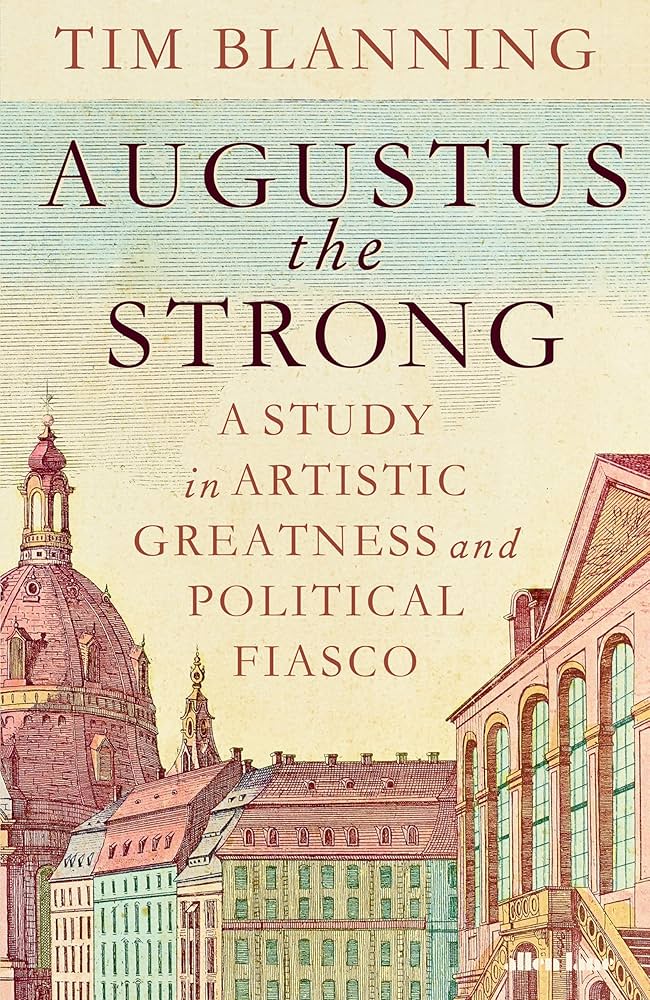 From the acclaimed author of The Pursuit of Glory and Frederick the Great, a riotous biography of the charismatic ruler of 18th-century Poland and Saxony—and his catastrophic reign.
Augustus is one of the great what-ifs of the 18th century. He could have turned the accident of ruling two major realms into the basis for a powerful European state—a bulwark against the Russians and a block on Prussian expansion. Alas, there was no opportunity Augustus did not waste and no decision he did not get wrong. By the time of his death Poland was fatally damaged and would subsequently disappear as an independent state until the 20th century. Tim Blanning’s wonderfully entertaining and original new book is a study in failed statecraft, showing how a ruler can shape history as much by incompetence as brilliance. Augustus’s posthumous sobriquet ‘The Strong’ referred not to any political accomplishment, but to his legendary physical strength and sexual athleticism. Yet he was also one of the great creative artists of the age, combining driving energy, exquisite taste, and apparently boundless resources to master-mind the creation of peerless Dresden, the baroque jewel of jewels. Augustus the Strong brilliantly evokes this time of opulence and excess, decadence, and folly.
Until age-dictated retirement in 2009, Tim Blanning was Professor of Modern History at the University of Cambridge. He remains a Fellow of Sidney Sussex College, Cambridge, and has been a Fellow of the British Academy since 1990. His major works include The French Revolution in Germany, The French Revolutionary Wars, The Power of Culture and the Culture of Power, The Pursuit of Glory: Europe 1648–1815, and The Triumph of Music. He has written biographies of Joseph II, Frederick the Great, and George I.
Exhibition | Furniture by Jean-Pierre Latz at the Dresden Court
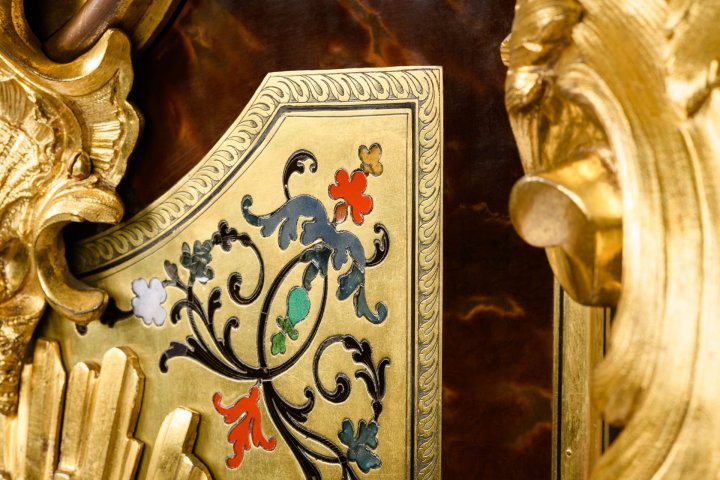
Pedestal detail, signed and dated: Jean-Pierre Latz, Paris, 1739 (Dresden, Inv. No. 37616-2).
◊ ◊ ◊ ◊ ◊
Now on view in Dresden:
Made in Paris: Furniture Creations by Jean-Pierre Latz at the Dresden Court
Fait à Paris: Die Kunstmöbel des Jean-Pierre Latz am Dresdner Hof
Royal Palace, Dresden, 19 October 2024 — 2 February 2025
In the impressive staterooms of the Dresden Residenzschloss (Royal Palace) the collection of Latz furniture shall be presented for the first time in its full extent at the special exhibition of the Kunstgewerbemuseum (Museum of Decorative Arts). This exhibition is the conclusion of the twelve years of comprehensive research and conservation project that the furniture has undergone.

Pendulum clock on pedestal, attributed to Jean-Pierre Latz, Paris, ca. 1739 (Dresden, Inv. No. 37679-1).
The Museum of Decorative Arts Dresden holds the largest and most important collection worldwide of magnificent furniture of the renowned Parisian cabinetmaker Jean-Pierre Latz (1691–1754). The collection contains approximately twenty object ensembles, consisting of thirty individual items. They demonstrate with striking effect the magnificence and representation at the Polish-Saxon court of King Augustus III (1696–1763) and of his prime minister, Count von Brühl (1700–1763).
The Second World War and its aftermath deeply affected the furniture collection of the museum when, apart from destruction, it suffered damages caused by evacuation and transportation. For many years, the necessary conservation and restorations could not be achieved because of a lack of resources; the furniture had to be put into storage and thus lapsed into oblivion. That is until now! For the first time since their wartime storage, eighty years ago, and after years of careful and thoughtful conservation and restoration, the highly important Dresden Latz collection will be shown in the splendour of the staterooms—the very stage where they once enhanced the representation of the Saxon monarchs.
Born in the Electorate of Cologne, an ecclesiastical principality of the Holy Roman Empire, Jean-Pierre Latz followed in the footsteps of many German cabinetmakers and went to Paris in 1719. Latz´s works are striking for a very distinct individual artistic signature and boast opulent, sculpturally conceived corpus forms, technically superb craftsmanship and great sculptural skill in the fashioning of bronze mounts, as well as consummate marquetry work. These high-quality technical aspects were combined in designs that reflect the exquisite taste of the royal and aristocratic customers and patrons in France and abroad. Impressive, elegant and playful as well, his furniture combines mythological themes from the antiquity with their symbolic connotations of the 18th century: monumental, playful and superb, they impressed with their costly materials. Sought after by the royalty in France and abroad, Latz´s furniture is among others still to be found in the former palaces of Augustus III (King of Poland & Elector of Saxony), Frederick the Great (King of Prussia; 1712–1786) and the presidential Quirinal Palace in Rome—originating from the former royal court in Parma.
Important loans from the former royal palaces in Potsdam and from the Palazzo Quirinale in Rom, combined with the splendid collection of Latz furniture of the State Art Collections Dresden, will enable us to present an unprecedented and probably one-time concerted show of outstanding masterpieces by Jean-Pierre Latz. The exhibition will be completed withhighlights from the State Art Collections to throw light on the official representation and demonstration of power at the Saxon Court through the vehicle of French luxury products.
Old artisanship always brings up fascinating issues for today´s museum public: how many different materials and techniques come together as a unity in Latz´s creations? The exhibition will use computer techniques to show how the furniture as a work of art can be digitally disassembled directly before the visitor´s very eyes, so that all its secrets can be penetrated and understood.
New Book | Scottish Furniture, 1500–1914
From National Museums Scotland:
Stephen Jackson, Scottish Furniture, 1500–1914 (Edinburgh: NMSE Publishing, 2024), 272 pages, ISBN: 978-1910682487, £40.
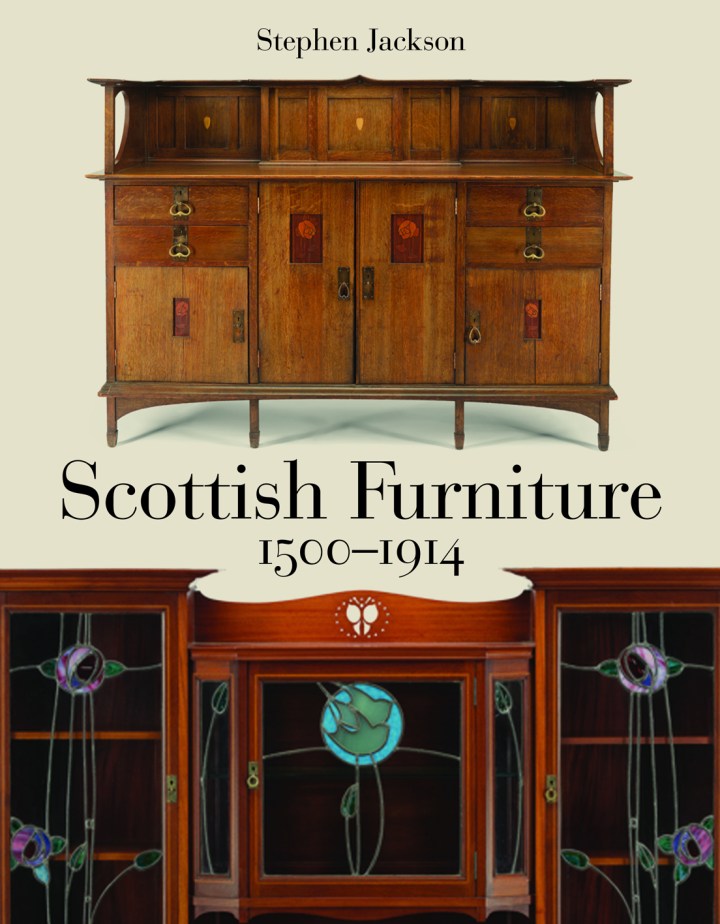 Scotland’s furniture evolved against a background of social and cultural change that included religious reformation, civil war, union with England, and participation in rapidly expanding commercial empire. The contribution of the country’s finest workshops has been overlooked in general histories of British furniture and sever decades of scholarly research is represented here to a wider public for the first time. From the beguiling and fragmentary woodwork of the sixteenth century to the blossoming of new art movements in the years around 1900, Scottish Furniture explores a form of material culture that was central to both everyday life and the expression of status and identity. The careers of prominent cabinet-makers such as Francis Brodie and William Trotter are explored in depth, while over sixty others from all regions of the country are represented among the 340 illustrations. Well-known designers such as Charles Rennie Mackintosh are considered alongside the firms which made their furniture.
Stephen Jackson is Senior Curator, Furniture and Woodwork at National Museums Scotland.
Online Course | British Furniture Abroad in the 18th Century
From British and Irish Furniture Makers Online and The Furniture History Society:
British Furniture Abroad in the Eighteenth Century: Impacts and Influence
BIFMO-FHS Online Autumn Course: 12, 19, and 26 November 2024

Side chair, attributed to Benjamin Randolph, possibly carved by Hercules Courtenay, ca. 1769 (New York: The Metropolitan Museum of Art, 1974.325).
Join us online on three consecutive Tuesdays this November, when curators and historians will explore the influence of British furniture abroad and the ways furniture makers in other countries both copied and transformed these models to suit local traditions and tastes. This series of specialist lectures will look at the diaspora of British furniture in the eighteenth century, providing insights into the traditions of design and furniture making in other countries. Each session will deal with a slightly different stylistic phase in the eighteenth century with three expert speakers dealing with the impact of British furniture design on different countries.
Tickets may be purchased for individual sessions or for the entire course, but you will benefit from a discount if all three sessions are bought together. Don’t worry if you cannot attend the sessions live because they will be recorded and links to the recording will be sent to ticketholders. These recordings will not be available to purchase after the course has ended. FHS members and ECD members will receive a discount on all tickets. For further information and to purchase tickets, please go to the Eventbrite listing. If you have any questions, please email bifmo@furniturehistorysociety.org.
Times each week: 5.30–8pm (GMT) / 12.30–3pm (EST)
Week 1 | Tuesday, 12 November
British Furniture Abroad in the Early Eighteenth Century
• Amy Lim — Daniel Marot and the Influence of His Design
• Henriette Graf — Furniture Design in Germany, 1700–1760
• Alyce Englund — The Influence of Chippendale’s Designs in the Americas
Week 2 | Tuesday, 19 November
British Furniture in Germany, Portugal, and Spain
• Wolfram Koeppe — Abraham and David Roentgen: The Chippendale Connection
• João Magalhães — Portugal and English Furniture
• Mario Mateos Martín — English Influences in Spain: The Royal Collections as a Case Study
Week 3 | Tuesday, 26 November
The Influence of British Furniture in Germany and Italy
• Enrico Colle — British Models for Italian Craftsmen during the Eighteenth Century
• Ulrich Leben — Molitor and English Design
• Daniel Ackermann — Title forthcoming
Call for Papers | Irish Heritage Studies, Volume 2
From Ireland’s Office of Public Works:
Irish Heritage Studies, Volume 2
Proposals due by 1 December 2024
Irish Heritage Studies is the new annual research journal of the Office of Public Works in Ireland, published in association with Gandon Editions. Volume one will be published next spring, and we’re currently inviting abstracts for volume two. The deadline is 1 December 2024.
The journal showcases original critical research rooted in the substantial portfolio of material culture in the care of or managed by the OPW: built heritage; historic, artistic, literary, and scientific collections; the national and international histories associated with these places and objects; and its own long organisational history. Papers contribute to a deeper understanding of this important collection of national heritage, and investigate new perspectives on aspects of its history. The journal is designed for a broad public, specialist, and professional readership. Full details on the journal are available here; and enquires are welcome at IHSjournal@opw.ie.










 Enfilade
leave a comment