Conference | Unfolding the Coromandel Screen
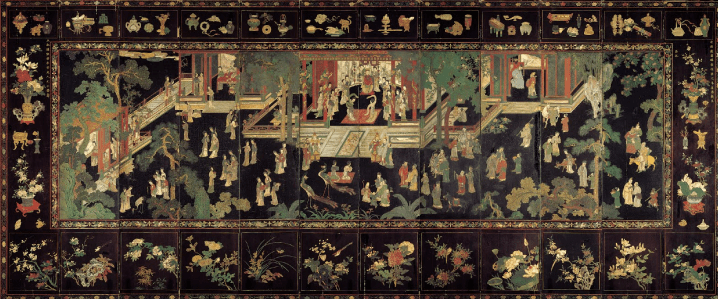
Coromandel Screen, Kangxi reign (1662–1722), Qing dynasty, carved lacquer, 258 × 52 × 3.5 cm
(Art Museum, The Chinese University of Hong Kong, 2001.0660)
◊ ◊ ◊ ◊ ◊
From the conference website and programme:
Unfolding the Coromandel Screen: Visual Mobility, Inscribed Objecthood, and Global Lives
Online and in-person, City University of Hong Kong, 22–23 November 2024
Organized by by Lianming Wang and Mei Mei Rado
During the second half of the seventeenth century, the production of Coromandel screens, also known as kuancai (‘carved polychrome’), flourished along China’s southeast coast. These screens became immensely popular both domestically and in European markets, establishing connections between regional artisans, merchants, and prominent European figures, including royalty and nobility. In the last two decades of this century, Coromandel screens emerged as one of China’s most frequently exported commodities, rivaling porcelain and challenging Japanese lacquerware exports. Their significance extends far beyond the common perception of them as merely mass-produced craftwork of inferior quality.
 With the generous support of the Bei Shan Tang Foundation, the Department of Chinese and History at City University of Hong Kong will host a two-part academic event titled Unfolding the Coromandel Screen to celebrate the department’s tenth anniversary. The conference, organized by Lianming Wang (City University of Hong Kong) in collaboration with Mei Mei Rado (Bard Graduate Center, New York), will take place on-site at City University of Hong Kong and via Zoom from 22 to 23 November 2024. It will bring together an international group of art historians, museum curators, conservators, collectors, and global historians. Participants will explore various aspects of the Coromandel screen and its intricate histories, including its interrelations with paintings, prints, decorative arts, palatial and interior designs, global maritime trade, and the fashion industry. Following the conference, the speakers will join a two-day traveling seminar from 24 to 25 November, visiting lacquer and conservation workshops as well as museum collections in Hong Kong and Guangzhou.
Registration for both onsite and online participation is available here»
Advisory Board
May Bo Ching (City University of Hong Kong), Burglind Jungmann (UCLA), Mei Mei Rado (Bard Graduate Center, New York), Anton Schweizer (Kyushu University), Ching-Fei Shih (National Taiwan University), Lianming Wang (City University of Hong Kong), Xiaodong Xu (†) (Art Museum of The Chinese University of Hong Kong)
Supporting Institutions
Art Museum of The Chinese University of Hong Kong, Indra and Harry Banga Gallery of City University of Hong Kong , Hong Kong Maritime Museum, Lee Shau Kee Library of The Hong Kong University of Science and Technology, Guangdong Provincial Museum, Guangzhou Museum, Chen Clan Ancestral Hall – Guangdong Folk Arts Museum
f r i d a y , 2 2 n o v e m b e r
8.30 Registration
9.00 Welcome and Introduction
• May Bo Ching (City University of Hong Kong), Lianming Wang (City University of Hong Kong), and Mei Mei Rado (Bard Graduate Center, New York)
9.15 Keynote
• Transcultural Treasures: Kuancai (Coromandel) Screens in China and Abroad — Jan Stuart (National Museum of Asian Art, Washington DC)
10.00 Coffee break
10.15 Panel 1 | Coromandel Screens as Sites of Power Representation
Chair: Libby Chan (Indra and Harry Banga Gallery, City University of Hong Kong)
• Place, Scale, and Medium in Several Cartographic Coromandel Screens — Stephen Whiteman (The Courtauld Institute of Art, London)
• Picture of the Immense Sea: Temporal and Spatial Transformation on the Birthday Celebration Screen of
Nan’ao (in Chinese with English subtitles) — Weiqi Guo (Guangzhou Academy of Fine Arts)
11.15 Panel 2 | Coromandel Screens and Intra-Asian Visual Entanglements
Chair: Wan Chui Ki Maggie (The Chinese University of Hong Kong)
• Coromandel Screens and Japanese Seminary Painters in Macau — Yoshie Kojima (Waseda University, Tokyo)
• When the Barbarians Came by Sea: Hunting Screens in China and Japan — Lianming Wang (City University of Hong Kong)
• Transcultural Pictorial Dynamics: Coromandel Screens and Joseon Court Painting and Visual Culture — Yoonjung Seo (Myongji University, Seoul)
12.40 Lunch break
14.00 Panel 3 | Format, Motif, and Technique: Understanding Coromandel Screens
Chair: Daisy Wang (Hong Kong Palace Museum)
• A Screen So Grand: Coromandel Screens from the Perspective of Scale — Tingting Xu (University of Rochester, New York)
• Decoding Frames: Unveiling Names, Provenance, and Connections of the Framed Images on the ‘Dutch
Tribute Screen’ in the National Museum of Denmark, Copenhagen — Xialing Liu (Central Academy of Fine Arts, Beijing / Utrecht University)
• Textiles, Taste, and Templates: Kuancai Screen Motifs and Techniques — Ricarda Brosch (Museum am Rothenbaum – World Culture and Arts, Hamburg)
• Copy Culture and Commodification in Coromandel Screens and Related Lacquerwares, 1680–1780 — Tamara Bentley (Colorado College)
15.40 Coffee Break
16.00 Panel 4 | Materials and Conservation: Perspectives from Labs and Workshops
Chair: Josh Yiu (Art Museum, The Chinese University of Hong Kong)
• On the Origins and Regional Differences of the Kuancai Screens (in Chinese with English subtitles) — Bei Chang (Southeast University, Nanjing) and Linlong Li (Centre de recherche sur les civilisations de l’Asie orientale, Paris)
• A Conservator’s Perspective: Technical Examination and Treatment Strategies for Coromandel Lacquer from the Kangxi Period — Christina Hagelskamp (The Metropolitan Museum of Art, New York)
• Scientific Analysis of a Coromandel Cabinet from the Victoria and Albert Museum, London — Julie Chang (Fu Jen Catholic University, Taipei) and Lucia Burgio (Victoria and Albert Museum, London)
18.00 Museum Visit — Might and Magnificence: Ceremonial Arms and Armour across Cultures,
Indra and Harry Banga Gallery, City University of Hong Kong
19.00 Dinner
s a t u r d a y , 2 3 n o v e m b e r
9.15 Keynote
• The Taste for Coromandel Lacquer in France in the 17th and 18th Centuries: Trade, Reception, and Customs — Stéphane Castelluccio (CNRS, Centre André Chastel, Paris)
10.00 Coffee Break
10.30 Panel 5 | Coromandel Screens as Global Artefacts
Chair: Phil Kwun-nam Chan (Art Museum, The Chinese University of Hong Kong)
• On the ‘Exoticness’ of the Coromandel Lacquerware — Ching-Ling Wang (Rijksmuseum Amsterdam)
• Coastal Landscape and Scenes of Europeans on Coromandel Folding Screens — Rui Oliveira Lopes (Museu das Convergências, Porto)
• Differences and Commonalities: Links between 17th- and 18th-Century Coromandel Export Lacquer Pieces and Luso-Asian Lacquers of the Previous Century — Ulrike Körber (IHA/FCSH//IN2PAST – Universidade Nova de Lisboa)
12.00 Lunch break
13.30 Panel 6 | Coromandel Screens and Their Global Lives, Part One
Chair: Nicole Chiang (Hong Kong Palace Museum)
• Beyond the Closet: The Taste for Coromandel Lacquerware Furniture in Holland and England, ca. 1675–1700 — Alexander Dencher (Rijksmuseum Amsterdam)
• ‘Sawed, Divided, Cut, Clift, and Split Asunder’? A Case Study of a European Chest of Drawers Decorated with Excerpts from a Coromandel Screen of Known Pictorial Model — Grace Chuang (Independent Scholar, Detroit)
• Reframing the West Lake in French Furniture and Interiors — Nicole Brugier (Ateliers Brugier, Paris)
14.30 Coffee Break
14.45 Panel 7 | Coromandel Screens and Their Global Lives, Part Two
Chair: Florian Knothe (University Museum and Art Gallery, The University of Hong Kong)
• The ‘Japanese Cabinet’ at the Hermitage in Bayreuth, Germany — Patricia Frick (Museum für Lackkunst, Münster)
• The Ludic Afterlife of Coromandel Screens: Integrating the Swinging Woman into 18th-Century French Interiors — Weixun Qu (Washington University in St. Louis)
16.00 Short Break
16.15 Panel 8 | The Afterlives of the Coromandel Screens
Chair: May Bo Ching (City University of Hong Kong)
• Art Dealer Florine Langweil and the European Market for Coromandel Screens in the Early 20th Century — Elizabeth Emery (Montclair State University, New Jersey)
• Inspiring Art Deco in Britain: The Architect, the Theatre, and the Coromandel Screen — Helen Glaister (Victoria and Albert Museum, London)
• Shifting Identities and Global Circulation of the Coromandel Screen in Early-20th-Century Buenos Aires — Mariana Zegianini (SOAS University of London)
• The Framework of Modernism: Lacquer Screen and Fashion Imagination in the 1920s — Mei Mei Rado (Bard Graduate Center, New York)










 Enfilade
leave a comment