Exhibition | Stan Douglas: The Enemy of All Mankind
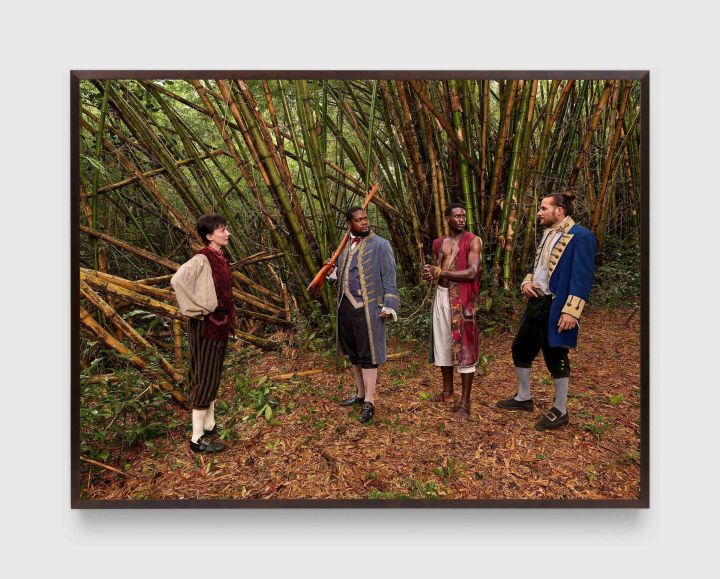
Stan Douglas, Act II, Scene XII: In which Polly Convinces Pirates Laguerre and Capstern to Release their Captive, Prince Cawwawkee, for a Prize Rather than go to War Against His People with Morano, 2024, inkjet print mounted on Dibond aluminum, 150 × 200 cm, edition of 5.
◊ ◊ ◊ ◊ ◊
From the press release for the show, which was covered by Walker Mimms for The New York Times (17 October 2024). . .
Stan Douglas | The Enemy of All Mankind: Nine Scenes from John Gay’s Polly
David Zwirner, New York, 12 September — 26 October 2024
David Zwirner is pleased to announce an exhibition by Stan Douglas, on view at the gallery’s 525 West 19th Street location in New York. Featuring a new photographic series, The Enemy of All Mankind: Nine Scenes from John Gay’s Polly, this will be the artist’s eighteenth solo exhibition with the gallery. In this stand-alone group of nine images, Douglas stages scenes from the eighteenth-century comic opera Polly, written by English dramatist John Gay (1685–1732), using the narrative as a vehicle through which to engage a wide range of themes that remain highly relevant today, including race, class, gender, and media. One work from the series debuted in David Zwirner: 30 Years, on view in summer 2024 in Los Angeles, and this will mark the first presentation of the body of work in its entirety.
Since the 1980s, Douglas has created films, photographs, and other multidisciplinary projects that investigate the parameters of their respective mediums. His ongoing inquiry into technology’s role in image making, and how those mediations infiltrate and shape collective memory, has resulted in works that are at once specific in their historical and cultural references and broadly accessible. Since the beginning of his career, photography has been a central focus of Douglas’s practice, used at first as a means of preparing for his films and eventually as a powerful pictorial tool in its own right. The artist is influenced in particular by media theorist Vilém Flusser’s notion of the photographic image as an encoded language that is determined by a specific set of technological, social, cultural, and political circumstances.
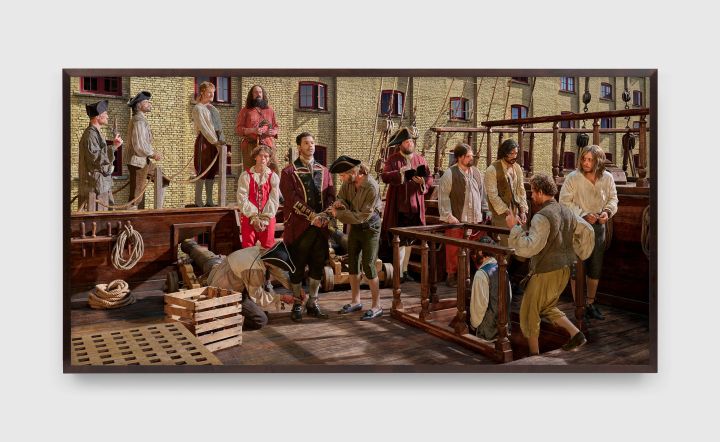
Stan Douglas, Overture: In which Convicted Brigand Captain Macheath is Transported to the West Indies Where He will be Impressed into Indentured Labour, 2024, inkjet print mounted on Dibond aluminum, 150 × 200 cm, edition of 5.
◊ ◊ ◊ ◊ ◊
A sequel to Gay’s well-known The Beggar’s Opera (which was later adapted as The Threepenny Opera), Polly was censored by the British government for its embedded satire and critique, particularly of policies around the parceling out of land; as a result, it was never produced during Gay’s lifetime. Douglas further notes that Polly was ahead of its time, as it “satirizes imperial patriarchal hierarchies of race and class—as well as gender norms, which it depicts as performative” (Douglas, in correspondence with the gallery, March 2024).
Gay’s stage play follows the eponymous Polly Peachum, who travels to the West Indies to search out her estranged husband, Captain Macheath, who has disguised himself as a Black man known as Morano and adopted the life of a pirate. Upon her arrival on the island, Polly is, unbeknownst to her, sold to a wealthy plantation owner as a courtesan. After eventually securing her freedom, she is advised to disguise herself as a young man to ward off unwanted male attention, and as a result becomes entangled in a series of skirmishes between the colonial settlers, the native population, and the pirates.
To create the photographs—which were shot in Jamaica using Hollywood-level production effects—Douglas enlisted a cast of actors to read from a loose script that he adapted for the chosen scenes, modifying certain characters and elements to bring the themes in line with the present day. For example, in Douglas’s version, Captain Macheath was a Black man passing as white in London who, once in the West Indies, drops the disguise and lets his hair grow out. Rather than posing the players, he photographed them continuously as they acted out and improvised the dialogue, then selected as the final images those that best embodied the ideas put forth in the narrative. The resulting large-scale photographs are dynamically realized, taking the form of sweeping tableaux where dramatis personae and setting collide in vivid color. Retaining Gay’s sense of comedic folly and satire as well as the underlying pathos of the story, the images bear traces of the various forms of media through which they have been filtered, employing formal elements drawn from theatrical, cinematic, and photographic conventions alike. Accordingly, Douglas positions the viewer as a spectator—a voyeuristic witness to the various narrative turns and apparent absurdities in which relationships are transactional and enemies expendable.
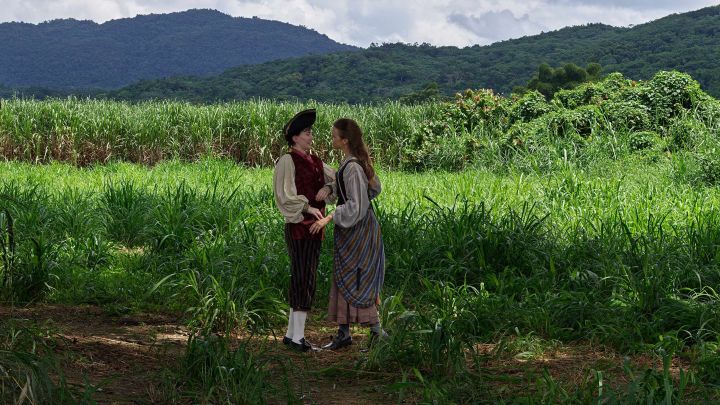
Stan Douglas, Act II, Scene VI: In which the Wife of Pirate Captain Morano, Jenny Diver, Attempts to Seduce Polly, who is Disguised as a Man to Avoid Molestation, detail, 2024, inkjet print mounted on Dibond aluminum, 150 × 150 cm, edition of 5.
◊ ◊ ◊ ◊ ◊
Douglas’s use of Polly as the basis for this project arose out of his long-standing interest in maroon societies, large groups of enslaved persons who banded together to run away and start new, proto-democratic societies. Contrary to their depiction in popular media, pirate ships occasionally functioned as collaborative maroon societies in their own right. The title of the series, The Enemy of All Mankind, is taken from a doctrine of eighteenth-century maritime law (in Latin, hostis humani generis) under which pirates could be attacked by anyone since they fell outside the protection of any nation, but its core notion of defining certain groups as enemies or outsiders resonates broadly today. In Polly, the pirates—in contrast to the settlers and indigenous people—are meant to embody immorality and evil, yet in pulling out specific strands of the narrative, Douglas points to a more nuanced understanding of such sweeping generalities.
Stan Douglas (b. 1960) was born in Vancouver and studied at Emily Carr College of Art in Vancouver in the early 1980s. Douglas was one of the earliest artists to be represented by David Zwirner, where he had his first American solo exhibition in 1993—the second show in the gallery’s history.
Douglas’s work has been the subject of solo exhibitions at prominent institutions worldwide since the 1980s. In 2022, the artist represented his native Canada at the Venice Biennale, where he debuted a major video installation, ISDN (2022)—now in the collection of the National Gallery of Canada, San Francisco Museum of Modern Art, and The Museum of Modern Art, New York—and a related body of photographs. Subsequently, the exhibition Stan Douglas: 2011 ≠ 1848 traveled around Canada with stops at The Polygon Gallery, Vancouver (fall 2022); Remai Modern, Saskatoon (February–April 2023); and the National Gallery of Canada, Ottawa (September 2023–October 2024). A solo exhibition also titled 2011 ≠ 1848 was subsequently staged in 2023 at De Pont Museum, Tilburg, the Netherlands. In 2023, this body of work inaugurated David Zwirner’s new Los Angeles location, and it is currently on view at the Parque de Serralves in Porto, Portugal, through 12 January 2025.
Douglas has been the recipient of notable awards, including the Audain Prize for Visual Art (2019); the Hasselblad Foundation International Award in Photography (2016); the third annual Scotiabank Photography Award (2013); and the Infinity Award from the International Center of Photography, New York (2012). In 2021, Douglas was knighted as a Chevalier of the Ordre des Arts et des Lettres by the French Minister of Culture, and in 2023 he was awarded an honorary doctorate by Simon Fraser University, Greater Vancouver. Work by the artist is held in major museum collections worldwide.










 Enfilade
leave a comment