Exhibition | Furniture by Jean-Pierre Latz at the Dresden Court
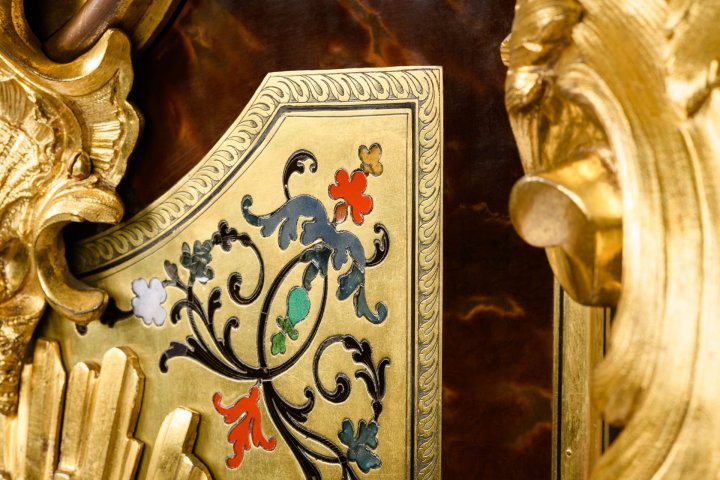
Pedestal detail, signed and dated: Jean-Pierre Latz, Paris, 1739 (Dresden, Inv. No. 37616-2).
◊ ◊ ◊ ◊ ◊
Now on view in Dresden:
Made in Paris: Furniture Creations by Jean-Pierre Latz at the Dresden Court
Fait à Paris: Die Kunstmöbel des Jean-Pierre Latz am Dresdner Hof
Royal Palace, Dresden, 19 October 2024 — 2 February 2025
In the impressive staterooms of the Dresden Residenzschloss (Royal Palace) the collection of Latz furniture shall be presented for the first time in its full extent at the special exhibition of the Kunstgewerbemuseum (Museum of Decorative Arts). This exhibition is the conclusion of the twelve years of comprehensive research and conservation project that the furniture has undergone.

Pendulum clock on pedestal, attributed to Jean-Pierre Latz, Paris, ca. 1739 (Dresden, Inv. No. 37679-1).
The Museum of Decorative Arts Dresden holds the largest and most important collection worldwide of magnificent furniture of the renowned Parisian cabinetmaker Jean-Pierre Latz (1691–1754). The collection contains approximately twenty object ensembles, consisting of thirty individual items. They demonstrate with striking effect the magnificence and representation at the Polish-Saxon court of King Augustus III (1696–1763) and of his prime minister, Count von Brühl (1700–1763).
The Second World War and its aftermath deeply affected the furniture collection of the museum when, apart from destruction, it suffered damages caused by evacuation and transportation. For many years, the necessary conservation and restorations could not be achieved because of a lack of resources; the furniture had to be put into storage and thus lapsed into oblivion. That is until now! For the first time since their wartime storage, eighty years ago, and after years of careful and thoughtful conservation and restoration, the highly important Dresden Latz collection will be shown in the splendour of the staterooms—the very stage where they once enhanced the representation of the Saxon monarchs.
Born in the Electorate of Cologne, an ecclesiastical principality of the Holy Roman Empire, Jean-Pierre Latz followed in the footsteps of many German cabinetmakers and went to Paris in 1719. Latz´s works are striking for a very distinct individual artistic signature and boast opulent, sculpturally conceived corpus forms, technically superb craftsmanship and great sculptural skill in the fashioning of bronze mounts, as well as consummate marquetry work. These high-quality technical aspects were combined in designs that reflect the exquisite taste of the royal and aristocratic customers and patrons in France and abroad. Impressive, elegant and playful as well, his furniture combines mythological themes from the antiquity with their symbolic connotations of the 18th century: monumental, playful and superb, they impressed with their costly materials. Sought after by the royalty in France and abroad, Latz´s furniture is among others still to be found in the former palaces of Augustus III (King of Poland & Elector of Saxony), Frederick the Great (King of Prussia; 1712–1786) and the presidential Quirinal Palace in Rome—originating from the former royal court in Parma.
Important loans from the former royal palaces in Potsdam and from the Palazzo Quirinale in Rom, combined with the splendid collection of Latz furniture of the State Art Collections Dresden, will enable us to present an unprecedented and probably one-time concerted show of outstanding masterpieces by Jean-Pierre Latz. The exhibition will be completed withhighlights from the State Art Collections to throw light on the official representation and demonstration of power at the Saxon Court through the vehicle of French luxury products.
Old artisanship always brings up fascinating issues for today´s museum public: how many different materials and techniques come together as a unity in Latz´s creations? The exhibition will use computer techniques to show how the furniture as a work of art can be digitally disassembled directly before the visitor´s very eyes, so that all its secrets can be penetrated and understood.










 Enfilade
leave a comment