New Book | The Irish Country House
From Rizzoli:
Robert O’Byrne, photographs by Luke White, The Irish Country House: A New Vision (Ne York: Rizzoli, 2024), 272 pages, ISBN: 978-0847832835, $65.

A unique presentation of Irish country house interiors, combining well-preserved historic estates with adventurous contemporary restorations, celebrating some of the most characterful houses in Ireland.
Forgoing the criteria of stateliness and opulence, this book is an exploration of the most captivating and unusual interiors in Ireland. Whether in the transformation of a derelict estate, the preservation of an historic hunting lodge, or the re-creation of a Gothic fantasy, each of the homes in this extraordinary book reflects a renewed vitality in the contemporary approach to Irish country houses.
Rich in detail and varied in scope, the houses reveal a refreshing dynamism in their decoration by equally diverse owners—from the ornate refurbishment of a castle by a Mexican financier to the bold palette of a contemporary artist’s renovation to an Elizabethan Revival house. The sparse interiors of a mansion in Westmeath reflect its painstaking restoration by descendants of the original owners, and at Coollattin—Ireland’s largest country house, part restored, part still in disrepair—the building’s baroque splendor is amplified by its raw, unfinished state. Accompanying photography of the houses made specially for the book, the author guides readers through fifteen exceptional spaces, elucidating the remarkable aspects of each—and in doing so celebrates the unexpected eclecticism and reinvigorated spirit of Ireland’s historic interiors.
Robert O’Byrne is a writer and lecturer specializing in the fine and decorative arts. He is the author of more than a dozen books, a former columnist for Apollo magazine, and has written for both The Burlington Magazine and the Irish Arts Review. He authors the award-winning blog The Irish Aesthete. Luke White is a British photographer of portraits, interiors, and architecture.
Mount Vernon Enters Next Phase of $30million Restoration
From coverage of the project by The Washington Post:
Michael Ruane, “George Washington’s Mansion Gets First Major Rehab in More than 150 Years,” The Washington Post (17 October 2024). Much of the historic Mount Vernon home in Virginia will close starting next month for a massive preservation project.
. . . On Nov. 1, the bulk of Washington’s famous home is due to close for several months as it undergoes the next phase of its largest-scale rehabilitation in over 150 years.
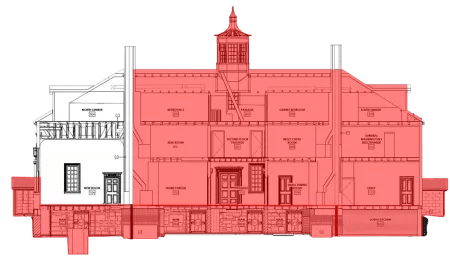
In Phase 2, scheduled to run from November 2024 until January 2025, the New Room, Servants’ Hall, and Kitchen are open; all other rooms will be closed to visitors.
The $30 million project is the most complicated preservation effort since the house was saved from decay in 1860 by the private, nonprofit Mount Vernon Ladies’ Association of the Union, which still owns it, said Douglas Bradburn, president of George Washington’s Mount Vernon. “We’re shutting down a big chunk of it for the next eight months or so,” he said. “I would say that’s two-thirds of the house.”
Other parts of the house, along with the extensive grounds, Washington’s tomb, the quarters for enslaved people and other outbuildings will remain open, Bradburn said in a recent interview. Mount Vernon gets about 1 million visitors a year, and millions more check out the historic estate online, he said.
The historic structure had become loosened from its foundation over time, and the work will resecure it, Bradburn said. There also will be restoration work done in the basement and on flooring, among other things. He said the goal is to complete the project in 2026.
“It’s some of the most important work that’s ever been done at Mount Vernon,” Bradburn said. Earlier repair projects have been piecemeal. At one point, ship masts were used to help support the roof of the crumbling piazza that overlooks the Potomac River. “They’re dealing with problems as they come,” he said. This is a chance for a more complete approach. . .
The full article is available here»
Exhibition | Stan Douglas: The Enemy of All Mankind
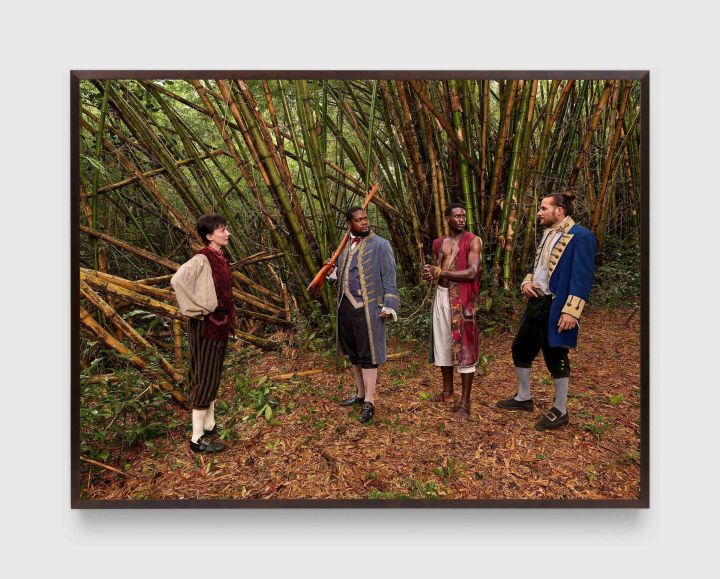
Stan Douglas, Act II, Scene XII: In which Polly Convinces Pirates Laguerre and Capstern to Release their Captive, Prince Cawwawkee, for a Prize Rather than go to War Against His People with Morano, 2024, inkjet print mounted on Dibond aluminum, 150 × 200 cm, edition of 5.
◊ ◊ ◊ ◊ ◊
From the press release for the show, which was covered by Walker Mimms for The New York Times (17 October 2024). . .
Stan Douglas | The Enemy of All Mankind: Nine Scenes from John Gay’s Polly
David Zwirner, New York, 12 September — 26 October 2024
David Zwirner is pleased to announce an exhibition by Stan Douglas, on view at the gallery’s 525 West 19th Street location in New York. Featuring a new photographic series, The Enemy of All Mankind: Nine Scenes from John Gay’s Polly, this will be the artist’s eighteenth solo exhibition with the gallery. In this stand-alone group of nine images, Douglas stages scenes from the eighteenth-century comic opera Polly, written by English dramatist John Gay (1685–1732), using the narrative as a vehicle through which to engage a wide range of themes that remain highly relevant today, including race, class, gender, and media. One work from the series debuted in David Zwirner: 30 Years, on view in summer 2024 in Los Angeles, and this will mark the first presentation of the body of work in its entirety.
Since the 1980s, Douglas has created films, photographs, and other multidisciplinary projects that investigate the parameters of their respective mediums. His ongoing inquiry into technology’s role in image making, and how those mediations infiltrate and shape collective memory, has resulted in works that are at once specific in their historical and cultural references and broadly accessible. Since the beginning of his career, photography has been a central focus of Douglas’s practice, used at first as a means of preparing for his films and eventually as a powerful pictorial tool in its own right. The artist is influenced in particular by media theorist Vilém Flusser’s notion of the photographic image as an encoded language that is determined by a specific set of technological, social, cultural, and political circumstances.
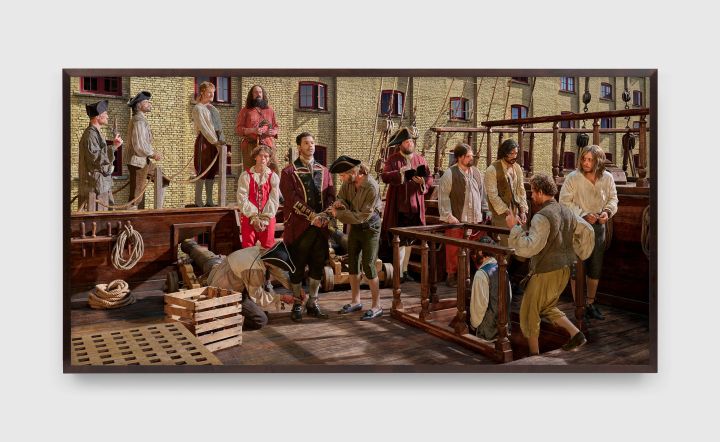
Stan Douglas, Overture: In which Convicted Brigand Captain Macheath is Transported to the West Indies Where He will be Impressed into Indentured Labour, 2024, inkjet print mounted on Dibond aluminum, 150 × 200 cm, edition of 5.
◊ ◊ ◊ ◊ ◊
A sequel to Gay’s well-known The Beggar’s Opera (which was later adapted as The Threepenny Opera), Polly was censored by the British government for its embedded satire and critique, particularly of policies around the parceling out of land; as a result, it was never produced during Gay’s lifetime. Douglas further notes that Polly was ahead of its time, as it “satirizes imperial patriarchal hierarchies of race and class—as well as gender norms, which it depicts as performative” (Douglas, in correspondence with the gallery, March 2024).
Gay’s stage play follows the eponymous Polly Peachum, who travels to the West Indies to search out her estranged husband, Captain Macheath, who has disguised himself as a Black man known as Morano and adopted the life of a pirate. Upon her arrival on the island, Polly is, unbeknownst to her, sold to a wealthy plantation owner as a courtesan. After eventually securing her freedom, she is advised to disguise herself as a young man to ward off unwanted male attention, and as a result becomes entangled in a series of skirmishes between the colonial settlers, the native population, and the pirates.
To create the photographs—which were shot in Jamaica using Hollywood-level production effects—Douglas enlisted a cast of actors to read from a loose script that he adapted for the chosen scenes, modifying certain characters and elements to bring the themes in line with the present day. For example, in Douglas’s version, Captain Macheath was a Black man passing as white in London who, once in the West Indies, drops the disguise and lets his hair grow out. Rather than posing the players, he photographed them continuously as they acted out and improvised the dialogue, then selected as the final images those that best embodied the ideas put forth in the narrative. The resulting large-scale photographs are dynamically realized, taking the form of sweeping tableaux where dramatis personae and setting collide in vivid color. Retaining Gay’s sense of comedic folly and satire as well as the underlying pathos of the story, the images bear traces of the various forms of media through which they have been filtered, employing formal elements drawn from theatrical, cinematic, and photographic conventions alike. Accordingly, Douglas positions the viewer as a spectator—a voyeuristic witness to the various narrative turns and apparent absurdities in which relationships are transactional and enemies expendable.
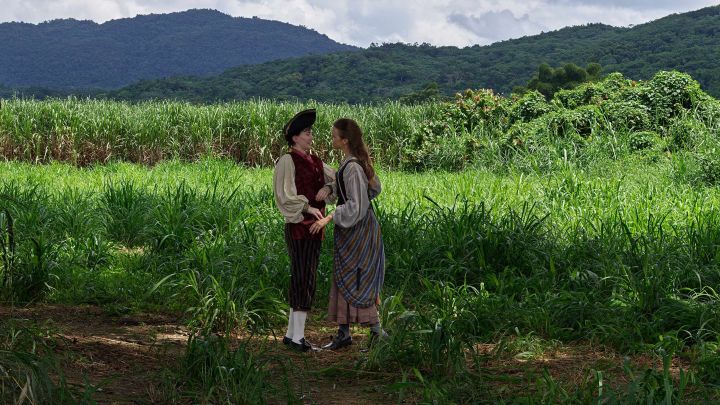
Stan Douglas, Act II, Scene VI: In which the Wife of Pirate Captain Morano, Jenny Diver, Attempts to Seduce Polly, who is Disguised as a Man to Avoid Molestation, detail, 2024, inkjet print mounted on Dibond aluminum, 150 × 150 cm, edition of 5.
◊ ◊ ◊ ◊ ◊
Douglas’s use of Polly as the basis for this project arose out of his long-standing interest in maroon societies, large groups of enslaved persons who banded together to run away and start new, proto-democratic societies. Contrary to their depiction in popular media, pirate ships occasionally functioned as collaborative maroon societies in their own right. The title of the series, The Enemy of All Mankind, is taken from a doctrine of eighteenth-century maritime law (in Latin, hostis humani generis) under which pirates could be attacked by anyone since they fell outside the protection of any nation, but its core notion of defining certain groups as enemies or outsiders resonates broadly today. In Polly, the pirates—in contrast to the settlers and indigenous people—are meant to embody immorality and evil, yet in pulling out specific strands of the narrative, Douglas points to a more nuanced understanding of such sweeping generalities.
Stan Douglas (b. 1960) was born in Vancouver and studied at Emily Carr College of Art in Vancouver in the early 1980s. Douglas was one of the earliest artists to be represented by David Zwirner, where he had his first American solo exhibition in 1993—the second show in the gallery’s history.
Douglas’s work has been the subject of solo exhibitions at prominent institutions worldwide since the 1980s. In 2022, the artist represented his native Canada at the Venice Biennale, where he debuted a major video installation, ISDN (2022)—now in the collection of the National Gallery of Canada, San Francisco Museum of Modern Art, and The Museum of Modern Art, New York—and a related body of photographs. Subsequently, the exhibition Stan Douglas: 2011 ≠ 1848 traveled around Canada with stops at The Polygon Gallery, Vancouver (fall 2022); Remai Modern, Saskatoon (February–April 2023); and the National Gallery of Canada, Ottawa (September 2023–October 2024). A solo exhibition also titled 2011 ≠ 1848 was subsequently staged in 2023 at De Pont Museum, Tilburg, the Netherlands. In 2023, this body of work inaugurated David Zwirner’s new Los Angeles location, and it is currently on view at the Parque de Serralves in Porto, Portugal, through 12 January 2025.
Douglas has been the recipient of notable awards, including the Audain Prize for Visual Art (2019); the Hasselblad Foundation International Award in Photography (2016); the third annual Scotiabank Photography Award (2013); and the Infinity Award from the International Center of Photography, New York (2012). In 2021, Douglas was knighted as a Chevalier of the Ordre des Arts et des Lettres by the French Minister of Culture, and in 2023 he was awarded an honorary doctorate by Simon Fraser University, Greater Vancouver. Work by the artist is held in major museum collections worldwide.
New Book | Travellers in Eighteenth-C. Europe: The Sexes Abroad
From Pen and Sword History:
Julie Peakman, ed., Travellers in Eighteenth-Century Europe: The Sexes Abroad (Barnsley: Pen and Sword History, 2024), 256 pages, ISBN: 978-1399049603, £25 / $50.
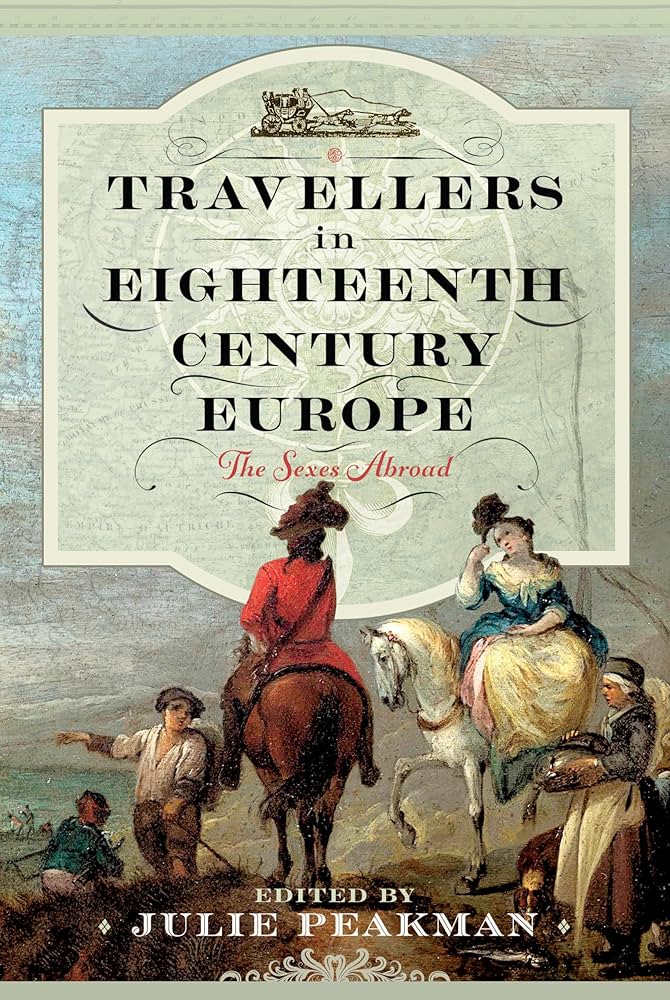 A collection of essays by leading scholars brought together by Julie Peakman, an expert in eighteenth-century culture.
The Grand Tour was considered a part of the education of a young gentleman. Travellers included blossoming scholars, poets, writers, and scientists. Visits were made to Greece and Italy via France and Switzerland, often taking in Turkey. But women also travelled extensively, though these accounts have been under-explored. This collection of essays examines first-hand accounts of the impact of foreign travel on both women and men, as seen through their letters, travel diaries, journals, and their creative response in poems, music, and art. Its originality is seen in its exploration of a comparison between the views of women and men abroad and the differences in what they deemed interesting and worthy of comment. The book is especially relevant in light of the many past (and current) xenophobic views of the ‘foreigner’. Here, we more often see travellers viewing their experience of ‘otherness’ and exoticism, in a positive light, a cultural appreciation rather than a cultural appropriation. This book examines how men and women saw these new worlds opening up before them, what delighted them, what influenced them, and their interaction with others in the light of domesticity, antiquity, politics, work, science, sex, and friendships.
Julie Peakman is an historian, a Fellow of the Royal Historical Society and Honorary Fellow at the Department of History, Classics, and Archaeology at Birkbeck College, University of London. She contributes regularly to newspapers, popular and academic journals and has worked on various documentaries for TV including for the BBC, Sky, Channel 4, and the Biography channel. She is a prolific author in the areas of eighteenth-century culture, history of sexuality, and social history. Her books include Libertine London, Licentious Worlds; The Pleasure’s All Mine; Amatory Pleasures, Lascivious Bodies; and Mighty Lewd Books: The Development of Pornography in Eighteenth-Century England; along with biographies of Dublin brothel-keeper Peg Plunket and Emma Hamilton.
Conference | The Expert’s Eye
From the conference website and programme:
El ojo experto: Método, límites y la disciplina de la Historia del Arte
The Expert’s Eye: Method, Limitations, and the Practice of Art History
Online and in-person, Museo Arqueológico Nacional, Madrid, 24–25 October 2024
Organized by Pilar Diez del Corral Corredoira and David Ojeda Nogales
 The work of the art historian revolves around the art object, and the need to tailor one’s methodology to that object gives the discipline its variety and richness. Yet paradoxically, to stress that art works are the centre of art history feels almost transgressive at a time when basic questions of identification and dating are increasingly deemphasized in training new generations of scholars and curators.
The new art history, by contrast, has shown itself perfectly capable of conducting research without having to study or even look at the art object. Without discrediting the results, which are sometimes more characteristic of departments of history or anthropology, the ease with which art-historical fact is blurred can be surprising. Over the last fifty years, the notable decrease in studies that examine the most fundamental problems of dating and authorship has raised questions about the usefulness of prevailing methodologies, leading to extreme cases in which a trained or expert eye is considered unnecessary, or at least insufficient, to deal with objects lacking documentary or other external proof of origin, creator, or date. By contrast, having an educated eye implies knowing the difference between a Roman bust from the first century AD and a modern copy, between discovering the hand of Leonardo and detecting an excellent falsification. In light of these trends, this conference aims to interrogate and challenge the abandonment of visual, material, and historical expertise among art historians.
Watch online here»
Technical coordination
• Marta I. Sánchez Vasco, misanchezvasco@gmail.com
Scientific coordination
• Pilar Diez del Corral Corredoira, diezdelcorral@geo.uned.es
• David Ojeda Nogales, dojeda@geo.uned.es
Scientific committee
• Amaya Alzaga Ruiz (UNED)
• Jeffrey Collins (Bard Graduate Center, Nueva York)
• Ana Diéguez Rodríguez (Instituto Moll)
• Pilar Diez del Corral Corredoira (UNED)
• David Ojeda Nogales (UNED)
• Markus Trunk (Universität Trier)
j u e v e s , 2 4 o c t u b r e
10.00 Presentación institucional a cargo de Isabel Izquierdo Peraile, directora del Museo Arqueológico Nacional
10.30 Conferencia plenaria
• Jeffrey Collins (BGC, NY) — Experts, Eyes, and Expert Eyes: A View from the Decorative Arts
11.30 Pausa café
11.50 Bloque 1
Modera P. Diez del Corral
• Hans R. Goette (DAI) — Remarks on Excavation Context and Epigraphy Serving Stylistic Analysis by Experts in Classical Archaeology: The ›Esquiline Sculptures‹ ‒ ca. 200 or 400 AD?
• Matteo Cadario (UNIUD) — I rischi dei giudizi ‘stilistici’ nello studio della scultura antica
• David Ojeda (UNED) — La desaparición del ‘ojo experto’: El problema del tiempo en el estudio de la escultura antigua
13.30 Pausa comida
15.00 Bloque 2
Modera Jeffrey Collins
• Benjamin Binstock (Independiente) — Less is More: Recognizing Young Rembrandt’s Painting-by-Painting Development
• Miguel Hermoso (UCM) — Truco o trato: Ojo crítico y pintura de la Edad Moderna
• Pilar Diez del Corral Corredoira (UNED) — Aprendices, copistas y falsarios: El dibujo de Carlo Maratta y sus seguidores
16.15 Pausa café
16.30 Bloque 3
Modera Ana Diéguez
• Beatriz Campderá Gutiérrez (MAN) — El ojo experto en las colecciones medievales
• Eduardo Lamas e Isabelle Lecocq (KIK-IRPA) — Inventory at the Service of the Expert Eye
• Sacha Zdanov (ULB) — Interrogating Erwin Panofsky’s Artistic Relativity: Methodological Reflections on the Aesthetic Diversity of Netherlandish Pictorial Production around 1500
• Rafael Villa (UNIGE) — Connoisseurship and French Stained Glass: On the Abandonment of a Method
v i e r n e s , 2 5 o c t u b r e
9.30 Conferencia plenaria
• Carmen Marcos Alonso (subdirectora del MAN) — Protección y enriquecimiento del Patrimonio Cultural: La labor de los museos en la expertización de bienes culturales
10.15 Bloque 4
Modera Amaya Alzaga
• José Luis Guijarro (Universidad Nebrija) — El ‘silencio de los expertos’: Consideraciones en torno a las responsabilidades legales del historiador del arte en el ejercicio de su labor
• Isabel Menéndez (UNED) — Historiadores y peritos en la valoración de la obra de arte
• Adolfo Gandarillas (UPO) — La Inteligencia Artificial y las tecnologías avanzadas aplicadas al patrimonio artístico: Herramientas y recursos del nuevo connoisseur
11.30 Pausa café
11.50 Mesa redonda
J18 | Provocations from HECAA@30
A selection of J18 Notes & Queries essays responding to the 2023 conference:
Elizabeth Saari Browne and Dana Leibsohn, eds., “Provocations from HECAA@30,” Journal18 (October 2024).
Responses
• Jennifer Van Horn — Absence and Abundance: Thinking Ahead from HECAA@30
• Karen Lipsedge — The Power of Storytelling and Story-Listening: Reflections on HECAA@30
• Emily C. Casey and Matthew Gin — Everything in Between: Reflections on HECAA@30
• Deepthi Murali —The Ethics of Study and Display of Ivory Objects
• Dawn Odell — Who (or What) Speaks in a Global History of Art?
• Kathryn Desplanque —Material Art History and Black Feminist Pedagogies
From the introduction by Elizabeth Saari Browne and Dana Leibsohn:
 In October 1725, a Jiwere (Otoe) leader named Aguiguida found himself at Versailles watching the fountains play. Invited by French men eager to secure allies amongst those who lived on the Central Plains of North America, this visit had been designed to impress. Along with a tour of Parisian sites and a meeting with the king, Aguiguida and his fellow travelers received gifts aplenty: dress coats with silver ornaments, plumed hats, royal medallions; also rifles and swords, and a painting depicting their audience with the monarch. The visitors had meant to offer their own gifts, but most of these were lost in a shipwreck off the coast of America.[1] Today, no material creations from their trip exist, neither those meant for Louis XV nor those offered the delegates.
By the 1720s, people had been traveling from the Americas to European courts for centuries. Itineraries varied, but when Aguiguida met Louis, it was as much trope as history. So why does this story still surprise? Indeed, who does it still surprise? These kinds of questions surfaced at the recent 30th-anniversary convening of HECAA (Historians of Eighteenth-Century Art and Architecture) in October 2023, Environments, Materials, and Futures. This particular eighteenth-century narrative circles around colonial and imperial histories and how creations of earthen and animal materials, of voyages across (and art lost to) land and sea, and of material cultures of global exchange and of war are implicated in such enterprises. But Aguiguida’s trans-Atlantic voyage and visit also pose other questions for historians of art and architecture: about archival absences, affective relationships, and presumed and real (im)balances of power embedded in materials, in pedagogical relationships, and in the Academy. It is these themes the following essays address. . .
Elizabeth Saari Browne is Assistant Professor of Art History and Women’s Studies at the University of Georgia in Athens.
Dana Leibsohn is the Alice Pratt Brown Professor of Art at Smith College in Northampton, Massachusetts.
The full introduction and all essays are available here»
New Book | Maurice Quentin de La Tour: L’Oeil absolu
From Cohen et Cohen:
Xavier Salmon, Maurice Quentin de La Tour: L’Oeil absolu (Paris: Cohen et Cohen, 2024), 623 pages, ISBN: 978-2367491141, €160.
 Maurice Quentin de La Tour (1704–1788) se joua des difficultés à reproduire ce qu’il voyait, transcrivant à l’aide des poudres de pastel aussi bien la douceur d’un velours, la délicatesse d’une dentelle, que le miroitement d’une armure, mais il sut aussi emporter l’âme de ses modèles en descendant à leur insu au plus profond de leur être.
L’homme n’a jamais laissé indifférent et il s’est livré tout au long de son œuvre et de ses écrits. Maurice Quentin de La Tour se joua des difficultés à reproduire ce qu’il voyait. Non seulement il eut le secret de toutes les manufactures, ainsi que se plurent à le souligner ses contemporains, transcrivant à l’aide des poudres de pastel aussi bien la douceur d’un velours, la délicatesse d’une dentelle, que le miroitement d’une armure, mais il sut aussi emporter l’âme de ses modèles en descendant à leur insu au plus profond de leur être. Fin psychologue, La Tour se piqua également de musique, de théâtre, de danse ou bien encore d’astronomie. Sans cesse en quête de perfection, il fut l’ami des philosophes, des savants et des artistes et livra leurs visages à la postérité.
Riche d’environ 500 pastels et préparations, l’œuvre de La Tour et la vie du maître n’ont pas fait en France l’objet d’une monographie complète depuis celle que publièrent Albert Besnard et Georges Wildenstein en 1928. Travaillant depuis bientôt 30 ans sur le maître et ses créations, Xavier Salmon relève aujourd’hui le défi de rendre un nouvel hommage au plus célèbres des pastellistes du XVIIIème siècle et livre une étude précise où chefs-d’œuvre et pastels inédits ou méconnus sont soigneusement analysés, replacés dans le contexte du temps et reproduits afin de restituer toute la richesse et la diversité d’un Siècle des Lumières dont Maurice Quentin de La Tour fut assurément l’un des témoins les plus fidèles.
Spécialiste de l’art européen du XVIIème et du XVIIIème siècle, Xavier Salmon est directeur du département des Arts graphiques du musée du Louvre. Il a été précédemment conservateur des peintures du XVIIIème siècle et du cabinet d’arts graphiques au château de Versailles, chef de l’inspection générale des musées et directeur du patrimoine et des collections du château de Fontainebleau. Il fut commissaire de nombreuses expositions dont les rétrospectives Jean-Marc Nattier, Maurice Quentin de La Tour: Le voleur d’âmes, et Alexandre Roslin: Un portraitiste pour l’Europe à Versailles, Madame de Pompadour et les arts également à Versailles, Marie-Antoinette et Elisabeth Louise Vigée Le Brun au Grand Palais à Paris. Il a reçu en 2014 le grand prix de l’Académie Française pour son ouvrage : Fontainebleau: Le temps des Italiens. Il a dédié une partie de ses travaux aux pastels français du XVIIIème siècle.
◊ ◊ ◊ ◊ ◊
As Adam Busiakiewicz noted at Art History News in June, Salmon’s is the first print catalogue raisonné to be published since 1928, though Neil Jeffares published a new online catalogue in 2022 as part of his Pastellists website, available for free here. –CH
Exhibition | French Neoclassical Paintings from the Horvitz Collection

Claude-Joseph Vernet, After the Storm, 1788.
(Wilmington: Horvitz Collection)
◊ ◊ ◊ ◊ ◊
Now on view at the AIC:
French Neoclassical Paintings from the Horvitz Collection
Art Institute of Chicago, 19 October 2024 — 6 January 2025
Curated by Emerson Bowyer and Andrea Morgan
This exhibition showcases 25 paintings from the preeminent private collection of French 18th-century art in the United States: the Horvitz Collection. The selection of works focuses on Neoclassicism, an artistic style that emerged in the later 1700s and flourished through the 1820s, a period of tremendous political and social upheaval in France. This time was also the heyday of ‘history painting’, a genre of painting characterized by large-scale compositions portraying scenes from history, mythology, and religion. Neoclassical painters looked to the art, architecture, and literature of ancient Greece and Rome for inspiration, often as a lens through which to depict and comment upon contemporary events, and several works included in the exhibition were displayed to a broad public at the annual Paris Salons.
While these works were created more than 200 years ago and often depict ancient or mythological events, they also reference social and political challenges that remain relevant today, from the overthrow of an absolutist government during the French Revolution—which saw the groundwork laid for modern democracies—through to Napoleon’s Empire and the eventual restoration of Bourbon monarchy. This period also coincided with the rise of Enlightenment ideals, the democratization of knowledge, the spread of printed materials, and the origins of industrialization and increased urbanization.
French Neoclassical Paintings from The Horvitz Collection is curated by Emerson Bowyer, Searle Curator, Painting and Sculpture of Europe and Andrea Morgan, research associate. The exhibition complements a major survey of drawings from the same period, Revolution to Restoration: French Drawings from The Horvitz Collection.
Exhibition | French Drawings from the Horvitz Collection

Étienne Barthélémy Garnier, Banquet of Tereus
(Wilmington: Horvitz Collection)
◊ ◊ ◊ ◊ ◊
Opening soon at the AIC:
Revolution to Restoration: French Drawings from the Horvitz Collection
Art Institute of Chicago, 26 October 2024 — 6 January 2025
Curated by Kevin Salatino and Emily Ziemba
The exhibition features approximately 90 drawings made from the 1770s through the 1850s, one of the most turbulent periods in French history. During this time, France abolished the monarchy, established a republic, terrorized perceived political enemies, waged war across the continent, imposed an empire, and eventually reinstated the monarchy—and these are only a handful of the tumultuous episodes that occurred across this 80-year period. Despite this profound instability, the country’s cultural environment flourished, spurring a significant stylistic shift in artistic production. Influenced by the rationalist ideas and moral seriousness of such Enlightenment thinkers as Voltaire and Jean-Jacques Rousseau, and inspired by important archaeological discoveries that radically altered contemporary ideas about the ancient Greco-Roman past, artists turned away from the playful, decadent Rococo style of the mid-18th century. In its place they adopted a more restrained and disciplined style, now known as Neoclassicism, a term invented only in the 19th century.

Henriette Lorimier, Female Nude, 1796, Black chalk, charcoal, and white crayon (Wilmington: Horvitz Collection).
Featuring works by the most accomplished and influential artists of the time, including Jacques-Louis David, Jean Auguste Dominique Ingres, Pierre-Paul Prud’hon, and Théodore Géricault, the exhibition explores the impact of ancient Greek and Roman art, history, and mythology on artistic production, as well as the role of the Academy, changing social norms, and convulsive contemporary events.
The selected drawings showcase a variety of media—pen and ink, watercolor, chalk, and pastel—and highlight how artists of the period demonstrated a surprisingly modern combination of intellectual curiosity, political commitment, and graphic virtuosity. The presentation demonstrates the expressive versatility and powerful immediacy of drawing as a medium of persuasion, propaganda, and, above all, aesthetic stimulation.
Revolution to Restoration: French Drawings from The Horvitz Collection is curated by Kevin Salatino, Chair and Anne Vogt Fuller and Marion Titus Searle Curator, Prints and Drawings, and Emily Ziemba, director of curatorial administration and research curator, Prints and Drawings. The exhibition complements French Neoclassical Paintings from The Horvitz Collection in Gallery 223.
Lecture | Margaret Grasselli on Neoclassical Drawings
Upcoming at the AIC:
Margaret Morgan Grasselli | Neoclassical Drawings—What’s Old Is New Again
Art Institute of Chicago, Saturday, 2 November 2024, 2pm
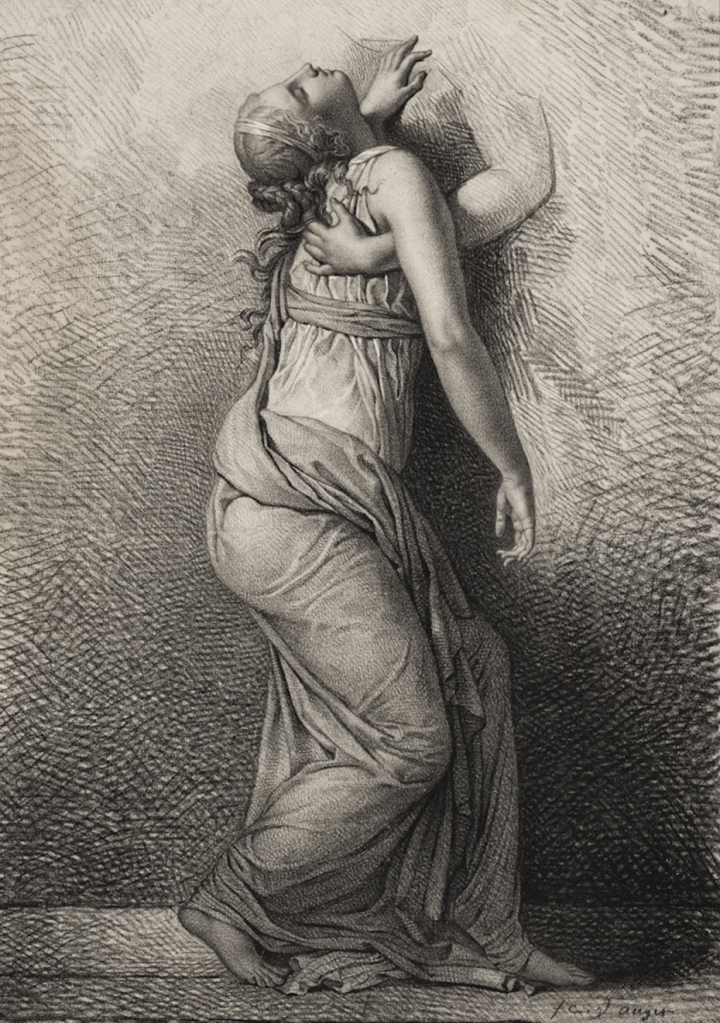
Adrien Victor Auger after Jacques-Louis David, Fainting Young Girl (Wilmington: Horvitz Collection).
Discover the defining features of Neoclassicism in this exploration of the origins and characteristics of the ‘new classical’ style that dominated Europe, especially France, in the late-18th century. With an eye towards the drawings featured in Revolution to Restoration: French Drawings from the Horvitz Collection, Margaret Morgan Grasselli, a leading expert in the field of French drawings, documents the movement’s roots: the careful study of Roman antiquities, the development of an austerely dramatic, visually striking pictorial style, and the depiction of subjects from both ancient and modern history.
Margaret Morgan Grasselli worked for 40 years in the department of graphic arts at the National Gallery of Art in Washington, 30 of them as curator of Old Master drawings. An expert on French drawings, especially those of the 18th century, she organized many major exhibitions, most notably Watteau, 1684–1721 in 1984; Renaissance to Revolution: French Drawings from the National Gallery of Art, 1500–1800 in 2009; and Hubert Robert in 2016. After retiring from the National Gallery in 2020, Meg spent three years as visiting senior scholar for drawings at the Harvard Art Museums, where she also served as visiting lecturer in the department of history of art in the faculty of arts and sciences.










 Enfilade
leave a comment