New Book | The Story of Drawing: An Alternative History of Art
From Yale UP:
Susan Owens, The Story of Drawing: An Alternative History of Art (New Haven: Yale University Press, 2024), 256 pages, ISBN: 978-0300260472, $35.
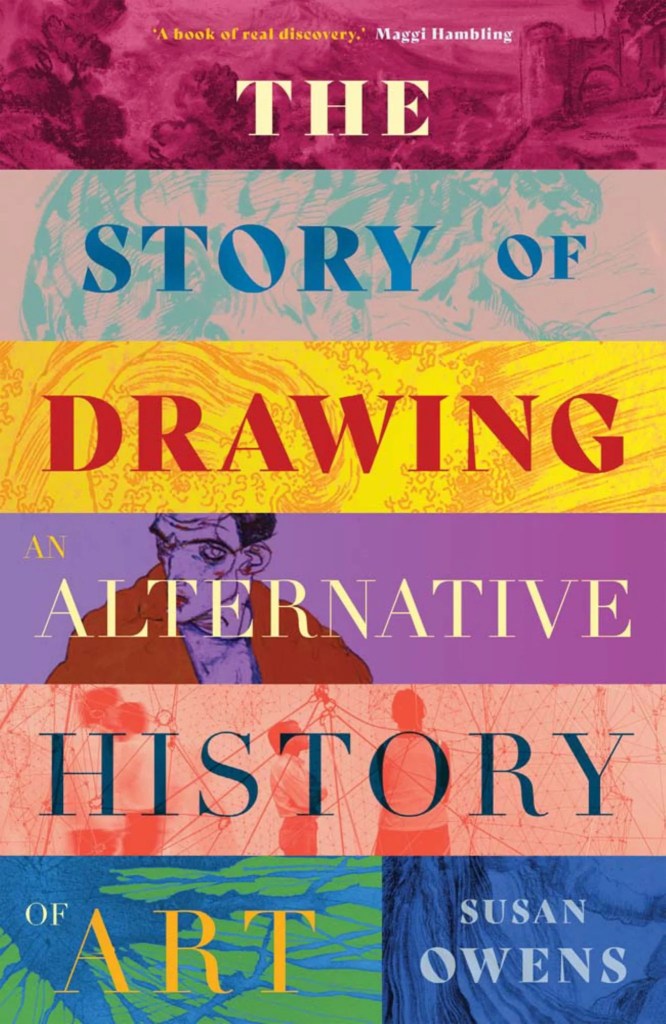 Drawing is at the heart of human creativity. The most democratic form of art-making, it requires nothing more than a plain surface and a stub of pencil, a piece of chalk or an inky brush. Our prehistoric ancestors drew with natural pigments on the walls of caves, and every subsequent culture has practised drawing—whether on papyrus, parchment, or paper. Artists throughout history have used drawing as part of the creative process.
While painting and sculpture have been shaped heavily by money and influence, drawing has always offered extraordinary creative latitude. Here we see the artist at his or her most unguarded. Susan Owens offers a glimpse over artists’ shoulders—from Michelangelo, Rembrandt, and Hokusai to Van Gogh, Käthe Kollwitz, and Yayoi Kusama—as they work, think, and innovate, as they scrutinise the world around them or escape into imagination. The Story of Drawing loops around the established history of art, sometimes staying close, at other times diving into exhilarating and altogether less familiar territory.
Susan Owens is a writer, art historian, and former V&A curator. Her previous books include The Art of Drawing, Spirit of Place, and Imagining England’s Past.
Online Symposium | Drawn to Blue
From the University of Amsterdam, as announced at ArtHist.net:
Drawn to Blue
Online, 12–13 November 2024
Organized by Edina Adam, Leila Sauvage, and Michelle Sullivan
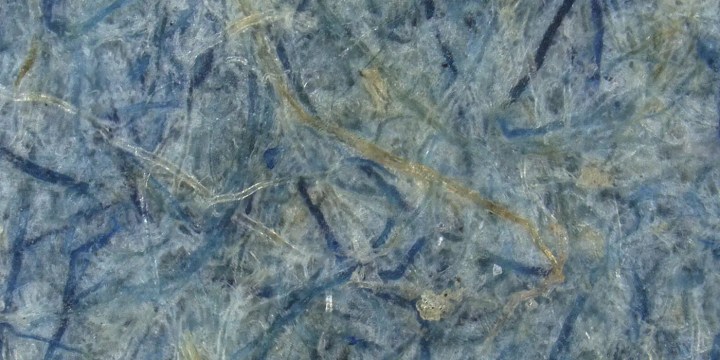
This two-day online symposium, co-organized by the J. Paul Getty Museum and the University of Amsterdam, brings together art historians and paper and textile conservators to share their new research on the history of early modern blue paper.
Made from discarded blue rags, early modern blue paper was a humble material. However, producing it required expert knowledge, and its impact on European draftsmanship was transformative. The rich history of blue paper, from the fifteenth to the mid-eighteenth centuries, illuminates themes of transcultural interchange, international trade, and global reach. Inspired by the recent Getty exhibition Drawing on Blue: European Drawings on Blue Paper, 1400s–1700s and coinciding with the current exhibition Drawn to Blue: Artists’ Use of Blue Paper at the Courtauld, this two-day online symposium brings together art historians and paper and textile conservators to share their new research on the history of early modern blue paper.
Registration is available here»
All times listed in Pacific Time and Central European Time.
t u e s d a y , 1 2 n o v e m b e r
9.00am / 6.00pm Opening remarks by Edina Adam, Leila Sauvage, and Michelle Sullivan
9.10am / 6.10pm Artistic and Non-artistic Use of Blue Paper
• Presence of the Blue Paper inside French Paintings of the 18th Century — Lorenzo Giammattei and Selene Secondo, La Sapienza Università di Roma
• Seeds of Blue: Archival Evidence of the Use of Blue Paper as Seed Packets — Maria Zytaruk, University of Calgary
10.15am / 7.15pm Raw Materials, Trade, Economics
• Blue Paper: Its Life, Origin, History and Artistic Exploration — Judith Noorman, University of Amsterdam
• Paper, Pastels, and Patriotism: Artistic Innovation and the American Revolution — Megan Baker, University of Delaware
11.20am / 8.20pm Works in Progress: Study, Examination, Collection Surveys on Blue Paper
• Surveying The Morgan’s Blue Paper Collection — Elizabeth Gralton, Reba Fishman Snyder, and Rebecca Pollak, The Morgan Library & Museum
• The Blue Paper Project at the Art Gallery of Ontario: Developing an Architecture for Close Looking of Drawing Supports — Maia Donnelly, Joan Weir, and Tessa Thomas, Art Gallery of Ontario
• The Blue Papers of Allan Ramsay at the National Galleries Scotland — Charlotte Park, Clara de la Pena McTigue, and Charlotte Topsfield, National Gallery of Scotland
w e d n e s d a y , 1 3 n o v e m b e r
9.00am / 6.00pm Technical Case Studies
• On Blue: The Portrait Drawings of Ottavio Leoni — Georg Dietz et al., Kupferstichkabinett, Staatliche Museen zu Berlin
• Out of the Blue? Tracing Object Biographies, Early Conservation Treatments, and the Original Appearance of Italian Old Master Drawings on Blue Paper at the Kunstmuseum — Annegret Seger, Rebecca Honold, and Max Ehrengruber, Kunstmuseum Basel
• Blue Paper in Late-19th Century Paris: Mary Cassatt Pastel Supports — Tom Primeau, Philadelphia Museum of Art
10.30am / 7.30pm Printing on Blue Paper
• From Aldus to Zanetti, Parenzo to Proops, Venice to Volhynia: Three Centuries of Hebrew Printing on Blue Paper in Southern, Western, Central, and Eastern Europe — Brad Sabin Hill, George Washington University
• Blueprint(s) — Armin Kunz, C.B. Boerner Gallery
• Etched in Blue: A Unique Set of Prints by the Abbé de Saint-Non — Rachel Hapoienu, Courtauld Gallery of Art
11.55 am / 8.55pm Roundtable
Moderated by Ketty Gottardo, Courtauld Gallery of Art
Program participants reflect on new insights, questions raised, and future avenues of research.
Exhibition | Drawn to Blue: Artists’ Use of Blue Paper
Now on view at The Courtauld:
Drawn to Blue: Artists’ Use of Blue Paper
The Courtauld Gallery, London, 4 October 2024 — 26 January 2025

Jonathan Richardson, the Elder (1665–1745), Self-Portrait (London: The Courtauld).
This display presents a selection of drawings on blue paper from The Courtauld’s collection, ranging from works by the Venetian Renaissance artist Jacopo Tintoretto to a watercolour by famed English artist Joseph Mallord William Turner.
Made from fibres derived from blue rags, blue paper first appeared in Northern Italy in the 14th century. It became a popular drawing support for artists, and its use spread across Western Europe by the late 16th century; it was widely used in England and France in the 18th century. Blue paper provided a nuanced mid-tone which allowed the creation of strong light and dark contrasts, an effect much sought after by draughtsmen. This exhibition project brought together a team of curators and paper conservators at The Courtauld and the J. Paul Getty Museum to explore the technical aspects and artistic richness of the use of blue paper.
Conference | Unfolding the Coromandel Screen
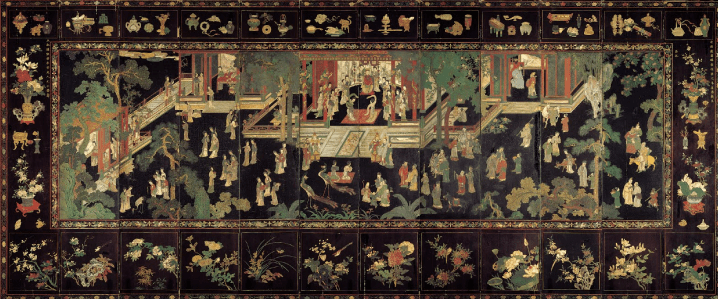
Coromandel Screen, Kangxi reign (1662–1722), Qing dynasty, carved lacquer, 258 × 52 × 3.5 cm
(Art Museum, The Chinese University of Hong Kong, 2001.0660)
◊ ◊ ◊ ◊ ◊
From the conference website and programme:
Unfolding the Coromandel Screen: Visual Mobility, Inscribed Objecthood, and Global Lives
Online and in-person, City University of Hong Kong, 22–23 November 2024
Organized by by Lianming Wang and Mei Mei Rado
During the second half of the seventeenth century, the production of Coromandel screens, also known as kuancai (‘carved polychrome’), flourished along China’s southeast coast. These screens became immensely popular both domestically and in European markets, establishing connections between regional artisans, merchants, and prominent European figures, including royalty and nobility. In the last two decades of this century, Coromandel screens emerged as one of China’s most frequently exported commodities, rivaling porcelain and challenging Japanese lacquerware exports. Their significance extends far beyond the common perception of them as merely mass-produced craftwork of inferior quality.
 With the generous support of the Bei Shan Tang Foundation, the Department of Chinese and History at City University of Hong Kong will host a two-part academic event titled Unfolding the Coromandel Screen to celebrate the department’s tenth anniversary. The conference, organized by Lianming Wang (City University of Hong Kong) in collaboration with Mei Mei Rado (Bard Graduate Center, New York), will take place on-site at City University of Hong Kong and via Zoom from 22 to 23 November 2024. It will bring together an international group of art historians, museum curators, conservators, collectors, and global historians. Participants will explore various aspects of the Coromandel screen and its intricate histories, including its interrelations with paintings, prints, decorative arts, palatial and interior designs, global maritime trade, and the fashion industry. Following the conference, the speakers will join a two-day traveling seminar from 24 to 25 November, visiting lacquer and conservation workshops as well as museum collections in Hong Kong and Guangzhou.
Registration for both onsite and online participation is available here»
Advisory Board
May Bo Ching (City University of Hong Kong), Burglind Jungmann (UCLA), Mei Mei Rado (Bard Graduate Center, New York), Anton Schweizer (Kyushu University), Ching-Fei Shih (National Taiwan University), Lianming Wang (City University of Hong Kong), Xiaodong Xu (†) (Art Museum of The Chinese University of Hong Kong)
Supporting Institutions
Art Museum of The Chinese University of Hong Kong, Indra and Harry Banga Gallery of City University of Hong Kong , Hong Kong Maritime Museum, Lee Shau Kee Library of The Hong Kong University of Science and Technology, Guangdong Provincial Museum, Guangzhou Museum, Chen Clan Ancestral Hall – Guangdong Folk Arts Museum
f r i d a y , 2 2 n o v e m b e r
8.30 Registration
9.00 Welcome and Introduction
• May Bo Ching (City University of Hong Kong), Lianming Wang (City University of Hong Kong), and Mei Mei Rado (Bard Graduate Center, New York)
9.15 Keynote
• Transcultural Treasures: Kuancai (Coromandel) Screens in China and Abroad — Jan Stuart (National Museum of Asian Art, Washington DC)
10.00 Coffee break
10.15 Panel 1 | Coromandel Screens as Sites of Power Representation
Chair: Libby Chan (Indra and Harry Banga Gallery, City University of Hong Kong)
• Place, Scale, and Medium in Several Cartographic Coromandel Screens — Stephen Whiteman (The Courtauld Institute of Art, London)
• Picture of the Immense Sea: Temporal and Spatial Transformation on the Birthday Celebration Screen of
Nan’ao (in Chinese with English subtitles) — Weiqi Guo (Guangzhou Academy of Fine Arts)
11.15 Panel 2 | Coromandel Screens and Intra-Asian Visual Entanglements
Chair: Wan Chui Ki Maggie (The Chinese University of Hong Kong)
• Coromandel Screens and Japanese Seminary Painters in Macau — Yoshie Kojima (Waseda University, Tokyo)
• When the Barbarians Came by Sea: Hunting Screens in China and Japan — Lianming Wang (City University of Hong Kong)
• Transcultural Pictorial Dynamics: Coromandel Screens and Joseon Court Painting and Visual Culture — Yoonjung Seo (Myongji University, Seoul)
12.40 Lunch break
14.00 Panel 3 | Format, Motif, and Technique: Understanding Coromandel Screens
Chair: Daisy Wang (Hong Kong Palace Museum)
• A Screen So Grand: Coromandel Screens from the Perspective of Scale — Tingting Xu (University of Rochester, New York)
• Decoding Frames: Unveiling Names, Provenance, and Connections of the Framed Images on the ‘Dutch
Tribute Screen’ in the National Museum of Denmark, Copenhagen — Xialing Liu (Central Academy of Fine Arts, Beijing / Utrecht University)
• Textiles, Taste, and Templates: Kuancai Screen Motifs and Techniques — Ricarda Brosch (Museum am Rothenbaum – World Culture and Arts, Hamburg)
• Copy Culture and Commodification in Coromandel Screens and Related Lacquerwares, 1680–1780 — Tamara Bentley (Colorado College)
15.40 Coffee Break
16.00 Panel 4 | Materials and Conservation: Perspectives from Labs and Workshops
Chair: Josh Yiu (Art Museum, The Chinese University of Hong Kong)
• On the Origins and Regional Differences of the Kuancai Screens (in Chinese with English subtitles) — Bei Chang (Southeast University, Nanjing) and Linlong Li (Centre de recherche sur les civilisations de l’Asie orientale, Paris)
• A Conservator’s Perspective: Technical Examination and Treatment Strategies for Coromandel Lacquer from the Kangxi Period — Christina Hagelskamp (The Metropolitan Museum of Art, New York)
• Scientific Analysis of a Coromandel Cabinet from the Victoria and Albert Museum, London — Julie Chang (Fu Jen Catholic University, Taipei) and Lucia Burgio (Victoria and Albert Museum, London)
18.00 Museum Visit — Might and Magnificence: Ceremonial Arms and Armour across Cultures,
Indra and Harry Banga Gallery, City University of Hong Kong
19.00 Dinner
s a t u r d a y , 2 3 n o v e m b e r
9.15 Keynote
• The Taste for Coromandel Lacquer in France in the 17th and 18th Centuries: Trade, Reception, and Customs — Stéphane Castelluccio (CNRS, Centre André Chastel, Paris)
10.00 Coffee Break
10.30 Panel 5 | Coromandel Screens as Global Artefacts
Chair: Phil Kwun-nam Chan (Art Museum, The Chinese University of Hong Kong)
• On the ‘Exoticness’ of the Coromandel Lacquerware — Ching-Ling Wang (Rijksmuseum Amsterdam)
• Coastal Landscape and Scenes of Europeans on Coromandel Folding Screens — Rui Oliveira Lopes (Museu das Convergências, Porto)
• Differences and Commonalities: Links between 17th- and 18th-Century Coromandel Export Lacquer Pieces and Luso-Asian Lacquers of the Previous Century — Ulrike Körber (IHA/FCSH//IN2PAST – Universidade Nova de Lisboa)
12.00 Lunch break
13.30 Panel 6 | Coromandel Screens and Their Global Lives, Part One
Chair: Nicole Chiang (Hong Kong Palace Museum)
• Beyond the Closet: The Taste for Coromandel Lacquerware Furniture in Holland and England, ca. 1675–1700 — Alexander Dencher (Rijksmuseum Amsterdam)
• ‘Sawed, Divided, Cut, Clift, and Split Asunder’? A Case Study of a European Chest of Drawers Decorated with Excerpts from a Coromandel Screen of Known Pictorial Model — Grace Chuang (Independent Scholar, Detroit)
• Reframing the West Lake in French Furniture and Interiors — Nicole Brugier (Ateliers Brugier, Paris)
14.30 Coffee Break
14.45 Panel 7 | Coromandel Screens and Their Global Lives, Part Two
Chair: Florian Knothe (University Museum and Art Gallery, The University of Hong Kong)
• The ‘Japanese Cabinet’ at the Hermitage in Bayreuth, Germany — Patricia Frick (Museum für Lackkunst, Münster)
• The Ludic Afterlife of Coromandel Screens: Integrating the Swinging Woman into 18th-Century French Interiors — Weixun Qu (Washington University in St. Louis)
16.00 Short Break
16.15 Panel 8 | The Afterlives of the Coromandel Screens
Chair: May Bo Ching (City University of Hong Kong)
• Art Dealer Florine Langweil and the European Market for Coromandel Screens in the Early 20th Century — Elizabeth Emery (Montclair State University, New Jersey)
• Inspiring Art Deco in Britain: The Architect, the Theatre, and the Coromandel Screen — Helen Glaister (Victoria and Albert Museum, London)
• Shifting Identities and Global Circulation of the Coromandel Screen in Early-20th-Century Buenos Aires — Mariana Zegianini (SOAS University of London)
• The Framework of Modernism: Lacquer Screen and Fashion Imagination in the 1920s — Mei Mei Rado (Bard Graduate Center, New York)
New Book | Philadelphia: A Narrative History
From Penn Press:
Paul Kahan, Philadelphia: A Narrative History (Philadelphia: University of Pennsylvania Press, 2024), 424 pages, ISBN: 978-1512826296, $40.
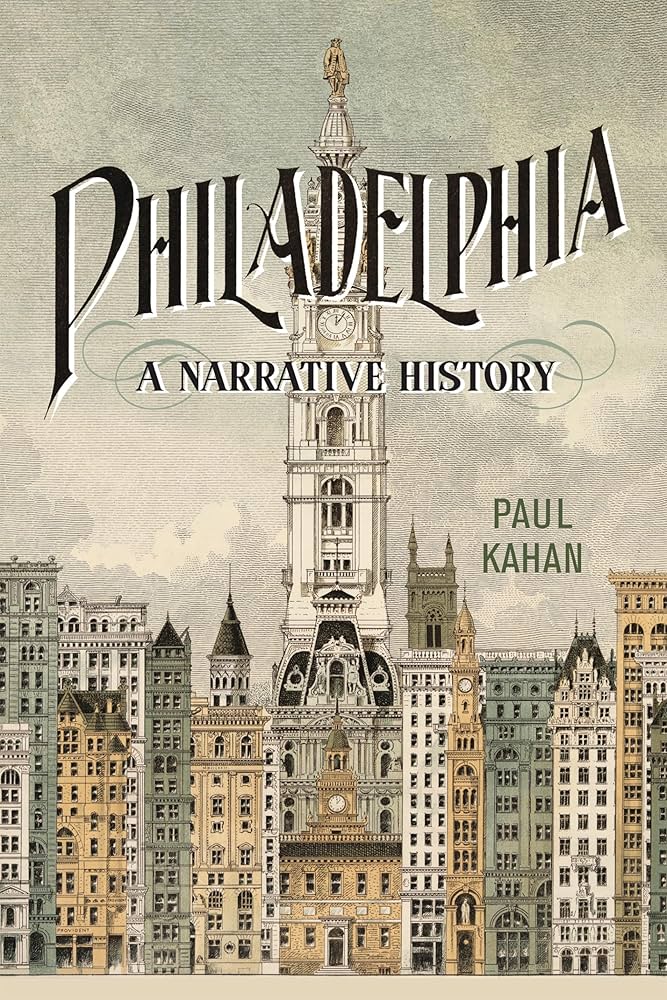 A comprehensive history of Philadelphia from the region’s original Lenape inhabitants to the myriad of residents in the twenty-first century
Philadelphia is famous for its colonial and revolutionary buildings and artifacts, which draw tourists from far and wide to gain a better understanding of the nation’s founding. Philadelphians, too, value these same buildings and artifacts for the stories they tell about their city. But Philadelphia existed long before the Liberty Bell was first rung, and its history extends well beyond the American Revolution. In Philadelphia: A Narrative History, Paul Kahan presents a comprehensive portrait of the city, from the region’s original Lenape inhabitants to the myriad of residents in the twenty-first century.
As any history of Philadelphia should, this book chronicles the people and places that make the city unique: from Independence Hall to Eastern State Penitentiary, Benjamin Franklin and Betsy Ross to Cecil B. Moore and Cherelle Parker. Kahan also shows us how Philadelphia has always been defined by ethnic, religious, and racial diversity—from the seventeenth century, when Dutch, Swedes, and Lenapes lived side by side along the Delaware; to the nineteenth century, when the city was home to a vibrant community of free Black and formerly enslaved people; to the twentieth century, when it attracted immigrants from around the world. This diversity, however, often resulted in conflict, especially over access to public spaces. Those two themes— diversity and conflict—have shaped Philadelphia’s development and remain visible in the city’s culture, society, and even its geography. Understanding Philadelphia’s past, Kahan says, is key to envisioning future possibilities for the City of Brotherly Love.
Paul Kahan is an expert on U.S. political, economic, and diplomatic history. He earned his Ph.D. in U.S. history from Temple University and lives outside of Philadelphia with his family. This is his seventh book.
c o n t e n t s
Introduction
1 Philadelphia Before 1681
2 The Founding of Philadelphia, 1681–1718
3 Franklin’s Philadelphia, 1718–1765
4 The Revolutionary City, 1765–1800
5 The Athens of America, 1800–1854
6 Civil War and Reconstruction, 1854–1876
7 Corrupt and Contended, 1876–1901
8 Wars, Abroad and at Home, 1901–1945
9 The Golden Age? 1945–1976
10 Crisis . . . and Renaissance? Philadelphia Since 1976
Notes
Index
Acknowledgments
New Book | Never Broken: Visualizing Lenape Histories
The exhibition was on view at the James A. Michener Art Museum in Doylestown, Pennsylvania this time last year (September 2023 – January 2024); the catalogue is still available from Penn Press:
Joe Baker and Laura Igoe, eds., Never Broken: Visualizing Lenape Histories (Philadelphia: University of Pennsylvania Press, 2024), 96 pages, ISBN: 978-1879636163, $30.
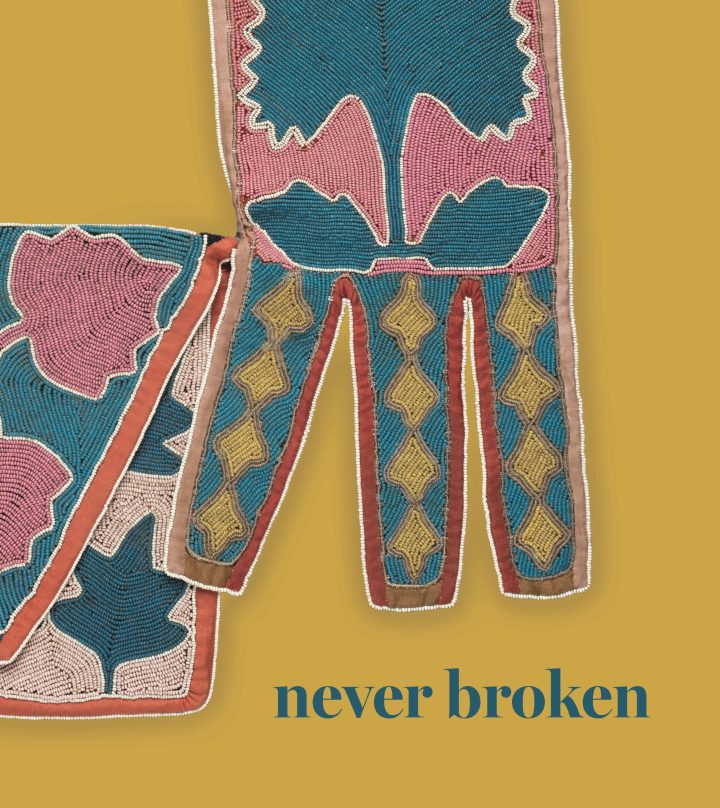 Through a focus on Lenape art, culture, and history and a critical examination of historical visualizations of Native and European American relationships, Never Broken explores the ways in which art can create, challenge, and rewrite history. This richly illustrated volume features contemporary work by Lenape artists in dialogue with historic Lenape ceramics, beadwork, and other cultural objects as well as re-creations of Benjamin West’s painting Penn’s Treaty with the Indians by European American artists. Published in conjunction with the first exhibition in Pennsylvania of contemporary Lenape artists who can trace their families back to the time of William Penn, Never Broken includes essays by Laura Turner Igoe, Joel Whitney, and Joe Baker. Igoe argues that the plethora of prints, paintings, and decorative arts that incorporated imagery from West’s iconic painting over a century after the depicted event attempted to replace the fraught history of Native and Anglo-American conflict with a myth of peaceful coexistence and succession. Whitney’s essay provides an overview of the culture of the Lenape and their forced removal out of Pennsylvania and the northeast to Oklahoma, Wisconsin, and Ontario. Finally, Baker highlights how he and the other contemporary Lenape artists featured in the exhibition, including Ahchipaptunhe (Delaware Tribe of Indians and Cherokee), Holly Wilson (Delaware Nation and Cherokee), and Nathan Young (Delaware Tribe of Indians, Pawnee, and Kiowa), tell their own stories rooted in memory, ancestry, oral history. Their work underscores the continuing legacy and evolution of Lenape visual expression and cross-cultural exchange, reasserts the agency of their Lenape ancestors, and establishes that the Lenape’s ties to the area were—unlike Penn’s Treaty—never broken.
Joe Baker is an artist, educator, curator, and culture bearer who has been working in the field of Native Arts for the past thirty years. He is an enrolled member of the Delaware Tribe of Indians of Oklahoma and co-founder and executive director of the Lenape Center in Manhattan. His work is included in the permanent collection of the Metropolitan Museum of Art and numerous other museums and collections in the United States and Canada, including the American Museum of Art and Design.
Laura Turner Igoe is the Gerry and Marguerite Lenfest Chief Curator at the James A. Michener Art Museum in Doylestown, Pennsylvania. At the Michener, she curated Impressionism to Modernism: The Lenfest Collection of American Art (2019), Rising Tides: Contemporary Art and the Ecology of Water (2020), and she co-curated Through the Lens: Modern Photography in the Delaware Valley (2021) and Daring Design: The Impact of Three Women on Wharton Esherick’s Craft (2021–22).
c o n t e n t s
Foreword and Acknowledgements — Vail Garvin
Introduction — Joe Baker and Laura Turner Igoe
Penn’s Treaty with the Indians: Myth-Making across Media — Laura Turner Igoe
Violence and the Forced Removals of the Lenape — Joel Whitney
Nèk Elànkumàchi Maehëleyok: The Relatives Gathered — Joe Baker
Plates
Contributors
New Book | Native Nations: A Millennium in North America
From Penguin Random House:
Kathleen DuVal, Native Nations: A Millennium in North America (New York: Random House, 2024), 752 pages, ISBN: 978-0525511038, $38.
 Finalist for the Cundill History Prize
Long before the colonization of North America, Indigenous Americans built diverse civilizations and adapted to a changing world in ways that reverberated globally. And, as award-winning historian Kathleen DuVal vividly recounts, when Europeans did arrive, no civilization came to a halt because of a few wandering explorers, even when the strangers came well armed.
A millennium ago, North American cities rivaled urban centers around the world in size. Then, following a period of climate change and instability, numerous smaller nations emerged, moving away from rather than toward urbanization. From this urban past, egalitarian government structures, diplomacy, and complex economies spread across North America. So, when Europeans showed up in the sixteenth century, they encountered societies they did not understand—those having developed differently from their own—and whose power they often underestimated.
For centuries afterward, Indigenous people maintained an upper hand and used Europeans in pursuit of their own interests. In Native Nations, we see how Mohawks closely controlled trade with the Dutch—and influenced global markets—and how Quapaws manipulated French colonists. Power dynamics shifted after the American Revolution, but Indigenous people continued to command much of the continent’s land and resources. Shawnee brothers Tecumseh and Tenskwatawa forged new alliances and encouraged a controversial new definition of Native identity to attempt to wall off U.S. ambitions. The Cherokees created institutions to assert their sovereignty on the global stage, and the Kiowas used their power in the west to regulate the passage of white settlers across their territory.
In this important addition to the growing tradition of North American history centered on Indigenous nations, Kathleen DuVal shows how the definitions of power and means of exerting it shifted over time, but the sovereignty and influence of Native peoples remained a constant—and will continue far into the future.
Kathleen DuVal is a professor of history at the University of North Carolina at Chapel Hill, where she teaches early American and American Indian history. Her previous work includes Independence Lost, which was a finalist for the George Washington Prize, and The Native Ground: Indians and Colonists in the Heart of the Continent. She is a coauthor of Give Me Liberty! and coeditor of Interpreting a Continent: Voices from Colonial America.
Exhibition | Colonial Crossings: The Spanish Americas

Unidentified workshop, Cuzco, Peru, Our Lady of the Rosary of Chiquinquirá with Female Donor, late 17th–early 18th century, oil and gold on canvas (Collection of Carl & Marilynn Thoma, 2013.046; photo by Jamie Stukenberg).
◊ ◊ ◊ ◊ ◊
Now on view at Cornell’s Johnson Museum of Art:
Colonial Crossings: Art, Identity, and Belief in the Spanish Americas
Johnson Museum of Art, Cornell University, Ithaca, New York, 20 July 2024 — 15 December 2024
Curated by Andrew Weislogel and Ananda Cohen-Aponte, with students in the course Colonial Connectivities: Curating the Arts of the Spanish Americas
The artworks featured in this exhibition span more than three hundred years of history, five thousand miles of territory, and two oceans, introducing the rich artistic traditions of Mexico, Venezuela, Colombia, Ecuador, Peru, Bolivia, Cuba, Puerto Rico, and the Philippines during the period of Spanish colonial rule (approximately 1492–1830).
This first exhibition of colonial Latin American art at Cornell considers the profound impact of colonization, evangelization, and the transatlantic slave trade in the visual culture of the Spanish empire, while also manifesting the creative agency and resilience of Indigenous, Black, and mixed-race artists during a tumultuous historical period bookended by conquest and revolution.
At first glance, these religious images, portraits, and luxury goods might seem to uphold colonial structures that suggest a one-way flow of power from Europe to the Americas. Yet closer consideration of these artists’ identities, materials, techniques, and subjects reveals compelling stories about the global crossings of people, commodities, and ideas in the creation of new visual languages in the Spanish Americas. These artworks testify to entangled cultural landscapes—from paintings of the Virgin Mary with ties to sacred sites of her apparition, to lacquer furniture bearing the visual stamp of trade with East Asia, they embody a plurality of cultural, material, and religious meanings.
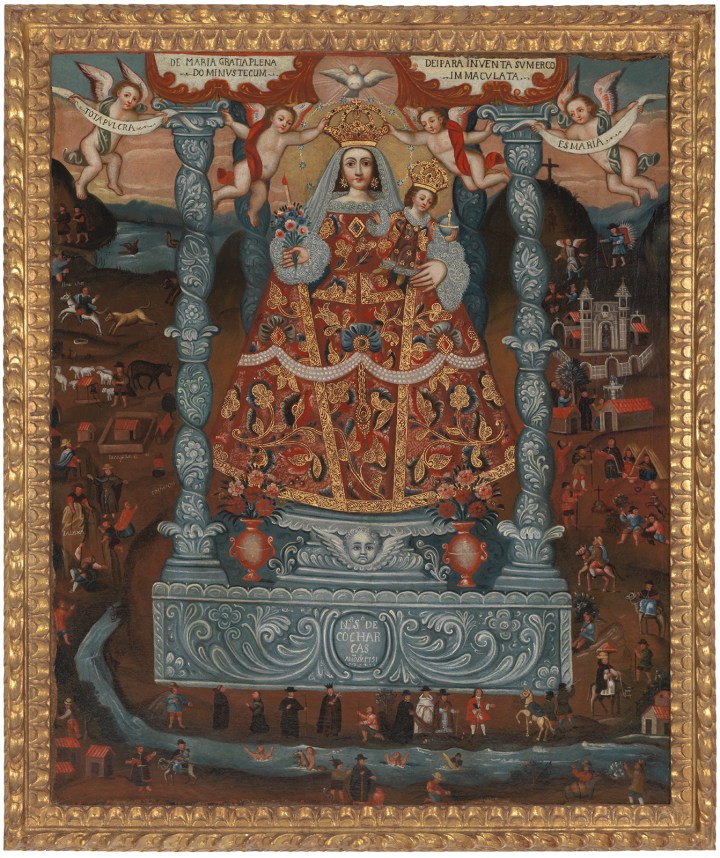
Unidentified workshop, Peru, Our Lady of Cocharcas, 1751, oiil and gold on canvas (Collection of Carl & Marilynn Thoma, 2011.040; photo by Jamie Stukenberg).
Colonial Crossings was curated by Dr. Andrew C. Weislogel, Seymour R. Askin, Jr. ’47 Curator of Earlier European and American Art at the Museum, and Dr. Ananda Cohen-Aponte, Associate Professor of the History of Art & Visual Studies, and the students in Colonial Connectivities: Curating the Arts of the Spanish Americas (ARTH 4166/6166):
Osiel Aldaba ’26
Miguel Barrera ’24
Daniel Dixon ’24
Juliana Fagua Arias, PhD student
Miche Flores, PhD student
Isa Goico ’24
Sara Handerhan ’24
Emily Hernandez ’25
Ashley Koca ’25
Maximilian Leston ’26
Maria Mendoza Blanco ’26
Lena Sow, PhD student
Nicholas Vega ’26
We are grateful to lenders Carl and Marilynn Thoma, the Denver Museum of Art, the Hispanic Society of America, and the Division of Rare and Manuscript Collections, Cornell University Library; and to David Ni ’24, the 2023 Nancy Horton Bartels ’48 Scholar for Collections, for organizational support.

Unidentified artist, Quito, Ecuador, Noah’s Ark, detail, late 18th century, oil on canvas (Collection of Carl & Marilynn Thoma, 2000.004).
◊ ◊ ◊ ◊ ◊
The Johnson Museum will also present this symposium:
Symposium | Reimagining the Américas: New Perspectives on Spanish Colonial Art
Online and in-person, Saturday, 9 November 2024
At this free symposium, presented in conjunction with the exhibition, established scholars whose work encompasses a variety of regions and approaches to colonial Latin American art history will offer new methodologies, seeking to expand the boundaries of this visual culture. Presentations will explore the exhibition’s thematic emphases on materiality and sacredness, hybridity and cross-cultural exchange, colonial constructions of race, and recovering art histories marked by silence and erasure.
• Time-Warping the Museum: Temporal Juxtapositions in Displays of Spanish Colonial Art — Lucia Abramovich, Museum of Fine Arts, Boston
• Framing Miracles for a New World: The Oval — Jennifer Baez, University of Washington
• Trent as Compass: Directions, Circuits, and Crossings of the Visual and Canonical in Spanish America — Cristina Cruz González, Oklahoma State University
• Splendor and Iridescence: Pearls in the Art of the Spanish Americas — Mónica Dominguez Torres, University of Delaware
• ‘Your Plenteous Grandeur Resides in You’: Asian Luxury in Spanish American Domestic Interiors — Juliana Fagua Arias, Cornell University
• Supplicant Africans: From Baptizands to Emblems of Abolition —Elena FitzPatrick Sifford, Muhlenberg College
• Voices of Influence: Exploring Power Dynamics in the Conservation of Musical Heritage in Colonial Latin America — Patricia García Gil, Cornell University
• Invisible Soldiers and Constant Servants: The Pre-Hispanic Roots of the Andean Cult of Angels — Maya Stanfield-Mazzi, University of Florida
A schedule will be posted soon. Please email eas8@cornell.edu to register in advance for in-person attendance. Click here to join the webinar.
Call for Papers | Global Material Culture and the Body, BSECS 2025 Panel
From HECAA:
Panel | Global Material Culture and the Body
British Society for Eighteenth-Century Studies Conference, Pembroke College, Oxford, 8–10 January 2025
Panel organized by Chloe Wigston Smith
Proposals for this session due by 18 October 2024
 Jointly supported by the Historians of Eighteenth-Century Art and Architecture and the University of York’s Center for Eighteenth Century Studies, this panel aims to foster interdisciplinary conversations about the relations between global material culture and the body, in keeping with the theme of the 54th annual BSECS conference, Bodies and Embodiment. Papers might focus on the body’s physical proximity to examples of global material culture, whether in the form of clothes, accessories, cosmetics, and domestic furnishings (and more); the body’s haptic experience of global objects, through making, production, handling, and consumption; and / or the representation of the body and bodies on specific objects. Papers might focus on a wide range of print, visual, and material sources, including ceramics, drawings, watercolours, handiwork, woodwork, etc, and / or the broad range of materials in the period, such as cotton, indigo, or silver. Submissions from early career scholars are especially encouraged. Please submit abstracts of no more than 350 words along with a short (1 page) CV to Chloe Wigston Smith at chloe.wigstonsmith@york.ac.uk.
Please note that selected presenters will need to become members of BSECS to register for the conference. Or BSECS honors ASECS memberships, so if you are an ASECS member you will not need to join BSECS.
Conference | The Window as Protagonist

Eric Ravilious, Beachy Head Lighthouse (Belle Tout), 1939, pencil and watercolour on paper (Christie’s Images / Bridgeman Images).
◊ ◊ ◊ ◊ ◊
From the Mellon Centre:
The Window as Protagonist in British Architecture and Visual Culture
Online and in-person, Paul Mellon Centre and The Warburg Institute, London, 21–22 November 2024
Organized by Rebecca Tropp
This two-day conference will explore the multifaceted, multi-purpose nature of the window as protagonist, with an emphasis on its place in British architecture and visual culture, broadly conceived. A range of interdisciplinary papers presented by international scholars will provide a platform for dynamic and engaging discourse that forefronts the cultural and social significance of the window in its many guises as object, as boundary, as frame, and as mediator.
More information is available here»
t h u r s d a y , 2 1 n o v e m b e r
Paul Mellon Centre
Panel 1 | Visions of Light
• Benet Ge (student, Williams College) — Looked Through: Edward Orme’s Transparent Prints and Masculinizing Georgian Windows, remote
• Francesca Strobino (independent) — The Window as a Test Object: W.H.F. Talbot’s Early Photographic Experiments with Latticed Patterns, remote
• Victoria Hepburn (postdoctoral associate, Yale Center for British Art) — A ‘Luminous Framework’ but not ‘Glass of a Modern Kind’: William Bell Scott’s Painted Windows for the Ceramic Gallery at the South Kensington Museum, remote
Panel 2 | Social Relations
• Shaona Barik (assistant professor of English literature at Visva-Bharati, Santiniketan, India) — Health, Hygiene, Sanitation in Colonial Bengal: Case Study of Windows, 1860–1920, remote
• Albie Fay (writer) — Through the Broken Glass: The Window as a Symbol of Social Unrest in Britain and Northern Ireland
• Ellie Brown (PhD candidate, University of Warwick) — The Window as a Frame and Boundary in the Shopping Centre
f r i d a y , 2 2 n o v e m b e r
The Warburg Institute
Panel 1 | The Art of Display: From Museums to Shop Windows
• Laura Harris (Senior Research Fellow, University of Southampton) — Art Gallery Windows
• Naomi Polonsky (assistant curator, House and Collection, Kettle’s Yard) — ‘The Vision of the Mind’: Windows In and Out of Art at Kettle’s Yard
• Alexandra Ault (Lead Curator of Manuscripts, 1601–1850, British Library) — Re-glazing the Print Shop Window: The Impact of Glass Technology on the Commercial Display of Fine Art Prints, ca. 1850–1900
• Birgitta Huse (social anthropologist, independent researcher) — More Than a Glimpse ‘In Passing’: Reflecting on Shop Windows as Provocateurs between Art, Commerce, and Cultural Traditions
Panel 2 | Architectural Manipulation
• Steven Lauritano (lecturer in architectural history, Leiden University) — Windows of Learning: Robert Adam, William Henry Playfair, and the Old College, University of Edinburgh
• Rebecca Tropp (archivist, Crosby Moran Hall and former Research and Events Convener at the Paul Mellon Centre) — Windows and the Picturesque
Panel 3 | Transparency and Materiality
• Alice Mercier (PhD researcher, University of Westminster) — Photographic Looking before Photographs: Watching through Windows in the Early-mid Nineteenth Century, remote
• Ruth Ezra (lecturer in art history, University of St Andrews) — Muscovy Glass, from Fenestration to Demonstration
• Deborah Schultz (senior lecturer in art history, Regent’s University London) — The Window as a Lens in the Work of Anna Barriball
Panel 4 | Cinematic and Literary Horrors
• Vajdon Sohaili (assistant professor of art history and contemporary culture, Nova Scotia College of Art and Design University) — Glass, Darkly: Equivocal Windows and the Architectural Paratext in Don’t Look Now
• Francesca Saggini (professor in English literature at the Università della Tuscia) — The Horror at the Window










 Enfilade
leave a comment