Berger Prize Shortlist, 2024
From the press release for the shortlist, as shared on 15 September; the winner will be announced 15 November.
 The Walpole Society has recently announced the shortlist for the Berger Prize, the most prestigious book prize for art history, including a major publication on Gwen John, one of the most significant British women artists of the 20th century, and a book which explores the role that art played in destabilising the legitimacy of the one of the most powerful corporations in history: the East India Company.
A lifetime of knowledge is gifted to the reader in Steven Brindle’s monumental Architecture in Britain and Ireland 1530–1830 (Paul Mellon Centre). From its brilliant opening introduction this magisterial overview sets the national architectural story alight and the reader is struck by the scale and the sweep of history that Brindle handles with consummate skill, revealing a lifetime of practical and scholarly expertise in the field. This book will become an essential handbook and a classic study for future generations of scholars.
In her critical biography, Gwen John: Art and Life in London and Paris (Thames & Hudson), Alicia Foster deftly dismantles the various myths surrounding John and ensures that she regains her full artistic stature; the author asks important theoretical questions about the status of a self-portrait and the artist-model relationship in the nineteenth and twentieth centuries. Enriched by over 240 reproductions of paintings and contemporary photographs and through many excerpts of letters, the reader is immersed in the artist’s deeply personal aesthetic world.
Richly researched and beautifully written, Laura Freeman charts the story of one of the most fascinating figures of mid-century British art, the curator, patron and museum maker, Jim Ede. Ways of Life: Jim Ede and the Kettle’s Yard Artists (Penguin, Jonathan Cape), brings Ede’s Cambridge house to life, offering fresh insights into its familiar collection of paintings, sculptures and pebbles. Based on meticulous research, Freeman populates her narrative with a fascinating cast of characters from Henri Gaudier-Brzeska to T.E. Lawrence.
 Highlighting an area which is gaining momentum and interest for scholars as well as collectors, Alun Graves’s Studio Ceramics (Thames & Hudson / V&A) presents the state of the national collection of Studio Ceramics and will have international impact. The exemplary writing, photography and design make this the unmissable reference work on the subject.
The complex world of post-colonial scholarship is nimbly traversed for a modern audience by Tom Young in Unmaking the East India Company: British Art and Political Reform in Colonial India, c.1813–58 (Paul Mellon Centre). This revelatory book explores how the visual culture of members of the East India Company prompted significant structural change. Fresh material is explored from a compelling new angle, charting the ways in which new artistic forms and practices presaged shifts in the governance of the Company and its relationship with the people it governed. This is a dazzling and erudite intervention that will define the discipline for future generations.
The Berger Prize is the most prestigious award in art history, offering the largest cash prize in the field: £5,000 is awarded to the winner and £500 to each of the shortlisted authors. Named in honour of the late William B. Berger, whose collection of British art is on display at the Denver Art Museum in his native Colorado, the award was founded in 2001 by the Berger Collection Educational Trust (BCET) and The British Art Journal. This year, for the first time, The Walpole Society, which promotes the study of Britain’s art history, has partnered with the BCET to deliver the prize, which celebrates brilliant writing and scholarship about the arts and architecture of the United Kingdom.
Lecture | Black Genius: The Extraordinary Portrait of Francis Williams
From the V&A:
Fara Dabhoiwala | Black Genius: Science, Race, and the Extraordinary Portrait of Francis Williams
Online and in-person, Victoria & Albert Museum, London, 16 October 2024, 7pm (2pm ET)

Unidentified painter, Portrait of Francis Williams of Jamaica, ca. 1740, oil on canvas, 76 × 64 cm (London: V&A).
Join historian Fara Dabhoiwala for the captivating story behind one of the V&A’s most fascinating portraits.
In 1928, the V&A acquired a previously unknown portrait. It shows the Black Jamaican polymath Francis Williams (c. 1690–1762), dressed in a wig, surrounded by books and scientific instruments. In all of the previous history of Western art, there is no other image like this: a man who had been born into slavery, shown as a gentleman and scholar. The museum presumed it was a satire—but who had made it, when, where, and why, has remained a puzzle ever since. Join Fara Dabhoiwala as he reveals the astonishing story of the painting’s true meaning, its connections to the greatest scientists of the Enlightenment—and Francis Williams’s extraordinary message to posterity. This talk will be streamed on Zoom, and all ticketholders will receive a link to view the morning of the event.
The talk is in association with the London Review of Books.
Lecture | Jean-Baptiste Boiston (1734–1814): Sculpteur ornemaniste
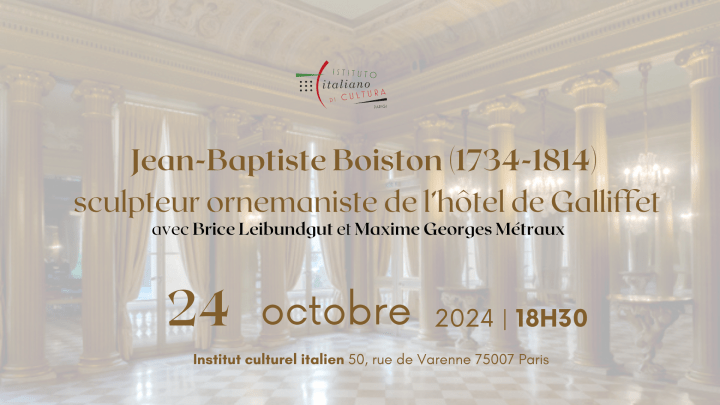
Upcoming at the Institut culturel italien de Paris:
Brice Leibundgut et Maxime Georges Métraux | Jean-Baptiste Boiston (1734–1814): Sculpteur ornemaniste de l’hôtel de Gallifet
Institut culturel italien de Paris / Istituto Italiano di Cultura di Parigi, 24 October 2024, 6.30pm
Né en 1734 à Morteau, dans le Doubs, Jean-Baptiste Boiston est un sculpteur ornemaniste de premier plan durant la seconde moitié du XVIIIe siècle. Il est principalement actif à Paris de 1760 à 1792, avant d’émigrer au moment de la Révolution. En 1814, au lendemain de la Restauration, il revient s’établir dans la capitale française où il s’éteint cette même année. Cette conférence se propose d’étudier son œuvre et d’inventorier sa production connue à ce jour. Les créations de Jean-Baptiste Boiston sont principalement à destination de nombreux hôtels particuliers parisiens, mais aussi au service du prince de Condé (Palais Bourbon, château de Chantilly). Ses différents chantiers auprès de l’architecte Étienne François Legrand feront l’objet d’une analyse détaillée, au premier rang desquels le chantier de l’hôtel de Galliffet, actuel Institut culturel italien de Paris. Cette conférence sera l’occasion de plonger dans l’univers de cet entrepreneur en ornements sous le règne de Louis XVI, de découvrir son métier et ses spécificités, mais aussi d’évoquer sa relation avec l’Italie.
Brice Leibundgut, historien de l’art, trésorier et administrateur de la Société de l’Histoire de l’Art français, spécialiste de l’art en Franche-Comté, expert UFE de trois peintres de cette région : Gustave Courtois, Dagnan-Bouveret, Robert Fernier.
Maxime Georges Métraux, historien de l’art, membre de l’équipe de la galerie Hubert Duchemin et chargé d’enseignement à l’université Paris 1 Panthéon-Sorbonne, administrateur de la Société de l’Histoire de l’Art français.
Online Talk | Rachel Jacobs on Ornament Prints at the Cooper Hewitt
From the Cooper Hewitt:
Rachel Jacobs | A Dictionary of Ornament: Highlights from Cooper Hewitt’s Print Collection
Online (via Zoom), 24 October 2024, 1.00pm ET
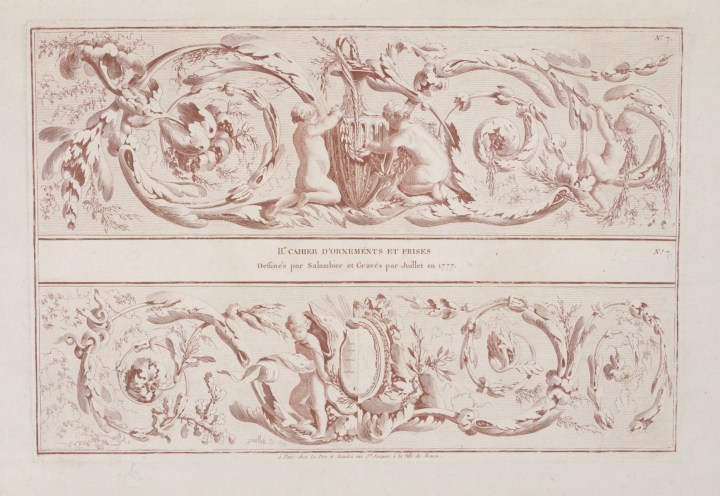
Title page and Frieze Designs, plate 7 from IIe Cahier d’Ornements et Frises (2nd Book of Ornaments and Friezes), 1777; Jacques Juillet after Henri Sallembier, published by Le Père et Avaulez (Paris); etching and engraving in red ink on laid paper (Cooper Hewitt).
Join Cooper Hewitt for an illustrated talk exploring the Decloux collection of ornament and architecture prints. The museum is home to the premier collection of ornament prints in the United States, consisting of over 13,000 European prints from the 16th to the 19th centuries. The lecture will include highlights from the collection by some of the most celebrated artists and designers of the period, as well a discovery of more hidden treasures by many forgotten or lesser-known artists and printmakers.
Ornament prints were produced with the purpose of illustrating designs, patterns, or motifs of decorative ornament for use by craftsman and applicable to all aspects of applied arts from ceramic vases to furniture, from wall paneling to wrought-iron gates. This illustrated talk will introduce the Decloux collection of ornament and architecture prints by exploring the language of ornament. How do these printmakers and publishers describe and title their works? What are the most common terms and motifs found in this broad genre and why? And how do these two-dimensional intaglio prints translate to real three-dimensional objects and interiors?
The talk is free with registration. It will also be recorded and posted on Cooper Hewitt’s YouTube channel within two weeks.
Rachel Jacobs is an independent curator specializing in French 17th-and 18th-century books and prints, based in Toronto, Canada. Since 2021, she is the Remote Senior Research Cataloguer for the Decloux collection of ornament and architecture prints in the Department of Drawings, Prints, and Graphic Design at Cooper Hewitt, Smithsonian Design Museum. She was previously Curator of Books and Manuscripts at Waddesdon Manor (Rothschild Collections) National Trust in England, where she continues to work remotely part-time. She has curated several exhibitions at Waddesdon Manor including most recently Alice’s Wonderlands: Life, Collections, and Legacy of Alice de Rothschild (1847–1922) (2022–23, co-curated).
Caitlin Condell is the associate curator and head of the Department of Drawings, Prints, and Graphic Design at Cooper Hewitt, Smithsonian Design Museum, New York, where she oversees a collection of nearly 147,000 works on paper dating from the 14th century to the present. She has organized and contributed to numerous exhibitions and publications. Prior to joining the Smithsonian, Condell held positions at the Massachusetts Museum of Contemporary Art and The Museum of Modern Art.
Research Lunch | London’s Periodical Architecture, 1700–1750
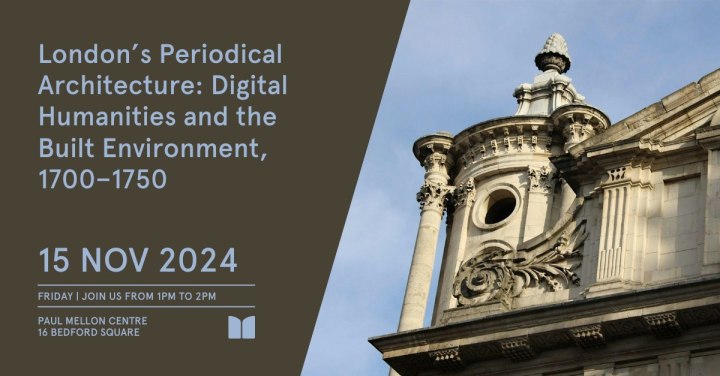
Thomas Archer, St John Smith Square, London, completed in 1728
(Photo: © Matthew Lloyd Roberts)
◊ ◊ ◊ ◊ ◊
Next month at the Mellon Centre:
Matthew Lloyd Roberts | London’s Periodical Architecture: Digital Humanities and the Built Environment, 1700–1750
Paul Mellon Centre, London, 15 November 2024, 1pm
In recent years, large-scale digitisation of early modern periodicals has revolutionised the searchability of collections of ephemeral print culture. Enabled by optical character recognition technology, this shift has transformed the way scholars use databases of primary material, introducing new quantitative approaches to these vast collections. However, this shift also poses epistemological questions within new digital humanities frameworks. The paper will explore this shift by presenting material newly discovered by these methods relating to church building in London in the first half of the eighteenth century. Firstly, looking at the way that the work of the New Churches Commission was represented and debated by the politically factional newspaper culture in the first years of Hanoverian rule, and then recognising the effect this discourse may have had in shaping the way that people experienced the city. By incorporating periodical culture as an important context of the work of the Commission, for the first time this study proposes a substantive media and reception history of these iconic buildings of the English Baroque.
Furthermore, this paper will consider the explosion of architectural publishing in the periodical press of the mid-1730s, in the context of James Ralph’s Critical Review, examining the way that architectural practitioners such as John James were increasingly forced to foray into periodical culture to defend their expertise and reputations. These events will be read towards the political and social meanings of church building and church restoration, and the growing anxiety about the need to disambiguate the meanings of the built environment to the urban public in an age of print culture.
Matthew Lloyd Roberts is a history of art PhD candidate at Downing College, Cambridge and member of the Ax:son Johnson Centre for the Study of Classical Architecture. His PhD research is concerned with the cultural reception of the changing built environment of England in the seventeenth and eighteenth centuries. He studied ancient and modern history at Keble College, Oxford and has an MA in architectural history from the Bartlett, UCL. Complementing his academic work, he is also interested in disseminating academic research to broader audiences and produces and hosts two podcasts concerned with architectural history and culture, the independent About Buildings and Cities and the official podcast of the Society of Architectural Historians of Great Britain. His architectural criticism has also appeared in Tribune (magazine), The New Statesman, and The Critic, and he leads architectural walking tours for a variety of organisations including Open City.
Conference | Sacred Silver in Southeast Europe, 15th–19th Centuries
From ArtHist.net and the conference website:
Southeast European Silversmithing: Artisans, Donors, and Piety in the Early Modern Period
Sofia, Bulgaria, 17–18 October 2024
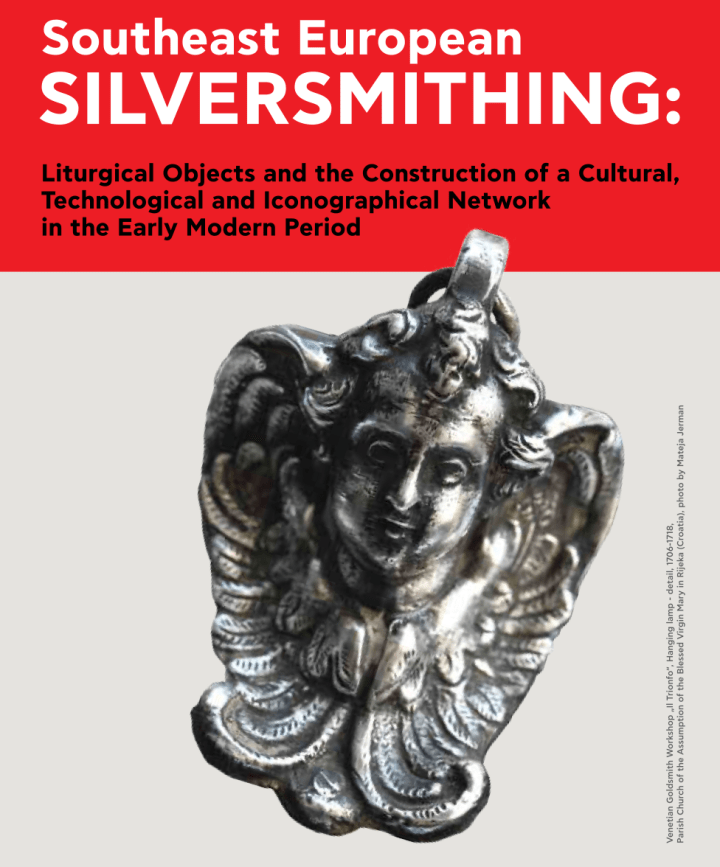 The international conference Southeast European Silversmithing: Artisans, Donors, and the Concept of Piety during the Early Modern Period will gather specialists studying sacral silver objects from the early modern period who, through their research, contribute to the field of applied arts with religious use. The scientific forum will enable the presentation of sacral silver objects still unpublished and unknown to the academic community. It will stimulate the comparative analysis of silversmiths’ works in wide geographic regions, which will also help improve the methodological means of their interpretation. A more meticulous approach to this field will represent a valuable contribution to art historical scholarship and a more comprehensive understanding of the visual culture of the early modern period.
Twenty-six specialists from prestigious organisations, universities, and cultural institutions from Austria, Armenia, Bulgaria, Greece, Italy, the Netherlands, Romania, the USA, Serbia, and Hungary will discuss issues related to the production and circulation of liturgical objects, as well as their role in shaping the pious image of the faithful in Southeastern Europe between the 15th and 19th centuries. The conference is organised within the framework of the project Liturgical Objects in the Context of Silversmiths’ Art during the Ottoman Period (Based on Materials from the Diocese of Plovdiv), funded by the Bulgarian National Science Fund, Ministry of Education and Science of the Republic of Bulgaria (contract No. КП-06-М80/2/7.12.2023).
Academic Committee
• Darina Boykina, PhD, Institute of Art Studies, Bulgarian Academy of Sciences, Bulgaria
• Mateja Jerman, PhD, Ministry of Culture and Media of the Republic of Croatia and Faculty of Humanities and Social Sciences, University of Rijeka, Croatia
• Vuk Dautović, PhD, University of Belgrade, Serbia
t h u r s d a y , 1 7 o c t o b e r
Institute of Ethnology and Folklore Studies with Ethnographic Museum, Bulgarian Academy of Sciences
9.30 Registration
10.00 Welcome
10.15 Constructing Piety
Chair: Vuk Dautović
• Dimitris Liakos — Constructing the Pious Image in Southeastern Europe at the Turn of an Era: Valuable Objects as Gifts to Athonite Monasteries from the 15th to the 16th Century
• Miljana Matić — Monks as Authors and Donors of Applied Art Objects (15th–17th Centuries) from the Serbian Orthodox Church Museum Collection
• Darina Boykina — Artisans’ Patronage: The Case of the Guild of Silversmiths in Tatar Pazardzhik during the Early Modern Period
11.30 Coffee Break
11.50 Personal and Collective Patronage
Chair: Teodor Lucian Lechintan
• Nikolaos Mertzimekis — The Silver Cover of the Gospel of Tsar Alexei Mikhailovich (1645–1676) in the Sacristy of the Iviron Monastery
• Paschalis Androudis — On a Pair of Candlesticks from the Metropolitan Church of Kastoria, 1708
• Nicoleta Bădilă — Donors’ Portraits from the Silver Liturgical Fans from Wallachia
• Nona Petkova — Examples of Faith and Community Belonging: Eucharistic Chalices from the National Church Museum of History and Archaeology in Sofia
13.30 Lunch
15.00 Influential Objects: Appearance and Morphology
Chair: Livia Stoenescu
• Mila Santova — Once Again about the Gospel Covers from the Teteven Monastery of Prophet Elijah (Teteven Gospel Covers from 1675)
• Georgi Parpulov — Two Romanian Ciboria at the Sinai Monastery
• Mariam Vardanyan — Innovative Tendencies in the Art of Armenian Book Binding: Myrophores Gospels Bindings
16.15 Coffee Break
16:30 Silver Objects as Emissary: Circulation, Diplomacy, and Gifts
Chair: Paschalis Androudis
• Mateja Jerman — Goldsmiths’ Works as Gifts to Our Lady of Trsat (Croatia)
• Milena Ulčar — Collective Patronage of St. Tryphon’s Head Reliquary in Venetian Kotor
• Arijana Koprčina — Gifts of Bishop Emerik Esterházy to Zagreb (Arch)diocese
• Francesca Stopper — La Serenissima and the Papal States: Liturgical Objects as Diplomatic Gifts in the 18th Century
f r i d a y , 1 8 o c t o b e r
Institute of Art Studies, Bulgarian Academy of Sciences
9.30 Patrons and Silversmith Creating Visual Culture
Chair: Darina Boykina
• Dragoş Năstăsoiu — Cross-confessional Artistic Negotiation: Transylvanian Saxon Silversmith Masters and Their Orthodox Patrons in 14th to 17th-Century Wallachia and Moldavia
• Teodor Lucian Lechintan — On Some Early Modern Silver Revetments of Romanian Icons: Donors, Techniques, Horizons
• Vuk Dautović — Silver Votive Offerings of 19th-Century Serbian Rulers: Shaping Church Visual Culture and their Role in Changing Cultural Models
10.45 Coffee Break
11.00 Silversmithing Centers and Production of the Liturgical Object
Chair: Mila Santova
• Stavroula Sdrolia, Paschalis Androudis — 17th-Century Goldsmiths’ Enamelled Production in Thessaly
• Barbara Kamler-Wild — Silversmithing in Vienna in the Golden Age of Empress Maria Theresia
• Livia Stoenescu — To Be Worth a Potosí: Mines, Wealth, and Global Crafting of Silver Liturgical Objects in Early Modernity
12.15 Coffee Break
12.30 Silver Embodying Sanctity
Chair: Milena Ulčar
• Konstantinos Dolmas — Like a Second Skin: The Head-Reliquary of St. Kliment of Ohrid
• Simeon Tonchev — The Reliquary from the Church ‘Mother of God the Fountain of Life’ in Svilengrad and Its Context
13.20 Lunch
15.00 Imagery and Iconography
Chair: Mateja Jerman
• Anna Mária Nyárádi — Images Between the Latin and Greek Worlds. Prints and Book Illustrations as Models for Gospel Covers
• Iglika Mishkova — Bread Stamps
• Carmen Tănăsoiu — Behold the Lamb of God: About a Certain Iconographic Type Found on Diskoi from the Collection of the National Museum of Art of Romania
• Ruth Bryant — Analyzing the Torah Shield: Understanding the Abundance of Animal Imagery through the Zohar
16.45 Closing Remarks
Lecture | Jussi Nuorteva on August Philip Armfelt in England, 1790–91
From the Society of Antiquaries:
Jussi Nuorteva | A Swedish-Finnish Antiquarian and Military Officer in England
Online (via YouTube), Society of Antiquaries of London, 14 October 2024, 1.30pm

August Philip Armfelt, ca. 1830 (Wiurila Manor, Halikko, Finland).
Discover the life of Baron August Philip Armfelt (1768–1839), Aide-de-Camp of the Swedish King Gustaf, and hear about his adventures during a trip to England in 1790–1791.
Free poster display on the ground floor of the Society’s Burlington House premises, 10am–4pm each day:
Tuesday, 15 October
Wednesday, 16 October
Thursday, 17 October
Friday, 18 October
During this period, the connection between Sweden and France had been close, but those ties were broken in the French Revolution of 1789. Afterward, new connections arose between Britain and Sweden. Britain was concerned about the rising power of Russia in the Baltic Sea area, crucial for import of tar and iron—essential materials in shipbuilding. Sweden, where Finland had been part of since 12th century, was the most important producer of these goods. Thus, new relations were formed.
While in England, August Philip Armfelt met many interesting people, not only the royals. His autobiography, around which the exhibition is built, tells of his various meetings and conversations with many other areas of the society. Armfelt met people like Goodfellow, the Swedish artist Elias Martin (one of the early academicians of the Royal Academy of Arts), and abolitionists like John Wedgwood and Swedish Carl Bernhard Wadenström. Sadly, Armfelt’s travels lasted only until 1792, when Swedish King Gustaf III was murdered by his opponents and a block of noble men took the power.
Live-streamed and open to anyone to join online, the lecture forms part of a series of events organised by the Embassy of Sweden in London and the Embassy of Finland in London, with the support of Samfundet Ehrensvärd, Medical Counsellor Sakari Alhopuro, Stiftelsen Tre Smeder and the Kalevi Kuitusen Foundation.
The YouTube link is available here»
Jussi Nuorteva was National Archivist of Finland until his retirement in 2022. He is a member of the Finnish Academy of Science and Letters, as well as Chancellor of the Orders of the White Rose of Finland and the Lion of Finland.
New Book | Goya’s Caprichos in Nineteenth-Century France
From CEEH:
Paula Fayos Pérez, Goya’s Caprichos in Nineteenth-Century France: Politics of the Grotesque (Madrid: Centro de Estudios Europa Hispánica, 2024), 544 pages, ISBN: 978-8418760204, €56.
 The impact of Goya’s oeuvre and particularly of the Caprichos (1799) on nineteenth-century French art was immense, long lasting, and multifaceted. Whereas in Spain Goya was associated with the work he produced as court painter, in France he became known as the author of the Caprichos, interpreted by the Romantics as a lampoon of late eighteenth-century Spain. This vision overlooked the fact that the true modernity of Goya’s work lies in its universalism, as a mirror reflecting the essence of humankind, unfettered by patriotism—this is also true of his monsters and witches, which are nothing more than the deformed reflection of humans. It could be argued that this was a two-way influence: Goya contributed to shape French Romantic art—and thus the beginning of modern art—and the Romantics in turn modelled his critical image. This study challenges the established interpretation of the Spanish artist that has dominated the scholarship until recently, based on Romantic stereotypes, many of which have been perpetuated to this day.
Goya became known in the French market—the main receptor of his work—through his graphic oeuvre. This was promoted by artists, critics and collectors such as Charles Yriarte, Paul Lefort, and Eugène Piot, most of them in association with the Spanish artist and dealer Valentín Carderera. Goya’s influence can be divided into two broad categories: aesthetics and politics. On the one hand, artists of the Romantisme noir—focusing on the taste for the grotesque and the literary vision of Spain—saw Goya as the last representative of the Spanish School. On the other, the political impact of his work can be appreciated in the satirical prints produced by artists such as Honoré Daumier and J. J. Grandville, who held him to be a politically engaged caricaturist who fought against censorship and mocked the aristocracy and the clergy. The case of Eugène Delacroix offers the richest example of Goya’s impact on nineteenth-century French art, here backed up by a catalogue of forty of his copies after the Caprichos, some of them hitherto unpublished.
Paula Fayos Pérez received a PhD in History of Art from the University of Cambridge in 2019 with a dissertation on the influence of Goya on nineteenth-century French art and literature. She worked as a researcher in the Duke of Wellington’s private collection at Apsley House (London) and Stratfield Saye House (Hampshire). Before receiving a ‘Leonardo’ scholarship from the BBVA Foundation she held a ‘Margarita Salas’ postdoctoral fellowship to teach and conduct research at the Universities of Strasbourg and Madrid (Complutense). In 2023 she organised the international seminar Goya: grotesco / coleccionismo. She has written articles for The Burlington Magazine (2019, 2020), Boletín del Museo del Prado (2022), and Print Quarterly (2023).
c o n t e n t s
Note to the Reader
Acknowledgements
Introduction
I | The Spread of Goya’s Œuvre in the French Art Market: Presentations, Viewers, and Collectors
• First Period (1799–1828): Goya’s Lifetime
• Second Period (1828–1854): The Dealing of Javier Goya
• Third Period (1854–1870): The Dealing of Valentín Carderera
• Fourth Period (1870–1900): Major Auction Sales and Collections
II | The Caprichos and Romantic Aesthetics: Goyaesque Spain and the Grotesque in Prints and Literature
• The Romantic Interpretation of Goya
• Romantic Literature and Illustration Inspired by Goya
III | Political Bigotry and Social Mœurs: Caricature, Censorship, and Democracy
• Goya as a Political Artist
• Political Caricature, Censorship and Democracy
• From Political to Social Criticism
IV | ‘Tout Goya palpitait autour de moi’: The Case of Eugène Delacroix
• A Self-proclaimed Classicist
• Goya’s Influence on Delacroix
• Delacroix’s Copies after the Caprichos
• Quotations or ‘Inspired Originals’ after the Caprichos
• Original Works Indirectly Influenced by Goya
V | Conclusion
• The Everlasting Influence of Goya
• Censorship and the Power of Caricature
• Future Research Threads
• The Fine Line between Admiration and Fabrication
Appendices
1 Goya’s Etchings and Lithographs: Series and Single Prints
2 Goya Mentions in French Literature (1771–1900)
3 Catalogue of Eugène Delacroix’s Works after Goya’s Caprichos (c. 1819–1827)
4 Copies by Capricho
List of Illustrations
Bibliography
Goya Works
Index
Illustration Credits
Call for Papers | Conservation through the Centuries
From the Call for Papers:
Matters of Knowledge: Paradigms and Practices of Conservation through the Centuries
Les matières du savoir: Paradigmes et pratiques de la conservation à travers les siècles
Université de Neuchâtel, June 5–6 June 2025
Proposals due by 31 October 2024
Preservation and conservation, along with collecting and valuation, are pillars of any institution that holds a collection of cultural heritage. However, conservation is rarely the subject of analytical and reflexive discourse, researched in a historical perspective. Studies in museology, the history of collections, and even the history of science and technology, have offered their perspectives on why and how all kinds of material collections are preserved in institutions dedicated to conservation. Further, the professionals of these institutions are faced with their own questions about the state of their collections and the origins of the practices they execute in their daily work.
Increasingly, questions relating to collecting, the status of objects, how to show them, as well as exhibition devices have been investigated within academia and museums. Over the past two decades, this self-reflection of institutions has become the subject of exhibitions, which incorporate the multiple identities and status of certain objects or collections (and their possible reassignment) in relation to the institution’s history, its constitution, its values and the formulation of its practices. What is the impact of this renewed look on conservation and the professions related to it?
Research into the ways in which collections are built has highlighted both the voluntary and unintentional nature of their constitution. How have ideas and practices of conservation been articulated and perpetuated since the building of institutions and the formalization of occupations related to collecting, whether within disciplinary or thematic museums, cabinets, libraries or even botanical gardens?
As part of the SNSF project Libraries and Museums in Switzerland (https://www.biblios-musees.ch/), a two-day conference will be held on June 5th and 6th, 2025, focusing on all these dimensions of the conservation of important collections since their founding. This event will bring together academic, scientific and professional circles, while providing an opportunity for theoretical reflection and case studies. It will take a global approach to the phenomenon, focusing primarily on the period between the 17th and the end of the 19th century. However, papers focusing on the 20th century will be welcome, if they engage with the past.
The following themes will be explored:
• Object trajectories and typologies: redefinitions and taxonomy; functionality and instruments; hybrid objects
• Genius loci and the diversity of collections: cabinets, museums, libraries, archives, botanical gardens, etc.; the vagaries of material history: moving, finding, relisting, etc.
• Conservation devices and the ‘spectacle of order’: containers, display cases, storage methods
• Nomenclature(s)
• Inventories, catalogues, ‘paper technologies’: When and why are inventories and catalogues drawn up? What classification criteria were applied? How did such systems contribute to conservation?
• Dematerialization of material history: digital measures and databases
• Theorizing conservation: historiography; methods, sources and models; traditions and innovation
• Individuals and institutions: curators (a profession that did not have a name); disciplines, professionalization; weight of politics; organization and evolution of public service
• Loss, sorting, destruction: criteria and challenges of ‘conscious’ conservation
Proposals—in French, German, Italian, or English—should not exceed 300 words. In addition to your abstract, please submit a short CV (1–2 pages). Please email your proposal by 31 October 2024 to Valérie Kobi (valerie.kobi@unine.ch) and Chonja Lee (chonja.lee@unine.ch). Notifications will be sent in November 2024.
New Book | The Dominion of Flowers
From Yale UP:
Mark Laird, The Dominion of Flowers: Botanical Art and Global Plant Relations (London: Paul Mellon Centre for Studies in British Art, 2024), 277 pages, ISBN: 978-1913107451, £35 / $50.
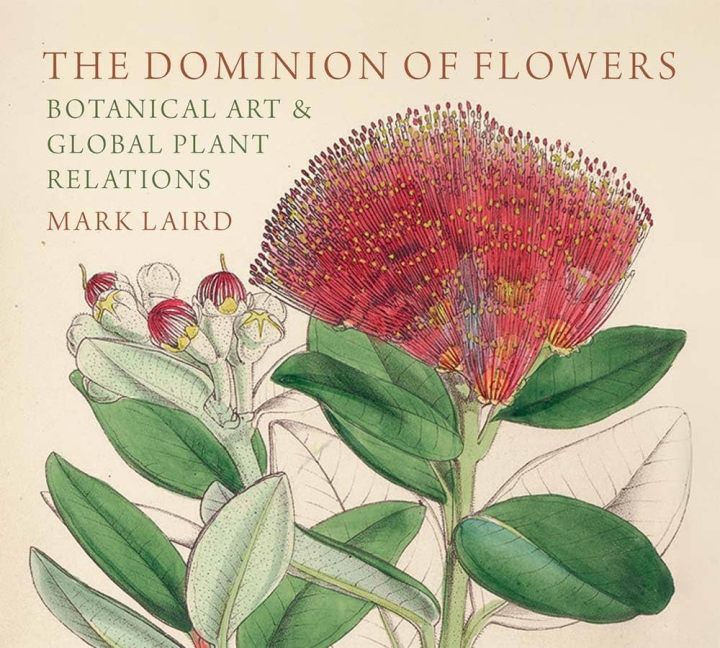 How a wave of exotic botanical imports from across Britain’s empire shaped its gardens and psyche
Between 1760 and 1840, exotic plants were imported from across Britain’s empire and were lavishly depicted in periodicals and scientific treatises as specimens collected alongside other objects of natural history. Mark Laird’s provocative new book—part art history, part polemic—weaves fine art, botanical illustration, and previously unpublished archival material into a political and ethical account of Britain’s heritage, showing how plants were not only integral to English gardens of the Georgian and Victorian eras but also to British culture more broadly. The Dominion of Flowers shines with captivating cross-cultural plant stories. The book opens with the Seymers’ exotic Butterflies and Plants and Pulteney’s catalogue of Dorset’s native wildflowers. It then moves to the German artist John Miller and his illustrations for Lord Bute’s Botanical Tables and concludes by tracing Britain’s fascination with New Zealand’s unique flora, first depicted in Mary Delany’s collages. Copiously illustrated with almost two hundred works, and drawing on Laird’s genealogical research into his own family’s colonial past, this volume foregrounds Indigenous ideas about ‘plant relations’ in a study that brings the trans-oceanic movement of plants and people alive.
Mark Laird is professor emeritus at the University of Toronto and former faculty member at Harvard University. He is the author of The Flowering of the Landscape Garden and A Natural History of English Gardening—recipient of an Elisabeth Blair MacDougall Award. He has been historic planting consultant to Painshill Park Trust, English Heritage, and Strawberry Hill Trust.










 Enfilade
leave a comment