New Book | The Dominion of Flowers
From Yale UP:
Mark Laird, The Dominion of Flowers: Botanical Art and Global Plant Relations (London: Paul Mellon Centre for Studies in British Art, 2024), 277 pages, ISBN: 978-1913107451, £35 / $50.
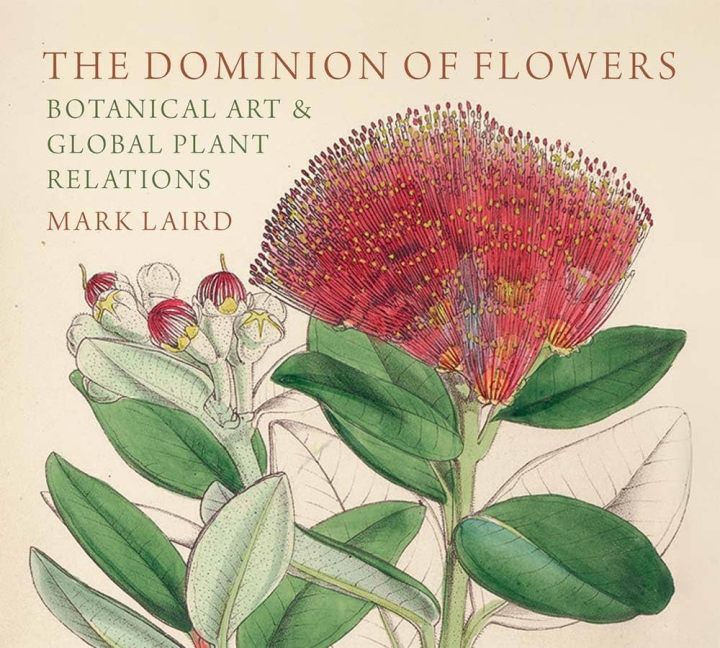 How a wave of exotic botanical imports from across Britain’s empire shaped its gardens and psyche
Between 1760 and 1840, exotic plants were imported from across Britain’s empire and were lavishly depicted in periodicals and scientific treatises as specimens collected alongside other objects of natural history. Mark Laird’s provocative new book—part art history, part polemic—weaves fine art, botanical illustration, and previously unpublished archival material into a political and ethical account of Britain’s heritage, showing how plants were not only integral to English gardens of the Georgian and Victorian eras but also to British culture more broadly. The Dominion of Flowers shines with captivating cross-cultural plant stories. The book opens with the Seymers’ exotic Butterflies and Plants and Pulteney’s catalogue of Dorset’s native wildflowers. It then moves to the German artist John Miller and his illustrations for Lord Bute’s Botanical Tables and concludes by tracing Britain’s fascination with New Zealand’s unique flora, first depicted in Mary Delany’s collages. Copiously illustrated with almost two hundred works, and drawing on Laird’s genealogical research into his own family’s colonial past, this volume foregrounds Indigenous ideas about ‘plant relations’ in a study that brings the trans-oceanic movement of plants and people alive.
Mark Laird is professor emeritus at the University of Toronto and former faculty member at Harvard University. He is the author of The Flowering of the Landscape Garden and A Natural History of English Gardening—recipient of an Elisabeth Blair MacDougall Award. He has been historic planting consultant to Painshill Park Trust, English Heritage, and Strawberry Hill Trust.
Artists in Conversation | Flora Yukhnovich
This evening from YCBA:
Artists in Conversation | Flora Yukhnovich
In-person and online, Hastings Hall, Yale School of Architecture, New Haven, 1 October 2025, 6pm

Flora Yukhnovich, photo by Kasia Bobula.
Flora Yukhnovich will talk to Eleanor Nairne, the Keith L. and Katherine Sachs Curator of Modern and Contemporary Art, the Philadelphia Museum of Art. Watch the livestream here.
The Artists in Conversation series brings together curators and artists to discuss artistic practices and insights into their work.
Born in 1990 in Norwich, UK, Flora Yukhnovich developed her characteristic painting language while studying at City and Guilds of London Art School, where she completed her MA in fine art in 2017. She also studied portraiture at the Heatherley School of Fine Art in London. Yukhnovich’s art boldly explores materiality and process as vehicles for meaning, with cascading and swirling forms that evoke rhythm and energy, flowing between representation and abstraction. Her immersive paintings splice historic styles, from French rococo and Italian baroque to abstract expressionism, with references drawn from contemporary films, music, literature, and consumer culture. Through her work, Yukhnovich addresses dynamics of power inherent in received readings of art-historical subjects and their associated hierarchies. She questions notions of femininity and gender that are hard-wired into the aesthetic language of color and form.
Yukhnovich received the Elizabeth Greenshields Foundation Award in 2013 and 2016. She has participated in group and solo exhibitions worldwide. Her work is included in many collections, including the Hirshhorn Museum, Washington, DC; the Montreal Museum of Fine Arts; the Roberts Institute of Art, London; and the National Gallery of Victoria, Melbourne. She lives and works in London.
Eleanor Nairne is the Keith L. and Katherine Sachs Curator of Modern and Contemporary Art and department head, modern and contemporary art, at the Philadelphia Museum of Art. Previously, she was the senior curator at Barbican Art Gallery, London, where her exhibitions included Basquiat: Boom for Real (2017), Lee Krasner: Living Colour (2019), Jean Dubuffet: Brutal Beauty (2021), Soheila Sokhanvari: Rebel Rebel (2022), Alice Neel: Hot Off The Griddle (2023), and Julianknxx: Chorus in Rememory of Flight (2023–24). She also curated Erotic Abstraction: Eva Hesse / Hannah Wilke (2021) at Acquavella Galleries in New York.
New Book | Carlo Maratta Catalogue Raisonné
From Ugo Bozzi Editore (as noted at Art History News) . . .
Stella Rudolph and Simonetta Prosperi Valenti Rodinò, Carlo Maratti (1625–1713) tra la magnificenza del Barocco e il sogno d’Arcadia. Dipinti e disegni (Rome: Ugo Bozzi Editore, 2024), 2 volumes, 1260 pages, ISBN: 978-8870030693, €480.
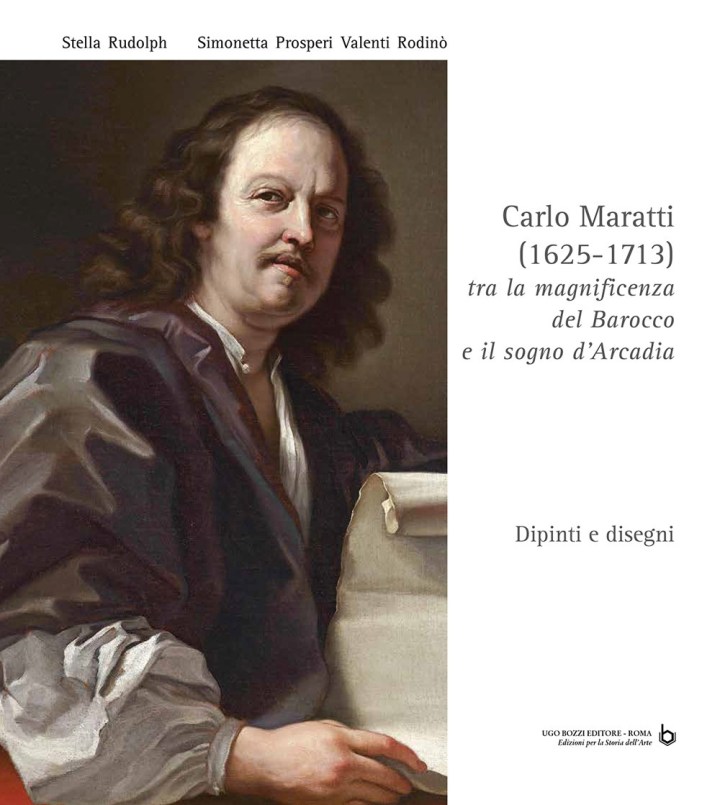 Il noto pittore Carlo Maratti (1625–1713), attivo a Roma per più di 60 anni, raggiunse una grande fama in vita, conteso da papi, cardinali, mecenati, collezionisti, milord venuti in Italia per il Grand tour e regnanti di tutt’Europa. Di contro a questa notorietà, gli studi storico-artistici a lui dedicati sono oggi limitati ad alcuni articoli e a due convegni, tenutisi a Roma nel 2013 e 2014 in occasione della ricorrenza della morte. La monografia a lui dedicata, qui presentata ed avviata da anni, restituisce la posizione di leader raggiunta dal pittore a Roma nella seconda metà del Seicento, mettendo a fuoco il ruolo fondamentale da lui svolto nell’ambiente artistico della città, divenendone protagonista assoluto dopo la scomparsa di Cortona (1669) e Bernini (1680). Artista prediletto di ben sette papi, Maratti fornì numerose pale d’altare in varie chiese romane, affreschi nei palazzi Altieri e del Quirinale, e quadri di soggetto sacro e mitologico inviati in tutta Italia e all’estero su commissione dei re di Francia, di Spagna e degli Absburgo. Maratti fu anche un assiduo ed elegante disegnatore, ne è prova la sua ricchissima produzione grafica, che ammonta a più di duemila fogli autografi, divisi nei nuclei più consistenti nel Kunstpalast di Düssseldorf, nella Real Academia di Madrid, nella Royal Library di Windsor e in molti altri.
In seguito a quattro anni di intenso lavoro, la Redazione della Ugo Bozzi Editore è dunque lieta di annunciare la pubblicazione in due volumi della tanto attesa monografia sull’artista, curata dalle due maggiori esperte sull’argomento, Stella Rudolph per i dipinti e Simonetta Prosperi Valenti Rodinò per i disegni. Oltre 1.000 riproduzioni di cui oltre 900 a colori, oltre 1250 pagine.
Il lavoro di Stella Rudolph, nota studiosa inglese scomparsa nel maggio 2020, che ha dedicato 30 anni a questo progetto senza riuscire a completarlo, ma producendo numerosi saggi su Maratti, è stato ultimato e aggiornato da Simonetta Prosperi Valenti Rodinò, cui si deve la catalogazione dei disegni afferenti ai dipinti e la redazione di ulteriori sezioni sull’attività di Maratti come progettista di statue, oggetti di argenteria, ritratti e caricature, illustrate da disegni di grande qualità esecutiva.
Conference | Marble as Device
From the conference programme and ArtHist.net:
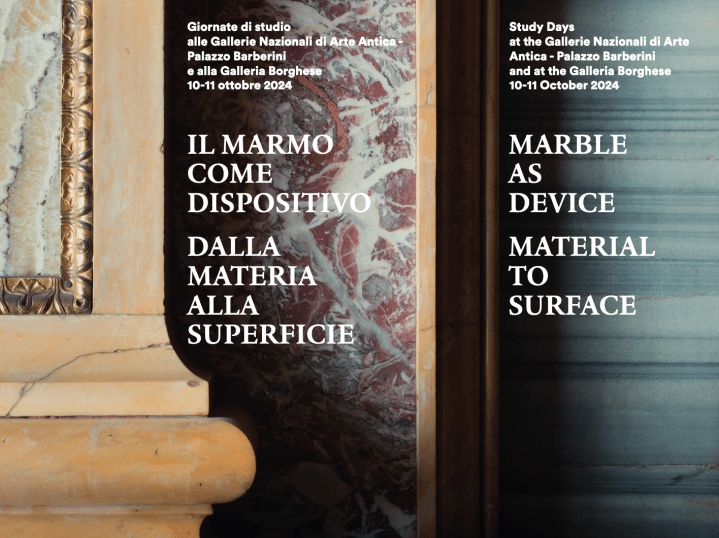
Marble as Device: Material to Surface / Il Marmo Come Dispositivo: Dalla Materia alla Superficie
Gallerie Nazionali di Arte Antica –Palazzo Barberini / Galleria Borghese, Rome, 10–11 October 2024
Organized by Adriano Aymonino, Geraldine Leardi, and Ariane Varela Braga
DAY 1 | Marble offers the ideal medium to investigate human dexterity in combining materiality and immaterial meanings. Frequently studied from various perspectives—from quarry extraction, distribution networks, and processing techniques, to aesthetic values and socio-cultural or olitical uses—more recently marble has been analysed as a powerful expressive medium straddling iconicity and aniconism, structure and ornament. Following on from the inaugural NeReMa meeting held in Rome in 2021, this study day will bring together international scholars to reflect on the theme of marble as ‘device’, a notion that allows an interdisciplinary approach to the study of this transversal artistic and architectural medium in the Mediterranean-European world: from the more concrete aspects of setting up the material components, to the intrinsic and expressive qualities of marble surfaces.
DAY 2 | ‘Device’ is a complex word, rich in possibilities, which allows broad interpretative approaches. The first part of this second study day will therefore be devoted to two less conventional subjects in the field of marble studies: ‘marbles and stones on paper’, focusing on an analysis of the famous manuscript Study of Many Stones by Pier Leone Ghezzi (1726), along with a discussion of works by contemporary artists who employ marble, or its conceptual bearings, as a ‘device’ for their creativity. The afternoon session will start with a roundtable addressing the launch of the volume La Galleria Borghese nei suoi marmi: Materia Colore Superficie (Allemandi), followed by a presentation of an ongoing digital project on ancient marbles and stones led by the Galleria Borghese. The day closes with a tribute to Raniero Gnoli, the founding father of modern studies on ancient marble, and a tour of the Galleria Borghese.
Registration is available through Eventbrite.
t h u r s d a y , 1 0 o c t o b e r
Gallerie Nazionali di Arte Antica –Palazzo Barberini
9.00 Registration
9.30 Francesca Cappelletti and Geraldine Leardi — Welcome and Introduction
10.00 Struttura e Forma / Structure and Form
Modera: Alessandro Poggio
• Rafael Rosenberg — Book-Matching: Why Are Stone Slabs Laid Symmetrically, and since When?
• Ruggero Longo — Materia e forma: Superfici marmoree nel Mediterraneo medievale
• Silvia Pedone — ‘Le parole e i marmi’: Estetica e colore a Bisanzio
11.30 Pausa Caffè
12.00 Teoria e Percezione / Theory and Perception
Modera: Daniela del Pesco
• Joris van Gastel — Le piume del pavone: Verso un’estetica della ricezione del commesso marmoreo napoletano
• Marthe Kretzschmar — „Je feiner das Korn ist, desto vollkommener ist der Marmor“: Winckelmann’s Description of Marble between Aesthetics and Mineralogy
13.30 Pranzo
15.00 Materia e Superficie / Materiality and Surface
Modera: Sara Bova
• Vitale Zanchettin — Michelangelo, le verità della pietra: Architetture oltre la superficie
• Grégoire Extermann — Importazione o continuità? Il dispositivo ‘romano’ della Casa de Pilatos a Siviglia
16.00 Pausa Caffè
16.30 Trasformazione e Display / Transformation and Display
Modera: Anna Frasca-Rath
• Christine Casey — From Mountainside to Fireside: Supplying and Working Marble for the British Interior, 1700–1770
• Ariane Varela Braga — Il marmo in mostra tra fine Ottocento e inizio Novecento
f r i d a y , 1 1 o c t o b e r
Galleria Borghese
10.00 Registration
10.20 Francesca Cappelletti and Geraldine Leardi — Welcome and Introduction
10.30 Nicola Samorì — Mal di pietra: Il corpo minerale tra geodi e fratture
11:00 Jo Stockham — Fluid Rock, Marble Stilled
11.30 Pausa Caffè
12.00 Adriano Aymonino — Rappresentare le pietre di Roma: Marmi su carta nel Settecento
12.30 Paolo Bertoncini Sabatini — Materia e significato: Il marmo in termini estetici e progettuali nell’allestimento di mostre temporanee
13.30 Pranzo
15.00 Tavola Rotonda | Presentazione del volume La Galleria Borghese nei suoi marmi. Materia Colore Superficie, a cura di Geraldine Leardi
Intervengono: Fabio Barry, Dario Gamboni, Lorenzo Lazzarini, Sophie Mouquin
17.00 Pausa Caffè
17.30 Geraldine Leardi e Adriano Aymonino — Presentazione del progetto di un database su litoteche storiche e marmi antichi
18.00 Proiezione del documentario | Le Pietre e le Parole: Ritratto di Raniero Gnoli, di Adriano Aymonino e Silvia Davoli + Q&A
18.30 Tour per conoscere i marmi della Galleria Borghese con Geraldine Leardi e Lorenzo Lazzarini
Conference | The Roman Drawings of Charles Percier
From ArtHist.net:
The Rome Drawings of Charles Percier and their Afterlife
Online and in-person, Zentralinstitut für Kunstgeschichte, München, 18–19 October 2024
Organized by Georg Schelbert and Sabine Frommel

Charles Percier, Unidentified Villa (Paris: Bibliothèque de l’Institut de France, MS 1008 fol. 2r num. 3).
Charles Percier (1764–1838) was one of the most influential architects and architectural theorists in France in the decades before and after 1800. In addition to his formative role as Napoleon’s architect, together with Pierre François Léonard Fontaine, his influence lies above all in his teaching activities, from which pupils such as J. Hittorf, P. Letarouilly, and A. de Montferrand emerged.
As in the case of many other European architects of the multifaceted 19th century, his personal experience of art and architecture in Italy was fundamental to his work. Honoured with the grand prix of the Académie royale d’Architecture, Percier stayed in Rome from 1786 to 1791, studying important architectural monuments there and in the surrounding area. He used his return journey on foot to Paris to familiarise himself with the architecture of central and northern Italy. During this time, he created a total of around 2000 drawings, a wide-ranging documentation that reflects the influence of new compositional methods and served both for his own training and as model material, and as such fulfilled a didactic function.
This largely unpublished material clearly reveals Percier’s comprehensive view, which encompasses architecture, sculpture, ornament, and gardens and spans a broad chronological horizon from antiquity to contemporary art at his time. These experiences flowed into an architectural theory that he anchored primarily in Roman palace construction. Conference contributions will shed light on various aspects of his oeuvre, primarily on the basis of drawings from his Roman period. Talks will also call attention to Percier’s European significance, which is also reflected in projects in the Polish lands and, not least, in the fact that the visual appearance of the young kingdom in Bavaria was placed in the hands of Napoleon’s architect.
The conference is part of a larger programme of work on the publication of Percier’s drawings made in Italy, most of which are in the Institut de France. The volumes Emilia e Romagna (2016) and Toscana, Umbria e Marche (2021) have already been published in the series I disegni di Charles Percier. Organized by Georg Schelbert (Zentralinstitut für Kunstgeschichte) and Sabine Frommel (EPHE-PSL, Paris), the conference will be held in English, Italian, French, and German. Please send questions to percier@zikg.eu.
The event will be broadcast in parallel via Zoom. Recording of the event or parts of the event as well as screenshots are not permitted. By participating, you accept these terms of use.
f r i d a y , 1 8 o c t o b e r
12.30 Registration
13.00 Introduction
• Sabine Frommel (EPHE-PSL, Paris) and Jean-Philippe Garric (Panthéon Sorbonne, Université Paris 1)
13.30 Section 1 | Percier in Rome — Villas and Gardens: Nature, Ornament, and Architecture
Chair: Christine Tauber (Zentralinstitut für Kunstgeschichte, Munich)
• Sabine Frommel (EPHE-PSL, Paris) — Lo sguardo del Rinascimento nei disegni di Charles Percier
• Alberta Campitelli (Vice President Associazione Parchi e Giardini d’Italia, Rome) — Ville e giardini del Grand Tour: un itinerario d’obbligo
• Alessandro Cremona (Sovrintendenza Capitolina, Rome) — Non solo ‘célèbres maisons de plaisance’: le ville e i giardini ‘minori’ nei taccuini di viaggio di Charles Percier
15.00 Coffee break
• Steffi Roettgen (Ludwig Maximilians-Universität Munich) — Zeichnungen zur Villa Albani und deren Antiken
• Susanna Pasquali (Università La Sapienza, Rome) — Roman Villas and Gardens in the Drawings by Hubert Robert, Pierre Adrien Pâris, and Charles Percier (1750–90)
• Iris Lauterbach (Zentralinstitut für Kunstgeschichte, Munich) — Les jardins de Rome vues par l’Europe: Les dessins de Percier dans leur contexte
18.15 Keynote Lecture
• Jean-Philippe Garric (Panthéon Sorbonne, Université Paris 1) — Learning by Drawing: The Albums of Charles Percier at the Institut de France
s a t u r d a y , 1 9 o c t o b e r
9.00 Section 2 | Percier and Europe
Chair: Sabine Frommel (EPHE-PSL, Paris)
• Mario Bevilacqua (Università La Sapienza, Rome) — Percier Reads and Corrects Piranesi: The Drawings of the Priorato
• Georg Kabierske (Philipps-Universität Marburg) — Drawing, Copying, and Collecting Architectural Ornaments in Rome: The Generation of Percier and Before
• Georg Schelbert (Zentralinstitut für Kunstgeschichte Munich) — Charles Percier and Prussia: Ludwig Theodor Liman
11.00 Coffee break
• Sabina de Cavi / Hélder Carita (Universidade Nova, Lisbon) — The Quinta da Praia: New Drawings by Charles Percier for a Villa in Belèm (1815)
• Pawel Migasiewicz (Instytut Sztuki, Polska Akademia Nauk, Warsaw) — Architectural Drawings by Charles Percier, Pierre François Léonard Fontaine, and Alexandre Dufour for Polish Patrons
• Hans Ottomeyer (Munich) — Das Königreich Bayern: Percier und die Folgen
13.30 End
New Book | Academic Writing as if Readers Matter
From Princeton UP:
Leonard Cassuto, Academic Writing as if Readers Matter (Princeton: Princeton University Press, 2024), 224 pages, ISBN: 978-0691195797 £19 / $23.
 If you want people to read your writing, it has to be readable. In Academic Writing as if Readers Matter, Leonard Cassuto offers academic writers a direct, practical prescription for writing that will be read and understood: Take care of your reader. With a wealth of examples from the arts and sciences, this short, witty book provides invaluable advice to writers at all levels, in all fields, on how to write better for both specialized and broad audiences. Good academic writing depends on connecting with readers, earning their time and attention. Cassuto offers tips and advice on how to sharpen arguments and make complex ideas compelling. He addresses the workings of introductions and conclusions, transitions, signposts, paragraphs, and sentences—all the building blocks of academic writing. He also shows how storytelling and metaphor can make your prose more engaging than you thought possible. And he explains the proper use of that most dangerous of tools: jargon.
This book can make any academic writer—including you—into a better writer. That means becoming a better communicator of the ideas and discoveries you want the world to grasp. For the sake of readers inside the academy and beyond it, Academic Writing as if Readers Matter shows how and why you have to make your writing connect with the people you’re writing for.
Leonard Cassuto is professor of English at Fordham University. He writes a regular column, “The Graduate Adviser,” for The Chronicle of Higher Education, and his many books include The New PhD: How to Build a Better Graduate Education.
New Book | The Bookshop
From Penguin Random House (Friss starts his story with Benjamin Franklin’s printing house) . . .
Evan Friss, The Bookshop: A History of the American Bookstore (New York: Viking, 2024), 416 pages, ISBN 978-0593299920, $30.
 An affectionate and engaging history of the American bookstore and its central place in American cultural life, from department stores to indies, from highbrow dealers trading in first editions to sidewalk vendors, and from chains to special-interest community destinations
Bookstores have always been unlike any other kind of store, shaping readers and writers, and influencing our tastes, thoughts, and politics. They nurture local communities while creating new ones of their own. Bookshops are powerful spaces, but they are also endangered ones. In The Bookshop, we see the stakes: what has been, and what might be lost. Evan Friss’s history of the bookshop draws on oral histories, archival collections, municipal records, diaries, letters, and interviews with leading booksellers to offer a fascinating look at this institution beloved by so many. The story begins with Benjamin Franklin’s first bookstore in Philadelphia and takes us to a range of booksellers including the Strand, Chicago’s Marshall Field & Company, the Gotham Book Mart, specialty stores like Oscar Wilde and Drum and Spear, sidewalk sellers of used books, Barnes & Noble, Amazon Books, and Parnassus. The Bookshop is also a history of the leading figures in American bookselling, often impassioned eccentrics, and a history of how books have been marketed and sold over the course of more than two centuries—including, for example, a 3,000-pound elephant who signed books at Marshall Field’s in 1944.
The Bookshop is a love letter to bookstores, a charming chronicle for anyone who cherishes these sanctuaries of literature, and essential reading to understand how these vital institutions have shaped American life—and why we still need them.
Evan Friss is a professor of history at James Madison University and the author of two other books: The Cycling City: Bicycles and Urban America in the 1890s and On Bicycles: A 200-Year History of Cycling in New York City. He lives with his wife (a bookseller) and two children (occasional booksellers) in Harrisonburg, Virginia.
Panel Discussion | Jeremy Bentham’s Books at UCL
From Eventbrite:
Jeremy Bentham’s Books in UCL’s Special Collections
UCL Object Based Learning Laboratory, London, 9 October 2024
An event exploring Jeremy Bentham’s book collection and ways in which it continues to shape UCL’s library holdings today.
It has long been known that the 18th-century philosopher Jeremy Bentham bequeathed a number of his books to University College London (known at the time as the London University). But the contents of the bequest and the faith of the books had remained obscure. A recent discovery of an item-by-item list of the books in the UCL library archives by Colin Penman (UCL Head of Records) and a Bentham expert, Professor Tim Causer, sparked a project to uncover some of Bentham’s books in UCL’s rare book collections, overseen by Erika Delbecque (UCL’s Head of Rare Books). Join UCL Special Collections to hear Colin, Tim, and Erika talk about the project, the discoveries made so far, the process of identifying Bentham’s books, and their significance today. The original list of the Bentham’s bequest, along with some of the books from his library (many heavily annotated by Bentham himself), will be on display. The event is free and open to all, but booking is essential.
The UCL guide to the Bentham Book Collection offers a helpful introduction to our holdings as well as information about researching and accessing this collection. You can also read more about our ongoing research into Bentham’s bequest here.
Wednesday, 9 October 2024
3.00–4.00pm | Panel discussion and collections display
4.00–4.30pm | Collections display and refreshments
New Acquisitions at the Raclin Murphy Museum of Art
From the press release (25 September 2024) . . .
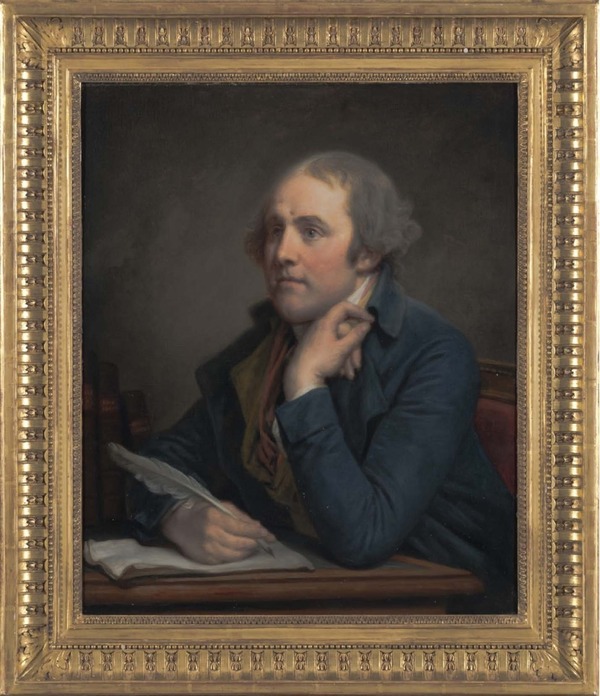
Jean Baptiste Greuze, Portrait of a Man, said to be Louis-François Robin, 1790, oil on walnut panel, 26 × 22 inches (South Bend: Raclin Murphy Museum of Art, 2024.008.006).
The Raclin Murphy Museum of Art is the beneficiary of a significant gift of paintings, sculptures, and decorative art objects from the estate of Ernestine Morris Carmichael Raclin (1927–2024). Iconic masters from Gainsborough and Reynolds, Houdon to Guillaumin, among many others, are included.
A life-long supporter of the arts, Raclin began collecting in earnest in the 1980s and 1990s, assembling the highest quality works that reflected her taste for old master and nineteenth-century aesthetics. A devoted supporter of the University of Notre Dame, and its first female Trustee, and committed to cultural institutions in and around her home of South Bend, Indiana, Raclin planned the donation to further the University’s mission to foster an appreciation for the greatest human achievements and intellectual exchange. She sincerely wished to encourage the growth of the museum that now bears her name, the Raclin Murphy Museum of Art.
“Our mother loved the arts and was devoted to the community in which she lived,” shared daughter, Carmi, and son-in-law, Chris Murphy. “She collected and displayed beautiful things in her home and joyously shared her art collection entertaining people from across the region and country. It is only appropriate that this gift can now be shared with the community she loved through the beautiful new Raclin Murphy Museum of Art and the University of Notre Dame.”

Joshua Reynolds, Portrait of Miss Barwell, 1785, oil on canvas, 30 × 25 inches (South Bend: Raclin Murphy Museum of Art, 2024.008.014).
The Raclin Bequest includes works from the fifteenth through the early twentieth centuries but is especially strong in eighteenth-century art. A portrait by Jean-Baptiste Greuze, a landscape sketch by Hubert Robert, and a fête champêtre by Nicolas Lancret, for example, offer further depth to holdings by French masters Elisabeth Vigée Lebrun and François Boucher already in the University’s collection. Portraits by Thomas Gainsborough and Joshua Reynolds bolster the representation of British art in the collection with impressive demonstrations of costume and technique. Jean-Antoine Houdon’s patinated terracotta portrait bust of his infant daughter is the first of its kind in the collection.
The University’s nineteenth-century collection is best known for its French academic works and oil sketches. The Raclin gift complements those holdings with proto-Impressionist, Impressionist, and post-Impressionist examples. Landscapes by Camille Corot and Johan Jongkind are the types of paintings that inspired the Impressionists and heralded a new approach to painting founded on advances in color theory. Hippolyte Petitjean, for example, is most closely aligned with Pointillism, a technique of placing dots or very short strokes of pure color next to each other recognizing that the human eye will combine the colors when viewed at a distance. In his painting of the Cathedral of Notre Dame, he uses a seemingly mechanical technique and further suggests the angst of an increasingly industrialized world by juxtaposing the buttresses of the medieval church with the crane in the foreground loading cargo onto a barge. The lone American work in the gift, John Alexander White’s Reflection, is notable for its synthesis of various avant-garde trends that make it difficult to categorize his work. He combines sinuous lines, abstract shapes, the limited, muted tones of his American compatriot J.A.M. Whistler, and a deep interest in psychological effects and technical experimentation to arrive at a unique revelation of the fin-de-siècle spirit.
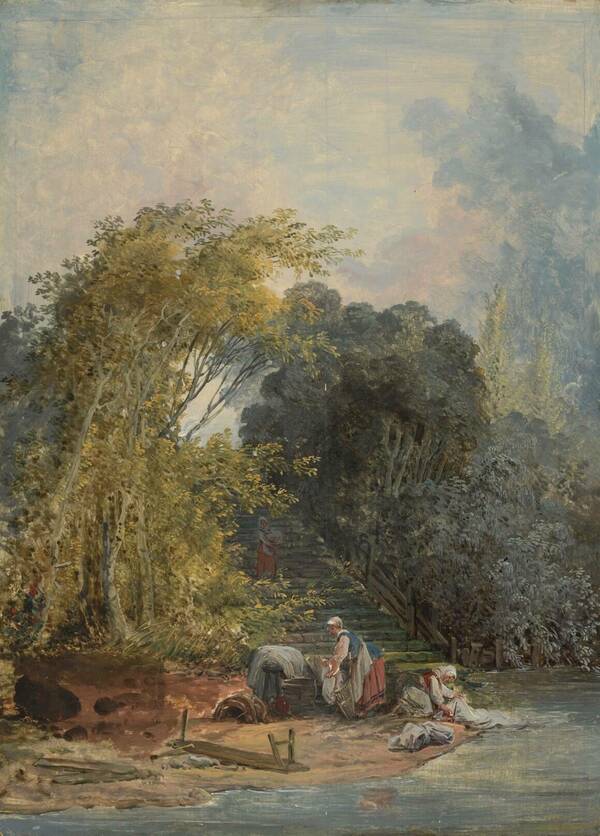
Hubert Robert, The Washerwomen of Charenton, 1767–70, oil on cradled panel, 15 × 11 inches (South Bend: Raclin Murphy Museum of Art, 2024.008.011).
“Throughout her extraordinary life, Ernestine Raclin demonstrated time and again her commitment to her local community and to increasing accessibility and appreciation of the arts,” said Rev. Robert Dowd, C.S.C., University president. “We are grateful for her generous support that enabled the creation of the Raclin Murphy Museum of Art, as well as this additional gift which will delight museum attendees for many generations to come.”
With origins that date to 1875, the University’s art museum is among the first and most esteemed academic art museums in the nation. The Raclin Bequest is cornerstone to a major initiative, 150 for 150: Art for Notre Dame the Sesquicentennial Campaign, to strategically build the collection for students, faculty, researchers, and the nation. The goal is to achieve 150 gifts for 150 years. A gift could be a single object or, as with the Raclin Bequest, an entire collection.
The campaign is focused on Museum collecting priorities including: Art of the Indigenous Americas, European and American Art before 1900, International Modern and Contemporary Art, Irish Art, Sculpture, and Works on Paper (prints, drawings and photographs). Such extraordinary generosity is not limited to the Notre Dame family. Friends, old and new, have stepped forward with great care. The Raclin Bequest and other gifts will debut at the end of the campaign in a major celebratory exhibition in early 2026.
“Although Ernie had long been a supporter of the Museum and generously gifted numerous works to the collection over decades, this gift is quite special,” shares Joseph Antenucci Becherer, PhD, Director and Curator of Sculpture. “To know that she lived with and found profound enjoyment and inspiration in these objects, and wanted to share that with the world, fills the Museum with her spirit of grace, passion, and love of others.”
It is critical to note that art is central to learning and research across the academy, and the Museum collections are available to the region, the nation, and beyond. At Notre Dame, the collections are annually utilized by more than forty departments, representing nearly every college and school on campus. Recent research shows that 91% of graduating seniors had visited the museum—an astonishing number. Additionally, the Museum welcomes more than 11,000 K-12 students yearly from a three-state area. Beyond those outreach efforts, the Museum lends works to the highest caliber exhibitions nationwide and worldwide; recently, works were lent to venues in Los Angeles, New York, Paris, Rome, and Washington, DC, among others.
Call for Papers | Recipes and Flavors on the Move
From ArtHist.net:
Recipes and Flavors on the Move: The Circulation of Traditions and Ingredients between the Mediterranean and the American Colonies
Institut national d’histoire de l’art (INHA), Paris, 22 January 2025
Organized by Maddalena Bellavitisl, Corinne Mencé-Caster, and José Manuel Santos Pérez
Proposals due by 21 October 2024
Scholars in recent years have intensified their interest in cultural aspects of the colonial world, going beyond purely historical and social analysis. They have also been looking at the whole context constituted by the expressions and habits related to the daily, intellectual, and artistic life of the local populations and of those who found themselves traveling—in one direction or another—between Europe and the distant lands of ancient or recent discovery. The question thus raised relates to the cultural heritage of the territories concerned, both tangible and intangible heritage, and therefore also a whole series of details belonging to the sphere of the senses and habits most closely linked to local traditions. Among these, of course, the most fundamentally intertwined with popular life and culture is that of food. Therefore, a research direction that looked precisely in this direction was needed, questioning food habits, raw materials, recipes, and flavors.
This workshop therefore proposes a dialogue on colonial culture and food, choosing to set the discussion according to a perspective of exchange and mutual enrichment, with a view to reconstructing paths and narratives that have seen the intertwining of knowledge and traditions. Thus, the first part will be devoted to the interchanges, reception, and perception of Mediterranean food culture in Latin America and vice versa, with a consideration of ingredients, recipes, and tastes, while the second part will focus on material and iconographic culture, considering visual representations that depict this diffusion of flavors and the objects involved in the process.
The organizers, Maddalena Bellavitisl, Corinne Mencé-Caster, and José Manuel Santos Pérez, welcome proposals for 20-minute contributions—in English, French, Spanish, or Portuguese—on interdisciplinary topics addressing the subjects to which the workshop is dedicated. Those who are interested can send a one-page PDF file with an abstract and short bio to maddalena.bellavitis@gmail.com by 21 October 2024. Selections will be made at the beginning of November 2024.










 Enfilade
leave a comment