Lecture | Mia Jackson on the Birds of Louis-Denis Armand

Louis-Denis Armand, Parrots, ca. 1750–70
(Paris: Galerie Dragesco-Cramoisan)
◊ ◊ ◊ ◊ ◊
This fall at BGC:
Mia Jackson | Flights of Fancy: The Birds of Louis-Denis Armand (1723–1796)
A Françoise and Georges Selz Lecture on Eighteenth- and Nineteenth-Century French Decorative Arts and Culture
Bard Graduate Center, New York, 11 December 2024, 6pm
Mia Jackson will talk about her recent exhibition, Flights of Fancy, the first ever survey of the life and work of the recently rediscovered Sèvres painter Louis-Denis Armand (1723–1796), now celebrated as one of the foremost painters of birds. Very few artisans from the eighteenth century have left us such a detailed biography; over thirty drawings by Armand survive, and research into the drawings and their inscriptions (by Jackson and collaborator Bernard Dragesco) has revealed a wealth of detail about the artist, his life, his work, and even his political opinions.
Mia Jackson has been curator of decorative arts at Waddesdon Manor since 2017. She studied French and Philosophy at the University of Oxford then completed an MA in eighteenth-century French decorative arts at the Courtauld Institute of Art. Her doctoral thesis entitled “André-Charles Boulle (1642–1732) and Paper: Prints and Drawings in the Workshop of an Ébéniste du Roi” was completed at Queen Mary, University of London in 2016. She previously worked in the Prints and Drawings Department at the British Museum, the Wallace Collection, and English Heritage. Eighteenth-century France is her area of expertise, in particular the links between works on paper and the decorative arts.
Exhibition | Flights of Fancy: Birds at Waddesdon
Now on view at Waddesdon:
Flights of Fancy: Birds at Waddesdon
Waddesdon Manor, Buckinghamshire, 22 May – 27 October 2024
Curated by Mia Jackson

Snuff-box with Sèvres porcelain plaques, 1758, painted by Louis-Denis Armand (Waddesdon Image Library, photo by Mike Fear).
Flock to Waddesdon this summer for a celebration of birds. Throughout the Manor, Aviary, and Gardens discover a range of bird-themed exhibitions, events, and activities for all the family.
Flights of Fancy is a rare chance for bird enthusiasts and art lovers alike to explore this beautiful subject through our birds and remarkable displays of porcelain, paintings, drawings, and prints. The exhibition features the life and work of the recently rediscovered Louis-Denis Armand (1723–1796), a painter at the world-famous Sèvres porcelain manufactory. Widely acknowledged as the most talented bird painter at Sèvres, his birds were initially ‘flights of fancy’, drawn from his wild imagination but as time went on, they gained ornithological accuracy. He also drew exotic birds from life, picking and choosing elements to combine and exaggerate. Waddesdon’s own impressive collection of Sèvres painted by Armand includes ten vases from the 1750s and 60s and important pieces from the Razumovsky dessert service. These are displayed alongside nearly 50 loans from private collections and from the Musée national de céramique at Sèvres.
Exhibition | The King’s Horses: The Marly Horses
From the press release for the exhibition (a companion to the show Horse in Majesty on view at Versailles):
The King’s Horses: The Marly Horses, Masterpieces of Equestrian Art
Musée du Domaine Royal de Marly, 7 June — 3 November 2024
Curated by Karen Chastagnol
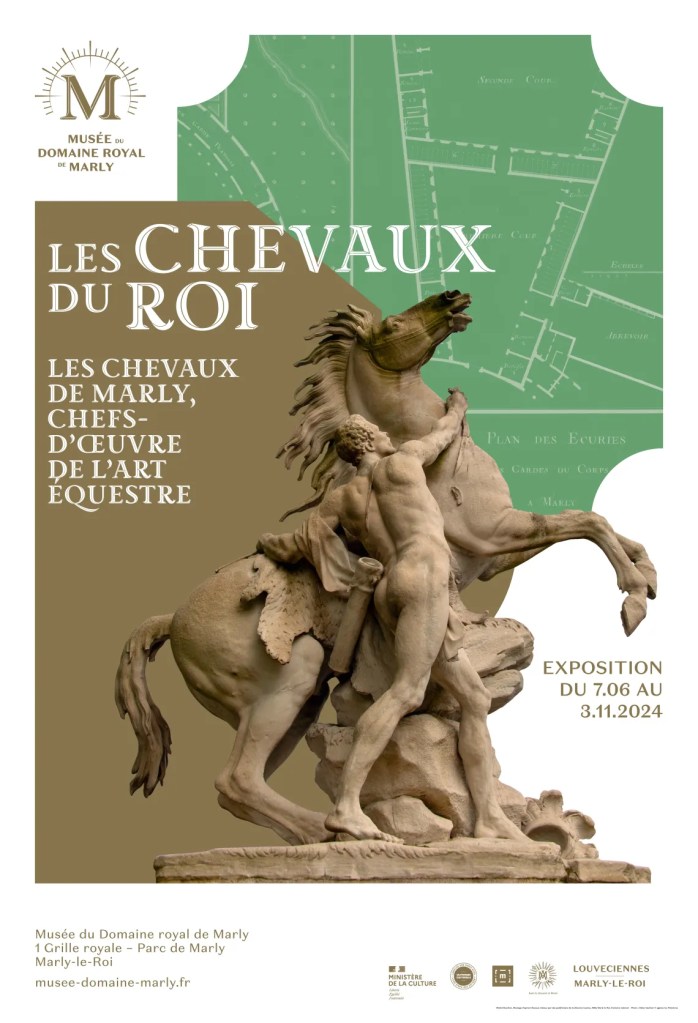 The Royal Estate of Marly, once a hunting residence of kings and the setting for the monumental Marly Horses, has always given an essential role to the horse. From transportation and aristocratic entertainments to military activities, equestrian buildings and artistic representations, horses have taken over the estate in various forms. Through a hundred paintings, sculptures, drawings, engravings, accessories, and archival documents, the Museum of the Royal Estate of Marly presents, on the occasion of the equestrian events of the Paris 2024 Olympic and Paralympic Games, an original exhibition dedicated to the role of the horse at the Estate of Marly, from Louis XIV to the French Revolution.
Karen Chastagnol, ed., Les chevaux du roi: Les chevaux de Marly, chefs-d’œuvre de l’art équestre (Milan: Silvana Editoriale, 2024), 104 pages, ISBN: 978-8836657919, €28. With contributions by Ambre Bozec, Valérie Carpentier-Vanhaverbeke, Annick Heitzmann, Carlos Pereira, and Benjamin Ringo.
The full press release is available here»
The Burlington Magazine, August 2024
The long 18th century in the August issue of The Burlington—and special thanks to The Burlington for making Rosalind Savill’s article available to Enfilade readers for free.
The Burlington Magazine 166 (August 2024) — Decorative Arts
a r t i c l e s

Unidentified artist, Portrait of Paul Crespin, ca.1726, oil on canvas laid on board, 114 × 90 cm (London: Victoria and Albert Museum).
• Lucy Wood and Olivia Fryman, “The 1st Duke of Devonshire’s ‘Queen Mary’ Beds at Devonshire House, Chatsworth, and Hardwick Hall,” pp. 780–809.
In 1696 the 1st Duke of Devonshire purchased two beds that had belonged to Mary II, one of which was made by Louis XIV’s upholsterer, Simon Delobel. Documents and fragments of its crimson velvet embroidered hangings record a lost example of Stuart state furniture of the highest quality.
• Stefano Rinadli, “Six Horses for the King of Poland: Making and Staging a Diplomatic Gift at the Court of Louis XIV,” pp. 810–25.
In July 1715 Augustus the Strong of Saxony-Poland received a splendid present from the Sun King: a team of six Spanish stallions, each equipped with embroidered trappings and a pair of elaborate flintlock holster pistols. Documents published here for the first time help establish the gift’s political context and chronology and provide detailed insight into the payment and the identity of all the craftsmen involved.
• Teresa Leonor M. Vale, “Eighteenth-Century English Silver for King João V of Portugal,” pp. 826–33.
João V of Portugal acquired works of art from Rome and Paris; analysis of diplomatic correspondence illustrates how he also commissioned objects from Britain in the 1720s, notably spectacular examples of silverware. These included and exceptionally large and renowned silver-gilt bath by Paul Crespin, the Huguenot silversmith who lived and worked in Soho, London.

Detail of the bottom tray of worktable mounted with two trays, attributed to Bernard II van Risenburgh, ca.1761–63. Table: wood, green varnish and gilt-bronze mounts, 68.6 × 36.8 × 30.5 cm; trays: Sèvres soft-paste porcelain, green ground, enamel colours and gilding, 32 × 26 cm (New York: Metropolitan Museum of Art, 58.75.45).
• Rosalind Savill, “From Storeroom to Stardom: The Revelations of Two Sèvres Porcelain Trays,” pp. 834–47.
Two porcelain trays set into a Rococo table in the early 1760s, now in the Metropolitan Museum of Art, New York, are reassessed and here confirmed as Sèvres. Their subjects are probably the family of the Marquis de Courteille, Louis XV’s representative at the porcelain factory, and their intimate representation in this manner is almost unique in eighteenth-century Sèvres.
The full article is available for free here»
r e v i e w s
• Elizabeth Savage, Review of two exhibition catalogues: Edina Adam and Julian Brooks, with an essay by Matthew Hargraves, William Blake: Visionary (J. Paul Getty Museum, 2020); and David Bindman and Esther Chadwick, eds., William Blake’s Universe (Philip Wilson Publishers, 2024), pp. 862–65.
• John Pinto, Review of the exhibition catalogue, John Marciari, Sublime Ideas: Drawings by Giovanni Battista Piranesi (Paul Holberton Publishing, 2023), pp. 865–67,
• Gauvin Alexander Bailey, Review of the exhibition catalogue, Rosario Inés Granados, ed., Painted Cloth: Fashion and Ritual in Colonial Latin America (University of Texas Press, 2022), pp. 867–69.
• Camilla Pietrabissa, Review of the exhibition catalogue, Anita Viola Sganzerla and Stephanie Buck, eds., Connecting Worlds: Artists and Travel (Paul Holberton Publishing, 2023), pp. 870–72.
• Giullaume Kientz, Review of the exhibition catalogue, Víctor Nieto Alcaide, ed., Goya: La ribellione della ragione (ORE Cultura, 2023), pp. 872–74.
• Timothy Wilson, Review of Marino Marini, Maiolica and Ceramics in the Museo Nazionale del Bargello, translated by Anna Moore Valeri (Allemandi, 2024), pp. 876–77.
• J. V. G. Mallet, Review of Caterina Marcantoni Cherido, Maioliche italiane del Rinascimento (Fondazione Musei Civici di Venezia, 2022), pp. 877–79.
• Aurora Laurenti, Review of Esther Bell, Pauline Chougnet, Sarah Grandin, Charlotte Guichard, Corinne Le Bitouzé, Anne Leonard, and Meredith Martin, Promenades on Paper: Eighteenth-Century French Drawings from the Bibliotheque nationale de France / Promenades de papier: Dessins du XVIIIe siècle des collections de la Bibliothèque nationale de France (Clark Art Institute and BnF Editions, 2023), pp. 883–84.
• Clare Hornsby, Review of Christopher M.S. Johns, Tommaso Manfredi, and Karin Wolfe, eds., American Latium: American Artists and Travelers in and around Rome in the Age of the Grand Tour (Accademia Nazionale di San Luca, 2023), pp. 884–86.
• Lydia Hamlett, Review of John Laycock, William Kent’s Ceiling Paintings at Houghton Hall (Houghton Arts Foundation, 2021), p. 887.
• Lin Sun, Review of Shane McCausland, The Art of the Chinese Picture-Scroll (Reaktion Books, 2023), pp. 887–88.
Exhibition | Sonya Clark: The Descendants of Monticello

Blinking eyes appear in the windows of Declaration House as part of Sonya Clark’s installation The Descendants of Monticello. Thomas Jefferson resided at the site while writing the Declaration of Independence, together with his enslaved valet Robert Hemmings. The original house was razed in 1883; it was reconstructed in 1975. (Photo by Steve Weinik/Monument Lab).
◊ ◊ ◊ ◊ ◊
From Philadelphia’s Monument Lab:
Declaration House | Sonya Clark’s The Descendants of Monticello
Independence National Historical Park, Philadelphia, 24 June — 1 December 2024
Declaration House is a public art and history exhibition presented by Monument Lab at Independence National Historical Park that explores the site where Thomas Jefferson and Robert Hemmings spent several months in Philadelphia during the drafting of the Declaration of Independence in 1776. The project poses a central question: What does the Declaration of Independence mean to us today? By moving Hemmings to the center of this moment in history, the project seeks to illuminate the entangled legacies of freedom and enslavement at the core of our nation’s founding.
Declaration House presents the exclusive premiere of Sonya Clark’s The Descendants of Monticello, a public artwork that brings the historic house to life through a monumental montage featuring the blinking eyes of Robert Hemmings’ collateral descendants and others who are related to the over 400 people enslaved at Monticello, including descendants biologically related to Jefferson. Declaration House also includes public programs with creative residents Jeannine A. Cook and Ty ‘Dancing Wolf’ Ellis, and a Welcome Station during summer weekend hours at the historic house where visitors are invited to respond to the project’s central question with hand-drawn responses that will be collected by Monument Lab and shared with Independence National Historical Park to inform future programming and reflection ahead of America’s Semiquincentennial in 2026.
◊ ◊ ◊ ◊ ◊
Philip Kennicott wrote about the installation for The Washington Post (12 August 2024). More information, including additional press coverage, is available at Monument Lab.
Exhibition | Wonders of Creation: Art and Science in the Islamic World
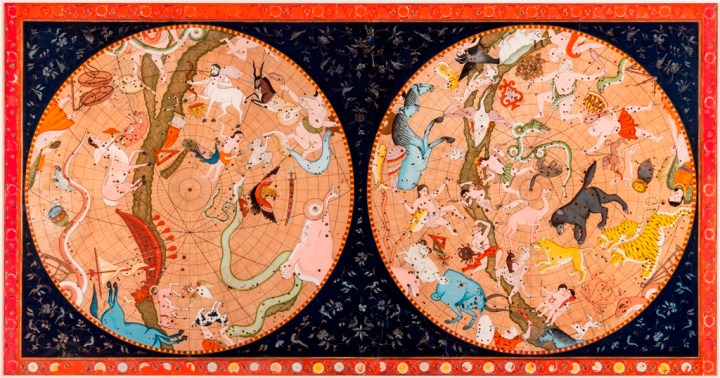
Star map depicting the Northern and Southern celestial hemispheres (with constellations inscribed in Devanagari), India, Jaipur, ca. 1780, ink, opaque watercolor, and gold on paper (Chicago: Pritzker Collection; photo by Michael Tropea).
◊ ◊ ◊ ◊ ◊
From the press release (11 July) for the exhibition:
Wonders of Creation: Art, Science, and Innovation in the Islamic World
The San Diego Museum of Art, 7 September 2024 — 5 January 2025
McMullen Museum of Art, Boston College, 2025
Curated by Ladan Akbarnia
The San Diego Museum of Art (SDMA) invites visitors to explore sources of wonder in the exhibition, Wonders of Creation: Art, Science, and Innovation in the Islamic World. The exhibition explores intersections of science and craft in Islamic material culture and contemporary art through the framework of a 13th-century text by Zakariyya ibn Muhammad al-Qazwini describing the wonders of the universe.
This trailblazing exhibition, organized by Ladan Akbarnia, Curator of South Asian and Islamic Art at The San Diego Museum of Art, showcases over 200 extraordinary works of art and objects from the eighth century to today. Using wonder as the vehicle to introduce and explore Islamic culture, Wonders of Creation illuminates the global impact of science and artistic production from the Islamic world while introducing new audiences to its diverse geographies and multifaceted visual cultures. With treasures including lavishly illuminated and illustrated manuscripts, fine textiles, luster-painted glass and ceramic wares, astrolabes and star maps, talismans, inscribed precious stones, and architectural marvels, visitors will gain a deeper appreciation of ingenuity and craftsmanship spanning 13 centuries across the Islamic world.
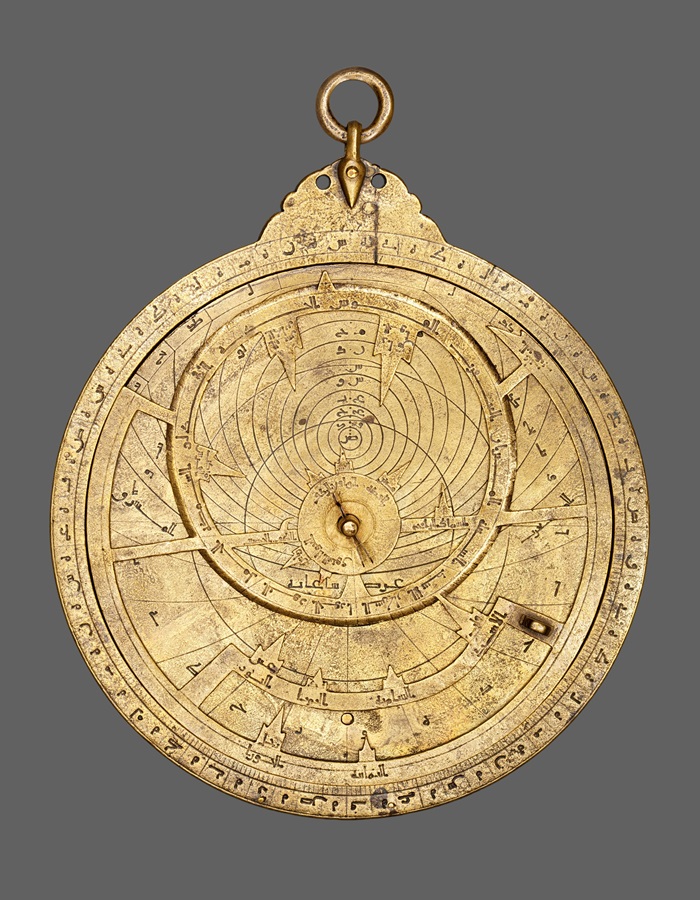
Nastulus, Astrolabe, 101 AH (ca. 720), 18 × 22 cm (Kuwait: al-Sabah Collection). The note at the Google Arts & Culture page describes this as “the earliest dated Islamic astrolabe.”
The exhibition presents works from more than 30 lenders, including major loans from The al-Sabah Collection, Dar Al-Athar al-Islamiyyah, Kuwait; and the Islamic Arts Museum Malaysia (IAMM). Works from the IAMM are on loan to the US for the first time. In addition to selections from these prestigious collections, visitors will also see contemporary commissions specifically for the exhibition by artists Ala Ebtekar and Hayv Kahraman, along with works by other prominent contemporary artists. The Museum has also commissioned Mamluk joinery samples made by master craftsman Hassan Abou Zeid of the Egyptian Heritage Rescue Foundation to introduce a hands-on opportunity for guests and commissioned two contemporary replicas of a 17th-century Persian astrolabe by Taha Yasin Arslan to further evoke a sense of awe throughout the exhibition. Wonders of Creation is designed to invite visitors to explore the marvels of the heavens and the earth and admire the crafts and customs of humanity.
“We are thrilled to present this groundbreaking exhibition to our visitors with support from the Getty through its PST Art: Art & Science Collide initiative,” says Roxana Velásquez, Maruja Baldwin Executive Director and CEO at The San Diego Museum of Art. “This exhibition celebrates the rich cultural heritage and enduring legacy of Islamic civilization, inviting audiences of all backgrounds to discover and appreciate its profound and diverse contributions.”
Qazwini’s text, The Wonders of Creation and the Rarities of Existence, is a revolutionary cosmography that meticulously details the universe, blending scientific knowledge with fantastical anecdotes, portraying all phenomena as signs of divine creation. The author, an Islamic judge and professor, emphasized wonder as a path to knowledge, urging readers to contemplate natural marvels to deepen their understanding of God and the cosmos. Today, his work remains influential, offering insights into Islamic culture and inspiring curiosity about natural phenomena. The exhibition invites visitors to explore some of the world’s wonders in the spirit of Qazwini’s call to wonder.
Wonders of Creation is part of Getty PST Art, an arts initiative that brings together more than 70 exhibitions from organizations across the Southern California region, all exploring intersections of art and science. Funding for this exhibition is made possible with support from Getty through its PST ART: Art & Science Collide initiative and the National Endowment for the Humanities. Wonders of Creation is also supported in part by the National Endowment for the Arts, and additional support is provided by Bank of America, Lani and Joe Curtis, Tatiana and Robert Dotson, Diana and Fred Elghanayan, Drs. Nasrin Owsia and Behrooz Akbarnia, The Nissan Foundation, and A.O. Reed. Institutional support is provided by the City of San Diego Commission for Arts and Culture and the members of The San Diego Museum of Art.
Wonders of Creation will be on view at The San Diego Museum of Art from 7 September 2024 until 5 January 2025. It will then travel to the McMullen Museum of Art, Boston College. The exhibition is complemented by a full-color catalogue with original research and contributions from leading international scholars, a scholarly symposium, artists in conversation, family-oriented art-making workshops, performances, and other programming for the community.
◊ ◊ ◊ ◊ ◊
Also worth noting is this recent study of al-Qazvini’s The Wonders of Creation from Edinburgh UP:
Stefano Carboni, The Wonders of Creation and the Singularities of Painting: A Study of the Ilkhanid London Qazvīnī (Edinburgh: Edinburgh University Press, 2020), 456 pages, ISBN: 978-1474461399, $65.
A beautifully illustrated study of the so-called London Qazvini, an early fourteenth-century illustrated Arabic copy of al-Qazvini’s The Wonders of Creation and the Oddities of Existing Things. One of a handful of extant illustrated codices produced under the Mongols of Iran, this unique manuscript gathers earlier Mesopotamian painting traditions, North Jaziran-Seljuq elements, Anatolian inspiration, the latest changes brought about after the advent of Mongols and a large number of illustrations of extraordinary subjects which escape proper classification. In this lavishly illustrated volume Stefano Carboni offers a stylistic analysis and discussion of the manuscript’s miniatures, a presentation and description of the 368 extant paintings that illustrate the codex, and a partial critical translation of the related Arabic text. This is the first time that sections throughout the whole text are available in English.
Stefano Carboni is the director and CEO of the Art Gallery of Western Australia and adjunct professor at the University of Western Australia. He is author and editor of several books including Glass from Islamic Lands: The Al-Sabah Collection (2001) and Venice and the Islamic World 828–1797 (2007).
Exhibition | Magnified Wonders: An 18th-Century Microscope
From the press release (17 July) for the exhibition:
Magnified Wonders: An 18th-Century Microscope
J. Paul Getty Museum, Los Angeles, 10 September 2024 — 2 February 2025
Curated by Miriam Schefzyk and Arlen Heginbotham
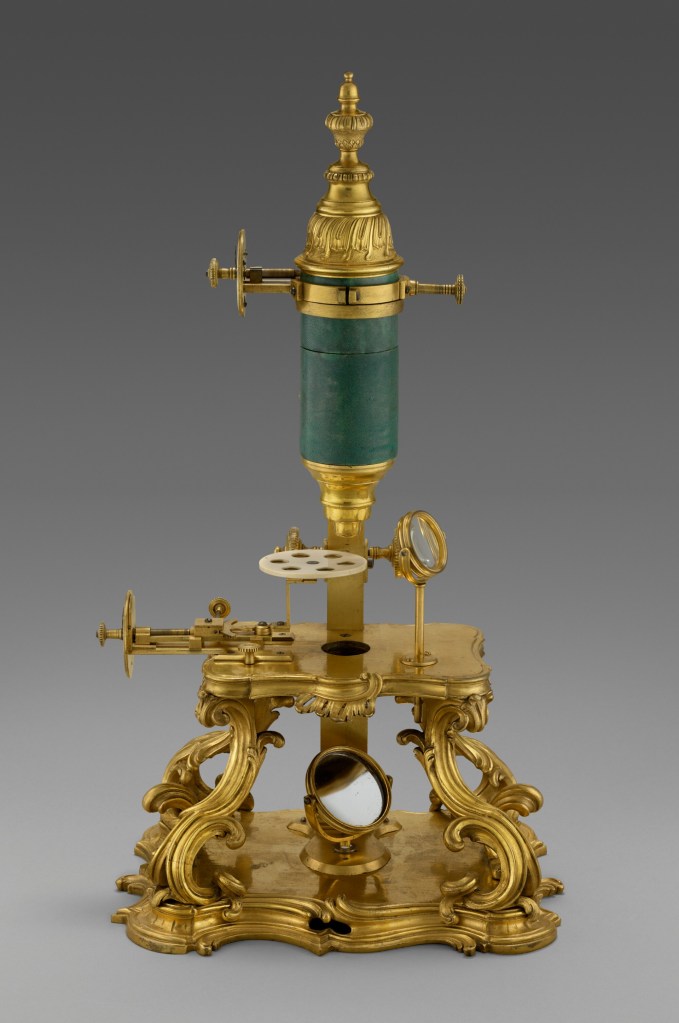
Compound Microscope with a Micrometric Stage, early 1750s, gilt bronze, iron, enamel, shagreen (sharkskin), and glass (Getty Museum, 86.DH.694.1).
The J. Paul Getty Museum presents Magnified Wonders: An 18th-Century Microscope, an exhibition showcasing a French microscope from Getty’s collection as both a scientific instrument and Rococo work of art during the Age of Enlightenment. On view at the Getty Center from 10 September 2024 until 2 February 2025, the exhibition highlights this object’s cultural and historical context and reveals its technical complexity. It is one of only ten existing microscopes of this type in the world, and Getty is the only museum in the United States with one in its collection.
Made in Paris around 1751, the microscope features advanced micrometers for precision measurement, and specialized accessories for viewing many types of specimens. It is nearly identical to the one used by the French king Louis XV. Aristocrats and amateur scientists used this microscope to explore the mysteries of the natural world, illustrating the social élite’s interest in scientific inquiry.
“It is remarkable that this microscope is still in perfect working order,” says Arlen Heginbotham, conservator of decorative arts conservation at the Getty Museum. “The quality of the optics is truly impressive, and the gears and dials still function smoothly and precisely.”
The Getty microscope will be on display alongside its lavish leather case containing lenses, tools, and specimen slides of natural curiosities. The exhibition highlights the scientific and social context of this instrument through a selection of illustrated scientific publications from the period, drawn from the collections of the Getty Research Institute. Robert Hooke’s famous Micrographia will be on view, a publication that features illustrations of specimens that he explored with the compound microscope. Video and digital presentations will demonstrate the fully functional microscope’s uses and capabilities and allow visitors to view period illustrations of microscopic specimens.
“It is incredible to think about how this microscope opened up a whole new cosmos heretofore invisible to the naked eye,” says Miriam Schefzyk, associate curator of sculpture and decorative arts at the Getty Museum.
While the microscope is a complex scientific instrument, it is also a unique work of art in the Rococo style. A dominant style in France from the 1730s through the 1750s, it was applied to all artworks, including decorative arts, gardens, interiors, and even scientific instruments. Inspired by nature, its major characteristics are C and S curves, asymmetrical composition, and dynamic movement. The exhibition will also feature several prints with designs that include these distinct Rococo motifs, as well as a wall clock made by Jacques Caffieri, highlighting the similarity of its elaborate design in gilt bronze.
Magnified Wonders: An 18th-Century Microscope is co-curated by Miriam Schefzyk, associate curator of sculpture and decorative arts at the Getty Museum, and Arlen Heginbotham, conservator of decorative arts conservation at the Getty Museum.
This exhibition is part of PST ART, a Getty initiative presenting over 70 exhibitions at institutions across Southern California tied to the theme Art & Science Collide.
Exhibition | Paper and Light
Opening in October at The Getty:
Paper and Light
J. Paul Getty Museum, Los Angeles, 15 October 2024 — 19 January 2025
 Artists have for centuries explored the interaction of paper and light. This exhibition of drawings charts some of the innovative ways in which the two media were creatively used together. Works include the Museum’s extraordinary 12-foot-long transparency by Carmontelle—essentially an 18th-century motion picture—which will be shown lit from behind as originally intended. Drawings by more contemporary artists including Vija Celmins will join sheets by Tiepolo, Delacroix, Seurat, and Manet to portray the themes of translucency and the representation of light.
Julian Brooks and Michelle Sullivan, Paper and Light: Luminous Drawings (Los Angeles: J. Paul Getty Museum, 2024), 112 pages, ISBN 978-1606069301, $25.
The treatment of light and shadow is one of the building blocks of drawing. From techniques such as highlights and reserves, to material selection and the creation of translucent tracing paper, to the use of light as a medium for viewing artworks, artists for hundreds of years have found innovative and dazzling ways to create light on a sheet of paper. This publication examines the central relationship between paper and light in the world of drawings in western European art from the Renaissance to the twentieth century. Focusing on drawings from the collection of the J. Paul Getty Museum, as well as works from the British Museum, Musée du Louvre, and others, and featuring masterful works by such artists as Parmigianino, Leonardo da Vinci, Nicolas Poussin, Odilon Redon, Edgar Degas, and Georges Seurat, Paper and Light will entice readers to look longer and more closely at drawings, deriving an even deeper appreciation for the skill and labor that went into them.
Julian Brooks is senior curator and head of the Department of Drawings at the J. Paul Getty Museum. Michelle Sullivan is associate conservator of drawings at the J. Paul Getty Museum.
New Book | The Mobile Image from Watteau to Boucher
From Getty Publications:
David Pullins, The Mobile Image from Watteau to Boucher (Los Angeles: Getty Research Institute, 2024), 208 pages, ISBN: 978-1606068885, $60.
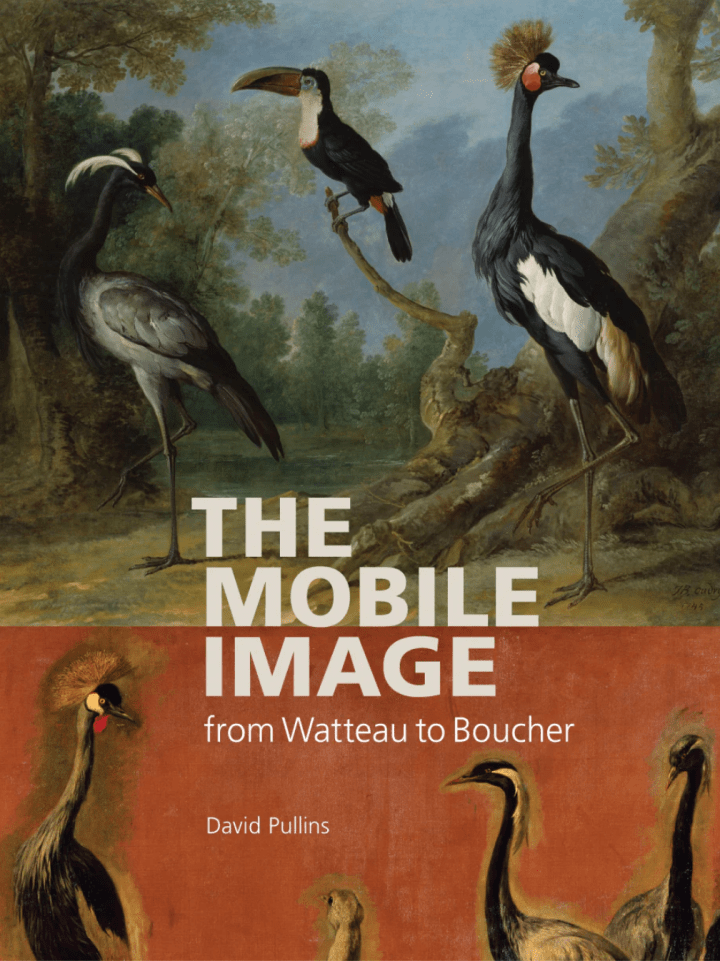 Reframing long-held assumptions about what distinguishes fine from decorative art, this innovative study explores a mode of making, seeing, and thinking that slices across eighteenth-century visual culture.
This book provides a new way of thinking about eighteenth-century French art and visual culture by prioritizing production over reception. Abandoning the ideologically driven discourse that distinguished fine from decorative art between the 1690s and 1770s, The Mobile Image reveals how the two have been inextricably bound from the earliest stages of artistic instruction through the daily life of painters’ workshops. In this study, author David Pullins defines artisanal and artistic means of learning, seeing, and making through a system of ‘mobile images’: motifs that were effectively engineered for mobility and designed never to be definitive, always awaiting replication and circulation. He examines the careers of Antoine Watteau, Jean-Baptiste Oudry, and François Boucher, situating them against a much broader cast of actors—such as printmakers, publishers, anonymous studio assistants, and architects, among others—to place eighteenth-century painting within a wider context of media and making.
David Pullins is Jayne Wrightsman Curator at the Metropolitan Museum of Art, where he is responsible for seventeenth-and eighteenth-century French, Italian, and Spanish painting.
New Book | Claude III Audran, Arbiter of the French Arabesque
From Amsterdam UP:
Barbara Laux, Claude III Audran, Arbiter of the French Arabesque (Amsterdam: Amsterdam University Press, 2024), 252 pages, ISBN: 978-9463729284, €129 / $147.
 Claude III Audran, Arbiter of the French Arabesque is the first substantial biographical study of Claude III Audran, a late 17th- and early 18th-century master of ornament and a proponent of cutting-edge design who took inspiration from contemporary sources. This work investigates Audran’s accomplishments and the factors that impacted the longevity and arc of his successful career, taking into consideration the contextual variables that influenced and shaped his work. Audran’s achievements bridge an important period with the eclipse of the Guild Maîtrise and the rise of the Académie royale. Audran subcontracted young artists, such as Watteau, Lancret, and Desportes, in order to circumvent restrictions on guild practice enacted by the crown. Looking at his commissions not only reveals the elite taste of his patrons, including Louis XIV, but also Audran’s ability to use elements from popular culture to animate his arabesques, which created hallmarks of rococo interior design.
Barbara Laux is an independent researcher and is currently Senior Curatorial Assistant at the Yale Center for British Art. She earned an MA in the History of Decorative Arts and in Art History prior to her PhD at the Graduate Center, City University of New York.
c o n t e n t s
Acknowledgments
Introduction
1 Biography of Claude III Audran (1658–1734)
2 The French Arabesque as an Art Form, Audran as Master Ornamentalist and His Initial Commissioned Works
3 Claude III Audran and Jean de La Fontaine’s Fables: Maintaining the Social Hierarchy
4 Attracting New Patrons in the Eighteenth Century
5 Claude III Audran’s Competitors and His Legacies
Illustrations
Appendix
Bibliography
Index










 Enfilade
leave a comment