Call for Papers | Securities of Art: The History of Authentication
From the ArtHist.net announcement, which includes the German:
Securities of Art: On the History of Authentication between Work, Text, and Context
Carl von Ossietzky Universität Oldenburg, 5–7 December 2024
Organized by Tobias Vogt and Lukas Töpfer
Proposals due by 15 June 2024
Workshop as part of the DFG project Wertpapiere der Kunst. Authentifizierung als künstlerisches Konzept in Zeiten von Finanzkrisen, 1720–2020 (Securities of art. Authentication as an artistic concept in times of financial crises, 1720–2020), Prof. Dr. Tobias Vogt and Lukas Töpfer M.A., Institute for Art and Visual Culture, Carl von Ossietzky University Oldenburg.
The workshop Securities of Art: On the History of Authentication between Work, Text, and Context (Wertpapiere der Kunst: Zur Geschichte künstlerischer Authentifizierung zwischen Werk, Text und Kontext) will examine artistically conceived authentications that have become constitutive for the status and value of artworks since the early 18th century. The guiding assumption is that artists in particular interrogate specific methods of authentication—such as signatures and titles, but also certificates, contracts, and other securities in the broadest sense—and integrate them into the structure of their works. Examples range from specially designed subscription tickets for the purchase of prints in the early 18th century to images of real and fake paper money dating from the French Revolution, from designs and caricatures of bonds since 1900 to certificates and contracts in works of contemporary art that comment on or criticize the changing financial system.
The focus is on exploring an art history of authentication in overarching social, economic, and legal-historical contexts on the one hand, and on the other, delineating the theoretical contours of the relationship between the authenticating and the authenticated, between work and parergon, and between text, paratext, and context. We will engage in a historical and theoretical analysis of the shift from the authentication of art to authentication as art and how this led to a corresponding blurring or reorganization of the relationships between ergon and parergon. Another important question is the extent to which authentications are particularly likely to emerge as artistically conceived in the face of radical changes to a prevailing value structure: in times of financial crises.
The presentations should last approximately 25 minutes in English or German and preferably focus on individual case studies of artistically designed authentications. We are particularly (but not exclusively) interested in the following questions:
• What are the pictorial and textual characteristics of a specific artistically conceived authentication?
• What procedures and constellations (of works and parerga) is it integrated into?
• How does authentication generate value not only as an element of economic practice, but also and especially within its own syntax and semantics, materiality, and mediality as determined by visual artistic practice?
• How does it respond in terms of form and function to the contemporary financial world? How does it perhaps even operate inside it?
• How does it specifically place the authenticating and the authenticated in relation to each other?
• What qualifies as an authentic work of art? How is it created—parergonally? How do artists themselves address this question, whether directly or indirectly?
• How does the question of the work relate to the creation, formation and preservation of value in general, where the intersection between art and finance is particularly relevant?
Please send an abstract of approximately 200 words, together with a short biographical note, to tobias.vogt@uni-oldenburg.de and lukas.mathis.toepfer@uni-oldenburg.de by 15 June 2024. Travel and accommodation costs will be covered within reason.
Exhibition | Timeless Beauty: A History of Still Life
From the Staatliche Kunstsammlung Dresden:
Timeless Beauty: A History of Still Life / Zeitlose Schönheit: Eine Geschichte des Stilllebens
Gemäldegalerie Alte Meister, Zwinger, Dresden, 17 November 2023 — 1 September 2024
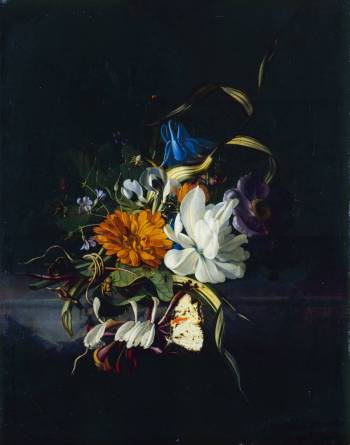
Rachel Ruysch (1664–1750), Floral Still Life, 1690, oil on canvas on oak panel, 35 × 27 cm (Dresden: Museum Gemäldegalerie Alte Meister, 3149).
In the Winckelmann Forum of the Semper Building, the Gemäldegalerie Alte Meister presents around 80 works from its own collection in the exhibition Timeless Beauty: A History of Still Life. The wide-ranging presentation—with masterpieces by painters such as Frans Snyders, Balthasar van der Ast, Jan Davidsz. de Heem, Adriaen van Utrecht, Willem Claesz. Heda, Abraham Mignon, and Rachel Ruysch—comprehensively illuminates the genre ‘still life’. Since when has it existed? What exactly constitutes a still life? What meaning, what content and what function did they have and still have today? What allegories and symbols are hidden in these motifs?
Still lifes were not only showpieces of decorative room furnishings, in which the overall effect was in the foreground. They also bear witness to natural scientific interests: the depicted object is regarded as a scientifically object and ‘document’—today as in the Age of Enlightenment. At the same time, however, still lifes are also an illusion, a game with the eye (trompe-l’œuil), in which the optical effect of the entire motif takes center stage. Through the bravura of painting, the ephemeral is immortalized. Many of the works on display, some of them recently restored, allow visitors to rediscover this fascinating genre, as only a few of the more than 100 still lifes in the Gemäldegalerie Alte Meister are on permanent display.
Konstanze Krüger, ed., Stillleben: Zeitlose Schönheit (Berlin: Hatje Cantz Verlag, 2023), 160 pages, ISBN: 978-3775751131, $50.
Konstanze Krüger, ed., Still Life: Timeless Beauty (Berlin: Hatje Cantz Verlag, 2024), 144 pages, ISBN: 978-3775751148, $40.
Exhibition | Two Masterpieces by Jan Van Huysum
From the press release for the exhibition:
Look Closely, Can You Spot the Butterfly? Two Masterpieces by Jan Van Huysum
Strawberry Hill, Twickenham, 16 May — 8 September 2024

Jan van Huysum, Flowers in a Vase with Crown Imperial and Apple Blossom at the Top and a Statue of Flora, 1731–32 (Private Collection).
Strawberry Hill House continues its acclaimed In-Focus series in 2024–25 with displays of extraordinary objects and artworks that have a connection with its original owner, Horace Walpole (1717–1797). Featuring paintings by Jan Van Huysum, a bronze bust of Caligula, and three mysterious daggers, each of the three exhibitions will tease out the fascinating facts and hidden histories connecting these artworks to this remarkable writer, connoisseur, and collector.
Evocatively demonstrating Jan Van Huysum’s (1682–1749) gift for creating sophisticated still life compositions depicting flowers and fruits, Strawberry Hill House is delighted to present the Dutch 18th-century master’s Flowers in a Vase with Crown Imperial and Apple Blossom at the top and a Statue of Flora and Fruit and Flowers in front of a Garden Vase with an Opium Poppy and a Row of Cypresses, both from 1731–32. On loan from a private collection, the paintings will be on public display for the first time in 10 years.
Art historian Andrew Graham Dixon has described the pair as “the two most brilliant and perfectly preserved paintings by the painter,” and they have remained together ever since leaving Van Huysum’s studio. It is believed that they were conceived as pendants from the outset, one showing mostly fruits, the other flowers. The pictures are in exceptional preservation and vividly showcase Van Huysum’s desired freshness of colour and transparency. They were originally owned by the painter Jeanne Etienne Liotard (1702–1789).
Van Huysum’s work was greatly appreciated during his lifetime, and for half a century afterwards his pictures sold for unprecedented sums and were only collected by the richest collectors in Europe, among which was Horace’s father, Sir Robert Walpole (1676–1745). Although Horace Walpole did not keep any Jan Van Huysums at Strawberry Hill himself—due to their rarity, expense, and difficulty in procurement—he did possess a painting by Jacob Van Huysum, Van Huysum’s brother, who resided at Sir Robert Walpole’s house in Chelsea, as well as numerous pictures by Jean Baptiste Monnoyer (1636–1699), a French-Flemish painter who relocated to Britain in the late 17th century, and works by his son Antoine Monnoyer, (1670–1747) whose compositions were similar to Van Huysum’s but less soft and finished.
Liotard was forced to sell his pair of Van Huysums, and afterwards they were bought by the Landgraf Friedrich II of Hesse-Cassel (1720–1785), only to be appropriated by Napoleon during the wars before remerging in England, in private collections. Strawberry Hill House’s In-Focus exhibition will provide visitors with an immersive experience, inviting them to delve into the intricate details and pictorial brilliance and to celebrate Walpole’s fascination with flowers and his garden at the villa, through Van Huysum’s beautiful paintings.
Rediscovered: The Lost Bronze of Roman Emperor Caligula
6 June — 8 September 2024
Is This a Dagger I See before Me? The Collector, the Actor, and the Mystery of the Ottoman Jewelled Dagger
3 October 2024 — 10 January 2025
More information on these two exhibitions is available here»
New Book | The Garden Against Time
From Pan Macmillan:
Olivia Laing, The Garden Against Time: In Search of a Common Paradise (London: Picador, 2024), 336 pages, ISBN: 978-1529066678, £20 / $28.
 “A garden contains secrets, we all know that: buried elements that might put on strange growth or germinate in unexpected places. The garden that I chose had walls, but like every garden it was interconnected, wide open to the world . . .”
In 2020, Olivia Laing began to restore an 18th-century walled garden in Suffolk, an overgrown Eden of unusual plants. The work drew her into an exhilarating investigation of paradise and its long association with gardens. Moving between real and imagined gardens, from Milton’s Paradise Lost to John Clare’s enclosure elegies, from a wartime sanctuary in Italy to a grotesque aristocratic pleasure ground funded by slavery, Laing interrogates the sometimes shocking cost of making paradise on earth.
But the story of the garden doesn’t always enact larger patterns of privilege and exclusion. It’s also a place of rebel outposts and communal dreams. From the improbable queer utopia conjured by Derek Jarman on the beach at Dungeness to the fertile vision of a common Eden propagated by William Morris, new modes of living can and have been attempted amidst the flower beds, experiments that could prove vital in the coming era of climate change. The result is a beautiful and exacting account of the abundant pleasures and possibilities of gardens: not as a place to hide from the world but as a site of encounter and discovery, bee-loud and pollen-laden.
Olivia Laing is a widely acclaimed writer and critic. She’s the author of seven books, including The Lonely City, Funny Weather, and Everybody. Her first novel, Crudo, was a Sunday Times top ten bestseller and won the 2019 James Tait Memorial Prize. Her work has been translated into twenty-one languages, and in 2018 she was awarded a Windham-Campbell Prize for non-fiction. She lives in Suffolk.
New Book | Charles Bridgeman (c.1685–1738)
From Boydell & Brewer:
Susan Haynes, Charles Bridgeman (c.1685–1738): A Landscape Architect of the Eighteenth Century (London: Boydell & Brewer, 2023), 270 pages, ISBN: 978-1837651177, £75 / $115.
 An examination of the garden plans of eighteenth-century landscape architect Charles Bridgeman, shedding light on his artistic vision and contributions to English garden history.
Charles Bridgeman was a popular and highly successful landscape architect in the first part of the eighteenth century. He was Royal Gardener to George I and George II, designing the gardens at Kensington Palace for them and working for many of the ruling Whig elite, including Sir Robert Walpole at Houghton Hall in Norfolk. His landscapes were audacious and monumental, but he is barely known outside the world of academic garden history; most of his gardens have disappeared, changed out of all recognition to chime with later tastes shaped by Lancelot Brown’s vision of a more ‘natural’ landscape, or buried under housing developments and golf courses; and there is little archaeological or written evidence of his work. This book aims to redress this injustice and rescue his legacy. It draws on the only significant body of evidence which survived him: an extensive but wildly heterogenous corpus of garden plans. Close examination of them reveals an artistic vision heavily influenced by the late seventeenth-century geometric garden but deeply rooted in the ‘genius of the place’, and working methods that include a proto-business model which prefigures the gentleman improvers who followed him. The volume brings Bridgeman from obscurity to demonstrate his skill as an artist, a manipulator of space on a grand scale, and a consummate practitioner, a deserved member of the canon of famous and revered English landscape gardeners.
Susan Haynes is a retired teacher with a PhD in landscape history from the University of East Anglia. Her principal interest is seventeenth- and eighteenth-century garden history.
c o n t e n t s
List of Illustrations
Acknowledgements
List of Abbreviations
Introduction
1 Who Was Charles Bridgeman?
2 Towards A Reliable Corpus
3 A Revised Catalogue
4 Reading The Plans
5 The Art-Historical Context Revisited
6 The ‘Ingenious Mr Bridgeman’
7 Building a Landscape
8 A Commercial Enterprise
Conclusion
Appendices
I A Summary of Willis’s Catalogue from Charles Bridgeman and the English Landscape Garden
II A Revised Catalogue
III Bridgeman’s Projects by Year
IV Bridgeman’s Income
Gazetteer of Bridgeman Sites
Glossary
Bibliography
Index
New Book | Chatsworth: The Gardens
From Penguin Books:
Alan Titchmarsh, with photography by Jonathan Buckley, Chatsworth: The Gardens and the People Who Made Them (London: Ebury Spotlight, 2023), 288 pages, ISBN: 978-1529148213, £35 / $65.
 Follow Alan Titchmarsh into Chatsworth’s irresistible world of visionaries, pioneers, heroes, villains, and English eccentrics and celebrate the men and women who have shaped the history of the estate over five centuries. With his passionate knowledge of both the house and gardens, as well as his long-established relationship with the Cavendish family, Alan is the perfect guide with whom to explore the Palace of the Peaks. Featuring stunning, specially commissioned photography of the gardens and parkland, alongside long-forgotten images and memorabilia newly unearthed in the estate archives, this vivid companion, crowded with character and colour, is a book to treasure and revisit over and over again.
Alan Titchmarsh MBE is an English gardener, broadcaster, and author of over 40 books, many of which have been bestsellers. He has twice been named Gardening Writer of the Year and for four successive years was voted Television Personality of the Year by the Garden Writers’ Guild.
Wentworth Woodhouse Visit
From the York Georgian Society:
Wentworth Woodhouse Visit with the York Georgian Society
24 April 2024
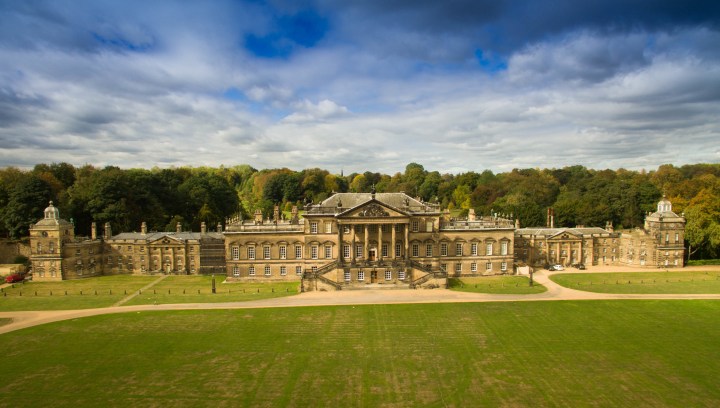
Wentworth Woodhouse, South Yorkshire.
An opportunity to visit one of England’s greatest Georgian country houses—rebuilt by the 2nd Marquess of Rockingham in the mid-18th century—to view the latest developments in its ambitious conservation and restoration programme.
The day will begin with a guided tour of the State Rooms on the main floor. Lunch will be followed by a look at the newly restored Camellia House in the company of Dorian Proudfoot, lead conservation architect for the Wentworth Woodhouse Restoration Project. Originally built in 1738 as an orangery and tea room, the building was later converted to house camellias and other rare plants from China and Japan. After complete restoration from dereliction it is now back in use as a tea room and events venue. Dorian will then take us to the magnificent stable block, originally built in 1782 to house 84 horses and more than 30 staff, together with a riding school, carriage house, and saddlery. The stables and courtyard are being transformed in a £5 million regeneration plan to accommodate a visitors’ centre, kitchen, café, and events venue.
Bookings: YGS members and Friends of York Art Gallery: £43; non-members: £48. Places are limited to 25 persons. The cost includes tea/coffee and biscuits on arrival, lunch, and tours of the State Rooms, Camellia House, and Stables. Book your place here.
Conference | Immanuel Kant and Hull
Immanuel Kant was born this month 300 years ago (April 22). From the conference registration form:
Immanuel Kant and Hull
Hull History Centre, East Yorkshire, 15 June 2024
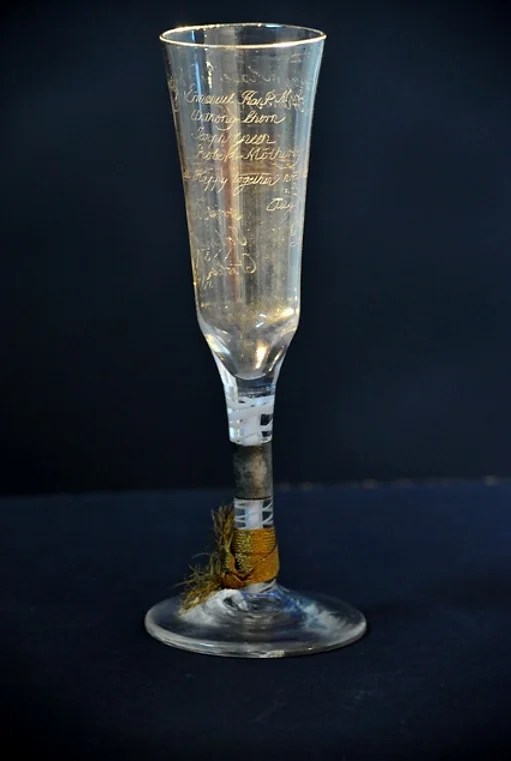
Drinking glass engraved with the names of Immanuel Kant and four men from Hull, 1763 (Lüneburg: East Prussian State Museum).
Presented by the Georgian Society for East Yorkshire and Friends of Kant and Königsberg, in association with Hull History Centre and University of Hull Maritime History Trust
This conference commemorates the tercentenary of the birth of the most important German philosopher, Immanuel Kant (1724–1804), and celebrates his close friendship with Joseph Green and Robert Motherby, merchants from Hull. It has been said that Green’s effect on the philosopher “cannot be overestimated.” The Königsberg firm of Green and Motherby managed Kant’s finances, and Kant had a great influence on the education of Robert Motherby’s children, one of whom, William, founded The Friends of Kant in 1805.
The fee of £30 (Georgian Society for East Yorkshire and Friends of Kant and Königsberg members £25) includes all refreshments. Book early, as places limited. Please direct questions to to Susan Neave, susananeave@gmail.com.
p r o g r a m m e
11.00 Introduction – Gerfried Horst (Chairman, Friends of Kant and Königsberg)
11.15 Morning Session
• Life and Work of Immanuel Kant – Tim Kunze (Curator, Immanuel Kant Department, East Prussian State Museum, Lüneburg)
• Königsberg Kant’s Home – Max Egremont (author of Forgotten Land: Journeys among the Ghosts of East Prussia)
1.00 Lunch
1.45 Afternoon Session
• Kant and Slavery – Judith Spicksley (Wilberforce Institute for the Study of Slavery and Emancipation, University of Hull)
• Hull’s Baltic Trade – Nick Evans (School of Humanties, University of Hull)
• Hull Merchants and Immanuel Kant – David Neave (Georgian Society for East Yorkshire)
• The Motherby Family of Hull and Königsberg – Marianne Motherby (Friends of Kant and Königsberg)
4.00 Tea and Cakes
Conference | Fragile Things
From Yale’s Program in Russian, East European, and Eurasian Studies at the MacMillan Center:
Fragile Things: Material Culture and the Russian Empire
Whitney and Betty MacMillan Center, Yale University, New Haven, 12–13 April 2024
 In February 2022, Russian forces set ablaze the Museum of History in Ivankiv, Ukraine. Locals struggled to save paintings by the celebrated folk artist Maria Primachenko, but other collections were lost: cutlery, textiles, fossils, stamps. In the museum’s burnt-out frame, metals, fibers, and bones mixed in the self-same gray of ashy heaps. Plucked from homes, factories, and workshops, these humbler objects so redolent of 19th- and 20th-century life in Ivankiv became the target of imperial erasure.
Today’s imperial violence highlights the fragility of objects like these, and urgently asks us to reconsider the frameworks by which we study the material culture of the Russian empire. How might such a landscape of endangered things resist the traditional presumptions with which we approach historical objects? In place of tactility, materiality, and presence, this conference offers a slipperier view. Objects can be hidden, stolen, destroyed. But such physical precarity belies other, intangible, mutabilities: ideologies shift, meanings elude, objects slip from our scholarly grasp. What would it mean to see material culture—and our study of it—as fragile? Fragility can be the threat of collapse or loss; it is also the gleam of volatile possibility. Where recent literary and art historical trends see matter as ‘vibrant’ or ‘powerful’, this conference proposes fragility as a model and a mood for understanding the Russian empire’s things.
In the past two decades the humanities has experienced a marked ‘material turn’, a new materialism that has brought fresh methods and theories to the study of objects. With amplified attention not only to matter itself, but to the ideological, social, economic, political, and ecological dimensions of material objects, historians and theorists of culture have imagined the deep human and environmental networks that make, shape, and mediate things. This conference will explore these materialities as defining of the Russian empire, comprised as it was not only of matryoshka nesting dolls and Faberge eggs, but of the artistic, industrial, and religious objects of the imperial peripheries, Central Asia, the Baltic region, the Caucasus, and Ukraine. How, for example, are stories of colonial expansion or class violence retained in the crumbling relics of imperial everyday life? Can we discern shifting social and political ideologies in the migration of ornamental forms across the decorative arts? In which materials might we seek inscriptions of ecological transformation and vulnerability? And how does the researcher engage materiality when objects are lost or made inaccessible by geopolitical upheaval? In asking these and other questions, Fragile Things will attend to three main goals: to propose the concept of ‘fragility’ as generative for material cultural scholars across a range of disciplines and methodologies; to explore the potential of new materialism to excavate previously overlooked objects, experiences, and frameworks of the Russian empire; and to leverage the framework of materiality in the project of decolonizing the study of Russia, Eastern Europe, and Eurasia.
f r i d a y , a p r i l 1 2
2.00 Welcome
2.15 Panel 1 | Animal Materialities
Moderator: Emily Ziffer
• Matthew Romaniello — Creation through Destruction: Animal Materials and their Afterlives in the 18th Century
• Philippe Halbert — ‘There’s no Rushia in Town’: Rethinking Russia’s Leather Empire
• Bart Pushaw — Otter Offerings: The Materials of Indigenous Insurgency in Russian-Occupied Alaska
4.30 Conference Keynote
• Michael Yonan — From Material Culture to Materiality: Conceiving Meaning for Historical Things
6.00 Reception
s a t u r d a y , a p r i l 1 3
9.00 Welcome
9.15 Panel 2 | Migrating Orientalisms
Moderator: John Webley
• Michael Kunichika — Ornament and Orient: Migration and the Fragility of National Identity
• Mary Roberts — The Fragile Things of Stanisław Chlebowski’s Epistolary Interiors
• Mollie Arbuthnot — Museums against Fragility: Material Heritage and Imperial Legacies in Revolutionary Turkestan
11.15 Panel 3 | Fragile Icons
Moderator: Molly Brunson
• Christine Worobec — The Ukrainian Okhtyrka/Akhtyrka Icon of the Mother of God: A Russian Imperial Project
• Wendy Salmond — The Fragile Icon
1.30 Panel 4 | Tastemaking
Moderator: Liliya Dashevski
• Margaret Samu — Fragile Clay, Firm Aspirations: A Safronov Teapot
• Karen Kettering — How ‘Russian’ Is a ‘Fabergé Egg’ and What Can They Actually Tell Us?
• Wilfried Zeisler — ‘You may rest assured that we will take the best care of them.’ – Marjorie Post to Colonel Serge Cheremeteff, 1964
3.30 Panel 5 | Peripheries Centered
Moderator: Emily Cox
• Christianna Bonin — Konstantin Korovin’s Borderline Modernism
• Ismael Biyashev — Mobile Pasts//Tethered Poetics: Archaeology, Nomadism, and Material Culture in Late Imperial Siberia
• Rosalind Blakesley — Vasily Surikov and the Precarity of Materializing History
5.15 Concluding Remarks
Telescope by James Short on Display at the Herschel Museum
On a day when many of us are looking to the skies . . . Press release from Bath’s Herschel Museum of Astronomy:

James Short, Gregorian reflector telescope, 1738–68 (Collection of Richard Blythe, on loan to the Herschel Museum of Astronomy).
The Herschel Museum of Astronomy recently revealed a new display: a Gregorian Reflector telescope created by James Short, the preeminent telescope maker of the 18th century. The brass telescope, on long-term loan to the museum from Richard N. Blythe of Shropshire, was created between 1738 and 1768. It has a focal length of 18 inches and sits on an equatorial mount. Similar telescopes made by Short were used to observe the transit of Venus in 1761 and 1769.
Gregorian Reflector telescopes are constructed with two concave mirrors. The primary mirror collects incoming light and brings it to a focal point. This focused light is then reflected off the secondary mirror, after which the light passes through a central aperture within the primary mirror. Ultimately, the light emerges from the bottom of the instrument, facilitating observation through the eyepiece.
In his 30-year career, Short made at least 1300 telescopes. Considered the finest available, they were sought after by observatories and customers all over the world. Short had no assistant, and when he died in 1768 his method of polishing mirrors was lost. Separately, William Herschel started experimenting with making telescopes in 1773 and went on to produce telescopes of even greater quality than those by Short.

Herschel Museum of Astronomy, 19 New King Street, Bath (Photo by Nick Veitch, Wikimedia Commons, August 2005). Brother and sister, William and Caroline Herschel moved into what was then a new town house in 1777, just a few years before William discovered Uranus (in March 1781). The Herschel museum was established in 1981.
Patrizia Ribul, Director of Museums for Bath Preservation Trust says: “The story of the Herschel siblings William and Caroline is very special, and our acquisitions policy is focused on objects that either belonged to them, or that add important context from the time. The James Short telescope provides visitors with an excellent example of the type of telescope that would have been known to William Herschel. The fact that William, with Caroline’s assistance, went on to create telescopes superior even to this excellent example by James Short, really underlines his expertise and dedication in the field of astronomy.”
The James Short telescope is the latest in a line of exciting long-term loans and acquisitions at the museum, including Caroline’s visitor book, a full-sized replica of William’s seven-foot reflecting telescope, and Caroline’s original memoir manuscript.
The Herschel Museum of Astronomy is dedicated to the achievements of the Herschels: distinguished astronomers and talented musicians. It was from this house that William discovered Uranus in 1781.










 Enfilade
leave a comment