New Book | The Virtues of Underwear
From Reaktion Books, with distribution by The University of Chicago Press:
Nina Edwards, The Virtues of Underwear: Modesty, Flamboyance and Filth (London: Reaktion Books, 2024), 224 pages, ISBN: 978-1789149562, £20 / $28.
 Unravels the intimate narratives woven into the fabric of our most personal garments.
Stories are woven into the fabric of our most personal garments. From the first loincloths to the intricate layers of shapewear, the concealed world of underwear is capable of expressing individual desire and also aspects of society at large. An indicator of the vagaries of fashion, underwear can be simple or elaborate. It both safeguards and exposes, reflecting our hopes and experiences. Underwear can embarrass and excite, amuse and shame us. This book illuminates the sometimes profound significance of the garments we wear beneath our outer clothing. It discusses the history of both women’s and men’s underwear, and global cultures of dress.
Nina Edwards is a freelance writer based in London. Her books include Darkness: A Cultural History (2018) and Pazazz: The Impact and Resonance of White Clothing (2023), both published by Reaktion Books.
c o n t e n t s
Introduction
1 What Is Underwear For?
2 Codpiece and Corset
3 Modesty and the Immodest Torso
4 Outer to Under and Back Again
5 Fabric and Fit
6 Medical and Other Practical Matters
7 Economic and Religious Concerns
8 The Underwear Drawer
Glossary
References
Bibliography
Acknowledgements
Photo Acknowledgements
Index
Exhibition | L’Isle-Adam across Three Centuries
Now on view:
Trois siècles à L’Isle-Adam
Musée d’art et d’histoire Louis Senlecq, L’Isle-Adam, 20 October 2024 — 21 September 2025
 À vingt-cinq kilomètres à vol d’oiseau de Paris, L’Isle-Adam se trouve aux portes du parc naturel régional du Vexin français, du Pays de France et du département de l’Oise. Qualifiée de « paradis terrestre » par Honoré de Balzac dans une lettre qu’il écrit à sa soeur en 1819, la ville bénéficie d’un environnement exceptionnel situé entre rivière et forêt domaniale. Avec l’exposition Trois siècles à L’Isle-Adam, les visiteurs sont invités à un voyage à travers l’histoire et le patrimoine de la cité adamoise et de son territoire.
Organisé de manière chronologique et couvrant une période allant du XVIIIe au milieu du XXe siècle, le parcours s’articule autour des grandes thématiques représentées dans les collections du musée. L’histoire et l’évolution urbaine de L’Isle-Adam y sont évoquées : des fastes des princes de Conti au développement de la villégiature et des loisirs. Le passé industrieux de la ville est également mis en avant, avec les manufactures de terres cuites décoratives qui ont fait la célébrité de L’Isle-Adam de la fin du XIXe au début du XXe siècle.
La région ayant attiré de nombreux artistes, c’est aussi à travers l’oeil des peintres que l’on découvre les paysages des bords de l’Oise et de la campagne environnante, par les toiles de Jules Dupré (1811–1889), Léon Victor Dupré (1816–1879), Auguste Boulard père (1825–1897), Renet-Tener (1846–1925), Fernand Quignon (1854–1941) et Emilio Boggio (1857–1920).
L’exposition rassemble peintures, sculptures, aquarelles, gravures, affiches publicitaires, cartes postales et photographies anciennes, toutes issues du fonds du musée.
Burlington Magazine Scholarship | French 18th-Century Art
From The Burlington:
The Burlington Magazine Scholarship | French 18th-Century Fine and Decorative Art
Applications due by 30 March 2025
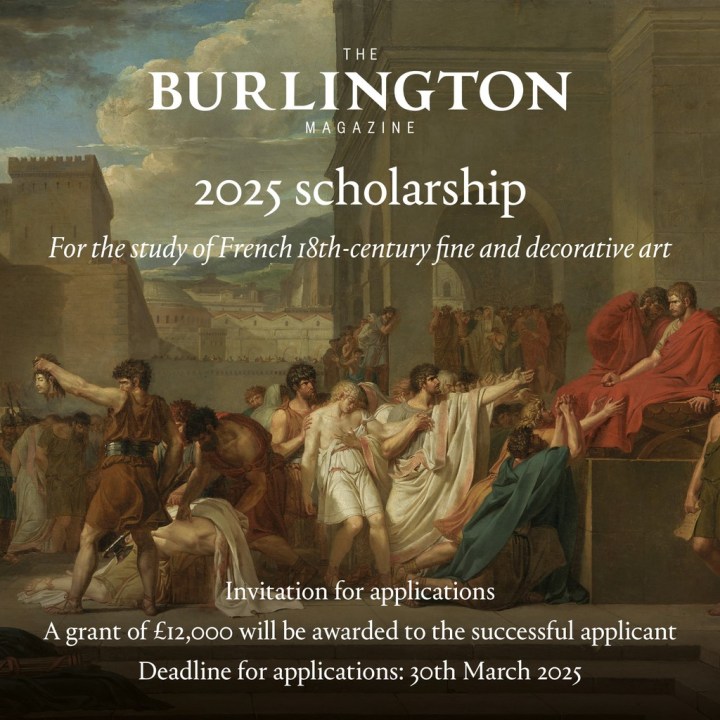 Applicants must be studying, or intending to study, for an MA, PhD, post-doctoral or independent research in the field of French 18th-century fine and decorative arts within the 12-month period the funding is given. The start date of successful applications should be at the beginning of the academic year (generally September). Earlier start dates will be considered for independent scholars or post-doctoral research. The funding is open to UK and international applicants. Research funded by this scholarship may lead to the submission of articles for publication in the Magazine: as such, the panel are looking for object related research, of the kind that the Burlington publishes.
To apply, please send your CV, description of project/research (no longer than 2 pages of A4), budget, proof of Institution you are attending/will attend to: scholarship@burlington.org.uk. Applications must be sent in PDF or Word document (.docx) format. Applications can only be submitted via email by 30 March 2025. The successful applicant will be notified by 31 May 2025.
The Burlington Magazine, January 2025
.
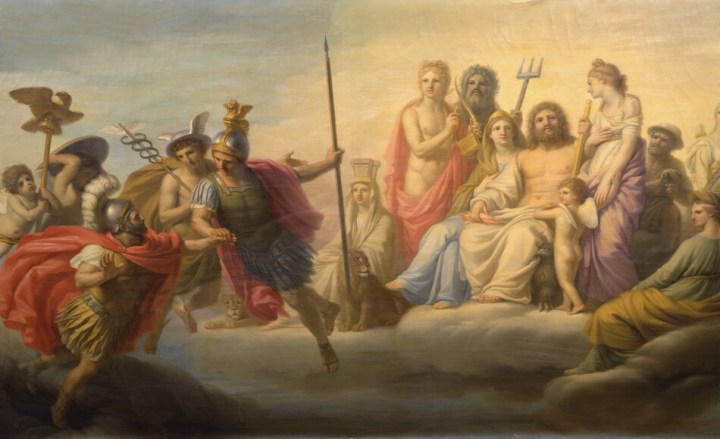
Stefano Tofanelli, Apotheosis of Romulus before the Gods of Olympus, 1790, oil on canvas, 208 × 318 cm
(Rome: Palazzo Altieri)
◊ ◊ ◊ ◊ ◊
The long 18th century in the January issue of The Burlington:
The Burlington Magazine 167 (January 2025)
e d i t o r i a l
• “A One Billion Pound Gift,” p. 3.
“Now you can gasp,” said the Chairman of the Trustees of the British Museum to guests at a recent fundraising dinner. He had just revealed the valuation of £1billion for the magnificent collection of Chinese ceramics that has been given to the museum by the Sir Percival David Foundation. Munificence on this scale is normally only associated with the richest of American museums, so a new record seems to have been set in the European context by this extraordinary gesture.
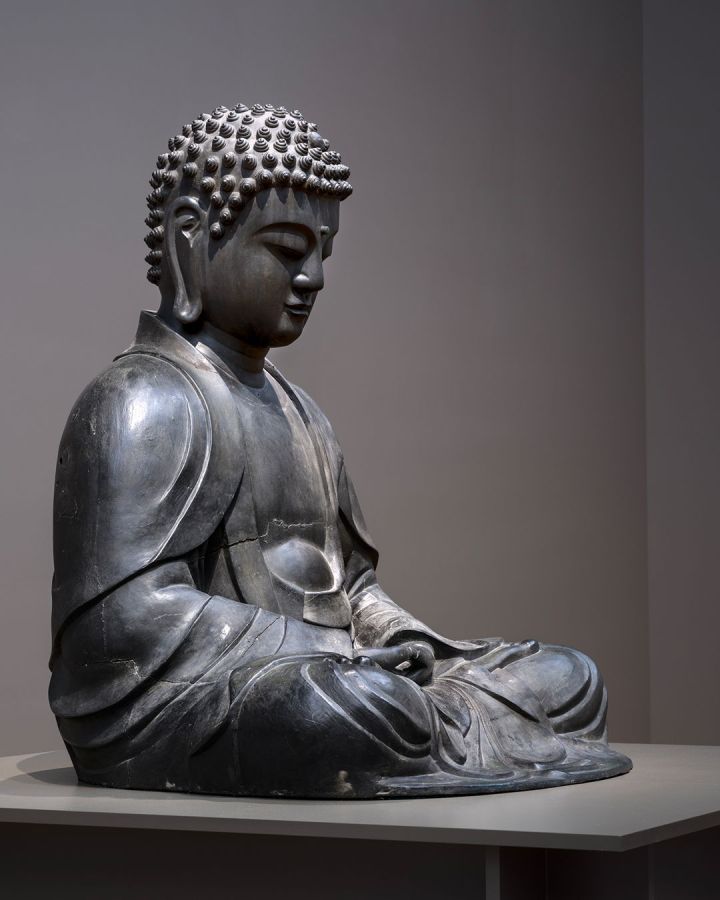
Buddha Amida (Amitabha), Japan, 1716 (Collection Wereldmuseum). Included in the exhibition Asian Bronze: 4,000 Years of Beauty.
s h o r t e r n o t i c e s
• Pilar Diez del Corral Corredoira, “A Project for the Church of Menino Deus, Lisbon, by Vieira Lusitano,” pp. 26–29.
• Alessio Cerchi, “Stefano Tofanelli’s Deification of Aeneas by Venus Rediscovered,” pp. 29–31.
r e v i e w s
• Lori Wong and Sujatha Arundathi Meegama, Review of the exhibition Asian Bronze: 4,000 Years of Beauty (Rijksmuseum, 2024–25), pp. 35–37.
• Delphine Bastet, Review of Grands décors restaurés de Notre-Dame de Paris, edited by Caroline Piel and Emmanuel Pénicaut (Silvana Editoriale, 2024), pp. 62–63.
• Peter Humfrey, Review of Anne Nellis Richter, The Gallery at Cleveland House: Displaying Art and Society in Late Georgian London (Bloomsbury, 2024), pp. 71–72.
Conference | Nature into Art
From ArtHist.net:
Nature into Art
Schloss Nymphenburg, Munich, 11–12 February 2025
Registration due by 2 February 2025
From 26 November 2024 to 16 March 2025, the Alte Pinakothek in Munich is hosting the world’s first major monographic exhibition on Rachel Ruysch. The exhibition is a collaborative effort between the Alte Pinakothek, the Toledo Museum of Art, and the Museum of Fine Arts, Boston. Rachel Ruysch (1664–1750) has always been regarded as one of the most important flower painters in European art, but her life and work have remained insufficiently researched to date. In addition to her perfected fine painting technique, her still lifes—featuring flowers, leaves, fruits, and insects rendered in the finest detail—reflect her interest in botanical and scientific subjects.
In conjunction with the exhibition Rachel Ruysch: Nature into Art and the CODARTfocus in Munich, the workshop Nature into Art will take place February 11–12 at Schloss Nymphenburg in München. The workshop aims to deepen new perspectives gained from the exhibition, particularly regarding the interplay between art and science. The speakers represent the interdisciplinary approach of the exhibition, which are derived from different scientific fields, such as art history, conservational sciences, postcolonial studies, and gender studies, as well as researchers with a botanical focal point. The workshop is intended to sustainably deepen the network of scholars with unique scientific approaches and from different countries, universities, research institutions, and museums. Participation of students from the University of Konstanz will involve the next generation of scholars and raise awareness for current research in the field of early modern painting.
Participation in the event is free of charge, but registration is requested. For more information and to register for the workshop, please contact laura.kromer@uni-konstanz.de until 2 February 2025.
Organizers
Christopher Atkins (Center for Netherlandish Art at the Museum of Fine Arts in Boston), Robert Felfe (University of Graz), Karin Leonhard (University of Konstanz), and Thijs Weststeijn (University of Utrecht)
t u e s d a y , 1 1 f e b r u a r y
9.00 Arrival
9.30 Opening Remarks
10.00 Morning Talks
• Marlena Schneider (Doerner Institut – Bayerische Staatsgemäldesammlungen) — Art Technological Insights on Five Paintings by Rachel Ruysch from the Former Wittelsbach Electoral Collections
• Kirsten Derks (University of Antwerp) — Tried and Tested? Rachel Ruysch’s Working Methods in Her Mature and Late Works
• Larissa van Vianen (University of Amsterdam) — From Observation to Publication: Pierre Lyonet and the Art of 18th-Century Natural History
• Jaya Remond (Ghent University) — Printing Floral Imagery in Northern Europe, c. 1590–1610: Pictorial Discourses and Frames of Representation
13.30 Lunch
14.30 Afternoon Talks
• Marie Amélie Landrin (Sorbonne University) — Rachel Ruysch: Botanical Art at the Intersection of Science and Patronage
• Laura Kromer (University of Konstanz) — The Companion Pieces of Rachel Ruysch: Intertwinings of Pictorial Combination
• Catherine Powell-Warren (KU Leuven) — TBA
17.00 Closing Remarks
17.30 Reception
18.00 Judith Noorman (University of Amsterdam) — Presentation
w e d n e s d a y , 1 2 f e b r u a r y
10.00–12.00 Study day in the exhibition Rachel Ruysch: Nature into Art at the Alte Pinakothek, Munich
Students from the University of Konstanz will offer tailored guided tours.
New Book | Reading the World, British Practices of Natural History
Coming in March from the University of Pittsburgh Press:
Edwin Rose, Reading the World: British Practices of Natural History, 1760–1820 (Pittsburgh: University of Pittsburgh Press, 2025), 408 pages, ISBN: 978-0822948513, $65.
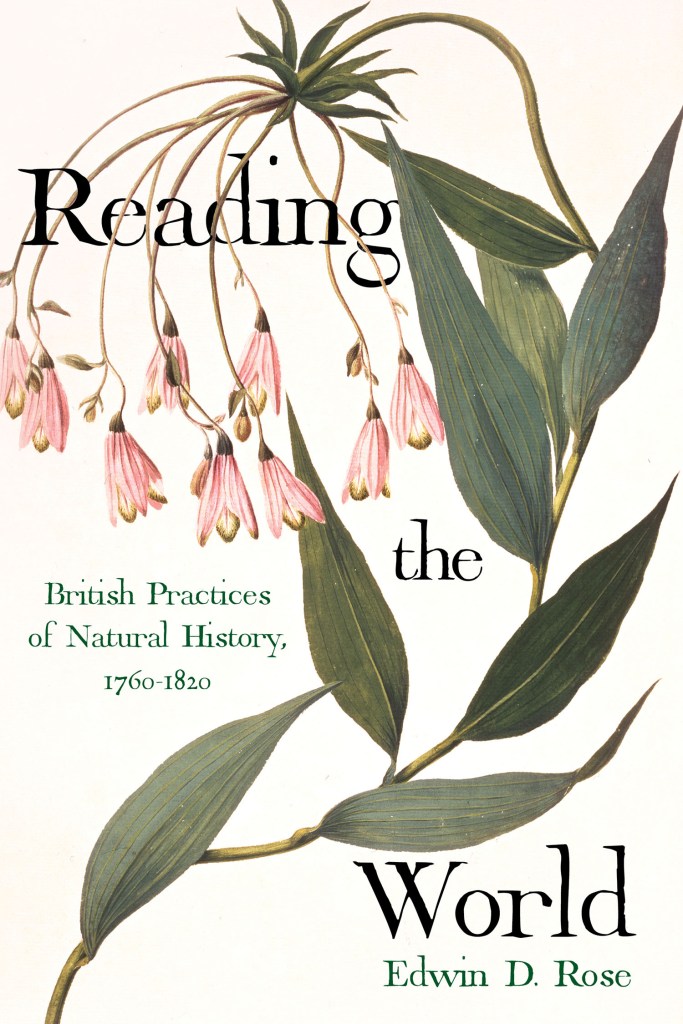 In the eighteenth and nineteenth centuries—a period that marked the emergence of a global modernity—educated landowners, or ‘gentlemen’, dominated the development of British natural history, utilizing networks of trade and empire to inventory nature and understand events across the world. Specimens, ranging from a Welsh bittern to the plants of Botany Bay, were collected, recorded, and classified, while books were produced in London and copies distributed and used across Britain, Continental Europe, the Pacific, Asia, and the Americas. Natural history connected a diverse range of individuals, from European landowners to Polynesian priests, incorporating, distributing, synthesizing, and appropriating information collected on a global scale. In Reading the World, Edwin D. Rose positions books, natural history specimens, and people in a close cycle of literary production and consumption. His book reveals new aspects of scientific practice and the specific roles of individuals employed to collect, synthesize, and distribute knowledge—reevaluating Joseph Banks’s and Daniel Solander’s investigations during James Cook’s Endeavour voyage to the Pacific. Uncovering the range of skills involved in knowledge production, Rose expands our understanding of natural history as a cyclical process, from the initial collection and identification of specimens to the formal publication of descriptions to the eventual printing of sources.
Edwin D. Rose is currently AHRC Research Fellow in the Department of History and Philosophy of Science at the University of Cambridge and Advanced Research Fellow at Darwin College, Cambridge. From May 2025 he will be a Leverhulme Trust Early Career Research Fellow in the School of Philosophy, Religion, and History of Science at the University of Leeds.
Research Seminar | Artists and the East India Company, 1760–1830
Upcoming at the Mellon Centre:
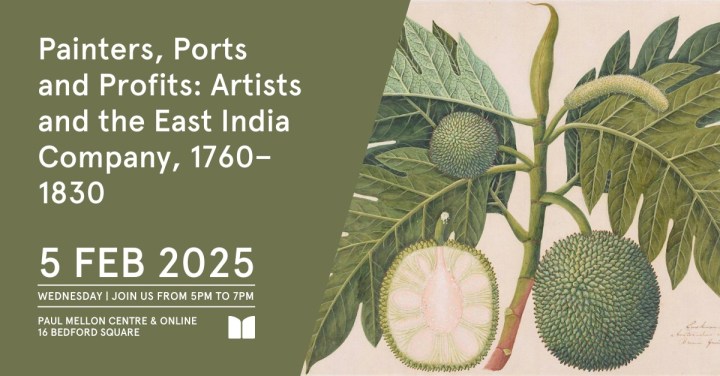
Holly Shaffer and Laurel Peterson | Painters, Ports, and Profits: Artists and the East India Company, 1760–1830
Online and in-person, Paul Mellon Centre, London, 5 February 2025, 5pm
In January 2026, the Yale Center for British Art (YCBA) will open Painters, Ports, and Profits: Artists and the East India Company, 1760–1830. This exhibition explores the interactions between artists trained in India, China, and Britain amid the relentless commercial ambitions of the East India Company at key ports and centres of trade in Asia. Featuring over a hundred objects drawn from the YCBA collection in various media—including architectural drafts, opaque watercolours, hand-coloured aquatints and small- and large-scale portraits—the exhibition highlights works by artists who are no longer well known alongside those of well-established ones. Brought together for the first time, these works tell a story of artists compelled by new subjects, styles and materials in expanding markets, profoundly affecting art within and beyond Asia.
As the power of the British empire waned in the twentieth century, ‘Company painting’ became a prevalent umbrella term to describe works made for Company officials, specifically by Indian artists, and ‘Export art’ became a descriptor for works created by Chinese artists for a European market. Painters, Ports, and Profits challenges and critically rethinks these terms while also putting the arts into dialogue. It presents an expanded conception of arts made under the auspices of the Company by focusing on artists trained in different ways who worked for Company patrons as well as commercial markets in India, China, and Britain; the types of subjects in which they specialised; and the artistic materials with which they experimented. By examining the range of arts and relationships developed during the Company’s relentless pursuit of profits, the exhibition sheds light on aesthetic and colonial discourses that were formed in the eighteenth and nineteenth centuries and persist today. Co-curators Laurel Peterson and Holly Shaffer will preview the themes and objects explored in the exhibition and the related catalogue.
Book tickets here»
Holly Shaffer is Robert Gale Noyes Assistant Professor of Humanities in the department of history of art and architecture at Brown University. Her research focuses on eighteenth- and nineteenth-century arts in Britain and South Asia, and their intersections. Her first book, Grafted Arts: Art Making and Taking in the Struggle for Western India, 1760–1910 (London and New Haven: Paul Mellon Centre with Yale University Press, 2022), was awarded the Edward C. Dimock Jr. Prize in the Indian Humanities and an Historians of British Art Book Award. In 2011, she curated Adapting the Eye: An Archive of the British in India, 1770–1830 at the YCBA, and in 2013, Strange and Wondrous: Prints of India from the Robert J. Del Bontà Collection at the National Museum of Asian Art. She has published essays in Archives of Asian Art, The Art Bulletin, Art History, Journal 18, Modern Philology, and Third Text, and recently edited volume 51 of Ars Orientalis on the movement of graphic arts across Asia and Europe.
Laurel O. Peterson is the Assistant Curator of Prints and Drawings at the Yale Center for British Art. She specialises in British works on paper produced during the long eighteenth century. She served as the organising curator of John Singer Sargent: Portraits in Charcoal in 2019 and as co-curator of Architecture, Theater, and Fantasy: Bibiena Drawings from the Jules Fisher Collection in 2021, both at the Morgan Library and Museum. She received her PhD in the history of art from Yale and her research has been supported by the Sir John Soane’s Museum Foundation, the Paul Mellon Centre for Studies in British Art, and the Lewis Walpole Library. She has held positions at the British Museum and the Morgan Library.
Image: Unknown artist (Company style), Breadnut (Artocarpus camansi), ca. 1825, watercolor, gouache, and graphite (New Haven: Yale Center for British Art, Paul Mellon Fund, B2022.5).
New Book | Time Machines
Just published by MIT Press, with plenty of 18th-century material:
Richard Taws, Time Machines: Telegraphic Images in Nineteenth-Century France (Cambridge: MIT Press, 2025), 400 pages, ISBN: 978-0262049184, $50.
 A riveting exploration of the relationship between art and telegraphy, and its implications for understanding time and history in nineteenth-century France.
In Time Machines Richard Taws examines the relationship between art and telegraphy in the decades following the French Revolution. The optical telegraph was a novel form of visual communication developed in the 1790s that remained in use until the mid-1850s. This pre-electric telegraph, based on a semaphore code, irrevocably changed the media landscape of nineteenth-century France. Although now largely forgotten, in its day it covered vast distances and changed the way people thought about time. It also shaped, and was shaped by, a proliferating world of images. What happens, Taws asks, if we think about art telegraphically?
Placed on prominent buildings across France—for several years there was one on top of the Louvre—the telegraph’s waving limbs were a ubiquitous sight, shifting how public space was experienced and represented. The system was depicted by a wide range of artists, who were variously amused, appalled, irritated, or seduced by the telegraph’s intractable coded messages and the uncanny environmental and perceptual disruption it caused. Clouds, architecture, landscapes, and gestures: all signified differently in the era of telegraphy, and the telegraph became a powerful means to comprehend France’s technological and political past. While Paris’s famous arcades began to crisscross the city at ground level, a more enigmatic network was operating above. Shifting attention from the streets to the skies, this book shows how modern France took shape quite literally under the telegraph’s sign.
Richard Taws is Professor of History of Art and Visual Culture at University College London. He is the author of The Politics of the Provisional as well as coeditor, with Iris Moon, of Time, Media, and Visuality in Post-Revolutionary France and, with Genevieve Warwick, Art and Technology in Early Modern Europe.
Call for Applications | Baroque Summer Course: Death
From ArtHist.net:
Baroque — Death / Barock — Tod
24th Baroque Summer Course, Bibliothek Werner Oechslin, Einsiedeln, Switzerland, 22–26 June 2025
Organized by Anja Buschow Oechslin, Axel Christoph Gampp, and Werner Oechslin
Applications due by 23 February 2025
Death is omnipresent. No one can escape it; it is among us and goes about its business as it sees fit. If one takes seriously the “memento mori” that we encounter in droves on tombstones and that is addressed to us, the (still) living, then one can see that this commingling of life and death is of central importance to human culture and has always had a significant impact on its art forms.
This ubiquity and omnipresence of death was summed up in the long-popular Dance of Death: “we all die” according to the biblical saying “Omnes Morimur.” Patritius Wasserburger put this into verse for Count Sporck as “Zuschrift an das sämmtlich-menschliche Geschlecht” (“Letter to the whole human race”):
“You popes! Cardinals!
You bishops! You abbots!
You lappeted gentlemen!
You canons! You prelates!
All manner of priests,
Of high dignity, and also of lower rank. […]”
He records them all, even the “drunkards”:
“Oh you brothers of the wet stream!
Guzzle, dance, sing songs!
You are wild and tipsy, jolly: bluster, sleep around, shack up, rave!
Go on, twirl, feast, roister!
But: woe for eternity.”
Michael Heinrich Rentz illustrated this in his dramatic images and emphasized the direct partnership—and equality—of man and death. The series of images, first printed in 1753, was realized as a perfect baroque book, “full of meaning, instruction, and spirit.” And we are already amid the exuberant baroque pleasure in shaping and designing. Baroque rhetoric, with its astute precepts of “argutezza” or even “cavillatio,” takes particular pleasure in the boundaries, in the contact between life and death. Nothing is alien to this and the desire to transcend such boundaries fires the imagination. In 1774, the Archbishop and Elector of Mainz, who had been blessed with the “temporal right of sovereignty,” was mourned accordingly: “The tombstones may restrict his generous hands, but his heart allows no limits to be set, such as to work immortally in faithfulness to God, thus in love for his needy people.” After the “passing away,” as if only a small disturbance had occurred, it is all about the “denatus”; he has merely changed his condition—for the better, of course.
Glorification of human deeds in light of the future life after death, as the motto of the Duke of Brauschweig, Johann Friedrich, says: EX DURIS GLORIA. The separation through death is followed by reflection and the gain of a “better life.” Death is given this powerful, dialectical function of the historical continuation of “lived reality” by virtue of idealization. It challenges all the arts and the artifices of rhetoric, which “mediate” in all possible tones of a “heroic poem” in an “Imitatio Epica,” whether allegory, or panegyric or in the “Epicedium” particularly assigned to funeral ceremonies.
Those who focus so much on the afterlife, as was the case in the Baroque ecclesiastical world in the most pronounced way, have before their eyes all the glory that is emulated in this world with the greatest artistic effort in order to convey it to people and their sensory perceptions. This is what led someone like Karl Wilhelm Ferdinand Solger to recommend: “He who cannot reach God in his spirit should seek him in images, he will not be led astray.” To “draw God down into his sphere” was the motto and it fit best precisely where the scene is changed, as it were, with death. Friedrich Wilhelm Schelling saw it correctly: “This symbolic view is the church as a living work of art.” And there is more, something fundamental, hidden behind this paradigm of human destiny and the conditions of privileged human existence. Marsilio Ficino states this in the first sentences of his “Cristiana religione” (1474/5). If man could not distinguish between good and bad in the “lume dell’intellecto,” he would be the most miserable creature, as he, unlike other living creatures, also has to dress himself. And at the beginning of “Platonica Theologia” (1482), he formulates its essence: “Si animus non esset immortalis: nullum animal esset infelicius homine.”
Art draws its deeper justification from this and declares that no effort is too great for it, especially when it comes to the furnishings for funeral ceremonies, when entire church interiors are covered with allegorical scenes and high catafalques are erected. The unsurpassable dialectic of life and death calls for the greatest artistic invention, which is particularly desirable in “baroque” times and results in works of art that would give even someone like Wölfflin a headache. When Rudolf Wittkower opened the Guarini Congress in Turin in 1968, he had a whole repertoire of “unorthodox” forms at hand: “Paradossi ed apparenti contraddizioni, volute incongruenze”; it is much more than just “varietà” and—in the tradition of Nicholas of Cusa—also encompasses mathematics: “Famose (!) compenetrazioni di spazi diversi.” He observes the juxtaposition of “morbidi moduli ornamentali manieristici” and “forme cristalline di estrema austerità.” They are “prodigi strutturali.” And Wittkower’s insight was: “intelletto” and “emozione” are not separate, but belong together, just as—in art—life and death appear intertwined and death, if man takes his divinely inspired, spiritual life seriously, is ultimately only a gateway to another world. It is understandable that a cemetery is then described as “the Elysian Fields.” There are no limits to the imagination and to art.
The course is open to doctoral candidates as well as junior and senior scholars who wish to address the topic with short papers (20 minutes) and through mutual conversation. As usual, the course has an interdisciplinary orientation. We hope for lively participation from the disciplines of art and architectural history, but also from scholars of history, theology, theatre and other relevant fields. Papers may be presented in German, French, Italian or English; at least a passive knowledge of German is a requirement for participation. The Foundation assumes the hotel costs for course participants, as well as several group dinners. Travel costs cannot be reimbursed. Please send applications with brief abstracts and brief CVs by email to: anja.buschow@bibliothek-oechslin.ch. The deadline is 23 February 2025.
Concept / Organization: Dr. Anja Buschow Oechslin (Einsiedeln), Prof. Dr. Axel Christoph Gampp (Uni Basel, Fachhochschule Bern), Prof. Dr. Werner Oechslin (Einsiedeln)
New Book | Reading Typographically
From Stanford UP:
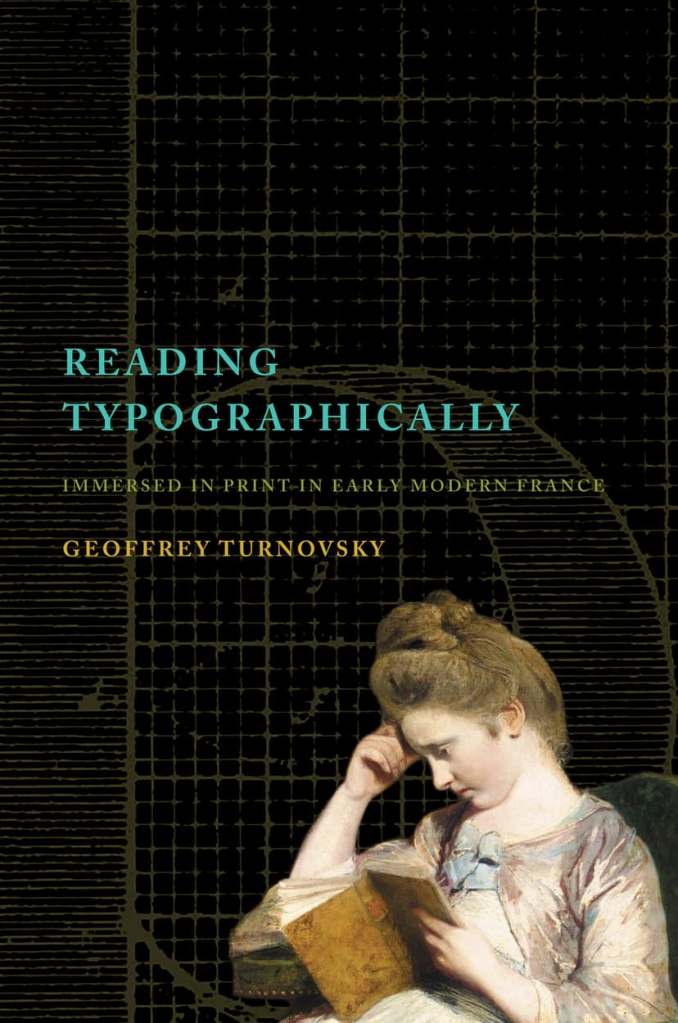
Geoffrey Turnovsky, Reading Typographically: Immersed in Print in Early Modern France (Stanford: Stanford University Press, 2024), 328 pages, ISBN: 978-1503637214, $70.
 Anxieties about the fate of reading in the digital age reveal how deeply our views of the moral and intellectual benefits of reading are tied to print. These views take root in a conception of reading as an immersive activity, exemplified by the experience of ‘losing oneself in a book’. Against the backdrop of digital distraction and fragmentation, such immersion leads readers to become more focused, collected, and empathetic.
How did we come to see the printed book as especially suited to deliver this experience? Print-based reading practices have historically included a wide range of modes, not least the disjointed scanning we associate today with electronic text. In the context of religious practice, literacy’s benefits were presumed to lie in such random-access retrieval, facilitated by indexical tools like the numbering of Biblical chapters and verses. It was this didactic, hunt-and-peck reading that bound readers to communities.
Exploring key evolutions in print in 17th- and 18th-century France, from typeface, print runs, and format to punctuation and the editorial adaptation of manuscript and oral forms in print, this book argues that typographic developments upholding the transparency of the printed medium were decisive for the ascendancy of immersive reading as a dominant paradigm that shaped modern perspectives on reading and literacy.
Geoffrey Turnovsky is Associate Professor of French at the University of Washington, Seattle. He is the author of The Literary Market: Authorship and Modernity in the Old Regime (2011).
c o n t e n t s
Acknowledgments
Introduction: The Benefits of Reading
1 Typeface: Disappearing Letters from the Romain du Roi to Didot
2 Print Runs: Tender Maps in the Marketplace
3 Format: Appropriations of the Book
4 Editorial Labors: The Typography of Intimate Texts
5 Punctuation Marks: Bringing Speech to Life on the Printed Page
Conclusion: Hybridity and Text Technologies
Notes
Selected Bibliography
Index










 Enfilade
leave a comment